
TL;DR:
- Autism evaluations are multi-stage, involving monitoring, screening, and comprehensive assessments by specialists.
- Diagnosis relies on behavioral observations and DSM-5 criteria, with severity levels indicating support needs.
- Support from families, including documentation and early intervention, is vital for accurate diagnosis and effective help.
1 in 31 children aged 8 years in the United States are now diagnosed with autism, yet many parents arrive at their first evaluation expecting a blood draw or brain scan. The reality is very different. Autism evaluations are behavioral, observational, and often involve a whole team of specialists working together over several sessions. That gap between expectation and reality can leave families feeling lost and anxious. This guide walks you through exactly what happens during an autism evaluation, how diagnosis is made, which tools specialists use, and how you can actively support your child every step of the way.
Table of Contents
- What are autism evaluations?
- How does autism diagnosis work?
- Key tools and screening instruments in autism assessment
- Nuances and challenges: Gender, comorbidities, and diagnostic accuracy
- Guidance for parents: Supporting your child before, during, and after evaluation
- The overlooked realities of autism evaluations: Practical wisdom for families
- Connect with autism evaluation resources and support
- Frequently asked questions
Key Takeaways
| Point | Details |
|---|---|
| Behavioral assessment is key | Autism is diagnosed based on behaviors and developmental observations, not medical tests. |
| Early screening matters | Timely screening at 18 and 24 months improves early intervention outcomes for children. |
| Diagnostic tools vary | Experts use specific instruments like M-CHAT-R/F, ADOS-2, and ADI-R for evaluation. |
| Nuanced challenges exist | Factors like gender, comorbidities, and masking behaviors often complicate diagnosis. |
| Parent advocacy is vital | Tracking milestones, proactive engagement, and seeking support accelerate positive outcomes. |
What are autism evaluations?
An autism evaluation is not a single appointment or a simple checklist. It is a layered process that typically unfolds across three stages: developmental monitoring, screening, and a full diagnostic assessment. Each stage serves a different purpose, and together they give specialists the clearest possible picture of your child’s development.
Autism evaluations involve developmental monitoring, screening, and diagnostic assessment by specialists. Developmental monitoring is ongoing. Your pediatrician watches how your child grows and develops at every well-child visit, comparing their progress against established milestones. Screening is a more structured step, usually involving a short questionnaire completed by parents. The American Academy of Pediatrics recommends autism-specific screening at 18 and 24 months. If screening raises concerns, a full diagnostic assessment follows.
That comprehensive assessment often includes input from multiple professionals:
- Developmental pediatricians who evaluate overall growth and medical history
- Child psychologists or neuropsychologists who assess cognitive and behavioral patterns
- Speech-language pathologists who examine communication skills
- Occupational therapists who look at sensory processing and motor development
No single medical test can diagnose autism. There is no blood panel, no brain scan, and no genetic test that delivers a yes or no answer. Autism is identified through careful observation of behavior, detailed parent interviews, and standardized assessments. This is why evaluations take time and why a team approach matters so much.
“A thorough evaluation is not about finding what is wrong with your child. It is about understanding how your child experiences the world so the right support can be put in place.”
If you want a broader foundation before your first appointment, exploring trusted autism information can help you walk in with better questions and clearer expectations.
How does autism diagnosis work?
Once a full evaluation is underway, specialists use the Diagnostic and Statistical Manual of Mental Disorders, Fifth Edition, known as the DSM-5, to determine whether a child meets the criteria for an autism spectrum disorder diagnosis.
Diagnosis is based on DSM-5 criteria, severity levels, and behavioral evidence, with no medical or blood test available. The DSM-5 identifies two core areas that must show persistent challenges:
- Social communication and interaction — difficulty with back-and-forth conversation, reduced sharing of interests, challenges understanding nonverbal cues, and trouble building or maintaining relationships
- Restricted, repetitive behaviors — insistence on sameness, highly focused interests, repetitive movements like hand-flapping, and unusual sensory responses
Both areas must be present, and symptoms must have appeared early in development, even if they were not fully recognized at the time.
| DSM-5 severity level | Support needed | Example behaviors |
|---|---|---|
| Level 1 | Requiring support | Difficulty initiating social interactions, inflexible behavior causing some interference |
| Level 2 | Requiring substantial support | Marked deficits in communication, distress when routines change |
| Level 3 | Requiring very substantial support | Severe communication challenges, extreme difficulty coping with change |
Severity levels are not fixed. A child assessed at Level 2 today may function at Level 1 with the right interventions. The levels describe current support needs, not a child’s potential.
A diagnosis also requires that the symptoms cause real functional impairment in daily life and are not better explained by another condition. This is why specialists gather information from multiple sources, including parents, teachers, and direct observation, rather than relying on a single session.
“The DSM-5 criteria exist to ensure consistency, but every child presents differently. A skilled evaluator looks at the whole child, not just a score.”
Key tools and screening instruments in autism assessment
Knowing which tools your child’s evaluation team uses helps you understand the process and ask informed questions. Different instruments are designed for different ages and purposes.
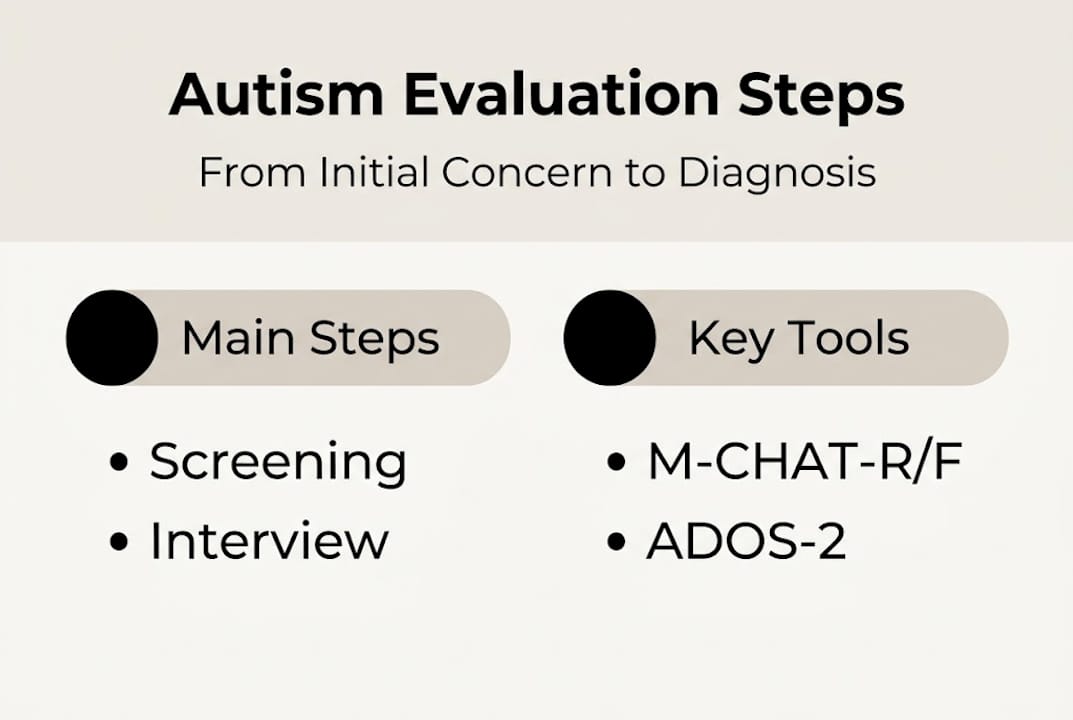
Key tools include screening instruments like the M-CHAT-R/F and diagnostic tools like the ADOS-2 and ADI-R, each with specialized modules based on age and verbal ability.

| Tool | Type | Age range | Key strength |
|---|---|---|---|
| M-CHAT-R/F | Screening | 16 to 30 months | Quick parent-report; flags children for further evaluation |
| ADOS-2 | Diagnostic | 12 months and up | Structured observation; gold standard for direct assessment |
| ADI-R | Diagnostic | Mental age 2 years and up | In-depth parent interview; strong historical context |
Here is how these tools typically fit into the evaluation process:
- M-CHAT-R/F is completed by parents during a routine well-child visit. It takes about five minutes and flags children who need a closer look.
- ADOS-2 is administered directly with the child. A trained clinician presents structured activities and social opportunities, then scores the child’s responses. It has five modules based on language level and age.
- ADI-R is a structured interview with parents or caregivers, covering the child’s developmental history in detail. It takes one to two hours but provides context that direct observation alone cannot capture.
Using ADOS-2 and ADI-R together gives evaluators both a real-time snapshot and a developmental history, which is why they are considered the gold standard combination.
Pro Tip: Ask your evaluation team which specific modules of the ADOS-2 they plan to use and why. This shows you are engaged and helps you understand how the tool is being matched to your child’s current verbal and developmental level.
For a deeper look at early detection, the autism screening guide walks parents through what to expect at each screening stage.
Nuances and challenges: Gender, comorbidities, and diagnostic accuracy
Even with well-validated tools and clear criteria, autism evaluations are not always straightforward. Several factors can complicate the process, and parents who understand them are better equipped to advocate for their child.
One of the most significant issues is the underdiagnosis of girls and women. Females are often underdiagnosed because overlapping conditions complicate diagnosis and some tools are less effective for certain groups. Girls frequently learn to mask or camouflage their autistic traits by mimicking social behaviors they observe in peers. This can make their challenges invisible during a short evaluation session, even to experienced clinicians.
Common factors that complicate accurate diagnosis include:
- Masking — consciously or unconsciously hiding autistic traits to fit in socially
- Comorbid ADHD — attention and hyperactivity challenges that overlap with autism symptoms
- Anxiety disorders — social anxiety can mimic or obscure autism-related communication differences
- Intellectual disability — can make it harder to isolate autism-specific behaviors
- Giftedness — high cognitive ability may compensate for social communication challenges in structured settings
The overlap between autism and ADHD is particularly common. Research suggests that up to 50 to 70 percent of autistic individuals also meet criteria for ADHD. When both are present, each condition can mask the other, making a thorough evaluation even more important.
Pro Tip: If your daughter receives an anxiety or ADHD diagnosis but you still feel something is being missed, trust your instincts. Request a referral to a specialist with specific experience in autism and gender differences and female presentations.
Parents should document subtle signs at home, including how their child plays alone versus with others, how they respond to unexpected changes, and whether they seem exhausted after social situations. These observations can reveal patterns that a clinical session might not capture.
Guidance for parents: Supporting your child before, during, and after evaluation
You are not a passive observer in this process. The information you bring to an evaluation and the steps you take before and after can significantly shape the outcome for your child.
Parents should track developmental milestones and seek early intervention, as telehealth also improves access, especially in underserved areas. Start by keeping a developmental journal. Note when your child reached milestones like first words, pointing, and eye contact, and flag any skills that appeared and then disappeared. Regression is a key data point for evaluators.
Before the evaluation, bring:
- A written developmental history covering pregnancy, birth, and early milestones
- Video clips of your child at home, especially during play, meltdowns, or social interactions
- School or daycare reports that describe your child’s behavior in group settings
- Previous assessments from speech therapists, occupational therapists, or other specialists
During the evaluation, ask questions. Ask what each tool measures, how results will be shared, and what the next steps look like. A good evaluation team welcomes engaged parents.
After the evaluation, early intervention matters enormously, even before a formal diagnosis is confirmed. Many states offer services based on developmental delay alone, so do not wait for a final report to start exploring options. Telehealth shows strong sensitivity and specificity for autism assessment, meaning virtual evaluations can be just as accurate as in-person ones, which is especially helpful for families in rural areas or those facing long waitlists.
Pro Tip: Ask your child’s school district about an Independent Educational Evaluation if you disagree with a school-based assessment. Parents have legal rights under IDEA to request one at no cost.
For practical next steps after evaluation, resources on supporting autistic children and guidance on best autism programs can help you move forward with confidence.
The overlooked realities of autism evaluations: Practical wisdom for families
Most articles about autism evaluations focus on the clinical process. What they rarely address is the emotional and strategic reality families face.
Conventional wisdom says to wait for a formal diagnosis before seeking help. We disagree. Early, proactive action, even when you are still in the evaluation phase, produces better outcomes. Therapy waitlists can stretch six to twelve months. Starting the process early means your child gets support sooner.
Families also tend to underestimate how much their own observations matter. Clinicians see your child for a few hours. You see them every day. The videos, notes, and patterns you document carry real diagnostic weight. Do not minimize them.
Persistence matters too. If one specialist dismisses your concerns, seek another opinion. Autism presentations vary widely, and not every clinician has equal experience with every presentation. Exploring autism information from multiple credible sources helps you stay informed and advocate effectively.
Finally, resist the urge to compare your child’s diagnosis or support level to another child’s. Every child’s needs are unique. A checklist can point you in a direction, but it cannot replace individualized assessment and individualized support.
Connect with autism evaluation resources and support
Finding the right specialists, therapy services, and schools after an autism evaluation can feel overwhelming. You do not have to figure it out alone. Autism Doctor Search connects families with vetted providers across ABA therapy, occupational therapy, mental health services, and special education schools, all in one place. Whether you are just starting the evaluation process or looking for post-diagnosis support, our directory makes the search faster and less stressful. Browse autism therapy services, explore special schools for autism, or visit Autism Doctor Search to find the right support for your child and family today.
Frequently asked questions
Why isn’t there a blood test to diagnose autism?
No medical test exists for autism because diagnosis is clinical, based on DSM-5 behavioral criteria rather than any biological marker that can be measured in a lab.
At what age should my child be screened for autism?
The American Academy of Pediatrics recommends autism screening at 18 and 24 months during routine well-child visits, with additional screening if concerns arise at any age.
What tools are most commonly used for autism evaluations?
Clinicians use the M-CHAT-R/F for screening and the ADOS-2 and ADI-R for comprehensive diagnostic assessment, often combining both for the most accurate picture.
Why are girls less likely to be diagnosed with autism?
Diagnostic tools are less sensitive for female presentations, and girls often camouflage symptoms by mimicking social behaviors, which can hide autism traits during evaluations.
Can telehealth help with autism evaluations?
Telehealth shows high sensitivity and specificity for autism assessments, making it a reliable option for families in underserved areas or those facing long in-person waitlists.