
Choosing an autism program for your child can feel like standing at a crossroads with no map. There are hundreds of options, each promising results, and the pressure to pick the right one is real. Many parents spend months researching, only to feel more confused than when they started. The good news is that a clear, step-by-step process exists for cutting through the noise. By focusing on evidence, measurable outcomes, and your child’s individual needs, you can make a confident, informed decision that sets your child up for genuine progress.
Table of Contents
- Understand what makes an autism program effective
- Gather essential information before enrolling
- Evaluate empirical outcomes and program intensity
- Watch for signs of quality and common pitfalls
- A fresh perspective: why personalized fit matters most
- Get expert support finding autism programs
- Frequently asked questions
Key Takeaways
| Point | Details |
|---|---|
| Choose evidence-based practices | Programs like ABA, ESDM, and PRT are proven by research to support autistic children’s growth. |
| Monitor progress with data | Effective programs track results using standardized tools and review goals regularly. |
| Check empirical benchmarks | Look for measurable improvements in adaptive skills, daily living, and language. |
| Prioritize program fit | No single program works for all—personalization and ongoing assessment are key to lasting results. |
Understand what makes an autism program effective
The foundation of any strong autism program is evidence-based practice. An evidence-based practice, or EBP, is a method that has been tested through rigorous research and consistently shown to produce positive results for children with autism. This is not about opinion or trend. It is about what the data actually shows.
Organizations like the National Clearinghouse on Autism Evidence and Practice conduct systematic reviews to identify which practices truly work. When you are evaluating a program, ask directly whether their methods appear on these validated lists. Evidence-based practices identified by reviews from NCAEP and the National Standards Project include applied behavior analysis, the Early Start Denver Model (ESDM), Pivotal Response Treatment (PRT), and social skills training.
Each of these approaches targets different areas of development. ABA focuses on reinforcing desired behaviors through structured techniques. ESDM blends ABA principles with play-based interaction for younger children. PRT targets pivotal areas like motivation and self-management. Social skills training helps children navigate peer relationships and communication. A quality program will often combine more than one of these methods depending on your child’s profile.
Here is a quick comparison of common program types:
| Program type | Primary focus | Best suited for |
|---|---|---|
| ABA therapy | Behavior and skill building | Wide age range, varied needs |
| ESDM | Social and language development | Toddlers and preschoolers |
| PRT | Motivation and communication | Children with limited language |
| Social skills training | Peer interaction | School-age children |
When visiting or researching a program, look for these key features:
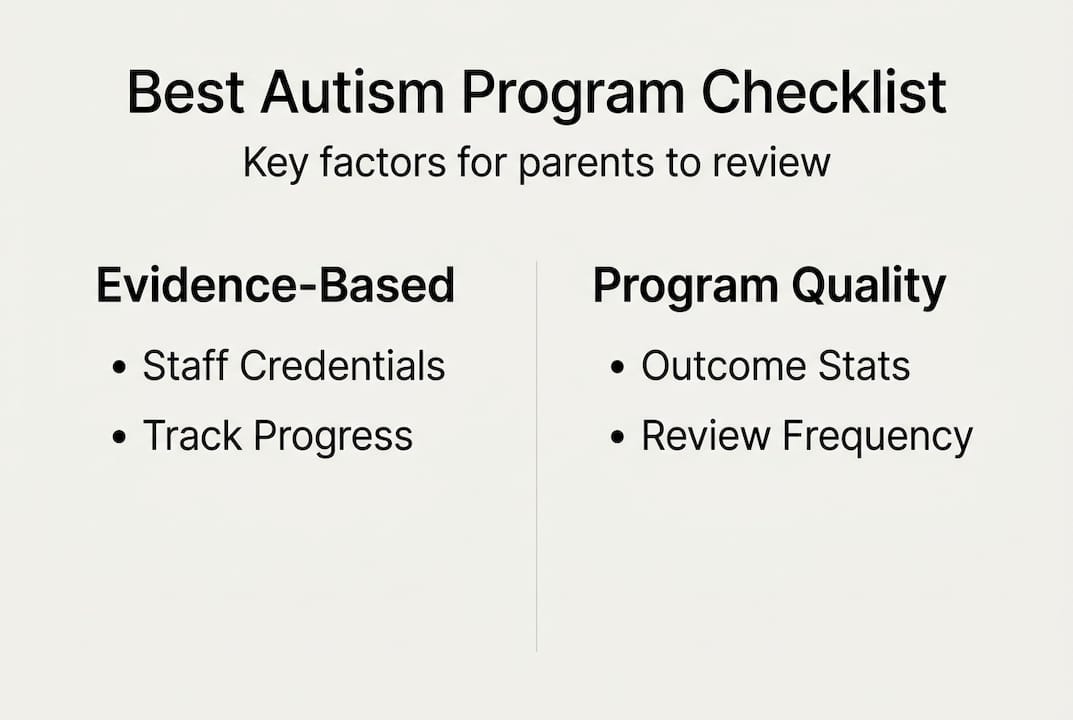
- Staff trained and certified in the methods they use
- Clear, written treatment goals for your child
- Regular data collection on your child’s progress
- Family involvement built into the program structure
- Transparent communication about what is working and what is not
- Individualized plans, not a one-size-fits-all curriculum
You can also explore autism therapy services in your area to compare what local providers offer against these standards.
Gather essential information before enrolling
Once you understand what makes a program effective, the next step is collecting solid facts before you commit. This means asking the right questions and knowing what answers should raise concern.
Start with staff qualifications. Ask whether therapists hold credentials like BCBA (Board Certified Behavior Analyst) or have specific training in the methods they use. A program can claim to use ABA, but without properly credentialed staff, the quality can vary widely.

Next, ask how the program tracks progress. Strong programs use standardized tools to measure your child’s development over time. Data-driven progress monitoring using tools like ATEC, Vineland-3, and SRS-2 ensures that programs show measurable outcomes and adjust plans when needed.
Here is a comparison of common monitoring tools:
| Tool | What it measures | Best used for |
|---|---|---|
| ATEC | Autism symptoms and behavior | Tracking overall symptom change |
| Vineland-3 | Adaptive behavior and daily living | Functional skill development |
| SRS-2 | Social responsiveness | Measuring social communication |
Follow these steps when gathering information about any program:
- Request a copy of the program’s treatment philosophy and methods
- Ask for sample progress reports or data charts from past clients (anonymized)
- Verify staff credentials and ask about ongoing training requirements
- Ask how often treatment goals are reviewed and updated
- Find out how parents are included in sessions or planning meetings
- Ask what happens if your child is not making expected progress
For a structured approach to program evaluation, look for providers who welcome these questions openly. Resistance to transparency is itself a red flag.
Pro Tip: Ask every program you visit how often they formally review your child’s goals. Monthly or quarterly reviews are a strong sign that the team is paying close attention to your child’s actual progress, not just running through a fixed curriculum.
You can also search autism remediation programs to find providers who specialize in structured, outcome-focused approaches.
Evaluate empirical outcomes and program intensity
With basic information gathered, it is time to look at real results. A program that sounds impressive in a brochure needs to back that up with actual outcome data.
Ask programs for their outcome statistics. What percentage of children meet their goals? How long does it typically take? What do gains look like across different skill areas? These are reasonable questions, and reputable programs will have answers.
Research gives us useful benchmarks. ABA meta-analysis data shows standardized mean difference improvements in adaptive behavior (0.31), daily living skills (0.36), and language (0.42), with higher intensity programs producing stronger language gains. These numbers tell you what realistic, measurable progress looks like when a program is working.
Here are the types of measurable outcomes you should expect a quality program to track:
- Gains in expressive and receptive language
- Improvements in adaptive behavior (dressing, eating, routines)
- Reduction in challenging behaviors
- Progress in social interaction and play skills
- Academic readiness skills for school-age children
- Independence in daily living tasks
Program intensity matters more than many parents realize. Intensity refers to how many hours per week your child receives direct therapy. Research consistently shows that children who receive more structured hours, especially early in life, tend to show stronger gains. This does not mean more is always better for every child, but it does mean you should ask about recommended hours and why.
Pro Tip: When comparing programs, ask specifically about language outcomes for children with a similar profile to your child. Language gains are one of the most reliable indicators that a program is actually working, and finding behavioral therapists who track this data closely is a strong signal of quality.
You can also look into autism support and training programs that pair direct therapy with caregiver coaching for even stronger results.
Watch for signs of quality and common pitfalls
Knowing what to look for in a strong program is just as important as knowing what to avoid. Quality programs share certain visible traits, and red flags are often easier to spot than parents expect.
Here are the numbered signs of a quality autism program:
- Staff turnover is low, meaning your child builds relationships with consistent therapists
- Methods are clearly explained to parents in plain language
- Parent involvement is structured into the program, not just encouraged in theory
- Progress data is shared regularly and used to adjust goals
- The program individualizes goals based on your child’s specific strengths and challenges
- Staff respond to your questions with confidence and transparency
“Prioritize evidence-based practices identified by systematic reviews like those from NCAEP or the National Standards Project. Programs that cannot name their evidence base or point to validated methods should be approached with caution.” Evidence-Based Practices for Children with Autism
Now, here are the warning signs to watch for:
- Vague promises like “we help every child reach their potential” with no data to back it up
- Staff who cannot explain their methods clearly
- No formal progress monitoring or goal-setting process
- Pressure to enroll quickly without time to ask questions
- Dismissiveness toward parent concerns or input
- No mention of evidence-based methods or professional credentials
One common mistake parents make is equating a long waitlist with quality. A long waitlist can mean a program is popular, but it does not automatically mean it is the right fit for your child. Always evaluate the program on its own merits.
For a closer look at applied behavior initiatives in your area, use a trusted directory to compare providers side by side before making any decisions.
A fresh perspective: why personalized fit matters most
Here is something most program guides will not tell you. Chasing the highest-rated or most well-known program in your city is often the wrong move. Success in autism intervention is deeply individual. A program that produced remarkable results for one child may be a poor fit for another, even with a similar diagnosis.
The checklist approach is useful, but it has limits. What matters most is whether a program can adapt to your child’s unique learning style, communication needs, and pace. Rigid programs with fixed curricula, even evidence-based ones, can underperform when they fail to flex around the child in front of them.
Ongoing assessment is what separates good programs from great ones. If a program is not regularly asking whether the current approach is still working, that is a problem. Your child will change, and the program needs to change with them.
Pro Tip: Pay attention to your child’s mood and engagement. A child who dreads sessions or shows increased anxiety may be in a poor-fit program regardless of its reputation. Explore autism therapeutics options that center the child’s experience alongside clinical outcomes.
Get expert support finding autism programs
Finding the right program takes time, but you do not have to do it alone. The Autism Doctor Search Directory gives you access to a regularly updated, carefully organized list of trusted autism resources across the country. Whether you are looking for autism therapy services, a specialized ABA provider like the missing piece aba therapy, or broader autism therapeutics support, our directory lets you filter by location, service type, and specialty. You can compare providers, read program details, and take the next step with confidence. Start your search today and find the right support for your child.
Frequently asked questions
What are evidence-based autism programs?
They use proven methods like ABA, ESDM, or PRT that research shows help children with autism develop skills and reach measurable goals.
How can I monitor my child’s progress in an autism program?
Ask programs to use standardized tools like ATEC, Vineland-3, or SRS-2 and request regular progress reports that show data over time.
Do more intensive autism programs lead to better outcomes?
Yes, higher-intensity programs often yield greater improvements in language and adaptive skills, especially when started early.
What are signs of a quality autism program?
Look for well-trained staff, evidence-based practices, measurable outcome tracking, and structured opportunities for parents to be involved in their child’s treatment plan.