
Many parents worry about their child’s development but feel uncertain about autism screening. You might wonder if screening is necessary, what it involves, or whether it will lead to a diagnosis. The truth is that early diagnosis and treatment can help children with autism reach their full potential, yet many families delay or skip screening due to confusion about the process. This guide walks you through autism screening tools, how to interpret results, and the steps to take after screening. You’ll learn what screening can and cannot tell you, and how to navigate the path toward support and services for your child.
Table of Contents
- Understanding Autism Screening And Why It Matters
- Common Autism Screening Tools And How They Work
- Interpreting Screening Results And Next Steps For Parents
- Challenges And Nuances In Autism Screening
- Explore Autism Support And Therapy Services
- Frequently Asked Questions
Key takeaways
| Point | Details |
|---|---|
| Early screening enables timely support | Identifying autism risk early allows families to access intervention services that improve developmental outcomes. |
| Screening tools vary by age and accuracy | Tools like M-CHAT and STAT target different age groups and have varying sensitivity and specificity rates. |
| Positive results require further evaluation | A positive screen indicates risk but is not a diagnosis, and 98% of positive screens warrant additional assessment. |
| Screening differs from diagnosis | Screening is a preliminary step to identify children who need comprehensive diagnostic evaluation by specialists. |
| Parents should consult healthcare providers | Discuss screening results and next steps with pediatricians or specialists to determine appropriate follow-up care. |
Understanding autism screening and why it matters
Autism screening is a brief assessment designed to identify children who may be at risk for autism spectrum disorder. It’s not a diagnosis but rather a first step that flags developmental concerns requiring further investigation. Screening tools use questionnaires or observational checklists to evaluate communication, social interaction, and behavior patterns that may indicate autism. These tools are quick, often taking just 10 to 15 minutes to complete during routine pediatric visits.
The difference between screening and diagnosis is crucial for parents to understand. Screening identifies potential risk, while diagnosis involves comprehensive evaluation by specialists using standardized diagnostic criteria. Think of screening as a smoke detector: it alerts you to possible danger but doesn’t tell you the source or severity of the fire. A positive screen means your child needs further assessment, not that they definitely have autism.
Early identification allows access to therapy and support sooner, which can significantly impact a child’s development. Research shows that children who receive intervention before age 3 often show better outcomes in communication, social skills, and adaptive behavior. The earlier you start, the more opportunities your child has to build foundational skills during critical developmental windows.
Common signs that prompt screening include:
- Limited eye contact or lack of response to name by 12 months
- Delayed speech or loss of previously acquired language skills
- Repetitive behaviors like hand flapping or lining up toys
- Difficulty with social interactions or understanding emotions
- Intense focus on specific objects or topics
Pro Tip: The American Academy of Pediatrics recommends autism screening at 18 and 24 month well child visits, but don’t wait if you notice concerning behaviors earlier. Trust your instincts and ask your pediatrician about screening anytime you have questions about your child’s development.
Common autism screening tools and how they work
The Modified Checklist for Autism in Toddlers, Revised with Follow Up (M-CHAT-R/F) is the most widely used screening tool for children aged 16 to 30 months. Parents answer 20 yes or no questions about their child’s behavior, focusing on social communication and restricted or repetitive behaviors. The scoring system includes reverse scored items, meaning some questions are designed so that a “no” answer indicates concern. The M-CHAT Follow-Up has been demonstrated to significantly improve positive predictive value over the initial M-CHAT screen alone, reducing false positives by allowing clinicians to clarify ambiguous responses.

The Screening Tool for Autism in Toddlers (STAT) takes a different approach by using direct observation rather than parent report. A trained clinician interacts with the child through structured play activities, scoring 12 items related to play, requesting, directing attention, and motor imitation. The Screening Tool for Autism in Toddlers demonstrated high sensitivity and specificity in the 14 to 23 and 24 to 36 months age groups compared to DSM-5 diagnoses, though accuracy decreases slightly in older toddlers who may have developed compensatory skills.
Screening questions focus on early indicators of autism that emerge in toddlerhood. Communication questions assess whether your child points to show interest, responds to their name, or uses gestures like waving. Behavior questions examine repetitive movements, unusual sensory interests, or rigid routines. Social questions look at joint attention, where a child shares experiences by looking between an object and a person.
| Screening Tool | Age Range | Administration | Key Strengths |
| — | — | — |
| M-CHAT-R/F | 16-30 months | Parent questionnaire | Quick, free, high sensitivity with follow up |
| STAT | 14-36 months | Clinician observation | Direct assessment, captures nuanced behaviors |
| CSBS-DP-ITC | 6-24 months | Parent questionnaire | Broad developmental screening, identifies delays |
When completing these screenings, follow these steps:
- Answer questions based on your child’s typical behavior, not their best or worst moments.
- Be honest about concerns even if they seem minor or embarrassing.
- Ask the clinician to clarify any questions you don’t understand.
- Share examples of specific behaviors rather than general impressions.
- Request a copy of the completed screening for your records.
Pro Tip: Before your screening appointment, spend a few days observing your child in different settings. Note specific examples of behaviors that concern you, like how they respond when you call their name three times at the playground. Concrete examples help clinicians understand your child’s patterns better than vague descriptions.
Interpreting screening results and next steps for parents
Understanding what screening outcomes mean can feel overwhelming, but breaking down the possibilities helps you know what to expect. A positive screen indicates your child scored above the threshold for concern, suggesting they should receive a comprehensive diagnostic evaluation. This doesn’t mean your child has autism, only that further assessment is warranted. 98% of all toddlers who screen positive are likely to show a developmental concern warranting further evaluation, whether autism, language delay, or another condition.
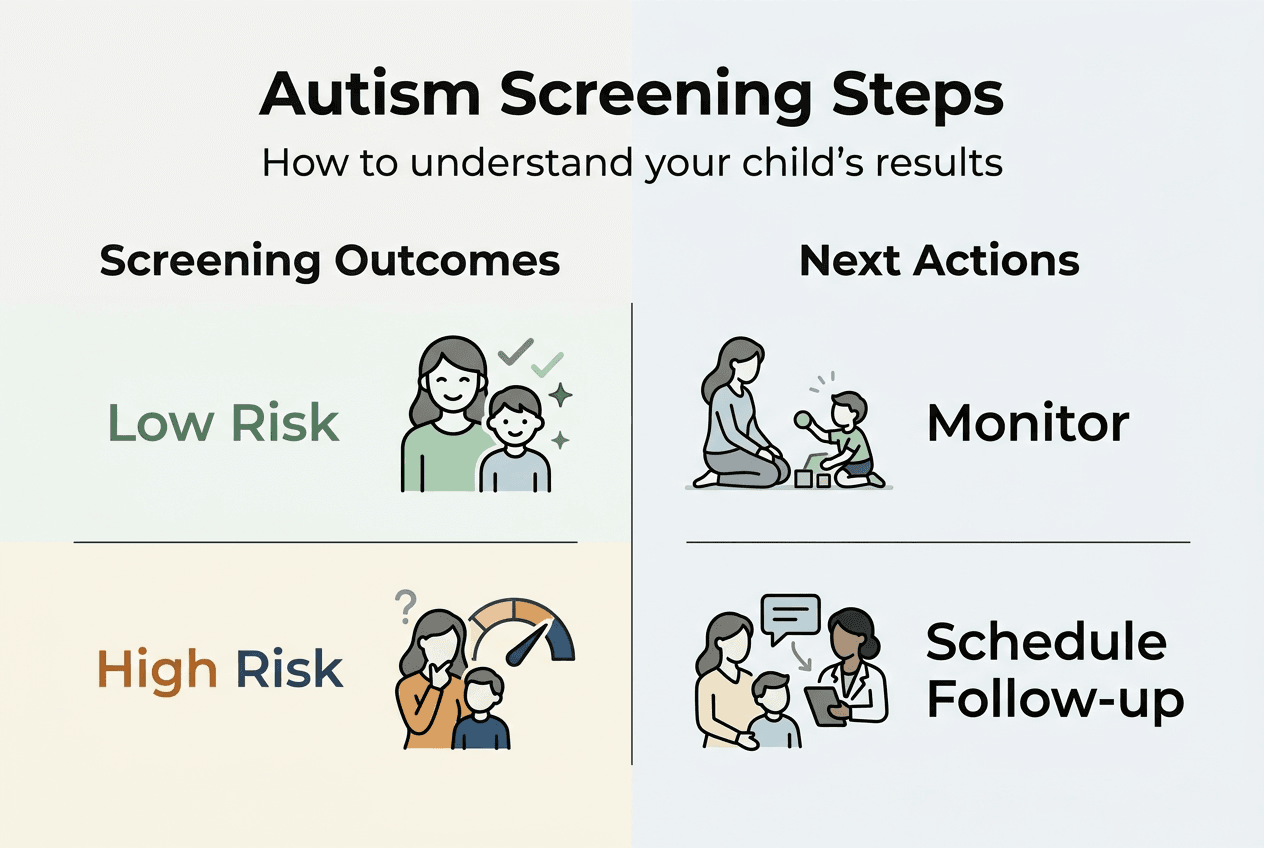
A negative screen means your child’s responses fell below the concern threshold, indicating low risk for autism at this time. However, autism can emerge or become more apparent as children grow, so continued monitoring during well child visits remains important. Some children develop typically until 18 to 24 months and then regress, losing skills they previously had. If you notice new concerns after a negative screen, request another screening rather than waiting for the next scheduled visit.
Inconclusive results occur when scores fall in a gray area or when the M-CHAT-R/F follow up interview doesn’t clearly resolve initial concerns. In these cases, clinicians typically recommend close monitoring with repeat screening in three to six months. Some children are late bloomers who catch up developmentally, while others show clearer signs of autism as they age.
Recommended follow up actions after a positive screen include:
- Schedule a comprehensive diagnostic evaluation with a developmental pediatrician, child psychologist, or autism specialist
- Request a referral to early intervention services while awaiting diagnostic assessment
- Document your child’s behaviors with videos to share with evaluators
- Connect with your local autism support resources to learn about available services
- Ask your pediatrician about hearing and vision tests to rule out sensory issues
If screening is negative but you still have concerns, trust your parental instincts. You know your child better than anyone, and subtle signs might not be captured by brief screening tools. Request a referral for comprehensive evaluation or contact early intervention services directly. Many states allow parents to self refer without a physician’s order. Don’t let a negative screen delay investigation if your gut tells you something needs attention.
Pro Tip: Start a behavior journal immediately after any screening, positive or negative. Note when and where behaviors occur, what happened before and after, and how your child responded to different situations. These detailed observations become invaluable during diagnostic evaluations and help specialists see patterns that emerge over time rather than just a snapshot during an office visit.
Challenges and nuances in autism screening
Current screening methods face limitations that parents should understand when interpreting results. Conditions that co-occur with autism, like intellectual disability, ADHD, or anxiety, can complicate screening accuracy. A child might screen positive due to attention difficulties rather than autism, or screen negative because anxiety masks social communication challenges. Comorbidity affects roughly 70% of autistic children, making it difficult to determine which symptoms belong to which condition during brief screening.
Diagnostic overshadowing occurs when clinicians attribute all of a child’s symptoms to one known condition, missing additional diagnoses. If your child already has a speech delay diagnosis, professionals might overlook autism signs by assuming everything stems from the language problem. The importance of rethinking psychometric testing in autism to address the challenges of comorbidity and diagnostic overshadowing has become a priority in autism research, as current tools weren’t designed to handle the complexity of overlapping conditions.
Screening tool effectiveness varies across ages and developmental levels. Tools designed for toddlers may miss autism in older children who’ve learned to mask social difficulties. Highly verbal children with autism might pass screening because they can answer questions appropriately even though they struggle with peer relationships. Conversely, children with significant developmental delays might screen positive for autism when their challenges stem primarily from intellectual disability.
The need for thorough, multidisciplinary diagnostic investigations cannot be overstated. Comprehensive evaluation includes developmental history, standardized diagnostic tools like the ADOS-2, cognitive testing, language assessment, and often occupational therapy evaluation. This process takes several hours across multiple appointments and involves professionals from different disciplines comparing notes. It’s far more involved than screening but provides the detailed picture needed for accurate diagnosis and treatment planning.
“Current psychometric approaches in autism research and clinical practice often fail to account for the heterogeneity of the autism spectrum and the high rates of comorbid conditions. This can lead to diagnostic overshadowing, where symptoms of one condition mask or are attributed to another, resulting in missed or delayed diagnoses and inadequate treatment planning.”
Variability in screening outcomes also relates to who completes the assessment. Parent report tools depend on caregivers recognizing and accurately reporting behaviors. Cultural differences in child rearing practices, parental expectations, and familiarity with developmental milestones all influence responses. Some parents minimize concerns due to stigma or fear, while others may over report typical toddler behaviors as problematic.
Understanding these limitations helps you advocate effectively for your child. If screening results don’t match your observations, pursue comprehensive developmental assessment anyway. Screening is just one data point in a larger picture of your child’s development, not the final word on their needs.
Explore autism support and therapy services
Now that you understand screening and diagnosis, discovering services that support your child’s development becomes the next crucial step. Whether your child received a positive screen, an autism diagnosis, or you’re simply seeking preventive support, early intervention services can make a meaningful difference in developmental outcomes. The journey from screening to effective support doesn’t have to feel overwhelming when you know where to find help.
Professional autism therapy services offer evidence based interventions tailored to your child’s unique needs. Applied Behavior Analysis remains one of the most researched approaches, using positive reinforcement to build communication, social, and daily living skills. ABA therapy can be delivered in your home, at a clinic, or in school settings, providing flexibility to fit your family’s schedule. Occupational therapy addresses sensory processing, fine motor skills, and self care abilities, while speech therapy targets communication challenges.
Our directory connects you with qualified providers in your area, making it easier to compare options and find the right fit for your family. Beyond therapy, child and family resources provide parent training, support groups, and educational workshops that help you understand autism and advocate effectively. Remember that early intervention services are most effective when started as soon as concerns arise, not after months of waiting for a formal diagnosis.
Frequently asked questions
What is autism screening?
Autism screening is a brief assessment tool used to identify children who may be at risk for autism spectrum disorder and need further evaluation. It typically involves a questionnaire or observational checklist completed by parents or healthcare providers during routine pediatric visits. Screening is not diagnostic but serves as an early alert system to catch developmental concerns when intervention can have the greatest impact.
How early can my child be screened for autism?
Most standardized screening tools like the M-CHAT begin around 16 to 18 months, though some broader developmental screenings can identify concerns as early as 9 months. The American Academy of Pediatrics recommends autism specific screening at 18 and 24 month well child visits. However, if you notice concerning behaviors at any age, you can request screening earlier or pursue direct evaluation without waiting for scheduled screening times.
What do the results of an autism screening mean?
Screening results indicate risk level, not a definitive diagnosis of autism. A positive result means your child scored above the concern threshold and should receive comprehensive diagnostic evaluation by specialists. A negative result suggests low risk at the current time but doesn’t guarantee your child won’t develop autism signs later. Approximately 98% of children with positive screens show some developmental concern requiring further assessment, though not all will receive an autism diagnosis.
Can autism screening be done at home?
Some screening tools like the M-CHAT-R are available online and can be completed at home by parents. However, results should always be shared with your pediatrician or healthcare provider for proper interpretation and follow up planning. Home screening can be a useful starting point if you have concerns between well child visits, but it doesn’t replace professional evaluation. Online tools lack the clinical context and follow up questions that help distinguish true concerns from typical developmental variations.
What happens if my child screens positive for autism?
A positive screen triggers a referral for comprehensive diagnostic evaluation by specialists trained in autism assessment. This evaluation process includes developmental history, standardized diagnostic tools, cognitive and language testing, and often takes several appointments to complete. While waiting for evaluation, you can request early intervention services in many states, as these don’t require a formal diagnosis. Your pediatrician should provide referrals and help coordinate the next steps in the assessment process.