
Choosing the right therapy for your child with autism can feel like standing in a maze with no map. You search online and find hundreds of options, each one claiming to be the answer, yet many of them contradict each other. The stakes are real: the wrong choice can waste precious time, drain your finances, and in some cases put your child at risk. This guide walks you through a clear, step-by-step process for researching autism treatments, grounded in guidance from the CDC, NIH, and other trusted health organizations, so you can make confident, informed decisions.
Table of Contents
- Understanding the challenge: Why researching autism treatments is hard
- Gathering reliable sources: Where to start your research
- Evaluating evidence: How to judge study quality and relevance
- Comparing common autism treatments: What works, what doesn’t
- Tracking results and partnering with professionals
- Find trustworthy autism therapy support near you
- Frequently asked questions
Key Takeaways
| Point | Details |
|---|---|
| Start with trusted sources | Rely on organizations like the CDC, NIH, and Cochrane for evidence-based autism treatment information. |
| Learn to evaluate studies | Check for recent, high-quality research such as RCTs and meta-analyses before accepting any therapy claims. |
| Focus on proven therapies | ABA and certain parent-involved approaches have the most support; avoid unproven or risky treatments. |
| Work with professionals | Regularly consult therapists or pediatricians to track progress and adjust interventions as needed. |
| Beware of misinformation | Skeptically approach ‘miracle cures’ and advice from non-authoritative sources to protect your child. |
Understanding the challenge: Why researching autism treatments is hard
The internet is full of conflicting advice about autism therapies. One website promises a “cure” through a special diet. Another pushes supplements with no clinical backing. Social media groups share personal stories that feel compelling but may not reflect what works for most children. This environment makes it genuinely hard to separate fact from fiction.
The risks go beyond wasted money. Families who chase unproven treatments often delay starting therapies that actually work. Some interventions, like certain detox protocols, carry real physical risks for children. Misinformation is common online, and the CDC and NIH consistently recommend relying on vetted, peer-reviewed sources rather than social media or commercial websites.
Here is what misinformation typically looks like:
- Claims of a complete “cure” for autism
- Testimonials with no supporting clinical data
- Products sold alongside therapy claims
- Advice that contradicts major health organizations
- Pressure to act fast before “missing a window”
“Parents deserve access to treatments that are safe, effective, and based on the best available science, not marketing.”
Understanding autism insurance coverage is also part of the picture, because financial barriers can push families toward cheaper, unproven options. Knowing your rights helps you access the therapies your child actually needs.
Gathering reliable sources: Where to start your research
Before you evaluate any specific therapy, you need a short list of sources you can trust. Starting in the right place saves you hours of frustration and protects you from biased information.
The four most reliable starting points are:
- CDC (Centers for Disease Control and Prevention): Offers plain-language overviews of autism and links to current treatment guidelines
- NIH/NICHD (National Institutes of Health): Funds and publishes research on autism interventions, with summaries written for families
- PubMed and Cochrane Library: Databases where you can find systematic reviews and RCTs on specific therapies
- American Academy of Pediatrics (AAP): Publishes clinical practice guidelines that pediatricians use
The CDC, NIH, Cochrane, and AAP are the most trusted organizations for evidence-based autism treatment reviews. If a therapy is not discussed or endorsed by at least one of these bodies, that is a red flag worth taking seriously.

Pro Tip: When searching PubMed, type the therapy name followed by “systematic review” or “randomized controlled trial.” This filters out weaker study types and gets you to the strongest evidence faster.
| Source | Best used for | Access |
|---|---|---|
| CDC | General autism facts and therapy overviews | Free, public |
| PubMed | Finding peer-reviewed studies | Free, public |
| Cochrane Library | High-quality systematic reviews | Free summaries |
| AAP | Pediatric clinical guidelines | Free summaries |
You can also explore vetted treatment guidelines through our directory to find providers who follow evidence-based protocols in your area.
Evaluating evidence: How to judge study quality and relevance
Not all research is created equal. A single small study showing promising results is very different from a large, well-designed trial replicated across multiple countries. Learning to tell the difference is one of the most powerful skills you can develop as a caregiver.
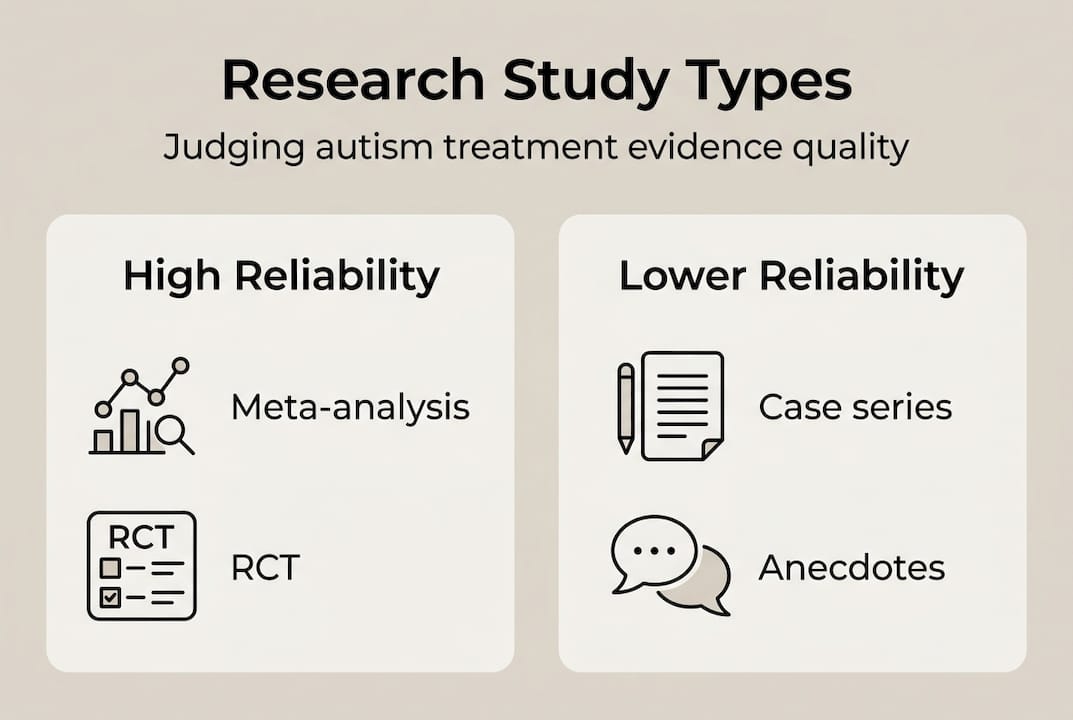
Here is the evidence hierarchy from strongest to weakest:
- Meta-analyses and systematic reviews: Pool data from many studies for the most reliable conclusions
- Randomized controlled trials (RCTs): Participants are randomly assigned to treatment or control groups, reducing bias
- Cohort and observational studies: Follow groups over time but cannot prove cause and effect
- Expert consensus and clinical guidelines: Useful but based on professional opinion, not direct data
- Case reports and testimonials: The weakest form of evidence, highly prone to bias
RCTs, meta-analyses, and GRADE-assessed outcomes are the gold standards for reliability in autism treatment research. GRADE is a system researchers use to rate how confident we should be in a finding.
| Study type | Reliability | Watch out for |
|---|---|---|
| Meta-analysis | Very high | Combining poor-quality studies |
| RCT | High | Small sample sizes |
| Observational | Moderate | Confounding variables |
| Testimonial | Very low | Selection bias, emotional framing |
Pro Tip: Check the NCCIH evidence summaries for plain-language breakdowns of complementary therapy research. They flag both what works and what lacks support.
Also look at who funded the study. Research funded by a company selling the therapy being tested deserves extra scrutiny. Independent, government-funded studies tend to be more objective.
For deeper reading on specific autism treatment research, our directory connects you with specialists who stay current with the latest clinical evidence.
Comparing common autism treatments: What works, what doesn’t
Once you understand how to evaluate evidence, you can look at specific therapies with clearer eyes. Some have strong, consistent support. Others have limited or mixed evidence. And a few should be avoided entirely.
Therapies with strong evidence:
- Applied Behavior Analysis (ABA): The most researched autism intervention, with strong support for improving communication, adaptive skills, and reducing challenging behaviors
- Naturalistic Developmental Behavioral Interventions (NDBIs): Includes approaches like the Early Start Denver Model (ESDM), which combines behavioral and developmental strategies in natural settings
- Parent-mediated interventions: Training parents to deliver strategies at home, shown to improve child outcomes and reduce caregiver stress
Therapies with limited but positive evidence:
- Melatonin for sleep difficulties in autistic children
- Speech-language therapy for communication goals
- Occupational therapy for sensory and daily living skills
RCTs and meta-analyses show the strongest support for ABA and some NDBIs like ESDM, though study quality varies. Chelation therapy and secretin lack evidence of benefit and carry real risks.
“No single therapy works for every child. The goal is to match the intervention to your child’s specific needs, strengths, and goals.”
Therapies to avoid based on current evidence:
- Chelation therapy: Designed to remove heavy metals, it has no proven benefit for autism and has caused serious harm in some cases
- Secretin injections: Multiple large trials found no benefit
- Hyperbaric oxygen therapy: Lacks reliable evidence and is expensive
For a closer look at parent training programs that support evidence-based home strategies, our directory lists vetted options by location. You can also review the Cochrane therapy review for auditory integration therapy, which found insufficient evidence to support its use.
Tracking results and partnering with professionals
Choosing a therapy is not a one-time decision. Your child’s needs will change, and what works at age four may need adjustment at age seven. Building a system for tracking progress keeps you informed and helps your care team make better decisions.
Here is a practical approach to monitoring your child’s progress:
- Set specific, measurable goals with your therapist before starting any intervention (for example, “uses three-word phrases to request items”)
- Keep a simple log of behaviors, skills, and mood changes at home, noting dates and context
- Schedule regular check-ins with your child’s therapist or pediatrician, at least every 90 days
- Ask for data from your therapy provider. Reputable ABA and NDBI programs track progress systematically and share it with families
- Reassess annually or sooner if you notice regression or a plateau
Child Find programs offer free evaluations for children under 21, and parent-mediated intervention studies report reduced stress and improved confidence for caregivers who take an active role in their child’s therapy.
Pro Tip: Bring your progress log to every appointment. Therapists and doctors make better recommendations when they can see real patterns over time, not just a snapshot from one visit.
Other practical steps include:
- Connecting with local parent advocacy groups for peer support and shared experience
- Asking your child’s school about Individualized Education Program (IEP) services
- Exploring caregiver training options that build your skills alongside your child’s progress
For additional guidance on complementary approaches, the HealthyChildren therapy guidance from the AAP is a reliable, family-friendly resource.
Find trustworthy autism therapy support near you
Researching autism treatments takes time and energy, and you should not have to do it alone. At Autism Doctor Search, we maintain a current, carefully organized directory of autism resources designed specifically for families like yours. Whether you are looking for autism therapy services in your area or trying to connect with qualified ABA therapy professionals, our directory makes it easier to find providers who follow evidence-based practices. We cover ABA therapy, occupational therapists, mental health services, special education schools, and more. Take the next step and search our directory to find the right support for your child and your family.
Frequently asked questions
What are evidence-based autism treatments?
Evidence-based autism treatments are therapies supported by strong research, including randomized controlled trials and systematic reviews. ABA and NDBIs like ESDM are among the most well-supported options currently available.
How can I spot a trustworthy study about autism interventions?
Look for large, recent studies from sources like Cochrane, NIH, or CDC. Meta-analyses and RCTs carry the most weight because they reduce the chance of bias and reflect findings across many participants.
Are there treatments for autism that parents should avoid?
Yes. Therapies like chelation, secretin, and hyperbaric oxygen lack reliable evidence and may be harmful. Chelation therapy risks are well-documented and outweigh any claimed benefits for autism.
What if my child’s therapy doesn’t seem to be working?
Track your child’s progress with specific goals and share that data with your care team. Consulting a specialist to reassess treatment goals is a normal and important part of effective autism care.
How can I find qualified autism therapy providers?
Start with your pediatrician’s recommendations and use reputable directories that list evidence-based providers. Child Find programs also offer free evaluations that can connect you with local services and qualified professionals.