
TL;DR:
- Parents should understand legal rights under IDEA and Section 504 to advocate effectively.
- Organizing documentation and preparing clear, data-driven requests strengthen advocacy efforts.
- Inclusive, autistic-centered advocacy values the child’s voice alongside parental efforts for better long-term outcomes.
Navigating school meetings, therapy decisions, and service systems can feel overwhelming when you’re trying to get your child the support they need. Many parents leave IEP meetings unsure whether they asked the right questions or secured the right services. Advocacy is not about being combative. It’s about knowing your child’s rights, preparing smart, and communicating effectively with the people who can make a difference. This guide walks you through the practical steps that actually work, from understanding federal law to finding evidence-based therapies, so you can show up as a confident, informed voice for your child.
Table of Contents
- Understand your child’s legal rights and needs
- Prepare effective documentation and communication
- Work collaboratively with school teams and providers
- Access therapies and empower your family
- What most advocacy guides miss: Centering autistic voices
- Find trusted autism therapy services and support
- Frequently asked questions
Key Takeaways
| Point | Details |
|---|---|
| Know your rights | Understanding legal protections is the foundation for effective advocacy. |
| Document everything | Accurate records and organized communication strengthen your requests and results. |
| Collaborate with teams | Working constructively with schools and providers leads to better outcomes. |
| Prioritize empowerment | Family empowerment and self-advocacy skills boost your child’s long-term independence. |
| Include autistic perspectives | Centering autistic voices leads to more respectful, effective advocacy for all. |
Understand your child’s legal rights and needs
Every parent who walks into a school meeting should know one thing: federal law is on your side. Two major frameworks protect autistic children in education. Understanding both gives you real power to ask for what your child needs and to push back when the system falls short.
IDEA vs. Section 504: what’s the difference?
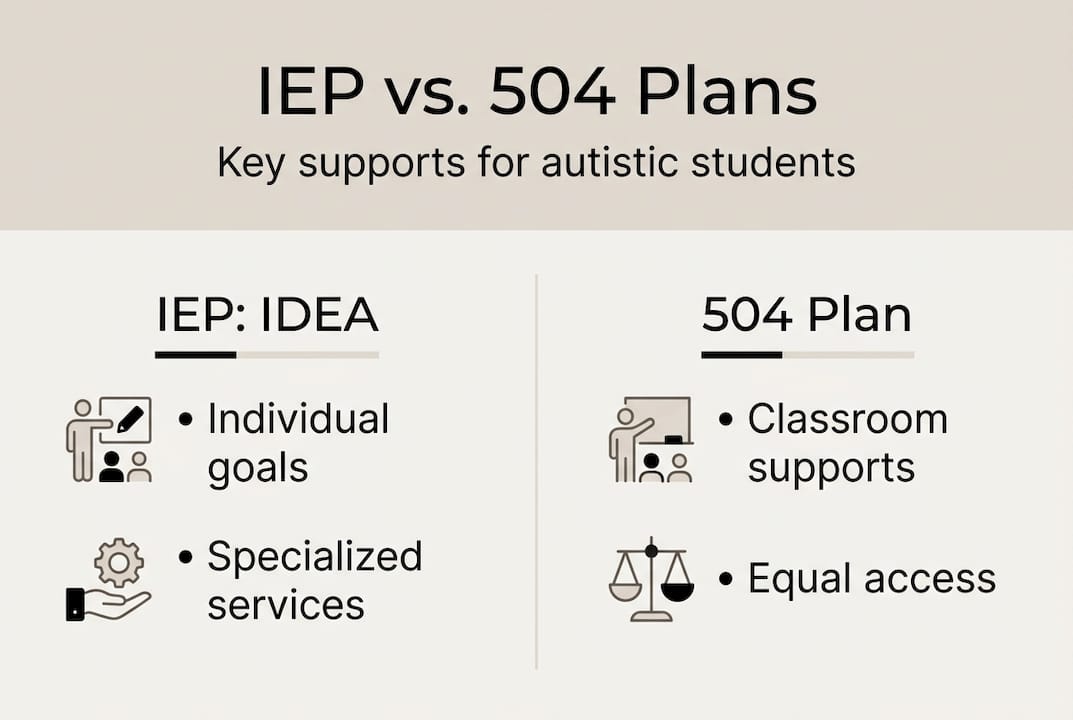
The Individuals with Disabilities Education Act (IDEA) guarantees eligible children a free and appropriate public education (FAPE) through an Individualized Education Program, commonly called an IEP. A Section 504 plan, under the Rehabilitation Act, provides accommodations without altering the curriculum. Here’s a quick side-by-side:
| Feature | IEP (IDEA) | Section 504 |
|---|---|---|
| Who qualifies | Children with qualifying disabilities needing specialized instruction | Broader eligibility, any disability affecting learning |
| What it provides | Individualized goals, special education services | Accommodations (extra time, seating, breaks) |
| Legal basis | IDEA | Section 504 of Rehab Act |
| Review frequency | Annually, with 3-year reevaluation | As needed |
| Parent involvement | Required team member | Required consent |
Knowing which plan applies to your child helps you request the right evaluation and the right services. Many autistic children qualify for an IEP, which opens access to therapies like speech, occupational therapy, and ABA within the school setting.
Key rights you must know
- You have the right to request an initial evaluation in writing at any time.
- You must give written consent before evaluations or changes to services.
- You can request an Independent Educational Evaluation (IEE) if you disagree with the school’s assessment.
- Prior Written Notice (PWN) means the school must document any changes to your child’s program in writing.
- Procedural safeguards must be provided to you at every IEP meeting.
Legal rights under IDEA and Section 504 are the foundation of every effective autism advocacy effort. You can explore more context and tools through this autism advocacy overview and review support resources for families navigating similar challenges.
Pro Tip: Request a copy of your district’s procedural safeguards document before your first IEP meeting. It’s long, but the dispute resolution section alone can change how you navigate disagreements.
Prepare effective documentation and communication
Once you understand your rights, the next step is building the paper trail and communication habits that make your advocacy credible and hard to dismiss. Schools and providers respond differently when they see organized, data-driven parents sitting across the table.
What to track and how
Use a dedicated notebook or digital folder for everything related to your child’s services. The goal is to walk into any meeting with evidence, not just feelings.

| Item to track | What to record | Why it matters |
|---|---|---|
| Behaviors and progress | Date, setting, triggers, response | Shows patterns and therapy effectiveness |
| Communications | Date, person, summary, outcome | Creates a verifiable record |
| Meeting notes | Attendees, decisions, action items | Prevents misunderstandings |
| Goals and benchmarks | Baseline, current level, target | Demonstrates growth or gaps |
Steps to prepare data-driven requests
- Collect at least 2 to 4 weeks of behavior or progress data before a meeting.
- Summarize the data into a one-page snapshot your team can review quickly.
- List your top three concerns with specific examples, not general statements.
- Draft written requests at least 10 business days before any major meeting.
- Keep copies of every email, letter, and form you send or receive.
Document everything including behaviors, progress, and communications, so your requests carry weight in every meeting. For more on coordinating therapies alongside school-based services, we’ve put together a dedicated resource.
“A parent who arrives with organized data and clear goals is far harder to ignore than one relying solely on emotion. Your records are your voice when words alone aren’t enough.”
Pro Tip: Use a simple shared Google Doc or folder to store all IEP documents, therapy notes, and emails in one place. This makes it easy to pull up evidence quickly during meetings or when filing a complaint.
Work collaboratively with school teams and providers
Preparation sets the stage. But how you show up in the room determines whether your advocacy moves the needle. The most effective parents are clear, firm, and collaborative, not confrontational.
Steps to request evaluations and follow up
- Submit a written evaluation request to the school’s special education coordinator.
- Note the date sent. Federal law gives schools 60 days to complete the evaluation.
- Follow up in writing if you haven’t heard back within two weeks.
- Review the evaluation results before the IEP meeting so you come prepared.
- Ask for clarification on any assessment terms or scores you don’t understand.
Before every IEP or 504 meeting
- Review last year’s goals and note which ones were met, partially met, or missed.
- Write down 3 to 5 specific goals you want addressed.
- Bring a trusted support person, a spouse, advocate, or family friend.
- Send your materials to the team at least 48 hours ahead of time.
- Know that requesting evaluations in writing and attending meetings with clear goals protects both you and your child.
Language matters enormously. Saying “I want to understand how we can support her reading goals together” lands differently than “You’re not doing enough.” One opens dialogue; the other shuts it down. When discussions stall or you feel unheard, bringing in a parent advocate or special education attorney is a legitimate and often effective step. Explore effective advocacy methods and family support strategies when you feel stuck.
Pro Tip: Record the date and time of every phone call with school staff, and follow up with a brief email summarizing what was discussed. This creates a written record even when conversations happen verbally.
Access therapies and empower your family
Advocacy doesn’t stop at the school door. Getting your child connected to the right outside therapies is just as critical, and your active involvement in those therapies makes a measurable difference.
Why parent involvement in therapy changes outcomes
Research confirms what many families already sense. Parent-mediated ABA produces greater gains in socialization and adaptive behaviors compared to paraprofessional-mediated approaches. When you are trained and active in your child’s therapy, you extend learning into everyday life in ways no clinic session can replicate.
At the same time, parent empowerment programs reduce family stress and increase both self-efficacy and overall family empowerment. That’s not a small benefit. A less stressed, more confident parent advocates better in every meeting.
Building your support network
- Connect with local or online autism parent support groups to share experiences and resources.
- Reach out to your state’s Parent Training and Information (PTI) center for free advocacy help.
- Follow autistic-led organizations and advocates who model neurodiversity-affirming approaches.
- Involve siblings and extended family in learning about your child’s needs and strengths.
Teaching self-advocacy early
One of the most powerful things you can do is help your child learn to speak up for themselves, even in small ways. Give them language for their needs. Let them attend parts of their IEP meeting when age-appropriate. Celebrate when they communicate a preference or set a boundary. These early skills grow into adult independence.
When researching autism treatments, look for approaches that build on your child’s strengths rather than focusing only on deficits. Our autism support services directory can help you locate specialized providers in your area.
Pro Tip: Ask any new therapy provider how they involve parents in sessions and how they measure progress. A provider who can’t answer both questions clearly may not be the right fit.
What most advocacy guides miss: Centering autistic voices
Most advocacy content focuses on parents as the primary drivers of change. And yes, your role matters enormously. But here’s the uncomfortable question most guides don’t ask: is your child’s advocacy actually centering your child’s perspective?
The “warrior parent” model, built around relentless fight and conquest, can unintentionally push deficit-focused thinking. When advocacy is framed as a battle to “fix” your child, autistic voices often get drowned out in the process. Autistic-led advocacy organizations like ASAN argue, rightly, that neurodiversity-affirming approaches lead to better long-term outcomes and honor autistic identity.
In practice, this means asking your child what they want, not just what you think they need. It means including them in IEP meetings when ready. It means reading work by autistic adults who have been through these systems and learned from them. Check out autistic advocacy methods that reflect this broader, more inclusive approach.
The most effective advocates we’ve seen combine legal knowledge and preparation with genuine respect for their child’s voice. That combination is rare. But it’s also the most powerful.
Find trusted autism therapy services and support
Armed with the strategies above, the next step is connecting with qualified providers who can turn these approaches into real outcomes for your child. The Autism Doctor Search Directory makes that connection simpler. Browse our curated listings of autism therapy providers to find specialists near you, or explore ABA therapy options from providers who prioritize family involvement. If school placement is part of your advocacy conversation, our special schools guide walks you through what to look for and how to evaluate fit. Start your search early, because building the right team takes time, and your child deserves providers who are the right match.
Frequently asked questions
What is the difference between an IEP and a 504 plan for autistic children?
An IEP provides individualized instruction, specific goals, and specialized services under IDEA, while a 504 plan provides classroom accommodations without changing the general curriculum. The IEP is typically more comprehensive for children with greater support needs.
How can parents prepare for special education meetings?
Document progress and behaviors, set clear meeting goals, send materials to the team ahead of time, and arrive with written questions and specific requests. Preparation turns you from a passive attendee into an active decision-maker.
What evidence-based therapies work best for autistic children?
Parent-mediated ABA shows stronger gains in socialization and adaptive behavior than paraprofessional-led approaches, though the best therapy plan is always individualized and ideally combines multiple evidence-based methods.
How do parent empowerment programs help families?
Empowerment programs lower parent stress, boost self-confidence, and increase the family’s overall capacity to advocate effectively. These benefits ripple directly into better outcomes for the child.
Should advocacy focus only on parent strategies or include autistic voices?
The strongest advocacy combines parent knowledge with autistic-led perspectives, creating support systems that are both effective and respectful of the autistic child’s identity and preferences.