Choosing a communication strategy for your autistic child can feel like standing in front of a wall of options with no clear map. Some approaches are backed by decades of research. Others sound promising but lack solid evidence. Caregivers often struggle to find methods supported by research, which means families sometimes spend months on approaches that don’t fit their child. This guide cuts through the noise and gives you a clear, practical look at the strategies that actually work.
Table of Contents
- How to choose the best autism communication strategies
- Evidence-based strategies every parent should know
- Quick comparison: Autism communication strategies at a glance
- Which strategy fits your child? Suggestions by situation
- Get professional support for your communication journey
- Frequently asked questions
Key Takeaways
| Point | Details |
|---|---|
| Match strategies to the child | Choose approaches based on age, needs, and preferences for best results. |
| Use evidence-based methods | Strategies like CST, Project ImPACT, and AAC are proven to boost communication. |
| Combine and adapt techniques | Mix methods and adjust as your child grows or challenges change. |
| Parent involvement is key | Parents who practice and reinforce skills daily achieve the most progress. |
| Support is available | Professional therapists and community resources can help tailor your approach. |
How to choose the best autism communication strategies
Not every strategy works for every child. Before you commit to any approach, it helps to know what separates a solid, evidence-based method from a trendy one. An evidence-based strategy has been tested in controlled studies, replicated across different populations, and shown measurable results in real children.
Here are the core criteria to evaluate any strategy:
- Scientific support — Is it backed by peer-reviewed research or clinical trials?
- Developmental fit — Does it match your child’s current age and skill level?
- Flexibility — Can it be adapted as your child grows or their needs shift?
- Ease of use — Can you realistically use it at home without a specialist present every time?
- Bidirectional adaptation — Does it ask both you and your child to adjust, not just your child?
Parent-child fit, sensory needs, and personal preferences are vital when selecting a strategy. A method that works beautifully in a clinic may fall flat at home if it doesn’t match your family’s rhythm. Some children respond best to visual supports, while others thrive with play-based interaction in autism-friendly settings.
Pro Tip: Prioritize strategies you can use during daily routines like meals, bath time, or car rides. Consistency across settings is what drives real generalization.
With these criteria in mind, let’s explore the communication strategies that research shows are most effective.
Evidence-based strategies every parent should know
NDBI, CST, and Project ImPACT are supported by meta-analyses, meaning they’ve been tested across many studies and consistently show results. These aren’t the only options, but they form the strongest foundation for supporting communication difficulties in autistic children.
Here are the main strategies covered in this guide:
- Caregiver Skills Training (CST) — WHO-recommended, routine-based parent coaching
- Project ImPACT and NDBIs — Play-based, parent-implemented interaction strategies
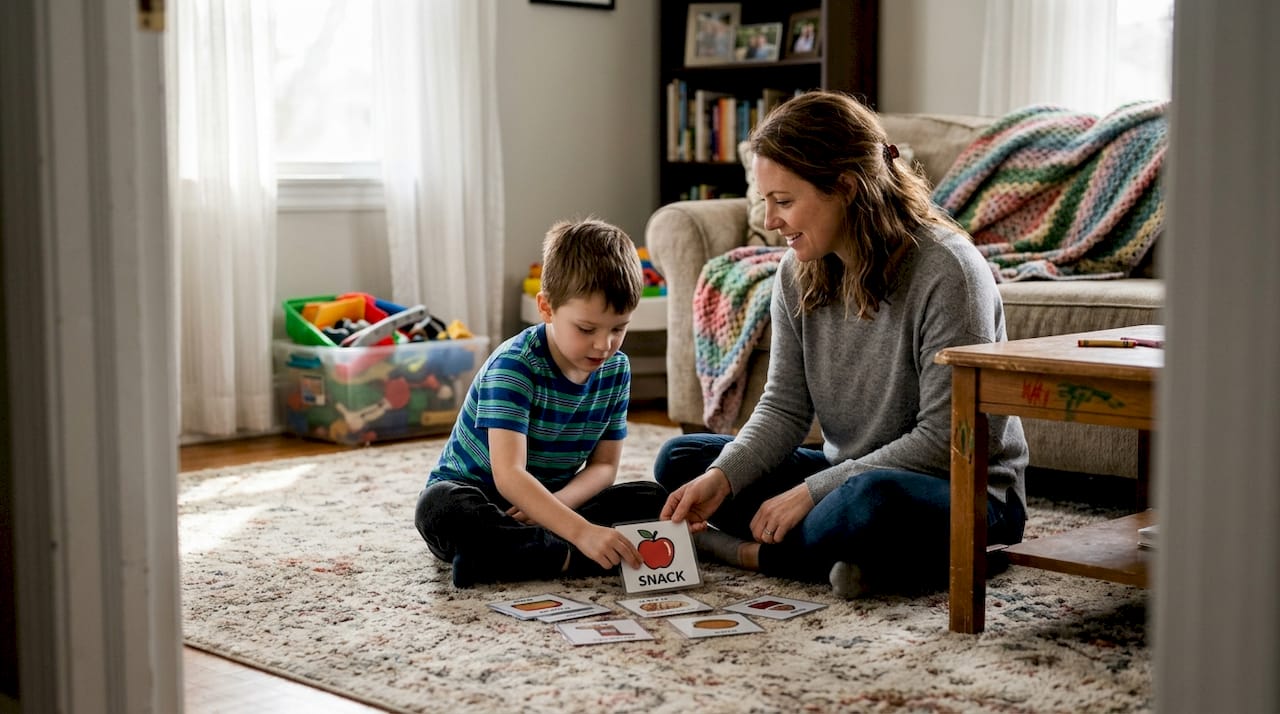
- Augmentative and Alternative Communication (AAC) — Picture cards, devices, and apps
- Visual supports — Schedules, choice boards, and first-then cards
- Imitation and modeling — Following your child’s lead and expanding on it
- Play-based intervention — Child-directed learning within structured play
- Accommodating individual differences — Adjusting for sensory needs and preferences
Now, let’s take a closer look at the individual strategies.
Caregiver Skills Training (CST): Practical routines for real life
CST is a WHO-recommended program designed for children ages 2 to 9. It teaches parents specific techniques through group sessions and home visits, so you’re not just learning theory but practicing in real situations. The proven CST methods are built around four core techniques:
- Look and listen — Pause and observe before responding
- Imitate your child’s actions — Mirror what they do to build connection
- Expand on attempts — If your child says “ba,” you say “ball” or “big ball”
- Use gestures alongside language — Point, show, and gesture to reinforce words
CST improves communication, engagement, and reduces caregiver stress, making it one of the few programs that benefits both the child and the parent at the same time.
Parents who completed CST reported meaningful reductions in stress and increased confidence in supporting their child’s communication at home.
Pro Tip: Try the “respond and expand” technique during snack time or bath routines. These low-pressure moments are perfect for natural, repeated practice.
While CST offers a structure for real-life routines, another approach specializes in play and engagement opportunities.
Project ImPACT and NDBIs: Follow, imitate, engage
Naturalistic Developmental Behavioral Interventions, or NDBIs, blend the precision of Applied Behavior Analysis (ABA) with child-led play. They’re structured but feel natural, which makes them easier to sustain at home. Project ImPACT is one of the most well-studied NDBIs available to parents.
Parent use of Project ImPACT increases child expressive language, meaning the more consistently you use the techniques, the more your child communicates. Here’s how to run a basic Project ImPACT routine:
- Follow your child’s lead — Join whatever activity they’ve chosen
- Imitate their actions and sounds — Copy exactly what they do
- Expand the interaction — Add one small step, word, or gesture
- Prompt a response — Create a natural opportunity for your child to communicate
- Reinforce any attempt — Respond warmly to every gesture, sound, or word
NDBIs lead to improvements in social communication across multiple studies, and many programs now offer telehealth options. This matters for busy families who can’t always make it to a clinic. You can explore NDBI parent strategies and connect with therapy service options that fit your schedule.
Children whose parents received NDBI coaching showed significantly greater gains in expressive language compared to control groups.
Not all children rely on speech. Let’s look at strategies that support alternative ways to communicate.
AAC and visual supports: Tools for minimally verbal communicators
An estimated 25-30% of autistic children are minimally verbal, meaning speech alone isn’t enough to meet their communication needs. AAC (Augmentative and Alternative Communication) fills that gap with tools ranging from simple picture cards to high-tech speech-generating devices.
Here are the key benefits of AAC:
- Gives children a reliable way to express wants, needs, and feelings
- Reduces frustration and challenging behavior linked to communication barriers
- Supports language development rather than replacing it
- Works alongside speech therapy, not against it
Pro Tip: Start modeling AAC with your child’s favorite activity. If they love trains, use picture cards or a device to label train parts during play. Motivation drives learning.
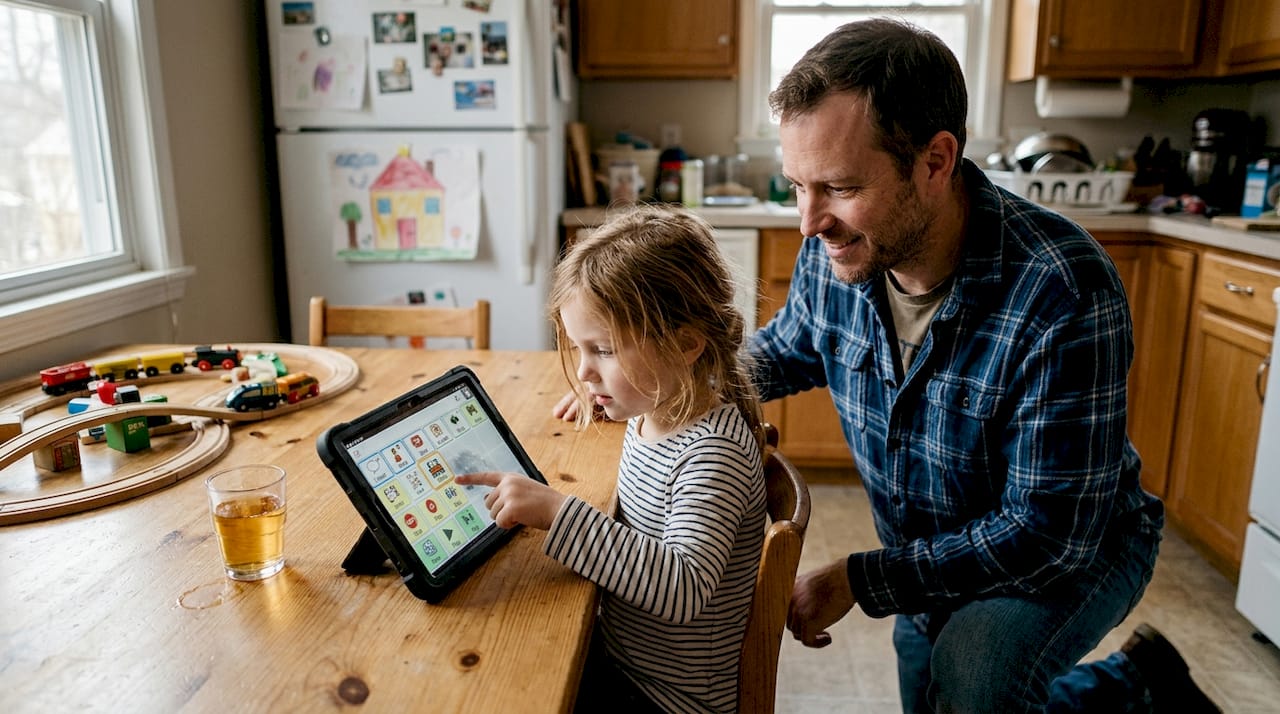
Visual supports like schedules, first-then boards, and choice cards work well alongside AAC. They reduce anxiety by making expectations predictable. Here’s a quick comparison of low-tech and high-tech AAC options:
| Feature | Low-tech AAC | High-tech AAC |
|---|---|---|
| Examples | Picture exchange cards, printed boards | Speech-generating devices, apps |
| Cost | Low | Moderate to high |
| Portability | Easy to carry | Varies by device |
| Customization | Manual updates needed | Easily updated digitally |
| Best for | Early learners, sensory-sensitive children | Children with strong visual/tech skills |
For sensory-friendly communication setups, low-tech options often work better in noisy or overwhelming environments.
Beyond tools, how you interact daily can set your child up for even greater success.
Daily practice: Modeling, narrating, and celebrating all communication
You don’t need a therapy session to build communication skills. The most powerful practice happens in everyday moments. Narrating your routines, modeling language, and celebrating every attempt builds a communication-rich environment your child can learn from all day long.
Here are daily routine ideas to embed communication practice:
- Morning routine — Name each step: “Shirt on. Now pants.”
- Mealtime — Offer choices and wait for a response before serving
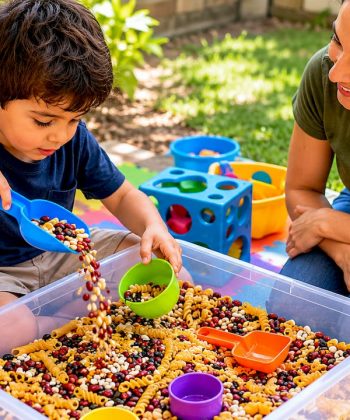
- Play time — Follow your child’s lead and narrate what they’re doing
- Errands — Label objects and actions as you move through the store
- Bedtime — Recap the day using simple phrases or picture cards
All communicative attempts should be encouraged and celebrated, whether that’s a word, a gesture, a point, or a device tap. Responding warmly to every attempt tells your child that communication works, which motivates them to keep trying.
Why celebrating gestures and sounds matters:
- It reinforces that all forms of communication have value
- It builds your child’s confidence to try again
- It reduces the pressure to produce “perfect” speech
Pro Tip: After modeling a word or phrase, pause for 5 to 10 seconds. This gives your child processing time and creates space for encouraging all forms of communication without pressure.
Every child’s communication will look different, and individual preference plays a key role.
Accommodating sensory needs and preferences
One concept worth understanding is the double empathy problem. It describes how communication breakdowns between autistic and non-autistic people are a two-way issue, not just a deficit in the autistic person. Both sides misread each other’s cues. Recognizing this shifts the goal from “fixing” your child to building mutual understanding.
Accommodate sensory needs and ask about communication preferences whenever possible. Some autistic children and adults find written or typed communication far easier than spoken conversation. Others need reduced background noise or softer lighting to communicate effectively.
Here’s how to adjust for sensory comfort:
- Reduce visual clutter and background noise during communication
- Offer written or typed options alongside spoken language
- Avoid touch or sudden sounds that may trigger sensory overload
- Use calm, predictable language and give extra processing time
Many autistic adults report that written communication feels more natural and accurate than verbal conversation, even when they are capable of speech.
For inclusive communication strategies, always observe your child’s reactions and ask for their preference when possible. Their comfort directly affects how well they can communicate.
With so many options, it helps to compare strategies side by side.
Quick comparison: Autism communication strategies at a glance
Evidence-based comparisons show NDBI and CST improve social communication outcomes across age groups. Here’s how the top strategies stack up:
| Strategy | Target age | Core method | Home training needed | Best for |
|---|---|---|---|---|
| CST | 2 to 9 years | Routine-based parent coaching | Yes, group + home visits | Early communicators, stressed caregivers |
| Project ImPACT / NDBIs | 2 to 8 years | Play-based, parent-led interaction | Yes, coaching sessions | Children with emerging play and social skills |
| AAC / Visual Supports | Any age | Tools and visual systems | Moderate, modeling required | Minimally verbal or nonverbal children |
| Daily Modeling / Narration | Any age | Embedded routine practice | Low, parent-driven | All children, especially as a supplement |
Most families use a combination of these approaches. You might use CST techniques at home while also using AAC tools and embedding daily narration. Explore different autism therapy options to find what fits your family’s schedule and goals.
Now, let’s match strategies to individual family needs.
Which strategy fits your child? Suggestions by situation
Tailoring strategies to individual differences consistently yields the best outcomes. Here’s a practical starting point based on your child’s current profile:
- Children under 9 with emerging speech — Start with CST or Project ImPACT. Both are designed for this age range and give you structured techniques to use at home.
- Nonverbal or minimally verbal children — Prioritize AAC and visual supports. Introduce low-tech options first, then move to devices as skills develop.
- Highly sensory-sensitive children — Focus on communication in calm, predictable environments. Reduce sensory demands before adding new communication tools.
- Children with strong play skills — NDBIs like Project ImPACT are a natural fit. Use play as the entry point for all communication goals.
Pro Tip: Try more than one strategy for two to four weeks each and track what your child responds to. Small observations like more eye contact, more pointing, or fewer meltdowns are meaningful data.
For guidance on advocating for personalized strategies, connect with specialists who understand your child’s full profile, not just their diagnosis.
Whether you’re just starting or looking to refine your approach, help is available to guide you on this journey.
Get professional support for your communication journey
Implementing these strategies consistently is much easier with professional guidance behind you. A trained therapist can observe your child, identify which methods are gaining traction, and help you adjust when something isn’t working. At Autism Doctor Search, we connect families with the right specialists, from autism therapy services and ABA therapy providers to occupational therapists and special education schools. Our directory is built for families who need real, vetted resources fast. Visit Autism Doctor Search to find local autism therapists and support services matched to your child’s needs and your family’s situation.
Frequently asked questions
What is the best communication strategy for a nonverbal autistic child?
AAC is essential for minimally verbal children. Picture exchange systems and speech-generating devices are strong starting points, chosen based on your child’s visual and motor strengths.
Can I use multiple communication strategies at the same time?
Yes. Mixing strategies to suit your child’s changing needs is not only acceptable but often recommended for the best results.
Are parent-led strategies as effective as therapy-led ones?
Parent fidelity mediates child language gains, meaning the more consistently you apply the techniques, the stronger the outcomes, especially when you’ve been trained in an evidence-based program.
How do I know if a strategy is working for my child?
Look for more frequent, varied, or confident communication attempts. Even small shifts like more pointing or fewer meltdowns signal real progress.
Should I adapt communication strategies as my child grows?
Absolutely. Needs, abilities, and preferences shift over time, and your strategies should evolve alongside your child to stay effective.