
TL;DR:
- Pediatricians conduct ongoing developmental surveillance and screening for autism at every well-child visit.
- They serve as coordinators, referring to specialists and managing co-occurring health issues.
- Parents should remain proactive and trust their observations, especially if concerns persist despite negative screenings.
Your child’s pediatrician does far more than hand out vaccines and measure height at annual checkups. For families navigating autism, the pediatrician is often the first professional to notice something worth investigating, the person who connects you to specialists, and the ongoing anchor for your child’s medical care across years of development. Most parents walk into a well-child visit focused on growth charts. What they may not realize is that each of those visits includes careful developmental observation that can change the entire course of their child’s life.
Table of Contents
- What do pediatricians actually do in autism care?
- How autism screening works: Inside the pediatrician’s office
- Diagnosis and referrals: What happens after a positive screen?
- Ongoing support: Medical home and care coordination
- What most parents miss: Nuances in autism surveillance
- Why trusting your pediatrician — and staying proactive — matters
- Find support services and specialist connections
- Frequently asked questions
Key Takeaways
| Point | Details |
|---|---|
| Pediatricians are first-line | They are usually the first to spot signs of autism and start the diagnostic journey. |
| Screening is routine | All children should undergo autism screening at 18 and 24 months, and anytime there are concerns. |
| Referral is key | A positive screen prompts specialized evaluation—screening alone does not confirm a diagnosis. |
| Ongoing care matters | Pediatricians continue to coordinate all aspects of support, including comorbid health needs, after diagnosis. |
| Trust your instincts | If you still have concerns, keep asking questions—even a negative screen isn’t the final word. |
What do pediatricians actually do in autism care?
The pediatrician’s role in autism is broader and more active than most families expect. From the moment your baby starts attending routine checkups, your pediatrician is doing something called developmental surveillance: watching how your child communicates, plays, makes eye contact, and responds to their name. This isn’t passive observation. It’s structured, purposeful, and repeated at every single visit.
Pediatricians are often the first professionals to notice early signs that prompt a closer look. A toddler who doesn’t point to share interest, a child who seems unusually sensitive to sounds, or a baby who doesn’t babble by twelve months — these are exactly the kinds of details a trained pediatrician is watching for during what might feel like a casual appointment.
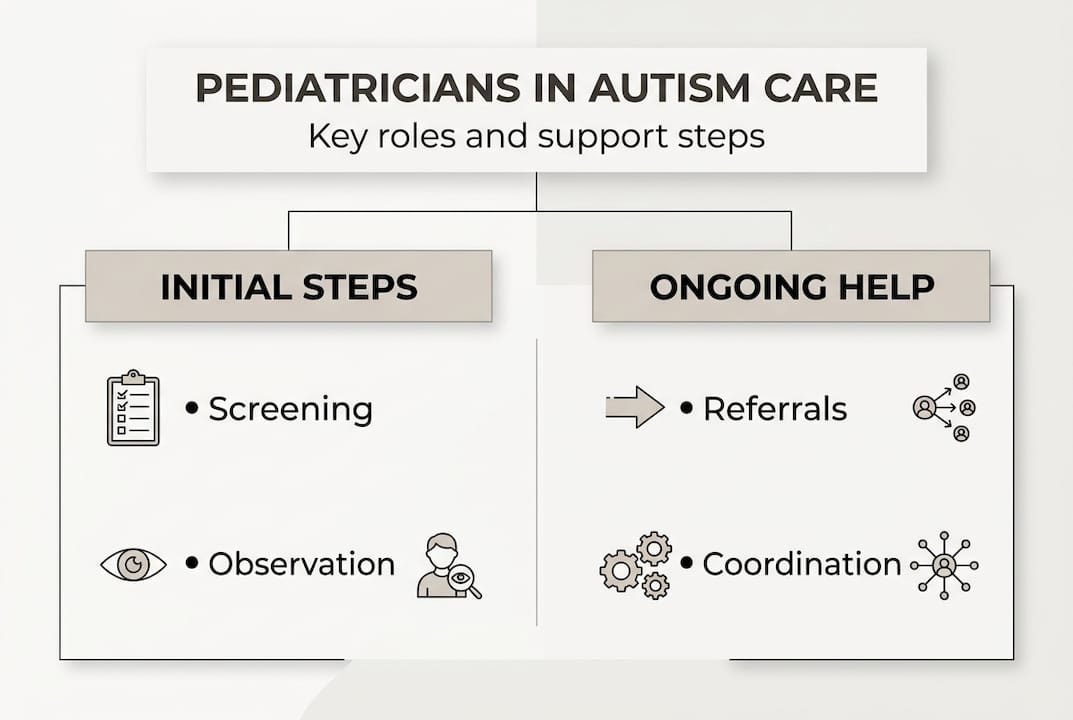
Beyond early detection, pediatricians serve as what’s called the medical home for autistic children. As the American Academy of Pediatrics explains, pediatricians coordinate care plans, therapies, referrals to specialists, and address comorbidities like sleep disorders, GI issues, and anxiety. That’s a significant responsibility. It means your pediatrician isn’t handing you off to specialists and walking away. They remain central to your child’s care at every stage.
Here’s a clear picture of what that role actually includes:
- Developmental surveillance at every well-child visit from birth onward
- Standardized autism screening using validated tools at recommended ages
- Referrals to specialists when screening results or parental concerns indicate further evaluation
- Care coordination between therapists, schools, specialists, and the family
- Management of co-occurring conditions like sleep problems, digestive issues, and anxiety
- Ongoing monitoring of your child’s development and response to therapies
- Family support and education to help parents understand the next steps
“The pediatrician is not just the entry point to autism care — they are the through line. While specialists may come and go based on your child’s evolving needs, your pediatrician remains the consistent, coordinating presence holding everything together.”
Understanding this foundational role helps you make the most of every appointment. When you learn about coordinating autism therapies across multiple providers, your pediatrician is the professional best positioned to keep that coordination organized and informed.
How autism screening works: Inside the pediatrician’s office
Understanding this foundational role, let’s zoom in on what happens when your child visits their pediatrician for developmental screening. The process is more structured than many parents realize, and knowing what to expect makes you a far more effective participant in it.
The American Academy of Pediatrics recommends universal autism screening at the 18-month and 24-month well-child visits using standardized tools. But screening can also happen at any age if you or your pediatrician notice something that warrants a closer look. Here is a step-by-step look at how this typically unfolds:
- Developmental surveillance begins early. From your child’s very first checkup, the pediatrician is observing developmental milestones and asking parents targeted questions.
- Standardized questionnaires are introduced. At 18 and 24 months, your child’s pediatrician will use a validated tool, most commonly the M-CHAT-R/F (Modified Checklist for Autism in Toddlers, Revised with Follow-Up).
- Parents complete the screening form. You answer questions about your child’s behavior, communication, and social interaction. Your input is genuinely essential.
- The pediatrician scores and interprets results. A score in the medium or high-risk range triggers a follow-up interview (the F portion of the M-CHAT-R/F) to clarify answers.
- Results guide next steps. Low-risk results mean continued surveillance. Medium or high-risk results prompt referral for a full diagnostic evaluation.
Here is a quick comparison of common tools used in screening:
| Screening Tool | Age Range | Format | Who Completes It |
|---|---|---|---|
| M-CHAT-R/F | 16 to 30 months | Parent questionnaire + follow-up | Parent with clinician |
| ASQ-3 | 1 to 66 months | Parent questionnaire | Parent |
| PEDS | Birth to 8 years | Parent elicitation | Clinician guided |
| CSBS-DP | 6 to 24 months | Parent questionnaire | Parent |
Pro Tip: A positive screen does not mean your child has autism. It means further evaluation is needed. Many children who screen positive receive evaluations that point to language delays, sensory differences, or other developmental patterns rather than an autism diagnosis. The screen is a signal, not a verdict.
If you want a deeper guide to navigating this process, our autism screening guide walks parents through each stage in practical detail.
Diagnosis and referrals: What happens after a positive screen?
With screening completed, it’s important to know what happens if the results point to possible autism. This is where many families feel most anxious, and it’s also where pediatricians play a crucial bridging role.

A critical distinction to understand: screening is not diagnosis. A pediatrician using the M-CHAT-R/F is identifying children who may need further evaluation. As the CDC clearly states, a positive screen leads to referral for diagnostic evaluation by specialists such as developmental pediatricians, psychologists, or speech-language pathologists. The formal autism diagnosis requires a comprehensive assessment that goes well beyond what a screening tool can capture.
Here is what most families experience after a positive screen:
- Pediatrician discusses results with parents. Your doctor explains what the screen found and why further evaluation is recommended.
- Referral is initiated. Your pediatrician refers you to a developmental pediatrician, child psychologist, or a multidisciplinary evaluation team.
- You are placed on an evaluation waitlist. In many regions, wait times for specialist evaluations can be several months. Your pediatrician can sometimes facilitate faster access or recommend early intervention services in the meantime.
- Comprehensive diagnostic assessment is completed. Specialists use tools like the ADOS-2 (Autism Diagnostic Observation Schedule) and ADI-R alongside clinical observation and parent interviews.
- Diagnosis is communicated and next steps are planned. Results are shared with both the specialist and your pediatrician, who then helps coordinate the ongoing care plan.
| Role | Pediatrician | Specialist |
|---|---|---|
| Conducts screening | Yes | Sometimes |
| Provides formal diagnosis | Rarely | Yes |
| Manages co-occurring health issues | Yes | Limited |
| Coordinates care plan | Yes | Sometimes |
| Monitors long-term progress | Yes | Usually not |
Pro Tip: Keep a dedicated folder — physical or digital — with all screening results, referral letters, developmental reports, and notes from appointments. When you arrive at a specialist evaluation, having this documentation organized saves significant time and helps clinicians understand your child’s full history.
Understanding autism doctor qualifications helps you know exactly who you’re being referred to and what to expect from each specialist. And if you’re unsure how to advocate for faster access, our guide on getting medical referrals offers practical steps.
Ongoing support: Medical home and care coordination
Diagnosis is only the beginning. Pediatricians’ work continues as your child’s needs evolve, and this is where their role as a medical home becomes genuinely invaluable to families. After a diagnosis, the number of providers, appointments, and services can feel overwhelming fast. ABA therapy, occupational therapy, speech therapy, special education, and more — all running simultaneously, all requiring communication.
Your pediatrician is positioned to be the connective tissue across all of it. According to the American Academy of Pediatrics, pediatricians coordinate care plans, manage referrals, and address comorbidities including sleep disruption, gastrointestinal problems, and anxiety. These are not minor issues. Research consistently shows that children with autism experience higher rates of sleep problems, constipation, and anxiety than neurotypical peers, and each of those conditions affects how well your child can engage with therapies and learning.
Here is what ongoing pediatric support looks like in practice:
- Regular monitoring of growth, nutrition, and physical health
- Screening for and managing sleep disorders, which affect a large percentage of autistic children
- Evaluating and treating gastrointestinal symptoms, which are extremely common in this population
- Coordinating with mental health providers for anxiety, sensory processing challenges, and behavioral concerns
- Reviewing therapy progress reports and adjusting referrals as needed
- Updating care plans as your child reaches new developmental stages
“The medical home model means your child never falls through the cracks between providers. It means someone is watching the whole picture, not just one piece of it.”
Effective communication between you, your pediatrician, and your therapy providers makes an enormous difference. Bring therapy progress notes to pediatric appointments. Share behavior changes you notice at home. Ask your pediatrician to loop in your child’s school team when appropriate. For more on how to manage this, see our guides on autism therapies coordination and support strategies for children.
What most parents miss: Nuances in autism surveillance
But what if your situation is a little outside the norm, or you still have worries after a clear screening? This is one of the most important and least-discussed aspects of pediatric autism care: a negative screen does not mean autism is off the table.
As the CDC notes, edge cases like high-risk siblings require intensified surveillance because negative screens don’t rule out ASD, given that symptoms may emerge later in development. Some children with autism, particularly those with strong verbal skills or who are girls, may not present in ways that standard screening tools easily capture at 18 to 24 months. Their autism may become more visible as social demands increase in preschool or early elementary school.
Siblings of autistic children carry a meaningfully higher likelihood of also being autistic. For these children, pediatricians should be applying increased vigilance at every visit, not just at the standard screening ages.
Here are warning signs parents can watch for even after a clear screening:
- Significant regression in language or social skills at any age
- Extreme difficulty with transitions or changes in routine
- Limited or absent pretend play by age 3
- Persistent lack of interest in other children or difficulty forming friendships
- Very restricted interests that significantly limit daily activities
- Unusual sensory responses, like extreme distress at ordinary sounds or textures
- Difficulty understanding social cues, taking turns in conversation, or reading facial expressions
Trust your instincts. You know your child better than any screening tool does. If something feels off after a clear screen, bring it back to your pediatrician at the next visit or call sooner. You are not being dramatic. You are being a good advocate. Our guide on supporting autistic child growth can help you track developmental patterns and prepare informed conversations with your child’s doctor.
Why trusting your pediatrician — and staying proactive — matters
With the big picture in place, let’s reflect on how you can truly make the most of the partnership with your pediatrician. Here’s something we see consistently: families who treat their pediatrician as an active partner, rather than a gatekeeper, get better outcomes. Not because the pediatrician is more competent in those relationships, but because the information flow is better.
Think about it this way. Your pediatrician sees your child for 20 to 30 minutes several times a year. You see your child every single day. When you bring specific, documented observations to appointments — behavioral changes, new symptoms, regression in skills, patterns you’ve noticed — your pediatrician can act on that information immediately. When you arrive uncertain and hope they’ll figure it out on their own, crucial details can slip by.
This is not about second-guessing your doctor. It’s about understanding that your observations are clinical data. A log of sleep disruptions, a video of a meltdown pattern, a list of foods your child suddenly refuses — all of it is useful. All of it helps your pediatrician make better decisions.
We also want to say clearly: don’t hesitate to seek a second opinion if your concerns persist after being told everything is fine. Parents who advocated persistently, got second and third opinions, and pushed for earlier evaluations often secured earlier diagnoses and earlier access to therapies. Earlier access to intervention consistently leads to better outcomes. Your pediatrician should welcome your engagement, and if they don’t, that’s worth reflecting on. Learn more about navigating this through our medical referral insights resource, which helps parents advocate effectively without burning bridges with their child’s care team.
Find support services and specialist connections
If you’re ready to take the next step or need specialized support, these resources can help. Finding the right autism specialists, therapy providers, and support services is one of the most practically challenging parts of this journey. Waitlists are long, insurance is complicated, and knowing who to call first isn’t always obvious.
The Autism Doctor Search Directory exists to make that part easier. We maintain an up-to-date, carefully organized directory of verified autism therapy services across the country, connecting families with ABA providers, occupational therapists, mental health services, special education schools, and medical clinics. If you’re specifically looking for behavioral support, our directory includes ABA therapy options from experienced providers. You don’t have to figure this out alone. We’re here to help you find the right people, faster.
Frequently asked questions
How often should my child be screened for autism?
Most children are screened at 18 and 24 months, but screening occurs at any age if parents or pediatricians raise developmental concerns. Developmental surveillance happens at every well-child visit throughout childhood.
Can a pediatrician diagnose autism on their own?
Pediatricians can identify developmental concerns and initiate the process, but they typically refer children to specialists for formal diagnosis. As the CDC explains, a positive screen leads to evaluation by developmental pediatricians, psychologists, or speech-language pathologists, not a diagnosis from the screening pediatrician.
What should I do if I still have concerns after a negative screen?
Keep raising your concerns at every visit, because autism symptoms can emerge later in development, particularly in high-risk children like younger siblings of autistic kids. A single negative screen is not a final answer.
What other health problems can pediatricians help with for autistic children?
Pediatricians are well-equipped to address the full range of co-occurring conditions common in autism. The AAP confirms that pediatricians manage sleep disorders, gastrointestinal problems, anxiety, and coordinate referrals to other health providers as part of their medical home role.