
Many parents feel completely lost when they first suspect their child may have autism. You search online, get conflicting advice, and wonder: which type of doctor can actually diagnose autism? The answer surprises most families. Qualified professionals for autism diagnosis include primary care pediatricians, developmental pediatricians, child psychologists, neuropsychologists, child psychiatrists, and multidisciplinary teams. There is no single “autism doctor” you must find. This guide walks you through exactly who qualifies, what credentials to look for, and how to verify that your child is in capable hands.
Table of Contents
- Who can diagnose autism? An overview of eligible professionals
- Credentials and training: What makes a doctor qualified to evaluate autism?
- Autism screening and diagnosis: Evaluations, gold standards, and what to expect
- US vs. UK approaches: Regional differences in autism diagnosis standards
- What parents should ask: Verifying your doctor’s qualifications
- Find a qualified autism doctor or therapy service near you
- Frequently asked questions
Key Takeaways
| Point | Details |
|---|---|
| Multiple specialists qualify | Several types of professionals, not just one, can accurately diagnose autism. |
| Training and credentials matter | Always ask about degrees, licensure, and board certifications before starting evaluation. |
| No single autism test | Autism diagnosis relies on behavioral assessments, not blood or genetic tests. |
| Parent concerns are vital | If you suspect autism, request a thorough assessment even if initial screenings are negative. |
Who can diagnose autism? An overview of eligible professionals
Many parents assume only a neurologist or a highly specialized autism expert can make a diagnosis. That is not the case. Several types of professionals are fully qualified, and knowing each one helps you move faster toward answers.
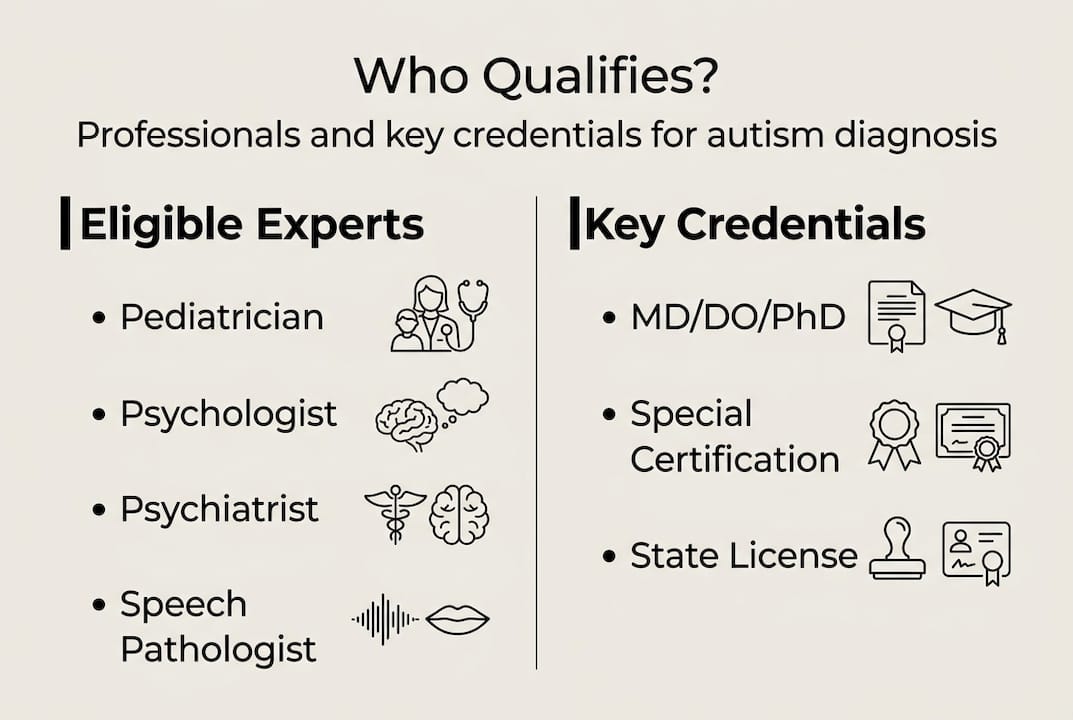
Here are the professionals who can diagnose autism in children:
- Primary care pediatricians: Your child’s regular doctor can diagnose autism, especially in straightforward cases. They are also your first point of contact for screening.
- Developmental pediatricians: Specialists in child development and behavior. They are especially skilled at distinguishing autism from other developmental delays.
- Child psychologists: Trained in behavioral assessment and standardized testing. They use tools like the ADOS-2 to evaluate social communication and behavior.
- Neuropsychologists: Focus on how brain function affects behavior and learning. Useful when cognitive or learning differences are also present.
- Child psychiatrists: Medical doctors who can assess both psychiatric and developmental conditions. They are particularly helpful when co-occurring conditions like anxiety or ADHD are involved.
- Multidisciplinary teams: A group of specialists working together. This is the preferred approach for accuracy, especially when the picture is complex or unclear.
The American Academy of Pediatrics (AAP) recommends that all children be screened for autism at their 18-month and 24-month well-child visits using tools like the M-CHAT-R/F. This is a standardized questionnaire your pediatrician completes with you during a routine visit.
“If you raise concerns about your child’s development and the screening comes back negative, push for a full evaluation anyway. A negative screen does not rule out autism.”
Understanding the full range of autism specialist types available to your family is the first step toward getting a reliable diagnosis. You can also learn more about the role of doctors in autism care to understand how each professional fits into your child’s overall support plan.
Credentials and training: What makes a doctor qualified to evaluate autism?
Not every professional who claims to evaluate autism has the same depth of training. Knowing what credentials to look for protects your child from incomplete or inaccurate assessments.
Here is a breakdown of what each professional type typically brings to the table:
| Professional | Degree required | Training pathway | Certification body |
|---|---|---|---|
| Developmental pediatrician | MD or DO | Pediatric residency plus fellowship in developmental-behavioral pediatrics | American Board of Pediatrics (ABP) |
| Child psychiatrist | MD or DO | General psychiatry residency plus child psychiatry fellowship | ABPN or ABP |
| Child psychologist | PhD or PsyD | Doctoral program plus 1,500 to 6,000 supervised hours and state licensure via EPPP exam | State psychology board |
| Neuropsychologist | PhD or PsyD | Doctoral program plus specialized neuropsychology training and supervised hours | State psychology board |
| Primary care pediatrician | MD or DO | Pediatric residency (3 years) | American Board of Pediatrics |
Both medical and psychology backgrounds are valid pathways to autism evaluation. Do not assume a medical degree is automatically better than a doctoral degree in psychology. Child psychologists often have more hours of direct autism assessment experience than some physicians.
Pro Tip: When you call a new provider’s office, ask directly: “What specific training does this clinician have in autism assessment, and which standardized tools do they use?” A qualified provider will answer this question clearly and confidently.
You can also review autism doctor credentials on our directory to filter providers by specialty and training background.
Autism screening and diagnosis: Evaluations, gold standards, and what to expect
One of the biggest misconceptions parents carry into the process is expecting a blood test or brain scan to confirm autism. There is no such test. Diagnosis is based entirely on behavioral observation, developmental history, and standardized assessment tools.
Here is what the diagnostic process typically looks like, step by step:
- Developmental screening: Your pediatrician uses the M-CHAT-R/F at the 18-month and 24-month visits to flag potential concerns.
- Comprehensive developmental evaluation: A specialist conducts a full assessment of language, cognition, adaptive behavior, and social skills.
- Standardized autism-specific tools: The ADOS-2 (Autism Diagnostic Observation Schedule) and ADI-R (Autism Diagnostic Interview-Revised) are considered gold-standard instruments.
- DSM-5 criteria review: The clinician compares findings against the Diagnostic and Statistical Manual of Mental Disorders, 5th Edition criteria for Autism Spectrum Disorder.
- Parent and caregiver input: Your observations matter enormously. Clinicians rely on detailed developmental history from you.
- Multidisciplinary review: In complex cases, findings are reviewed by a team before a final diagnosis is given.
Here is a quick reference for common tools used in autism evaluation:
| Tool | Type | Who administers it |
|---|---|---|
| M-CHAT-R/F | Screening questionnaire | Pediatrician with parent |
| ADOS-2 | Observational assessment | Trained psychologist or clinician |
| ADI-R | Structured parent interview | Trained clinician |
| Vineland Adaptive Behavior Scales | Adaptive behavior rating | Psychologist or clinician |
While no routine lab tests can diagnose autism, genetic testing may be recommended in some cases. Up to 42% of children with autism may show genetic findings when tested, which can inform medical management even if it does not change the autism diagnosis itself.
Pro Tip: If your child is evaluated and you feel the process felt rushed or incomplete, you have every right to request a second opinion. Early, thorough evaluation leads to better outcomes.
Learn more about what to expect from the full autism screening process so you can walk into every appointment prepared.
US vs. UK approaches: Regional differences in autism diagnosis standards
If you have read advice from UK-based sources or are relocating internationally, you may notice that the diagnostic pathway looks different. Both systems are rigorous, but the structure varies.
| Feature | United States | United Kingdom |
|---|---|---|
| First point of contact | Primary care pediatrician | General practitioner (GP) |
| Screening tools | M-CHAT-R/F at 18 and 24 months | No universal screening; referral based on concern |
| Diagnostic team | Varies; can be single specialist or team | Multidisciplinary autism team required |
| Governing guidelines | AAP, DSM-5 | NICE guidelines, ICD-11 |
| Typical pathway | Pediatrician screens, refers if needed | GP refers to specialist autism team |
In the UK, NICE guidelines require referral to a specialist autism team, and diagnosis must be made by a multidisciplinary group that includes a paediatrician when developmental regression or significant concerns are present. The US model gives more flexibility to individual specialists but still strongly encourages team-based evaluation for complex cases.
Both systems share a core principle: no single professional should rush a diagnosis, and parent input is essential throughout the process.
What parents should ask: Verifying your doctor’s qualifications
You are your child’s strongest advocate. Asking the right questions before and during an evaluation is not rude. It is responsible parenting.
Here are the key questions to ask any provider before moving forward:
- What is your specific training in autism spectrum disorder assessment?
- Which standardized tools do you use, and are you certified to administer the ADOS-2?
- How many autism evaluations do you complete per year?
- Do you work with a multidisciplinary team, or will you refer us if needed?
- How do you incorporate parent observations into your assessment?
- What happens after the diagnosis? Do you provide referrals for therapy and support services?
Watch for red flags too. Be cautious of any provider who promises a diagnosis in a single short visit without gathering developmental history, dismisses your concerns without offering a referral, or claims to diagnose autism using only a questionnaire.
Pro Tip: Bring a written summary of your child’s developmental history to every appointment. Note milestones, any regression, and specific behaviors you have observed at home and in social settings. This saves time and gives the clinician richer data to work with.
Remember, early diagnosis by age 2 is possible and significantly improves long-term outcomes. If your concerns are dismissed, seek a second opinion without hesitation. You can find a list of targeted autism doctor questions to bring to your next appointment.
Find a qualified autism doctor or therapy service near you
Now that you understand who qualifies to diagnose autism and what the process looks like, the next step is finding the right provider for your child. That search does not have to be overwhelming. The Autism Doctor Search Directory gives you access to a carefully curated database of credentialed autism doctors, therapists, and support services across the United States. Whether you are looking for autism therapy services like occupational therapy and play therapy, or need to find ABA therapy options in your area, our directory connects you with vetted providers who meet gold-standard qualifications. You can filter by specialty, location, and service type so you spend less time searching and more time getting your child the support they deserve.
Frequently asked questions
Who can officially diagnose autism in a child?
Pediatricians, developmental pediatricians, psychologists, psychiatrists, and multidisciplinary teams are all qualified to diagnose autism in children. No single specialist holds exclusive authority over this diagnosis.
What credentials should an autism doctor or specialist have?
They should hold an appropriate degree such as MD, DO, PhD, or PsyD, along with state licensure. Child psychiatrists need board certification through ABPN or ABP, while child psychologists must pass the EPPP exam and complete 1,500 to 6,000 supervised hours.
Are medical tests needed to confirm an autism diagnosis?
No single medical or lab test can diagnose autism. Diagnosis relies on behavioral observation and standardized tools, though genetic testing may be recommended in some cases to identify co-occurring conditions.
What should I do if my pediatrician dismisses my autism concerns?
You can request a specialist referral or seek a second opinion. Early diagnosis significantly improves outcomes, so acting on your instincts as a parent is always the right move.
At what age is autism typically diagnosed?
The median earliest diagnosis age is around 47 months, but with expert evaluation, diagnosis is possible as early as age 2. Earlier identification leads to earlier access to therapy and support.