


TL;DR:
- Most autism diagnoses are first noticed by families rather than clinicians. Diagnosis involves a multidisciplinary team using standardized tools like ADOS-2, ADI-R, and CARS-2. Early parental concern and ongoing family involvement are crucial for timely, personalized support.
Most parents are surprised to discover that 70.3% of autism detection is first noticed by families themselves, not by clinicians. Yet after that first moment of concern, families often feel lost about what comes next. Who exactly is on a diagnosis team? What tests will they run? How long does all of this take? These are the questions that keep parents awake at night. This article explains exactly what autism diagnosis teams do, which professionals you will meet, which tools they use, and how you can actively support the process every step of the way so your child gets the most accurate and personalized evaluation possible.
Table of Contents
- Why diagnosis teams are essential in autism care
- Standard tools and methods used by diagnosis teams
- The family’s journey: From first concern to post-diagnosis support
- Overcoming barriers: Improving access and equity in autism diagnosis
- A collaborative approach: Respecting family context and values
- What most families miss about working with diagnosis teams
- Find support: Connect with autism therapy and diagnosis resources
- Frequently asked questions
Key Takeaways
| Point | Details |
|---|---|
| Multidisciplinary teams matter | A team approach brings together various experts to ensure a thorough, accurate autism diagnosis. |
| Standardized tools improve accuracy | Gold-standard assessments like ADOS-2 and ADI-R are key to reliable diagnoses. |
| Parent input is crucial | Diagnosis teams rely on families’ observations and insights to guide and personalize assessments. |
| Barriers can be overcome | Awareness, telehealth, and advocacy help families navigate and speed up the autism diagnostic pathway. |
| Support goes beyond a label | Diagnosis teams often focus on practical supports and family goals, not just the diagnostic outcome. |
Why diagnosis teams are essential in autism care
With the stage set, let’s clarify just why diagnosis teams play such an important part in a child’s autism journey.
Autism is not something a single clinician can diagnose in one office visit. It is a condition that touches language, behavior, social development, sensory processing, and daily functioning all at once. That complexity is exactly why a multidisciplinary team (a group of specialists from different fields working together) is considered the standard of care. No single professional has the full picture on their own.
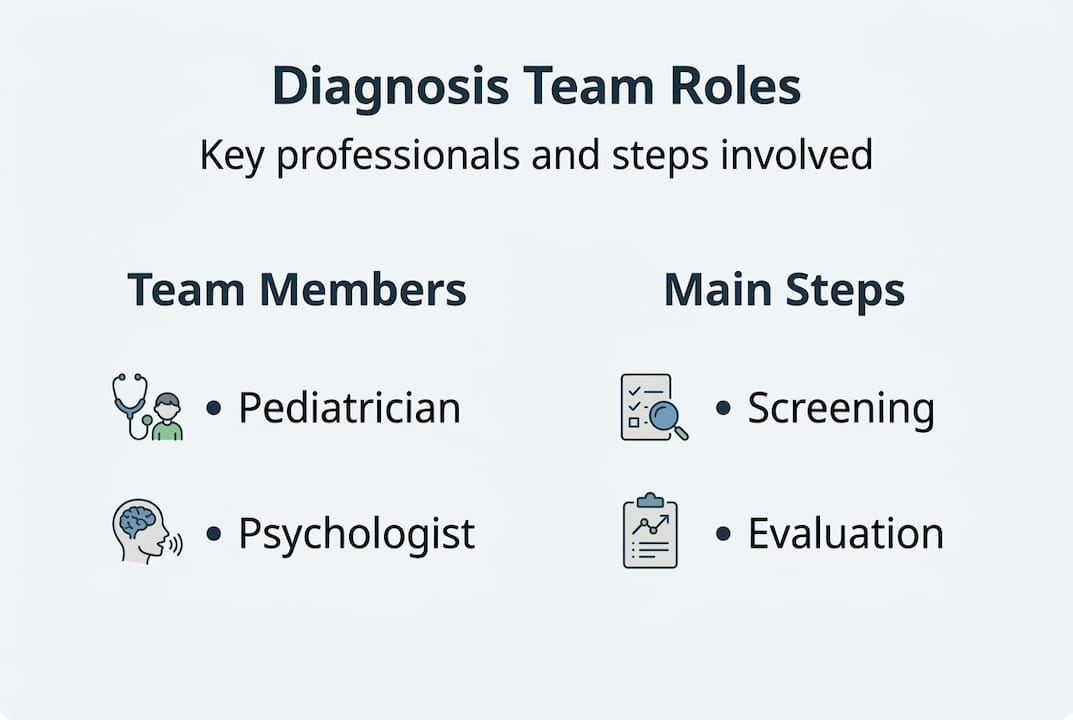
A typical autism diagnosis team includes:
- Developmental pediatrician – evaluates overall development and medical history
- Child psychologist or neuropsychologist – administers standardized cognitive and behavioral assessments
- Speech-language pathologist – assesses language development, communication, and pragmatics (social use of language)
- Occupational therapist – examines sensory processing and daily living skills
- Social worker or care coordinator – helps families access services and navigate the system
- Pediatric neurologist – may be involved when seizure disorders or other neurological concerns are present
What makes this team approach so valuable is coordination. Each specialist brings a different lens, and together they construct a complete picture of your child’s strengths and challenges. A psychologist might observe repetitive behaviors during testing while a speech therapist notices difficulties with conversational turn-taking. Together, those observations support or clarify each other in ways that a single evaluation never could.
NICE guidelines emphasize referral to autism team based on observed signs, symptoms, and parental concern. In plain terms, this means your voice matters. If you raise a concern, it should trigger a referral. You do not need to wait for a teacher or a pediatrician to notice something first.
“The goal of the diagnostic team is not just to attach a label but to understand a child’s unique developmental profile so that the right supports can be put in place as early as possible.”
Once the evaluation is complete, the team produces a written diagnostic report. This document is one of the most important tools you will ever have for your child. It outlines findings, recommendations, and specific support strategies. It is also what schools, insurance companies, and therapy providers typically require before services begin. Understanding autism doctors’ roles within the team can help you know exactly who to contact with follow-up questions. Knowing how to navigate getting autism medical referrals is your first practical step toward starting this process.
Standard tools and methods used by diagnosis teams
Knowing the value of diagnosis teams, it’s helpful to peer inside the methods and tests they use.
The diagnosis process involves standardized tools like ADOS-2, ADI-R, and CARS-2, combined with caregiver interviews, observations, and developmental history. These are not informal checklists. They are rigorously developed instruments built on decades of research. Here is what each one does and why it matters.
| Tool | Full name | Type | Primary use |
|---|---|---|---|
| ADOS-2 | Autism Diagnostic Observation Schedule, 2nd Edition | Structured observation | Directly observes social communication and play |
| ADI-R | Autism Diagnostic Interview, Revised | Parent interview | Gathers detailed developmental history from caregivers |
| CARS-2 | Childhood Autism Rating Scale, 2nd Edition | Rating scale | Rates severity across behavioral domains |
| Vineland-3 | Vineland Adaptive Behavior Scales, 3rd Edition | Caregiver interview | Measures real-world adaptive functioning |
The ADOS-2 is often described as the “gold standard” because it involves a trained clinician directly interacting with your child through structured activities, play, and conversation. It is not a pass-or-fail test. The clinician is watching how your child communicates and responds, not whether they answer questions correctly.
ADOS-2 sensitivity is 83 to 91%, and specificity ranges from 80 to 94% when used alongside the ADI-R. In practical terms, sensitivity measures how well the tool catches true autism cases. Specificity measures how well it avoids false positives. Combining both tools improves accuracy significantly, which is why they are typically used together rather than in isolation.
The ADI-R is a lengthy structured interview conducted with you, the caregiver. A clinician guides you through questions about your child’s development from infancy to the present. This part of the evaluation can take one to three hours. It may feel exhausting, but this is where your first-hand observations become clinical data. Details you share about your child’s early language milestones, play patterns, and social responses are genuinely irreplaceable.

The CARS-2 is a rating scale that pulls observations together into a scored profile, which is especially useful for tracking progress over time.
Pro Tip: Before your child’s evaluation, write down specific examples of behaviors you have observed at home, like unusual responses to sounds, loss of words, or difficulty with eye contact. The more concrete and time-stamped your examples are, the more useful they are to clinicians during the ADI-R interview.
Understanding multidisciplinary autism care helps families see why no single tool is ever used alone. The autism screening process typically begins earlier, before these deeper diagnostic tools are even introduced.
The family’s journey: From first concern to post-diagnosis support
While tools and teams matter, understanding your family’s journey is equally important.
Most families follow a general sequence, though timelines vary widely depending on where you live and what resources are available in your area.
- Well-child screening: The American Academy of Pediatrics (AAP) recommends that all children be screened at 18 and 24 months, with a comprehensive evaluation following a positive screen. Your pediatrician uses a brief screening tool like the M-CHAT-R (Modified Checklist for Autism in Toddlers, Revised) at these visits.
- Parental concern triggers referral: Even if a screen is negative, parental concern alone is a valid reason to request evaluation. Trust your instincts.
- Specialist referral: Your pediatrician refers you to a developmental pediatrician, a child psychologist, or a hospital-based autism diagnostic center.
- Comprehensive evaluation: The multidisciplinary team conducts its full assessment over one or more appointments, using the tools described above.
- Feedback session: The team meets with you to explain findings and answer questions before the written report is finalized.
- Written report and recommendations: You receive a formal document with diagnosis, profile details, and specific next-step recommendations for therapy, school supports, and medical follow-up.
- Connecting to services: You begin accessing ABA therapy, speech therapy, occupational therapy, special education services, and community resources.
A striking data point from a multi-center study shows that language delay is the most commonly reported first concern, appearing in 88.9% of cases. This matters because it means many children first enter the diagnostic pathway through speech evaluations, not autism-specific screenings.
| Stage | Who is involved | Typical timeline |
|---|---|---|
| Initial screening | Pediatrician | 18 and 24 months |
| Referral to specialists | Pediatrician, family | Weeks to months |
| Diagnostic evaluation | Multidisciplinary team | 2 to 6 months wait |
| Report and feedback | Full team | 2 to 4 weeks after evaluation |
| Service connection | Care coordinator, family | Ongoing |
Pro Tip: Keep a dedicated folder (physical or digital) for all evaluation paperwork, screening results, and written reports. Schools and therapy providers will ask for these documents repeatedly, and having them organized saves considerable stress.
Knowing what autism screening guidelines recommend helps you advocate confidently with your child’s pediatrician. After diagnosis, navigating autism services becomes the next critical skill to develop.
Overcoming barriers: Improving access and equity in autism diagnosis
Given the steps involved, many families run into obstacles. Let’s look at the most common and how to get around them.
Barriers to timely diagnosis include parental awareness, resource shortages, and systemic gaps, but strategies like education, telehealth, and awareness campaigns are actively helping families close those gaps.
The most frequently cited obstacles include:
- Long wait times for specialist appointments, sometimes stretching six months to over a year
- Geographic barriers in rural or underserved communities where diagnostic specialists are scarce
- Cultural and language barriers that can affect how families describe symptoms or interpret professional recommendations
- Financial barriers including limited insurance coverage for comprehensive evaluations
- Parental awareness gaps where families do not yet know that what they are observing may warrant an autism evaluation
“Awareness is the first intervention. A parent who knows what early signs look like is far more likely to seek help at the age when early support makes the most difference.”
Telehealth has become a meaningful bridge in recent years. Remote interviews and even modified versions of observational assessments are now available through some diagnostic centers. While telehealth cannot fully replace in-person evaluation, it can accelerate the initial steps and expand access for families who live far from specialists.
Community outreach and parent education programs are also showing strong results. When parents understand developmental milestones and recognize early signs of autism, referrals happen sooner and children reach diagnosis at younger ages. This matters enormously because early intervention is among the most powerful predictors of long-term outcomes.
Building communication support for autism alongside the diagnostic process is a practical way families can support their child during what can be a lengthy wait. Exploring evidence-based autism strategies while you wait for an evaluation gives you tools to support your child right now, not just after a formal diagnosis.
A collaborative approach: Respecting family context and values
Finally, it’s important to consider how diagnosis teams can and should adapt to your family’s needs.
Not every family approaches diagnosis the same way. Cultural values, family structure, language background, and past experiences with healthcare systems all shape how families experience and interpret the diagnostic process. The best diagnosis teams understand this and adjust accordingly.
A collaborative, nondiagnosis-focused approach considers family context, cultural values, and may even withhold a formal diagnostic label in cases where it would not be helpful, focusing instead on functional support. This is not about avoiding the truth. It is about recognizing that a label is only as valuable as the support it unlocks, and sometimes functional support can be delivered without one.
Key principles of a collaborative diagnostic approach include:
- Transparency – teams share findings in plain language, not just clinical jargon
- Shared decision-making – families are active partners, not passive recipients of information
- Cultural responsiveness – teams use interpreters when needed and adapt explanations to family values and communication styles
- Flexibility – when a formal diagnosis is not yet possible or not immediately helpful, teams focus on building support structures
- Ongoing communication – diagnosis is not the end of the relationship; teams remain available as your child grows and needs change
“A great diagnosis team does not hand you a report and disappear. They help you understand what it means and what to do next.”
Accessing autism care for families means finding teams that truly practice these values, not just describe them. When your diagnostic team listens, explains, and follows up, outcomes improve measurably for children and for the whole family system.
What most families miss about working with diagnosis teams
Here is an honest perspective grounded in real family experiences.
Most families enter the diagnostic process focused entirely on one question: does my child have autism? That is completely understandable. But it can cause families to mentally “check out” after the diagnosis is confirmed, treating the team as a one-time resource rather than an ongoing partner.
The families who see the best outcomes are the ones who treat their diagnosis team as a long-term relationship. They share observations from home between appointments. They come to follow-up meetings with specific questions. They ask for the written report to be explained in plain terms and request addendums when their child’s needs evolve. They also advocate for additional evaluations when something feels incomplete. If a report does not address sensory needs or academic accommodations, ask for it.
You are not obligated to accept a report that does not fully reflect your child. Getting the right referrals is sometimes an iterative process, not a one-time event. The most useful mindset shift is this: the diagnosis is the beginning of the conversation, not the end of it.
Find support: Connect with autism therapy and diagnosis resources
Ready to take the next steps toward effective support? Here’s where you can start.
At Autism Doctor Search, we have built the most complete and current directory of autism resources to help your family move from confusion to confident action. Whether you are looking for autism therapy services in your area, exploring ABA therapy providers, or simply trying to find the right specialists to start the diagnostic process, our directory makes it easier to locate vetted, high-quality support at every stage. Find autism specialists near you and connect with the professionals who can help your child thrive from diagnosis through ongoing care.
Frequently asked questions
Who are the members of an autism diagnosis team?
Diagnosis teams typically include pediatricians, psychologists, speech-language pathologists, occupational therapists, and sometimes social workers or neurologists. The diagnosis process combines their expertise using standardized tools, caregiver interviews, and direct observation.
What is the typical process for autism diagnosis?
Most children are screened at 18 and 24 months, then referred for a comprehensive evaluation if concerns arise. AAP screening guidelines recommend this timeline to catch developmental differences as early as possible.
How accurate are autism diagnostic tools like ADOS-2?
ADOS-2 shows sensitivity of 83 to 91% and specificity of 80 to 94% when used alongside complementary assessments like the ADI-R.
What should families do if they experience delays in getting a diagnosis?
Families can seek parent education resources, use telehealth services, and formally request specialist referrals to move the process forward. Resource shortages and awareness gaps are real barriers, but knowing your options helps you navigate around them.
Is getting an autism diagnosis always necessary for services?
Not always. A collaborative nondiagnosis approach may be appropriate when functional needs are documented and services can be accessed through other pathways, depending on your state and school district policies.


