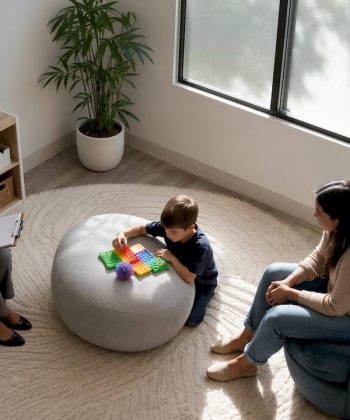
The most effective preschool autism activities share three qualities: they are sensory-friendly, built around a child’s individual interests, and structured enough to reduce anxiety while maintaining spontaneity. Whether you are a parent, a preschool teacher, or a therapist, the activities that actually move the needle combine play-based learning with clear visual supports and predictable routines. This guide covers the full range, from social skills games and sensory bins to communication strategies like the 6-second rule, so you can pick what fits your child right now.
Key activity categories at a glance:
- Social skills: emotion cards, turn-taking games, the Name Game, role-play scenarios
- Sensory-friendly play: tactile bins, slime experiments, obstacle courses, fidget tools
- Communication supports: picture schedules, communication boards, visual task checklists
- Fine and gross motor: snack sorting, art and craft projects, movement-based activities
- Early intervention: parent-coaching models, individualized play routines, daily living practice
What makes preschool autism activities work?
The single biggest predictor of whether an activity succeeds is whether it matches the child’s sensory profile and current developmental level. A child who is hypersensitive to texture will not engage with a slime station the same way a sensory-seeking child will. Start by observing what the child gravitates toward and what triggers withdrawal or distress, then build from there.
Individualization is not just a best practice. A randomized controlled trial of the Early Social Interaction model found that toddlers who received intensive, individualized intervention at 18 months made gains of nearly one standard deviation in receptive and expressive language compared to those who started the same program at 27 months. The window matters, and so does the fit.
Visual supports and consistent routines are the structural backbone of any activity plan. Picture schedules and clear boundaries help children anticipate transitions and understand expectations far more reliably than verbal instructions alone. Pair every new activity with a visual cue, and you will see less resistance at transitions.
1. Emotion cards and feeling recognition games
Emotion cards are one of the most practical social skills tools available for autistic preschoolers. Each card shows a facial expression tied to a specific feeling, such as happy, sad, angry, or surprised. Children practice matching expressions, naming feelings, and eventually connecting those feelings to situations they recognize from their own day.
Start with just two or three emotions and add more as the child builds confidence. Puppets work well here too. A child who resists direct eye contact will often engage freely with a puppet, making puppetry an underused bridge for emotion recognition in early childhood autism skills work.
Pro Tip: Tie emotion cards to the child’s favorite characters. If a child loves a particular cartoon, print emotion cards featuring those characters. Familiarity lowers the entry barrier and keeps attention longer.
2. Turn-taking and cooperative group games
Turn-taking is one of the hardest social concepts for autistic preschoolers to internalize, partly because waiting feels abstract. Make it concrete by using a physical object, like a talking stick or a special toy, that signals whose turn it is. The child holding the object speaks or acts; everyone else waits.
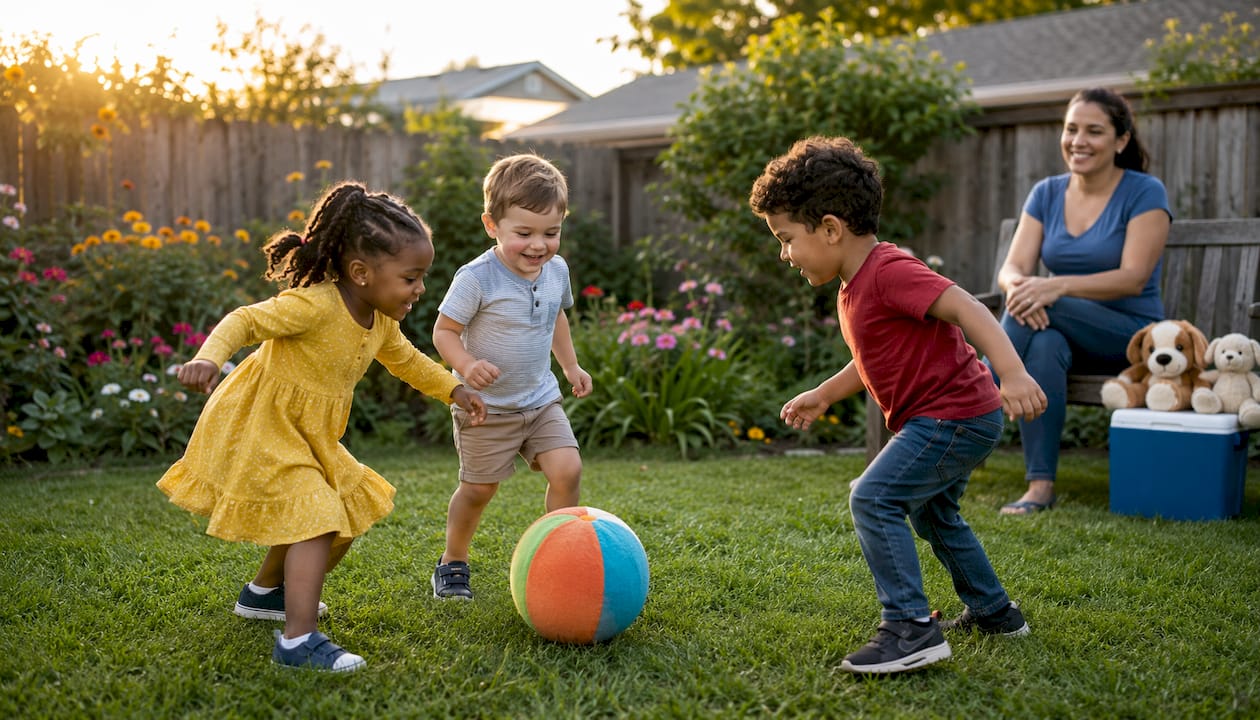
Simple games like rolling a ball back and forth, building a block tower one piece at a time, or passing a beanbag in a circle all teach sharing and cooperation without requiring complex language. Descriptive praise reinforces the behavior immediately: “I noticed you waited for your friend’s turn” lands better than a generic “good job.”
Incorporate the child’s special interests to boost buy-in. If a child loves trains, a turn-taking game where each player adds a train car to a track gives the same social practice wrapped in something motivating.
3. Role-play and the “What Would You Do?” game
Role-play gives autistic preschoolers a low-stakes space to rehearse social scenarios before they encounter them in real life. Set up simple situations: a friend wants to use the same toy, someone falls down and looks sad, or it is time to say goodbye at the end of the day. Walk through each scenario with puppets, dolls, or direct acting.
The “What Would You Do?” game extends this by presenting hypothetical situations and asking children how they would respond. It builds problem-solving and empathy at the same time. Keep scenarios short and concrete. Abstract moral dilemmas are too far ahead; focus on situations the child actually faces at preschool.
Step-by-step scaffolding matters here:
- Model the scenario yourself first.
- Walk through it together with the child.
- Let the child try with a prompt available.
- Fade the prompt over repeated practice.
4. The Name Game for building peer connection
The Name Game is deceptively simple and genuinely effective for preschool social skills games. Children sit in a circle, and each child says their name while doing a short action, like clapping or jumping. The group repeats the name and the action together. It builds name recognition, comfort in group settings, and a sense of belonging.
For children who are not yet verbal, the action itself becomes the contribution. A child can wave, stomp, or spin, and the group mirrors it back. That moment of being seen and repeated by peers is meaningful, even without words.
5. Sensory bins for tactile exploration
Sensory bins are containers filled with materials like rice, kinetic sand, water beads, or dried pasta. Children dig, pour, scoop, and sort, engaging their tactile and proprioceptive senses in a controlled way. The sensory exploration these bins provide supports emotional regulation and helps children build tolerance for different textures over time.
Customize the bin to the child’s profile. A child who is tactile-defensive might start with dry rice before moving to wet sand. A sensory-seeking child might prefer water beads or shaving cream. Adding small themed objects, like dinosaurs for a child who loves them, layers in language and imaginative play.
Materials checklist:
- Dry rice, sand, or water beads as the base
- Small scoops, cups, and funnels for pouring
- Themed miniatures tied to the child’s interests
- A plastic tray underneath to contain spills
6. Slime and dough for fine motor and sensory regulation
Slime and playdough are among the most versatile preschool sensory activities available. The repetitive squeezing, stretching, and rolling motions build fine motor skills while providing deep pressure input that many autistic children find calming. Making slime from scratch adds a simple science element and gives children a sense of control over the outcome.

For children with tactile sensitivities, start with tools rather than bare hands. A rolling pin or cookie cutter lets a child engage with dough without direct skin contact, and you can gradually introduce hand contact as comfort grows. Sensory play benefits extend well beyond the activity itself, supporting attention, self-regulation, and even language development through narration during play.
7. Movement-based obstacle courses
Obstacle courses address gross motor development and sensory processing at the same time. Set up a simple course using couch cushions to crawl over, a balance beam made from tape on the floor, and a tunnel to crawl through. The proprioceptive and vestibular input from climbing, crawling, and balancing helps children regulate their nervous systems before or after more demanding cognitive tasks.
Keep the course predictable at first. Use picture cards at each station so the child knows what comes next. Once the sequence is familiar, you can introduce small variations to build flexibility. This is also a natural context for practicing turn-taking if multiple children are involved.
8. Fidget tools and calming sensory stations
Designated quiet zones with calming tools like weighted blankets, noise-canceling headphones, and fidget toys give children a place to self-regulate without feeling singled out. The key is framing: the quiet corner is a resource, not a consequence. Children should be able to choose it, not just be sent there.
Fidget tools, including stress balls, textured rings, and pop-it toys, give children a productive outlet for sensory needs during seated activities. The repetitive tactile feedback helps many children maintain focus during circle time or group instruction. Rotate the tools periodically to maintain novelty.
9. Snack sorting for fine motor and sensory integration
Sorting snacks by color, shape, or size turns an everyday routine into a developmental activity. A child sorting crackers by shape practices fine motor control, visual discrimination, and categorization simultaneously. It is also a natural context for language: naming colors, counting pieces, and describing textures.
This activity works well as a transition activity between more demanding tasks. It is familiar, low-pressure, and gives children a clear endpoint. For children working on fine motor skills, using tongs or tweezers to sort adds an extra layer of hand strength practice.
10. Art and creative expression activities
Art activities give nonverbal and minimally verbal children a channel for self-expression that does not depend on spoken language. Finger painting, collage, and stamping all develop fine motor control while allowing children to communicate preferences, moods, and ideas through color and form. Creative play for autism does not need to produce a finished product; the process is the point.
Offer limited, clear choices rather than an open-ended “make whatever you want.” Two paint colors, two stamp shapes, or two types of paper keeps the decision simple and reduces the anxiety that can come with too many options. Display the child’s work prominently. Seeing their creation valued builds confidence and a sense of identity.
11. Music and movement for language and engagement
Music is one of the most reliable engagement tools for autistic preschoolers. Many children who speak very few words can sing along to familiar songs, a phenomenon that reflects how differently music is processed in the brain compared to speech. Songs with repetitive phrases and predictable rhythms, like “Wheels on the Bus” or call-and-response songs, support language development through pattern and repetition.
Movement paired with music, like dancing, clapping rhythms, or playing simple percussion instruments, adds proprioceptive input and makes the activity multisensory. For children who are reluctant to join group activities, music often lowers the barrier because participation can be as minimal as tapping a foot.
How to use teaching strategies and communication supports effectively
The way you deliver an instruction matters as much as the instruction itself. Many behaviors that look like defiance in autistic preschoolers actually stem from communication challenges. A child who does not respond to a verbal direction may simply not have processed it yet.
The 6-second rule addresses this directly. After giving an instruction, wait silently for at least six seconds before repeating or rephrasing. Adding new words during that window forces the child to restart comprehension from the beginning, which reduces the chance of a successful response. Some children need up to 8–10 seconds during moments of dysregulation or high noise.
Pro Tip: The 6-second pause benefits you as much as the child. Waiting aligns with the body’s cortisol peak timing, which means you are also less likely to escalate reactively. It is a co-regulation strategy for both of you.
Key communication strategies for parents and educators:
- Pair every verbal instruction with a visual support, such as a picture card or gesture.
- Use the fewest words possible. “Shoes on” works better than “Can you please put your shoes on now?”
- Deliver instructions in a calm, even tone. Loud or frustrated tones increase behavioral escalation.
- Break tasks into steps using visual checklists so children can follow along independently.
- Use consistent routines with image-based schedule boards to reduce transition anxiety.
- Give two concrete choices rather than open-ended questions to support decision-making.
Why early intervention changes outcomes for autistic preschoolers
Starting structured, individualized activities early produces measurably better results than waiting. The Early Social Interaction RCT found that toddlers who began intensive, individualized intervention at 18 months showed improvement of nearly one standard deviation in receptive and expressive language compared to those starting at 27 months. That gap, produced by a difference of just nine months, underscores how much the early years matter.
Research finding: Children who began individualized intervention at 18 months showed gains of nearly one standard deviation in receptive and expressive language compared to those starting at 27 months, per a randomized controlled trial of the Early Social Interaction model.
Early activities support multiple developmental domains at once:
- Language: Repetitive songs, picture communication boards, and narrated play build vocabulary and comprehension.
- Social skills: Turn-taking games and emotion recognition activities lay the groundwork for peer relationships.
- Sensory processing: Regular exposure to controlled sensory experiences builds tolerance and self-regulation capacity.
- Daily living skills: Embedding practice into routines like hand washing and snack time generalizes skills to real contexts.
- Fine and gross motor: Art, dough, obstacle courses, and sorting activities build the physical foundations for writing and self-care.
The NICHD and other federal health bodies consistently identify early intervention as one of the most effective supports available for children on the autism spectrum. Starting before age three, when brain plasticity is highest, gives activities the best chance of producing lasting change.
Trusted resources for autism therapy and support
Finding the right professional support is as important as choosing the right activities. A few key resources worth knowing:
- Applied Behavior Analysis (ABA) therapy: ABA remains one of the most researched interventions for autism, targeting communication, social skills, and adaptive behavior through structured, data-driven sessions. The autism therapy services directory at Autismdoctorsearch lists vetted ABA providers across the United States.
- Occupational therapy (OT): OT practitioners specialize in sensory integration and fine motor development, making them natural partners for the sensory activities described throughout this guide.
- Special education programs: Inclusive preschool classrooms with trained special education staff provide structured social learning alongside typically developing peers. Autismdoctorsearch maintains a directory of special education schools for families navigating placement decisions.
- The National Institute of Mental Health (NIMH): Publishes updated, evidence-based information on autism spectrum disorder at nimh.nih.gov.
- The CDC’s autism data and resources: The CDC tracks autism prevalence and publishes free screening and early identification tools at cdc.gov/autism.
- Autismdoctorsearch: The Autismdoctorsearch directory connects families with ABA therapists, occupational therapists, mental health services, child care providers, and special education schools across the country. Use it to find specialists in your area who work specifically with preschool-aged children.
Collaboration between caregivers, educators, and specialists produces the most consistent outcomes. When the strategies used at home match those used in the classroom and therapy room, children do not have to relearn expectations in every new context.
Key Takeaways
Play-based, sensory-friendly preschool autism activities, when started early and individualized to the child’s profile, produce the strongest gains in language, social skills, and self-regulation.
| Point | Details |
|---|---|
| Start early | Individualized intervention starting earlier in toddlerhood produces substantially more language gain than beginning later during this period. |
| Use visual supports | Picture schedules and communication boards reduce anxiety and improve task completion better than verbal instructions alone. |
| Apply the 6-second rule | Wait silently after giving an instruction; adding words during processing forces the child to restart comprehension. |
| Match activities to sensory profile | Tailor tactile, movement, and auditory activities to each child’s sensitivities before introducing new materials. |
| Align home and classroom strategies | Consistent approaches across caregivers, educators, and therapists prevent children from having to relearn expectations in each setting. |