
TL;DR:
- Verify autism doctor credentials through recognized medical boards and independent verification tools.
- Check that behavior analysts are certified by the BACB and active in the registry.
- Be cautious of unqualified providers with vague titles or unverifiable claims, prioritizing credential transparency.
Choosing someone to care for your child with autism is one of the most important decisions you’ll make. The problem is that the internet is full of providers using impressive-sounding titles that nobody actually regulates. A parent might assume a doctor labeled an “autism specialist” has gone through special certification, only to discover later the title means nothing legally. These gaps in understanding can lead to delayed diagnoses, wasted money, or worse, ineffective or harmful interventions. This guide walks you through every step of verifying autism doctor credentials so you can make fully informed, confident choices for your child.
Table of Contents
- Understanding autism doctor roles and credentials
- How to verify physician credentials for autism care
- Verifying behavioral therapist and BCBA credentials
- Spotting and avoiding unqualified autism providers
- Why credential checks are more vital than ever for autism care
- How Autism Doctor Search can help you verify autism specialists
- Frequently asked questions
Key Takeaways
| Point | Details |
|---|---|
| Always verify credentials | Only use official board or registry tools to check any autism provider’s qualifications. |
| Beware of titles alone | Terms like ‘autism coach’ are unregulated—look for certification numbers and board listings. |
| Use the right resources | ABMS and BACB are the authoritative sources for medical and behavioral autism provider verification. |
| Check for autism experience | Credentialed providers should have specific autism training, publications, or affiliations. |
Understanding autism doctor roles and credentials
With parents and caregivers looking to protect their children, it’s crucial to first understand which professionals are truly qualified to diagnose and treat autism.
Here’s something that surprises many families: no single license exists for the title “autism doctor.” This means anyone can technically call themselves an autism specialist without formal certification specific to autism. What you should look for instead are credentials within recognized medical and behavioral fields, combined with documented autism-specific experience.
The professionals most commonly involved in autism diagnosis and treatment include:
- Developmental pediatricians: Physicians specializing in child development disorders, including autism spectrum disorder (ASD)
- Child neurologists: Doctors focused on brain and nervous system conditions in children
- Child psychologists: Mental health professionals who conduct autism evaluations and behavioral assessments
- Board Certified Behavior Analysts (BCBAs): Specialists in applied behavior analysis (ABA) therapy, one of the most widely used autism interventions
- Speech and occupational therapists: Often part of a broader autism care team, though their credentials are managed by separate licensing boards
Knowing which role you are evaluating matters because each professional type has a different credentialing process. Checking autism doctor qualifications helps you ask the right questions for each type of provider.
Here is a quick comparison of the main provider types:
| Provider type | Key credential | Licensing body |
|---|---|---|
| Developmental pediatrician | Board certification | American Board of Pediatrics |
| Child neurologist | Board certification | American Board of Psychiatry and Neurology |
| Child psychologist | State licensure + doctoral degree | State psychology boards |
| BCBA | BCBA certification | Behavior Analyst Certification Board (BACB) |
| Occupational therapist | State licensure | State OT licensing boards |
Beyond base credentials, look for autism-specific experience. Ask providers about their training with AAP-endorsed screening tools, including the M-CHAT screener, which is a standard early autism detection tool used by qualified pediatricians. Professional affiliations, peer-reviewed publications, and membership in autism-focused organizations are also meaningful signals.
“The more specific a provider’s autism experience, the better. A credential alone tells you someone met a standard. Their autism-focused history tells you they’ve actually done the work.”
For a fuller breakdown of all provider types, the guide to autism specialist types is an excellent next step.
How to verify physician credentials for autism care
Once you know the roles involved, it’s time to dig into how to confirm a physician’s legitimacy.
Board certification is the gold standard for physician credentialing. It means a doctor passed a rigorous evaluation beyond basic medical licensure. But here’s the catch: website bios and printed brochures often list certifications that have lapsed or were never verified. Self-reported claims on websites can be outdated, so always use third-party verification tools.
The American Board of Medical Specialties (ABMS) runs Certification Matters, the official tool for checking physician board certification. It covers 24 specialty boards and over 1 million certified physicians. If a doctor’s name does not appear there with an active certification, that is a significant red flag.
Here is a step-by-step process to verify any autism-related physician:
- Identify the physician’s specialty. Is this a developmental pediatrician, child neurologist, or child psychiatrist? Knowing the specialty helps you select the right board on the ABMS site.
- Visit ABMS Certification Matters. Go to certificationmatters.org and search by the provider’s name. Confirm their listed specialty matches what they told you.
- Check certification status and dates. Active certification should be current. Expired certification is a warning sign.
- Search your state’s medical board. Every state has an online license verification tool. This check reveals disciplinary actions, license suspensions, or complaints.
- Look up any malpractice or disciplinary history. The Federation of State Medical Boards also maintains a public physician data system.
Here is a quick reference guide for credential verification tools:
| What to check | Where to check |
|---|---|
| Board certification | certificationmatters.org |
| State medical license | Your state’s medical board website |
| Disciplinary history | FSMB.org physician data center |
| Autism-specific training | Provider’s CV or academic publications |
Pro Tip: When you call a physician’s office to schedule an appointment, ask directly: “Can you tell me what board certifications Dr. [Name] holds, and are they currently active?” A qualified office will answer confidently. Hesitation or vague answers are worth noting.
For a full physician credential checklist you can print and bring to consultations, that resource covers everything in one place.
Verifying behavioral therapist and BCBA credentials
Physicians aren’t the only crucial providers. Next, you’ll need to know how to check the credentials of popular autism therapists: behavior analysts.
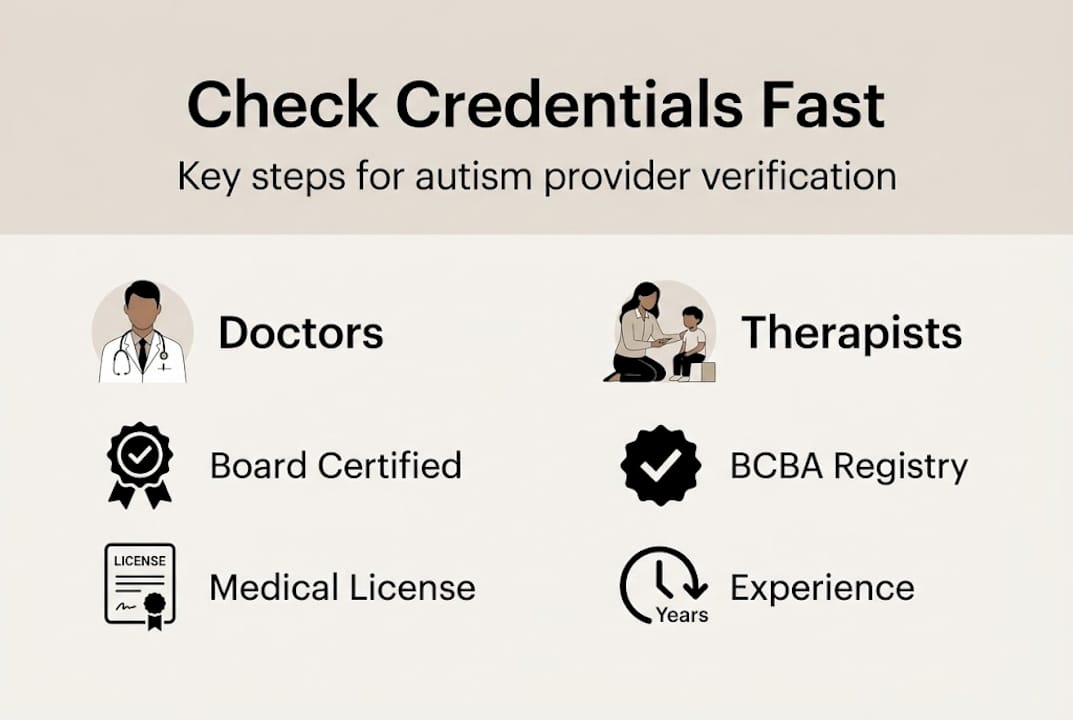
ABA therapy is one of the most researched and widely used interventions for autism. The professionals who deliver it are called Board Certified Behavior Analysts, or BCBAs. Becoming a BCBA is rigorous: it requires a graduate degree, 1,500 to 2,000 or more hours of supervised fieldwork, and passing a national certification exam. A lower-level credential, the Board Certified Assistant Behavior Analyst (BCaBA), requires less training and works under BCBA supervision.
The Behavior Analyst Certification Board (BACB) maintains a public registry where you can verify BCBA credentials in real time. Here’s how:
- Go to the BACB certificant registry at bacb.com.
- Search by the provider’s name or their certificate number if they provided it.
- Review the result carefully. The registry shows certification type, active or inactive status, certification expiration date, and any disciplinary actions on record.
- Confirm the credential type. A BCBA and a BCaBA have different scopes of practice. Know which one you’re working with.
- Ask if they carry liability insurance. While not always required, it reflects professional accountability.
Here are red flags that should make you pause:
- A provider calls themselves an “autism coach” with no verifiable license or certification number
- They cannot or will not give you a BACB certificate number to verify
- Their credentials are described only in vague terms like “trained in autism” or “experienced specialist”
- They claim to offer ABA therapy but have no BCBA overseeing the sessions
Pro Tip: Ask the provider directly, “Are you listed on the BACB registry, and can I have your certificate number?” A legitimate BCBA will give you this immediately without hesitation.
For more information on finding qualified therapists in your area, the resource on autism behavioral therapists is a reliable starting point. You can also review information on behavioral certification verification to understand how certification bodies operate.
Spotting and avoiding unqualified autism providers
With these steps in hand, it’s critical to stay alert to misleading or false credentials that could put your child at risk.
The rise of social media and online therapy platforms has made it easier than ever for unqualified individuals to market themselves as autism experts. Because there is no single protected title for “autism specialist,” almost anyone can use it. Self-reported claims on websites may be outdated or simply inaccurate, making third-party verification non-negotiable.
Use this checklist before trusting any autism provider:
- Ask for their license or certification number. Every legitimate provider should have one.
- Verify it independently. Do not take a printed copy as proof. Use official board or registry tools yourself.
- Look up their disciplinary history. Both the ABMS and BACB publish this publicly.
- Check their autism-specific experience. How many years have they worked with autistic children? What age ranges and severity levels have they treated?
- Review their professional affiliations. Membership in bodies like the Association for Behavior Analysis International or the American Academy of Pediatrics suggests active engagement with the professional community.
- Be skeptical of guarantees. Legitimate providers do not promise cures or guaranteed results.
Titles to watch out for include “autism coach,” “holistic autism guru,” “neurodevelopmental healer,” and similar terms that have no regulatory definition. Some of these individuals may have good intentions, but good intentions do not replace clinical training.
“If a provider gets defensive or vague when you ask to verify their credentials, treat that as your answer.”
For a closer look at what a genuine coaching relationship looks like versus unproven claims, the article on the difference between real coaches and unproven claims offers clear, grounded context.
Why credential checks are more vital than ever for autism care
Here is the uncomfortable reality: the online wellness industry has made it remarkably easy to project expertise without earning it. In 2026, a single website and a few testimonials can make an unqualified provider look indistinguishable from a board-certified specialist. Families navigating an autism diagnosis are often overwhelmed, moving fast, and emotionally vulnerable. That combination makes them a target.
From our experience at Autism Doctor Search, we’ve seen families spend months in ineffective therapy with providers who were not qualified to deliver it. The child lost critical early intervention time. The family lost trust and money. And the intervention gap made future care harder. None of this would have happened if credential verification had been part of the first step.
Here’s what we know to be true: qualified providers welcome your questions. A board-certified developmental pediatrician will not flinch when you ask for their ABMS certification number. A credentialed BCBA will hand you their BACB ID without hesitation. When a provider is defensive, evasive, or frames credential questions as an insult, that tells you everything.
Vigilance is not paranoia. It is a parent’s most powerful tool. Credential verification takes less than 30 minutes and can prevent years of harm. Families who take this step also tend to build stronger, more trusting relationships with their providers because the foundation is solid from day one. Reviewing your options for navigating specialist choices before your first appointment puts you in the strongest possible position.
How Autism Doctor Search can help you verify autism specialists
Having a reliable verification system is key, and that’s exactly what the Autism Doctor Search directory is built for. Our Autism Doctor Search directory connects families with vetted professionals across a wide range of autism care services, including ABA therapy, medical clinics, mental health services, occupational therapists, and special education schools. Every listing is designed to give you transparent, up-to-date information so you spend less time second-guessing and more time getting your child the right support. Whether you’re looking for a behavioral therapy center like The Missing Piece ABA Therapy or broader support through Autism Therapy Services, our directory gives you a clear starting point with peace of mind built in.
Frequently asked questions
How do I check if an autism doctor is board certified?
Visit ABMS Certification Matters and enter the doctor’s name to confirm their current board certification status and specialty. Always verify directly rather than relying on what their website says.
How can I verify a BCBA’s credentials?
Use the official BACB registry to search by the provider’s name or certificate number, and confirm their certification is active and in good standing.
What should I do if a provider claims to be an ‘autism coach’?
Ask for formal credentials and a verifiable license or registry number. “Autism coach” is not a regulated title, so you need to dig deeper to confirm any real qualifications, as the BACB emphasizes the importance of distinguishing certified analysts from unregulated claims.
What are the most important credentials for autism doctors?
Look for board certification in developmental pediatrics, child neurology, or psychology from a recognized ABMS board, along with documented autism-specific experience, using AAP-recommended screening tools.
Can therapists without certification provide autism care?
Some therapy roles have their own licensing requirements, but for behavioral therapy specifically, always confirm BCBA or BCaBA certification through the BACB registry before beginning any ABA-based program.