


TL;DR:
- Clinical psychologists play a central role in autism assessment and personalized treatment planning.
- They diagnose autism using standardized tools and translate findings into practical family guidance.
- Early, ongoing involvement of psychologists benefits children’s long-term communication, behavior, and mental health.
Many families assume clinical psychologists only treat anxiety or depression in adults. That misconception can delay critical support for children on the autism spectrum. Clinical psychologists actually play a central, hands-on role in autism care, from the very first assessment to long-term treatment planning. They work alongside behavioral therapists, occupational therapists, and medical teams to give your child the most complete support possible. This article walks you through exactly what a clinical psychologist does in autism care, what the diagnostic process looks like, how therapy is personalized, and why including the whole family makes a real difference.
Table of Contents
- Understanding the unique role of clinical psychologists in autism
- How clinical psychologists diagnose autism: From assessment to feedback
- Therapeutic interventions: How clinical psychologists tailor treatment for children with autism
- Supporting the whole family: Collaboration and remote care
- A fresh perspective: What most families overlook about clinical psychologists in autism care
- Find trusted clinical psychologists and autism support near you
- Frequently asked questions
Key Takeaways
| Point | Details |
|---|---|
| Early diagnosis matters | Clinical psychologists can identify autism early, leading to better outcomes. |
| Individualized treatment | Therapy plans are tailored to each child’s strengths, challenges, and family situation. |
| Family-focused support | Clinical psychologists include parents and siblings in the care process and use remote tools to increase accessibility. |
| Ongoing collaboration | Working closely with psychologists ensures therapy remains responsive to your child’s changing needs. |
Understanding the unique role of clinical psychologists in autism
A clinical psychologist is a doctoral-level mental health professional trained in psychological assessment, diagnosis, and therapy. They are not the same as a behavioral therapist, psychiatrist, or counselor, though they often work closely with all of these professionals. What sets them apart is their deep training in psychological testing and their ability to connect emotional, cognitive, and behavioral patterns into one clear picture of a child’s needs.
In autism care specifically, clinical psychologists bring a rare combination of skills. They assess how a child processes the world, identify co-occurring conditions like anxiety or ADHD, and develop treatment strategies grounded in research. They also play a coordinating role, sharing findings with teachers, pediatricians, and therapists to keep everyone aligned.
“Clinical psychologists offer evidence-based, individualized assessment and intervention, making them a cornerstone of effective autism care teams.”
Below is a quick comparison to help clarify the differences between common autism care specialists:
| Specialist | Core focus | Can diagnose autism? | Prescribes medication? |
|---|---|---|---|
| Clinical psychologist | Assessment, diagnosis, therapy | Yes | No |
| Behavioral therapist | Skill-building, ABA | No | No |
| Psychiatrist | Medication management | Yes | Yes |
| Occupational therapist | Sensory and daily living skills | No | No |
Many families explore autism remediation programs and wonder where to start. A clinical psychologist is often the right first stop because they can map out a full picture before recommending specific interventions. This prevents families from spending time and money on programs that may not fit their child’s actual profile.
Because clinical psychologists sit at the intersection of science and real-world family life, they bring something unique to the table. Their work is not just about tests and reports. It is about translating complex findings into practical steps your family can actually use.
How clinical psychologists diagnose autism: From assessment to feedback
The autism diagnostic process can feel overwhelming for families, especially when you are not sure what to expect. Clinical psychologists follow a structured, multi-step process designed to be thorough and accurate.
Here is a general timeline of what the process looks like:
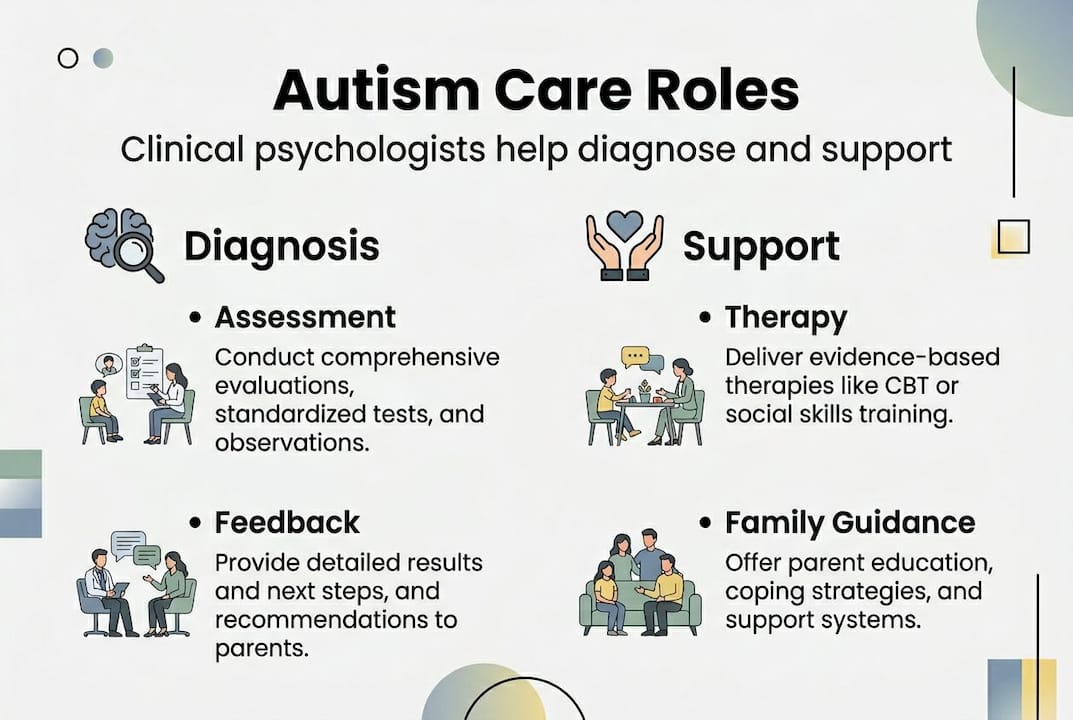
- Initial intake interview: The psychologist gathers detailed history from parents and caregivers, covering developmental milestones, behavior patterns, school experiences, and family concerns.
- Standardized assessments: Tools like the ADOS-2 (Autism Diagnostic Observation Schedule) and ADI-R (Autism Diagnostic Interview-Revised) are used to observe and measure specific behaviors associated with autism.
- Cognitive and adaptive testing: Additional tests may assess intelligence, language, memory, and daily living skills.
- Behavioral observation: The psychologist directly observes the child during structured and unstructured activities.
- Collateral information: Reports from teachers, therapists, or pediatricians are reviewed to complete the picture.
- Feedback session: The psychologist meets with the family to explain findings, deliver the diagnosis if appropriate, and outline recommended next steps.
One of the most important parts of this process is how the diagnosis is delivered. A skilled clinical psychologist does not just hand over a report. They walk families through what the results mean in plain language, validate the feelings that come up, and provide a clear path forward. Evidence-based plans for autism emphasize individualized approaches from the very start, which means the recommendations you receive are built for your child, not a generic checklist.
Key statistic: Children who receive an early, accurate autism diagnosis supported by a clinical psychologist are better positioned to access timely interventions, which research consistently links to stronger long-term outcomes across communication, behavior, and social skills.
Families who want to understand what support comes after diagnosis can explore an autism therapeutics overview to see what types of therapy are available and how they fit together.
Getting an accurate diagnosis is not just a formality. It is the foundation that every subsequent support decision is built on, and clinical psychologists are trained to get it right.
Therapeutic interventions: How clinical psychologists tailor treatment for children with autism
Once a diagnosis is in place, clinical psychologists shift into a treatment role. This is where many families are surprised by how broad and flexible the support can be.
Clinical psychologists use several evidence-based approaches, each selected based on a child’s age, strengths, and specific challenges:
| Therapy type | Key benefits | Best age range |
|---|---|---|
| Cognitive Behavioral Therapy (CBT) | Manages anxiety, emotional regulation | 7 and up |
| Social skills training | Builds peer interaction and communication | 4 to 16 |
| Parent coaching | Empowers caregivers with practical strategies | Any age |
| Play-based therapy | Supports early communication and connection | 2 to 6 |
Therapeutic plans are individualized and adjusted over time as a child grows and their needs shift. A treatment plan that works at age five may look very different at age ten, and a good clinical psychologist revisits and revises the plan regularly based on real progress data.

Pro Tip: Before your child’s first therapy session, write down three specific challenges you want the psychologist to address. This helps set measurable goals and gives you a clear way to track whether the plan is working.
Here are signs that your child’s therapy plan is having a positive effect:
- Your child is showing improved emotional regulation, even in small ways
- Communication, whether verbal or non-verbal, is becoming more consistent
- Your child is more willing to try new activities or social situations
- Meltdowns or difficult behaviors are decreasing in frequency or intensity
- You feel more confident managing challenges at home
If you are not seeing any of these signs after a few months, that is a valid reason to ask your psychologist about adjustments. Families exploring personalized autism therapies or looking for autism remediation strategies can use this framework to evaluate whether their current plan is the right fit.
The key insight here is that therapy is not a one-size-fits-all prescription. It is an ongoing, responsive process, and you have every right to be an active participant in it.
Supporting the whole family: Collaboration and remote care
A child with autism does not exist in a vacuum, and neither does their care. Clinical psychologists understand that how a family functions directly affects a child’s progress. That is why effective support extends well beyond one-on-one sessions with the child.
Clinical psychologists work with parents and siblings through education sessions, coping strategy workshops, and individual counseling when needed. They help parents understand their child’s behavior from a clinical perspective so they can respond more effectively at home. Siblings often need their own space to process feelings, and psychologists can provide or coordinate that support too.
Benefits of including the family in treatment sessions:
- Parents learn to reinforce therapy strategies consistently at home
- Siblings develop empathy and coping skills of their own
- The child feels supported across all environments, not just in the clinic
- Communication between family members and the care team improves
- Parents report lower stress and greater confidence over time
Family-centered remote support enhances accessibility and reduces stress, making it a powerful tool for families who face geographic, financial, or scheduling barriers. Telehealth has made it easier than ever to stay connected with a clinical psychologist without disrupting your entire week.
Pro Tip: When working with multiple providers, ask your clinical psychologist to take the lead in coordinating communication. One person holding the thread reduces confusion and ensures your child’s care stays consistent across all settings.
You can also explore family roles in autism care and connect with resources through autism support and training programs designed to build family capacity alongside clinical care.
The takeaway is simple. When families are included as true partners in autism care, outcomes improve for everyone.
A fresh perspective: What most families overlook about clinical psychologists in autism care
Here is something we see consistently: families wait until a situation reaches a crisis point before they seek out a clinical psychologist. By then, anxiety has built up, school challenges have compounded, and the child’s confidence has taken real hits. The truth is that clinical psychologists are most powerful when engaged early and consistently, not just when things fall apart.
Proactive psychologist involvement can actually prevent many crises. Regular check-ins, even quarterly, help catch emerging challenges before they escalate. They also create space to celebrate progress and recalibrate goals based on where your child actually is, not where they were six months ago.
The other thing families often miss is the mental health piece. Autistic children experience anxiety, depression, and self-esteem challenges at higher rates than their peers. A clinical psychologist is uniquely qualified to address these alongside autism-specific support. Ignoring mental health while focusing only on behavior or communication is like treating one symptom and leaving the others to grow.
Exploring remediation strategies alongside consistent psychological support creates a more complete picture. The families who see the strongest long-term outcomes are not necessarily those with the most resources. They are the ones who stayed consistent, asked questions, and treated the psychologist as a true partner rather than a last resort.
Find trusted clinical psychologists and autism support near you
If you are ready to take the next step, finding the right local support is simpler than many families think. The Autism Doctor Search Directory connects families with vetted, qualified providers across a wide range of autism services, all in one place. You can browse listings for Autism Therapy Services and explore options for Autism Therapeutics that fit your child’s specific needs and your family’s schedule. Whether you are just starting the diagnostic journey or looking to add clinical psychology support to an existing care team, our directory makes it easy to find trusted professionals who specialize in evidence-based autism care.
Frequently asked questions
What is the difference between a clinical psychologist and an autism behavioral therapist?
A clinical psychologist focuses on assessment, diagnosis, and broad therapy for mental and behavioral health, while a behavioral therapist uses targeted methods like ABA to build specific skills but does not provide clinical diagnosis. Evidence-based, individualized assessment is a defining feature of the clinical psychologist’s role.
Can a clinical psychologist diagnose autism in children?
Yes, clinical psychologists are fully qualified to diagnose autism spectrum disorder using standardized tools like the ADOS-2 and ADI-R, along with parent interviews and behavioral observation. Their individualized, evidence-based plans begin at the assessment stage.
How does remote support from clinical psychologists help families?
Remote support increases accessibility for families in rural or underserved areas, reduces the stress of frequent travel, and ensures continuity of care through consistent virtual check-ins. Remote support approaches are now widely recognized as effective for autism care.
What should parents look for in a clinical psychologist for autism care?
Look for a psychologist with direct experience in autism, a family-focused approach, and a commitment to using validated assessment tools and therapies. Strong communicators who explain results clearly and involve parents in planning are especially valuable.


