
TL;DR:
- Effectively managing autism therapies requires clear goals, team coordination, and family involvement.
- Choose evidence-based therapies aligned with your child’s needs and monitor progress regularly.
- Flexibility and family-centered support are key to sustainable progress and improved outcomes.
Managing five different therapy appointments, three different professionals, and a child who is exhausted by Tuesday afternoon is a reality many parents know well. When your child has autism, the sheer number of moving parts can feel impossible to organize. Speech therapy conflicts with ABA, the occupational therapist has different goals than the school team, and you are left trying to hold it all together. This guide gives you a clear, step-by-step approach to coordinating your child’s therapies so that every provider is working toward the same goals, your family stays sane, and your child makes real progress.
Table of Contents
- Assessing your child’s needs and setting goals
- Mapping and selecting evidence-based therapies
- Building your coordination team and scheduling therapies
- Ensuring consistency and supporting generalization at home
- Why flexible, family-centered coordination makes the biggest difference
- Find the right autism therapy support for your family
- Frequently asked questions
Key Takeaways
| Point | Details |
|---|---|
| Start with clear goals | Define your child’s priorities before coordinating therapies. |
| Choose proven therapies | Prioritize evidence-based approaches that fit your family’s values. |
| Build a supportive team | Collaborate with professionals, caregivers, and family for consistent results. |
| Support skills at home | Consistency across home and therapy settings boosts progress. |
| Adapt and review regularly | Monitor outcomes and adjust plans to meet your child’s evolving needs. |
Assessing your child’s needs and setting goals
Before you schedule a single appointment, you need a clear picture of where your child stands right now. This is not about labeling weaknesses. It is about understanding your child fully so that every therapy dollar and every therapy hour goes toward what matters most.
Start by listing your child’s current strengths. Can they follow two-step directions? Do they show interest in peers? Are they making progress with self-care routines? Then list the areas where they need the most support. Common priorities for families include:
- Communication: Expanding vocabulary, using AAC devices, or improving conversational skills
- Social skills: Turn-taking, reading facial expressions, joining group play
- Adaptive behaviors: Dressing, toileting, managing transitions
- Emotional regulation: Handling frustration, reducing meltdowns
- Academic readiness: Attention, following classroom routines
Once you have this list, work with your child’s developmental pediatrician or psychologist to turn it into measurable goals. A good goal is specific: “Will initiate a greeting with a peer three out of five opportunities” beats “will improve social skills.”
One of the most powerful tools you have is your own active involvement. Parent-mediated autism interventions show that PMIs significantly improve adaptive functioning and reduce disruptive behavior when parents are trained as active participants. You are not just a scheduler. You are a co-therapist.
“The most effective therapy plans are built around the child’s life, not around the clinic’s schedule.”
Pro Tip: Bring your written goal list to every provider meeting. When everyone sees the same priorities, it becomes much easier to align therapy plans and avoid duplication of effort. You can also explore autism therapy services and spend time researching autism treatments to understand what is available in your area before your first assessment meeting.
Mapping and selecting evidence-based therapies
With your goals written down, the next step is choosing therapies that actually have research behind them. There are dozens of options marketed to autism families, and not all of them are equal. Sticking to evidence-based approaches protects your child and your time.
Here is a quick comparison of the main therapy types:
| Therapy | Core focus | Evidence strength | Best fit for |
|---|---|---|---|
| ABA (Applied Behavior Analysis) | Skill-building, behavior reduction | Strong | Structured skill acquisition |
| DRBI/NDBI | Relationship-based, child-led | Growing | Social communication, play |
| Speech/language therapy | Communication, language | Strong | All communication goals |
| Occupational therapy | Sensory, motor, daily living | Strong | Adaptive and sensory needs |
ABA therapy has a long track record for teaching specific skills. However, ABA and relationship-based approaches each have distinct strengths: ABA is praised for skill-building but can feel compliance-focused, while DRBI and NDBI models prioritize child-led, relationship-based intervention that many families find more natural. You can read more about ABA therapy perspectives to decide what fits your child.
Key questions to ask when choosing therapies:
- Does this therapy have peer-reviewed research supporting it?
- Does the approach match my child’s learning style and personality?
- Can our family realistically sustain this schedule and cost?
- Will providers share data and communicate with each other?
Pro Tip: Ask every provider how they measure progress. If they cannot show you data or describe clear milestones, that is a red flag. Also review evidence-based communication strategies before your first speech therapy consultation so you can ask sharper questions. You can also browse autism therapeutics for additional vetted options.
Avoid therapies that promise rapid cures or that lack published studies. Your child deserves approaches that are built on real evidence, not marketing.
Building your coordination team and scheduling therapies
Once you have chosen your therapies, the biggest practical challenge is making them work together. A therapy team that does not talk to each other is not really a team.
Your coordination team should include:
- You and your co-caregiver as the central organizers and decision-makers
- The lead therapist or case manager who oversees the overall plan
- Each individual therapist (ABA, speech, OT, etc.)
- School staff including the special education teacher and any aides
- The developmental pediatrician for medical oversight
A sample weekly structure might look like this:
| Day | Therapy | Duration |
|---|---|---|
| Monday | ABA | 2 hours |
| Tuesday | Speech therapy | 45 minutes |
| Wednesday | Occupational therapy | 45 minutes |
| Thursday | ABA | 2 hours |
| Friday | School-based services | As scheduled |
Research on therapy intensity guidelines is clear: you should tailor intensity to the child, monitor progress consistently, and adjust the plan at least quarterly. More hours do not always mean faster progress. A burned-out child learns very little.

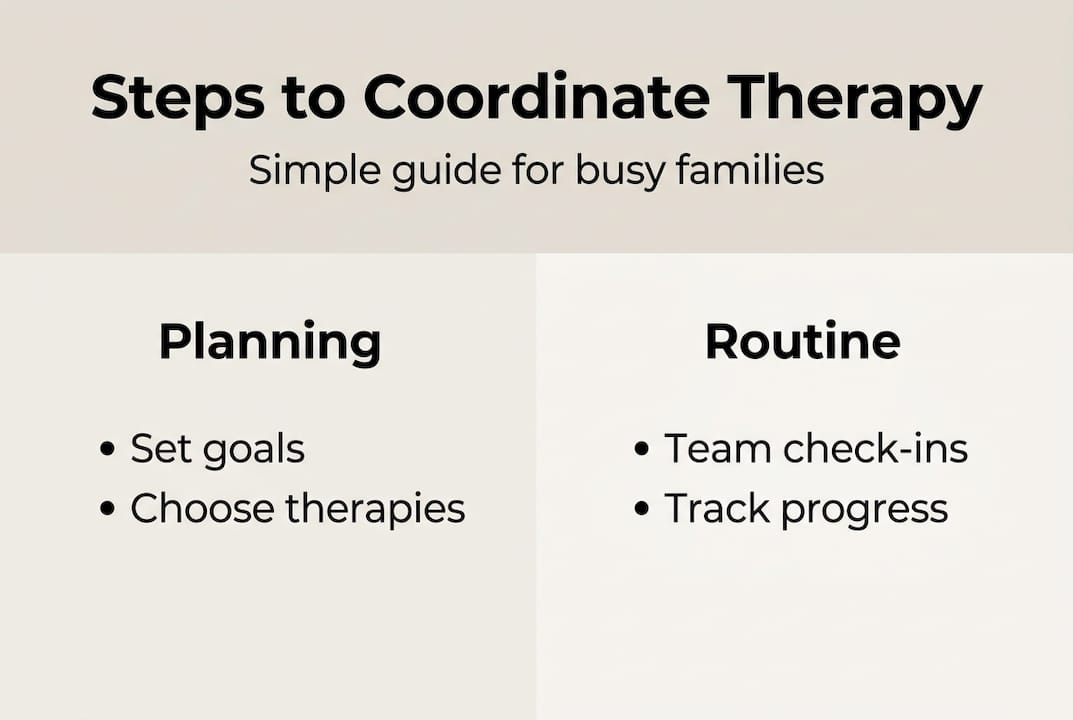
Pro Tip: Set a monthly “team check-in” by email or video call. Even a 20-minute conversation where every provider shares one win and one concern can prevent months of misaligned effort. Explore parent training resources to strengthen your role as coordinator, and look into remediation advice when you need to address specific skill gaps.
Scheduling is also about protecting your family’s energy. Leave at least two afternoons per week completely free of structured therapy. Children need unstructured time to practice what they have learned.
Ensuring consistency and supporting generalization at home
Therapy only works if the skills transfer to real life. A child who can request items during a clinic session but cannot do it at the dinner table has not truly learned the skill yet. Generalization is the goal, and it happens at home.
Here is how to build consistency across your household:
- Ask every therapist for a “home strategy sheet” summarizing the top two or three techniques to use each week
- Post visual reminders in key spots like the kitchen and bathroom so all caregivers use the same prompts
- Hold a brief weekly family meeting to review what is working and what needs adjustment
- Include extended family members such as grandparents and regular babysitters in basic training
- Use natural routines like mealtimes, bath time, and car rides as practice opportunities
Parent involvement research consistently shows that involving both parents and training all caregivers for consistency produces significantly better outcomes. Fathers, grandparents, and other regular caregivers are not optional extras. They are part of the treatment team.
“Consistency is not about being perfect every day. It is about using the same language and the same strategies often enough that your child starts to predict and trust the pattern.”
Caregiver stress is real and it affects outcomes. If you are running on empty, your child feels it. Connect with a parent support group, ask your child’s therapist about caregiver coaching, and read more about family involvement tips to build a sustainable support system for yourself and your family.
Pro Tip: Pick one skill per month to focus on at home. Trying to practice everything at once leads to inconsistency. One focused skill practiced daily across all caregivers moves faster than ten skills practiced randomly.
Why flexible, family-centered coordination makes the biggest difference
Here is something most therapy guides will not tell you: the families who see the strongest progress are rarely the ones with the most perfectly structured schedules. They are the ones who adapt.
Rigid therapy plans look great on paper. Then a parent loses a job, a sibling has a health crisis, or the child simply refuses to engage with a particular provider. A plan that cannot bend will break. What we have seen, both in research and in real family stories, is that the family’s role in autism therapy is not just supportive. It is central.
Family buy-in matters more than any specific therapy model. A parent who genuinely believes in the approach, who feels respected by providers, and who has the bandwidth to follow through at home will outperform a family with a gold-standard schedule but zero energy left to implement it. The uncomfortable truth is that a slightly less intensive therapy plan that the whole family can sustain consistently will produce better results than an aggressive plan that collapses by month three.
Be willing to drop a therapy that is not working, even if it is supposed to be the best option. Be willing to slow down when life gets hard. Progress is not linear, and flexibility is not failure.
Find the right autism therapy support for your family
If you are ready to move from overwhelmed to organized, Autism Doctor Search is built for exactly this moment. Our directory connects you with vetted, family-centered providers across ABA therapy, speech and language, occupational therapy, mental health services, special education schools, and more. You do not have to search blindly or rely on word of mouth alone. You can find therapy services that match your child’s needs and your family’s values in one place. Explore detailed ABA therapy guides and compare providers who share your priorities. Start your search today and take the next step toward a coordinated, confident plan for your child.
Frequently asked questions
How do I know which autism therapies work best for my child?
Choose therapies backed by peer-reviewed research and matched to your child’s specific goals. Evidence-based, child-led interventions like DRBI and NDBI are increasingly recommended alongside ABA based on family preferences and the child’s learning style.
How many therapy hours per week are most effective?
Intensity should match your child’s needs and your family’s capacity. Intensive behavioral programs typically range from 20 to 40 hours per week, but the right number is the one your child can benefit from without burning out.
How can I keep therapy consistent across different caregivers?
Train all caregivers in the same key strategies and keep communication open between home and every provider. Involving both parents and extended family members in basic training produces measurably better consistency.
What’s the best way to monitor my child’s progress?
Review goals with your full team at least every three months. Monitor and adjust therapies quarterly using simple notes, therapist data, and teacher feedback to catch what is working and what needs to change.