
TL;DR:
- Autism spectrum disorder is highly heterogeneous, with symptoms and support needs varying widely among individuals.
- Diagnosis relies on behavioral observation and assessments, with no definitive medical test available.
- Rising prevalence reflects increased awareness, broader criteria, and improved diagnostic practices, not just more cases.
Many families assume getting an autism diagnosis is straightforward. You notice some signs, see a doctor, and get an answer. The reality is far more complex, and that complexity matters deeply for how you support your child or loved one. Autism Spectrum Disorder is one of the most heterogeneous neurodevelopmental conditions we know of, meaning two children with the same diagnosis can look completely different from one another. This guide walks you through the latest definitions, how diagnoses are made, who is affected, and what the gray areas mean for your family’s path forward.
Table of Contents
- What is autism spectrum disorder?
- How experts diagnose autism: Criteria and tools
- Who is affected and how prevalence is changing
- Challenges and nuances in defining autism
- A new way to think about autism spectrum disorder
- Find the right support for your family’s ASD journey
- Frequently asked questions
Key Takeaways
| Point | Details |
|---|---|
| Spectrum nature | Autism is a spectrum, meaning everyone with ASD is different in abilities and challenges. |
| Diagnosis process | Experts use behavior observation and history, not medical tests, to diagnose ASD. |
| Growing prevalence | ASD rates are rising due to increased awareness and screening, especially in diverse communities. |
| Importance of nuance | Many factors, like masking and overlap with other conditions, make diagnosis more complex. |
| Early support | Getting an early, accurate diagnosis can improve outcomes through timely intervention. |
What is autism spectrum disorder?
ASD stands for Autism Spectrum Disorder, a neurodevelopmental condition defined by the Diagnostic and Statistical Manual of Mental Disorders, Fifth Edition (DSM-5). The word spectrum is not just a polite way of saying “everyone is different.” It reflects something clinically precise: the condition spans an enormous range of abilities, communication styles, sensory profiles, and support needs.
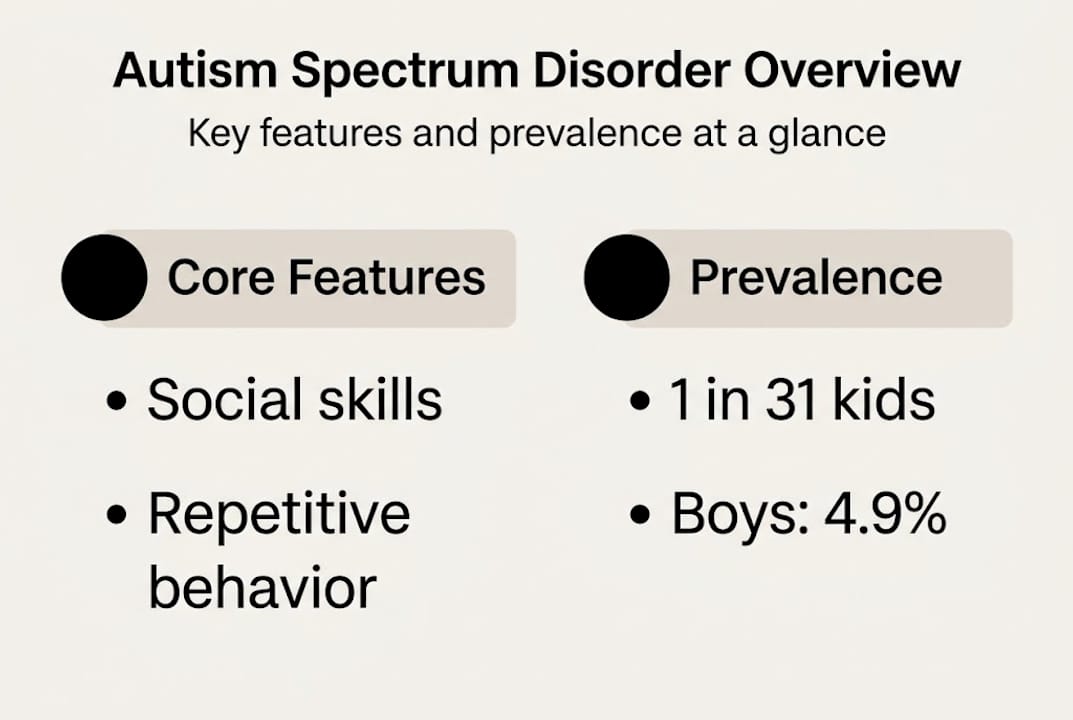
The DSM-5 definition requires persistent deficits in social communication and social interaction across multiple contexts, plus at least two of four types of restricted, repetitive behaviors, with symptoms present in early development, causing real-life impairment, and not better explained by intellectual disability. Every word in that definition carries weight.
Here is what those two core feature categories look like in practice:
Core features of ASD
| Feature category | Examples |
|---|---|
| Social communication deficits | Limited eye contact, difficulty with back-and-forth conversation, trouble understanding sarcasm or social cues |
| Restricted, repetitive behaviors | Rigid routines, intense narrow interests, unusual sensory responses, repetitive movements (stimming) |
The four types of restricted, repetitive behaviors recognized in the DSM-5 are:
- Stereotyped or repetitive motor movements, speech, or object use
- Insistence on sameness and inflexible routines
- Highly restricted, fixated interests
- Hyper or hypo-reactivity to sensory input
A child does not need all four. Two of the four types are enough to meet criteria, which is part of why presentations look so different across individuals.

The ICD-11 classification of ASD used internationally aligns closely with DSM-5 but organizes the criteria slightly differently, which matters for families navigating international resources or medical systems outside the U.S.
Understanding what autism actually is, including autism causes and symptoms, is the foundation for advocating effectively for your child. You can also explore our in-depth resource on autism in children for age-specific guidance.
Statistic: Approximately 1 in 31 U.S. children aged 8 years were identified with ASD in 2022, making it one of the most common neurodevelopmental diagnoses in the country.
How experts diagnose autism: Criteria and tools
Knowing what ASD is and knowing how professionals confirm it are two different things. Many families are surprised to learn there is no blood draw, brain scan, or genetic test that definitively diagnoses autism. Diagnosis relies on behavioral observation, developmental history, and standardized tools like the ADOS-2 (Autism Diagnostic Observation Schedule) and the ADI-R (Autism Diagnostic Interview Revised). No biomedical test exists.
The DSM-5 assigns three severity levels based on how much support a person needs:
- Level 1: Requires support
- Level 2: Requires substantial support
- Level 3: Requires very substantial support
These levels apply separately to social communication and to restricted, repetitive behaviors. A child can be Level 1 in one area and Level 3 in another. This matters enormously when requesting school services or insurance-covered therapies.
The ICD-11 (code 6A02) takes a slightly different approach. Instead of severity levels, it uses specifiers to note whether a person also has intellectual development disorder or functional language impairment. Both systems describe the same population but use different lenses, which can affect how services are documented globally.
DSM-5 vs. ICD-11 at a glance
| Feature | DSM-5 | ICD-11 |
|---|---|---|
| Severity classification | 3 levels (1, 2, 3) | Specifiers for intellectual and language function |
| Social/communication criteria | Combined into one domain | Same core requirement |
| Used primarily in | United States | International contexts |
A proper evaluation typically involves a multidisciplinary team. Learn more about how multidisciplinary autism care works and why it leads to more accurate diagnoses. You can also read our guide on autism diagnosis referrals if you are unsure where to start. If your child has had a developmental screening, standardized autism assessments provide the next level of detail.
Pro Tip: If you suspect ASD, request a comprehensive evaluation rather than a brief developmental screening. Screenings flag concerns; evaluations confirm or rule out diagnoses with the depth needed to access services.
Who is affected and how prevalence is changing
The numbers are striking. U.S. prevalence among 8-year-olds in 2022 stands at 1 in 31 (32.2 per 1,000 children), with boys diagnosed at 3.4 times the rate of girls (4.9% vs. 1.4%). Rates are also higher among Black, Asian/Pacific Islander, and Hispanic children compared to White children, which researchers believe reflects improved access and outreach in communities that were historically underdiagnosed.
ASD prevalence by demographic group (U.S., 2022)
| Group | Prevalence estimate |
|---|---|
| All 8-year-olds | 1 in 31 (3.2%) |
| Boys | ~4.9% |
| Girls | ~1.4% |
| Global average | ~1-2% |
Here is something families often misread: rising prevalence rates do not simply mean more children suddenly have autism. Better awareness and diagnostic changes drive much of the increase, not just a true rise in new cases. Diagnostic criteria have broadened over time. Clinicians are better trained. Families are seeking evaluations earlier. All of these factors push the numbers up.
That said, ASD carries a significant lifelong impact. Global burden estimates reach 11.5 million disability-adjusted life years (DALYs) in 2021, a number that reminds us this is not a childhood phase but a lifelong identity and set of support needs.
What this means practically for your family:
- Boys are more often diagnosed, but girls are more often missed (more on that in the next section)
- Rising rates mean more services, more research, and more community support are being developed
- Understanding autism causes and symptoms across the full spectrum helps families advocate for appropriate support regardless of severity level
“Prevalence increasing reflects expanded awareness and evolving diagnostic criteria, not simply more children developing autism.” — CDC Autism Surveillance, 2026
Challenges and nuances in defining autism
Here is where the science gets honest about its own limits. ASD is not a clean category with sharp edges. It bleeds into neighboring conditions, hides under coping strategies, and shows up differently depending on gender, culture, and life stage.
Masking is one of the biggest complications. Masking in females and adults means consciously or unconsciously copying social behaviors to appear neurotypical, suppressing stimming, and forcing eye contact. Girls especially learn to do this so effectively that symptoms stay invisible until demands exceed their capacity, often in middle school, college, or early adulthood.
Overlap with other conditions makes diagnosis harder too. ADHD, anxiety disorders, and personality disorders all share features with ASD. A child can have all of them at once. Early diagnosis ideally by age 2 to 3 leads to better outcomes, but underdiagnosis in girls and adults means many people do not get that early window.
Here are the most common complicating factors families encounter:
- Masking conceals traits in girls, adults, and high-IQ individuals
- Co-occurring ADHD affects an estimated 50-70% of autistic individuals
- Anxiety and depression frequently overlap and can become the presenting concern
- Cultural context shapes whether behaviors are flagged as atypical at all
- Late-onset presentation occurs when environmental demands exceed coping capacity
The neurodiversity perspective is reshaping how clinicians and families talk about autism. A neurodiversity framework reframes autism not as a deficit to fix but as a different neurological profile with both challenges and genuine strengths. Future diagnostic systems may move toward strength-and-need profiles rather than deficit-only descriptions.
For families trying to identify the right environment and services, exploring best autism programs can help you match your child’s specific profile to appropriate support.
Pro Tip: If your daughter or teen has been told she is “just anxious” or “socially awkward,” ask her doctor specifically about masking and request an ASD evaluation that accounts for it. General screenings often miss her.
A new way to think about autism spectrum disorder
We have worked with thousands of families navigating ASD, and here is what we have learned: the diagnosis label opens doors, but it does not tell you who your child is. DSM-5 criteria are a communication tool between professionals. They are not a ceiling.
Many families spend enormous energy asking, “Why does my child have autism?” A more powerful question is, “What does my child need right now, and what are they capable of?” That shift changes everything about how you interact with therapists, schools, and medical providers.
The neurodiversity perspective is not about minimizing real challenges. A child who needs very substantial support still needs very substantial support. But it does mean that early intervention works best when it builds on strengths rather than only targeting deficits. Growth does not stop in childhood. Adults with ASD continue to develop skills, identity, and independence well into their lives.
We also believe that multidisciplinary autism care is not optional for most families. Occupational therapists, speech-language pathologists, behavioral analysts, and mental health professionals each see a different piece of the same person. Together, they see the whole picture.
Find the right support for your family’s ASD journey
You now have a clearer picture of what ASD is, how it is diagnosed, and why it looks so different from person to person. The next step is connecting your family with professionals who can turn that knowledge into real support.
Autism Doctor Search makes that step easier. Our directory includes vetted autism therapy services, ABA therapy for autism, and autism developmental assessments so you can find what your child needs without starting from scratch. Whether you are seeking a first evaluation or expanding your current care team, we are here to help you find the right fit, in your area, at the right time.
Frequently asked questions
What are the core symptoms of autism spectrum disorder?
ASD core symptoms include persistent deficits in social communication and social interaction plus at least two types of restricted, repetitive behaviors, all present from early development and causing functional impairment.
Can autism be diagnosed with a medical test?
No. No biomedical test diagnoses ASD; clinicians rely on behavioral observation, developmental history, and standardized tools such as the ADOS-2 and ADI-R to reach a diagnosis.
At what age can autism typically be diagnosed?
Median diagnosis age is around 47 months, but early signs are often visible by age 2 to 3, and earlier intervention consistently leads to better long-term outcomes.
Why are some children diagnosed with autism later than others?
Masking in females and adults hides symptoms effectively, and overlap with ADHD or anxiety can make ASD the secondary concern, pushing diagnosis much later than ideal.