
TL;DR:
- Not all medical tests are necessary after an autism diagnosis; focus on those impacting care.
- Hearing, vision, and genetic tests are essential early evaluations; advanced brain or metabolic tests depend on clinical signs.
- Routine screening for co-occurring conditions like ADHD, epilepsy, and sleep issues is crucial for ongoing health management.
After your child receives an autism spectrum disorder (ASD) diagnosis, the next question is almost always: what do we do now? The list of possible medical tests can feel endless, and well-meaning advice from every direction makes it harder to know what’s truly necessary. Here’s the reality: not every test is worth your time, money, or your child’s stress. This guide breaks down the evidence-based medical exams that actually matter after an ASD diagnosis, explains why each one is recommended, and helps you walk into your next specialist visit with confidence and a clear plan.
Table of Contents
- How to approach medical exams after an autism diagnosis
- Hearing and vision exams
- Genetic testing and why it matters
- Targeted brain and metabolic exams: Who needs them?
- Screening for common co-occurring conditions
- Why essential doesn’t mean exhaustive: Our perspective
- Find the right autism support and services
- Frequently asked questions
Key Takeaways
| Point | Details |
|---|---|
| Start with hearing and vision | These exams rule out sensory issues, which can mimic or magnify autism symptoms. |
| Genetic testing is advised | Chromosomal microarray and Fragile X are core tests and can yield explanations in many cases. |
| Brain and metabolic tests are selective | Advanced tests like EEG or MRI are only needed for specific signs like seizures or regression. |
| Check for common co-occurring issues | Regular monitoring for ADHD, epilepsy, anxiety, sleep, and GI problems ensures comprehensive care. |
| Skip unproven alternative tests | Avoid routine hair, heavy metal, or peptide screening unless a clear medical reason exists. |
How to approach medical exams after an autism diagnosis
The first thing to understand is that autism is not diagnosed through a blood test or brain scan. No single medical test diagnoses ASD; the process relies on behavioral observation, developmental history, and standardized screening tools. Medical exams that come after the diagnosis serve a different purpose: they help identify underlying health conditions, clarify causes, and guide your child’s care plan.
Not every child needs the same set of tests. The right exams depend on several factors you and your child’s doctor should discuss together:
- Symptom presentation: Does your child have unusual physical features, regression, or seizure-like episodes?
- Family history: Are there relatives with genetic conditions, intellectual disabilities, or similar developmental profiles?
- Coexisting health issues: Does your child have GI problems, sleep disturbances, or frequent infections?
- Age and developmental stage: Younger children or those with more significant delays may need broader workups.
The goal is to focus on tests that will directly change or improve your child’s care, not to run every possible lab out of anxiety. Following the autism screening steps recommended by your pediatrician keeps the process organized and purposeful.
Pro Tip: Before your specialist appointment, keep a written log of every symptom, behavior change, and question you have. Bring it with you. Specialists see many families and a clear, specific log helps them prioritize the right evaluations faster.
Hearing and vision exams
Before any advanced testing, hearing and vision exams come first. This is not a formality. Sensory impairments can directly mimic or worsen autism-related behaviors, and missing them means treating the wrong problem.
All children with ASD should have hearing and vision tests to rule out sensory issues that may be mimicking or worsening their symptoms. A child who appears unresponsive to their name may have hearing loss, not a social communication deficit. A child who avoids eye contact might be struggling with an undetected vision problem.
Here’s what to watch for that strengthens the case for prompt sensory screening:
- Inconsistent responses to sounds or voices
- Frequent ear infections or fluid in the ears
- Squinting, eye rubbing, or difficulty tracking objects
- Delayed speech or language that seems out of proportion to other skills
- Behavioral changes in different lighting or noise environments
For hearing, an audiologist performs a formal audiological evaluation, which is more thorough than the quick screening done at a pediatrician’s office. For vision, a pediatric ophthalmologist can assess children who are non-verbal or have limited cooperation.
Sensory testing is the foundation of the ASD medical workup. Skipping it or relying on informal screening risks missing a treatable condition that could be driving a significant portion of your child’s challenges.
When scheduling these exams, ask your pediatrician for a referral rather than waiting for the next routine checkup. Timing matters. If you want to prepare better questions for these appointments, reviewing questions for your autism doctor can help you get more out of each visit.
Genetic testing and why it matters
Once sensory issues are addressed, genetic testing becomes the next major step. Many parents are surprised to learn that genetics plays a significant role in autism, and testing can uncover answers that change how the whole family plans for the future.
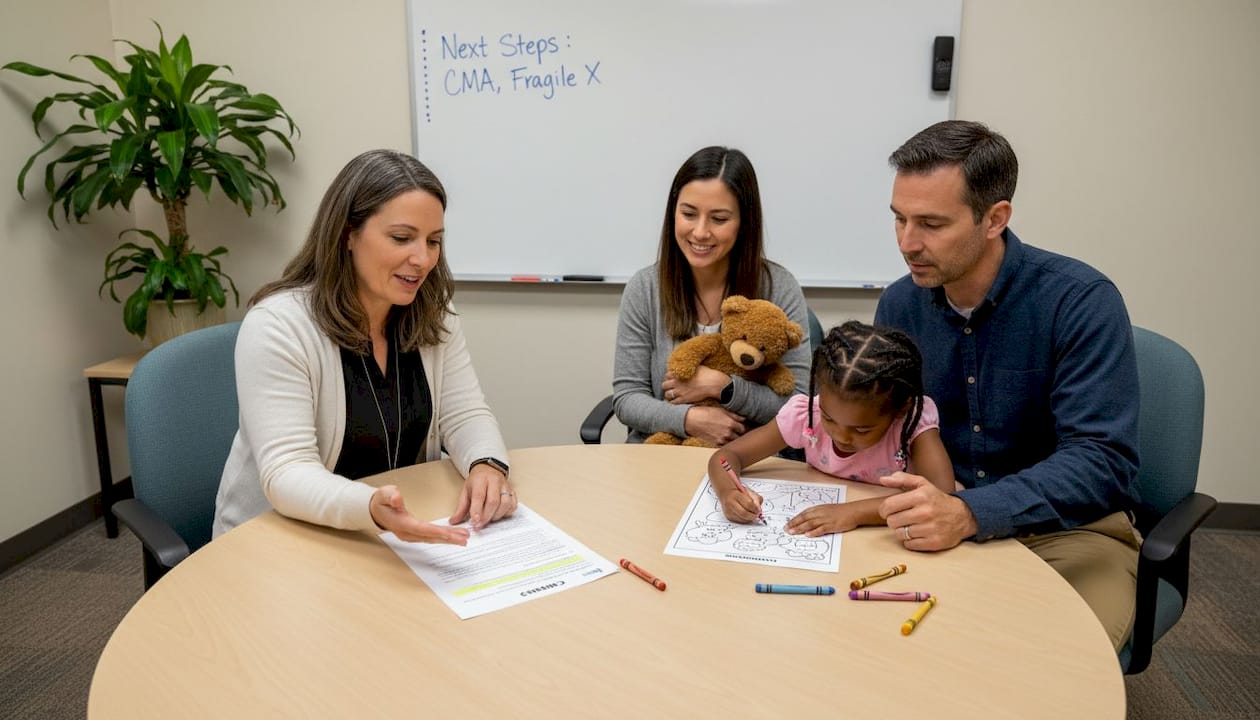
Genetic testing is recommended after an ASD diagnosis, with chromosomal microarray (CMA) as the first-tier test and Fragile X testing especially for males. Together, these tests identify a genetic cause in roughly 10 to 40% of cases.
Here’s a quick comparison of what each test offers:
| Test | What it detects | Who it’s most relevant for |
|---|---|---|
| Chromosomal microarray (CMA) | Extra or missing DNA segments | All children with ASD |
| Fragile X testing | FMR1 gene mutation | Males especially; females if family history |
Key reasons genetic testing matters for your family:
- Understanding the cause: A genetic finding can explain why your child developed ASD and what other health issues to watch for.
- Recurrence risk: Knowing whether a condition is inherited helps parents and siblings understand their own risk.
- Specialty referrals: Some genetic findings point directly to conditions that need subspecialty care.
- Family planning: Results can inform decisions for future pregnancies.
Pro Tip: Before scheduling genetic testing, call your insurance provider to ask specifically about coverage for CMA and Fragile X panels. Costs vary widely, and some insurers require prior authorization. Also ask whether results would affect coverage for siblings.
For more on how genetic understanding shapes daily family life, explore autism genetics and family support and the role of family in care.
Targeted brain and metabolic exams: Who needs them?
Not every child with ASD needs an EEG or MRI. These are targeted exams, ordered when specific clinical features suggest they will add useful information.
EEG is recommended when seizures or developmental regression are suspected. MRI and metabolic tests are ordered based on clinical features like dysmorphic physical features or signs of a metabolic crisis. These are not routine for every child.
Here’s when each advanced exam is typically triggered:
- EEG (electroencephalogram): Your child has had a seizure, staring spells, or a sudden loss of previously acquired language or social skills.
- Brain MRI: Your child has unusual head size, abnormal neurological exam findings, or physical features suggesting a structural brain condition.
- Metabolic studies: Your child shows signs of a metabolic disorder, such as episodes of unexplained illness, unusual odors, or extreme fatigue.
- Lead testing: Your child has pica (eating non-food items), which raises the risk of lead exposure.
Developmental issues are present in the vast majority of ASD cases, and neurologic coexisting conditions affect approximately 16% of children with ASD. That number is significant, but it also means most children will not need these advanced exams. The decision should always be driven by your child’s specific presentation, not by general anxiety or the desire to leave no stone unturned.
Preparing your child for these exams matters too. For EEGs, sleep deprivation is sometimes required beforehand. For MRI, sedation may be needed for younger or less cooperative children. Asking your specialist about doctor qualifications ensures you’re working with someone experienced in pediatric neurology.
Screening for common co-occurring conditions
After targeted exams, ongoing screening for co-occurring conditions becomes a regular part of your child’s care. Most children with ASD have at least one additional diagnosis, and many have several.
Co-occurring conditions in ASD are common: epilepsy affects up to 77% of some groups, ADHD up to 86%, anxiety up to 82%, and intellectual disability affects 33 to 52% of children with ASD depending on the population studied.
| Co-occurring condition | Approximate prevalence in ASD |
|---|---|
| ADHD | Up to 86% |
| Anxiety disorders | Up to 82% |
| Epilepsy | Up to 77% |
| GI problems | Highly variable, commonly reported |
| Intellectual disability | 33 to 52% |
| Sleep disorders | Frequently reported |
What parents should track and report at every medical visit:
- Changes in sleep patterns, including difficulty falling or staying asleep
- GI symptoms like chronic constipation, diarrhea, or stomach pain
- New or increasing anxiety, mood changes, or self-injurious behavior
- Attention difficulties or impulsivity that affect learning and daily function
- Any seizure-like activity, staring spells, or unexplained falls
These conditions don’t always announce themselves clearly. A child who seems more irritable or whose behavior suddenly worsens may be experiencing pain from an undiagnosed GI issue or disrupted sleep. Tracking changes at home and sharing them with your medical team is one of the most powerful tools you have. Learning more about family impact and support can also help you recognize when your family needs additional resources.
Which tests are not generally recommended
Just as important as knowing what to test for is knowing what to skip. Some tests are popular in certain communities but lack evidence for routine use in ASD.
Not recommended routinely are hair analysis, heavy metal testing, and urinary peptide analysis, unless specific clinical indications exist, such as pica warranting lead testing.
- Hair analysis: Not a validated diagnostic tool for ASD-related concerns.
- Heavy metal testing: Not recommended unless there is documented exposure or pica behavior.
- Urinary peptide analysis: No established clinical utility in ASD diagnosis or management.
- Food sensitivity panels (IgG-based): Not supported by evidence for routine ASD workup.
Routine use of these tests can create false leads, unnecessary anxiety, and significant out-of-pocket costs without improving your child’s care.
If a provider recommends any of these without a clear clinical reason, ask how the result will change your child’s treatment. If there’s no clear answer, it’s reasonable to decline. For guidance on navigating referrals, check the referral tips for parents resource.
Why essential doesn’t mean exhaustive: Our perspective
At Autism Doctor Search, we’ve seen how the pressure to “do everything” can overwhelm families at an already difficult time. The truth is, chasing every possible test rarely leads to better outcomes. It leads to exhaustion, financial strain, and distraction from the things that actually move the needle: therapy, relationships, daily routines, and building on your child’s strengths.
Every time a new test is suggested, ask one question: “How will this result change my child’s care?” If the answer is vague, the test probably isn’t essential right now.
Evidence-based exams exist because they guide real decisions. Genetic results shape family planning. Hearing tests prevent misdiagnosis. Seizure evaluations protect safety. These are not bureaucratic checkboxes. They are tools that directly connect to your child’s daily life and long-term health.
Focusing on autism understanding and support rather than an endless diagnostic search is often the most powerful thing a family can do. Your child needs you present and informed, not overwhelmed by a stack of inconclusive lab results.
Find the right autism support and services
Knowing which exams matter is a strong start, but the next step is connecting with the right professionals and services. Autism Doctor Search makes it easier to find trusted, local providers who specialize in supporting children with ASD and their families.
Explore autism therapy services to find ABA therapy, mental health support, and medical care near you. Connect with occupational therapy resources to support your child’s sensory and daily living skills. If schooling is a priority, the special schools guide helps you identify educational settings designed for children with ASD. Every child’s needs are different, and our directory is built to help you find the right fit.
Frequently asked questions
What is the very first medical test to schedule after an autism diagnosis?
Start with hearing and vision tests to rule out sensory issues that may be affecting your child’s behavior and development. These are the most immediate, actionable exams and can prevent misattributing sensory problems to ASD.
Is genetic testing necessary for all children with autism?
Genetic testing is widely recommended after diagnosis, particularly chromosomal microarray as first-tier testing, because it can identify a genetic cause in up to 40% of cases and has real implications for family planning and specialist referrals.
Which co-occurring conditions should be screened for regularly?
Common conditions include ADHD, epilepsy, anxiety, intellectual disability, sleep disorders, and GI problems. Many occur in over half of children with ASD, so ongoing monitoring at well-child visits is essential.
Are alternative medical tests like heavy metal or urinary peptide analysis needed?
These tests are not recommended for routine care unless specific clinical concerns are present. Without a clear clinical reason, they add cost and confusion without improving your child’s care plan.
How often should children with ASD undergo screenings for related health issues?
Ongoing surveillance is advised at well-child visits, with schedules individualized to each child’s health profile. The AAP and CDC recommend developmental screening at 9, 18, and 30 months, with specific ASD screening at 18 and 24 months.