What is school-based intervention, and why does it matter?
School-based intervention refers to programs, strategies, and services designed to influence students’ emotional, behavioral, or social functioning, delivered within or directly coordinated through the school setting. These are not informal check-ins or general classroom management. They are structured, often evidence-based approaches targeting specific student needs, from anxiety and aggression to reading difficulties and social skill deficits.
The school setting is uniquely positioned to deliver these supports. Children spend the majority of their waking hours at school, and research consistently shows that students who need mental health services most often receive them there, if they receive them at all. The multi-tiered system of support (MTSS) framework, recognized under the Every Student Succeeds Act, organizes these interventions into three tiers based on student need:
- Tier 1 (Universal): Schoolwide programs for all students, focused on wellness promotion and prevention
- Tier 2 (Selective): Targeted supports for students showing early signs of risk or emerging problems
- Tier 3 (Indicated): Intensive, individualized services for students with identified disorders or significant behavioral health needs
School-based interventions span a wide range of goals: improving social skills, building emotional regulation, reducing disruptive behavior, supporting academic achievement, and promoting mental wellness. Effective programs integrate the school, family, and community rather than treating the classroom as an isolated unit. Evidence-based approaches, organizational support, and trained staff are what separate programs that produce lasting change from those that fade after a semester.
Types of school-based interventions you should know
The categories of school-based support are broader than most people expect. They range from classroom curricula taught to every student to intensive one-on-one therapy for a child with a diagnosed condition. Understanding the distinctions helps parents and educators ask the right questions and push for the right level of support.
By tier and intensity:
- Universal programs (Tier 1) reach the entire student body without screening. Social-emotional learning (SEL) curricula, positive behavioral interventions and supports (PBIS), and schoolwide mental wellness campaigns fall here. A meta-analysis of 213 universal SEL programs involving over 270,000 students found statistically significant improvements across social-emotional skills (effect size g=0.57), academic achievement (g=0.27), and reductions in emotional distress (g=0.24).
- Selective programs (Tier 2) target students identified as at-risk, typically through teacher referral or screening data. Small group cognitive behavioral therapy (CBT) sessions, social skills training groups, and daily behavior report cards are common formats.
- Indicated programs (Tier 3) serve students with identified disorders. These look more like clinical treatment: individual CBT, applied behavior analysis (ABA), and comprehensive treatment planning delivered by trained school mental health professionals.
By category and focus:
- Behavioral interventions: Token economies, behavior-specific praise, and functional behavior assessments address externalizing problems like aggression and noncompliance.
- Academic interventions: Targeted tutoring, reading support programs, and structured homework help address learning gaps that often co-occur with behavioral challenges.
- Social-emotional learning (SEL): Programs using the SAFE criteria (Sequenced, Active, Focused, Explicit) and taught by classroom teachers show better outcomes than add-on programs delivered by outside facilitators.
- Self-regulation programs: Mindfulness-based curricula, emotion identification training, and coping skills groups help students manage stress and impulse control.
- CBT-based treatments: Structured cognitive behavioral programs address anxiety, depression, and trauma. Camp Cope-A-Lot, a 12-session computer-assisted CBT program, was specifically designed to reduce barriers to school implementation by minimizing required therapist training and cost.
Delivery formats vary just as much as content. Programs may run in a general classroom, a small pull-out group, or a private counseling office. Some involve parents directly; others coordinate with community mental health providers. The right format depends on the student’s needs, the school’s resources, and the evidence base behind the specific program.
How school-based intervention teams are structured
A school-based intervention team is a multidisciplinary group of school staff who collaborate to identify student needs, develop support plans, and track whether those plans are working. Effective teams typically include teachers, school counselors, school psychologists, nurses, and administrators, with the composition shifting based on the student’s presenting concerns.

The process usually follows a structured cycle. A teacher or parent raises a concern. The team reviews existing data, such as grades, attendance, and behavioral records, and may conduct additional screening. From there, the team selects an appropriate intervention, assigns responsibility for delivery, sets a timeline, and schedules a follow-up to review progress. That follow-up is not optional. Without it, interventions drift or get abandoned when the first obstacle appears.
What makes teams work well:
- Leadership support from principals and district administrators who prioritize mental health alongside academics
- Ongoing training so staff can deliver programs with fidelity, not just familiarity
- Data-driven decision making, using screening tools and progress monitoring rather than gut instinct alone
- Consistent parent involvement, since collaborative communication among teachers, parents, and mental health professionals measurably improves outcomes
- Clear role delineation so no one assumes someone else is handling follow-through
Pro Tip: Match the intervention to the student’s actual need and tier. A universal SEL curriculum will not adequately support a student with a diagnosed anxiety disorder who needs Tier 3 services. Mismatching intensity to need wastes time and can delay appropriate care.
Organizational culture shapes how well teams function. Schools with what researchers call “proficient organizational cultures,” where staff share norms around continuous improvement and evidence use, implement programs more completely and sustain them longer.
Evidence and effectiveness of school-based interventions
The research base for school-based interventions is substantial, though not uniform. Programs vary widely in quality, and effect sizes depend heavily on who receives the intervention, how well it is delivered, and whether the school has the infrastructure to sustain it.
The meta-analysis of 213 universal SEL programs cited earlier found consistent benefits across multiple outcomes. Effect sizes were modest to moderate, which is typical for population-level prevention programs, but the scale of impact across hundreds of thousands of students makes even small effects meaningful at a public health level.
Approximately 25% of students experience notable mental health problems during their school years, yet 70–80% of those students receive no formal support. Schools are often the only realistic access point. That gap is the core argument for investing in school-based programs, not just as a clinical nicety but as a basic equity issue.
| Intervention tier | Target population | Typical effect size | Common delivery format |
|---|---|---|---|
| Tier 1 (Universal) | All students | Small to moderate | Classroom curriculum, schoolwide policy |
| Tier 2 (Selective) | At-risk students | Moderate | Small group sessions, check-in/check-out |
| Tier 3 (Indicated) | Students with identified disorders | Moderate to large | Individual counseling, intensive treatment |
Selective and indicated interventions tend to produce larger effect sizes than universal programs, which makes intuitive sense: a more targeted approach applied to students with greater need has more room to show measurable change. A meta-analysis on school-based programs for aggressive and disruptive behavior found that programs with better implementation produced significantly larger reductions in problem behavior, regardless of the specific treatment modality used.
Implementation fidelity is the variable that most consistently separates effective programs from ineffective ones. A program delivered at 50% fidelity is not half as effective. It often produces no measurable benefit at all. Schools that invest in pre-implementation preparation, staff training, and ongoing monitoring see substantially better outcomes than those that adopt a program and assume it will run itself.
Long-term gains require booster sessions and sustained organizational support. Without follow-up, even well-implemented programs see their effects erode within a year or two.
How autism-specific resources fit into school-based support
Students with autism spectrum disorder (ASD) present needs that general school-based programs often do not fully address. Communication differences, sensory sensitivities, rigid behavioral patterns, and co-occurring anxiety or ADHD require interventions tailored to how autistic students learn and respond, not just adapted versions of neurotypical-focused curricula.
Autism-focused school-based interventions typically involve a combination of services:
- Applied Behavior Analysis (ABA): Delivered in school settings by trained behavior technicians or BCBAs, ABA targets specific skill deficits and behavioral challenges using data-driven, individualized programs.
- Occupational therapy (OT): Addresses sensory processing, fine motor skills, and daily living tasks that affect a student’s ability to participate in the classroom.
- Speech-language therapy: Targets communication, social pragmatics, and language processing, often delivered in pull-out sessions or embedded in classroom routines.
- Specialized education plans: Individualized Education Programs (IEPs) under the Individuals with Disabilities Education Act (IDEA) legally require schools to provide appropriate services, including behavioral supports and related therapies.
- Social skills groups: Structured peer interaction programs teach turn-taking, perspective-taking, and conversation skills in a controlled, supportive environment.
Families navigating these options often struggle to identify what is available locally and how to coordinate services across school, clinic, and home. Autismdoctorsearch maintains a directory of autism therapy services, ABA providers, occupational therapists, specialized clinics, and educational programs across the United States, giving families a single starting point for finding qualified providers. School counselors working with autistic students can also benefit from understanding how to support students with autism within the existing school team structure.
The most effective approach integrates school-based services with outside providers, keeping communication open between the IEP team, the family, and any community-based therapists. Fragmented care, where the school does one thing and the outside provider does another with no coordination, is one of the most common and most preventable barriers to progress.
Steps and best practices for implementing school-based interventions
Getting an intervention off the ground in a real school takes more than selecting a good program. The gap between a well-researched manual and a well-run classroom program is where most implementation failures happen.
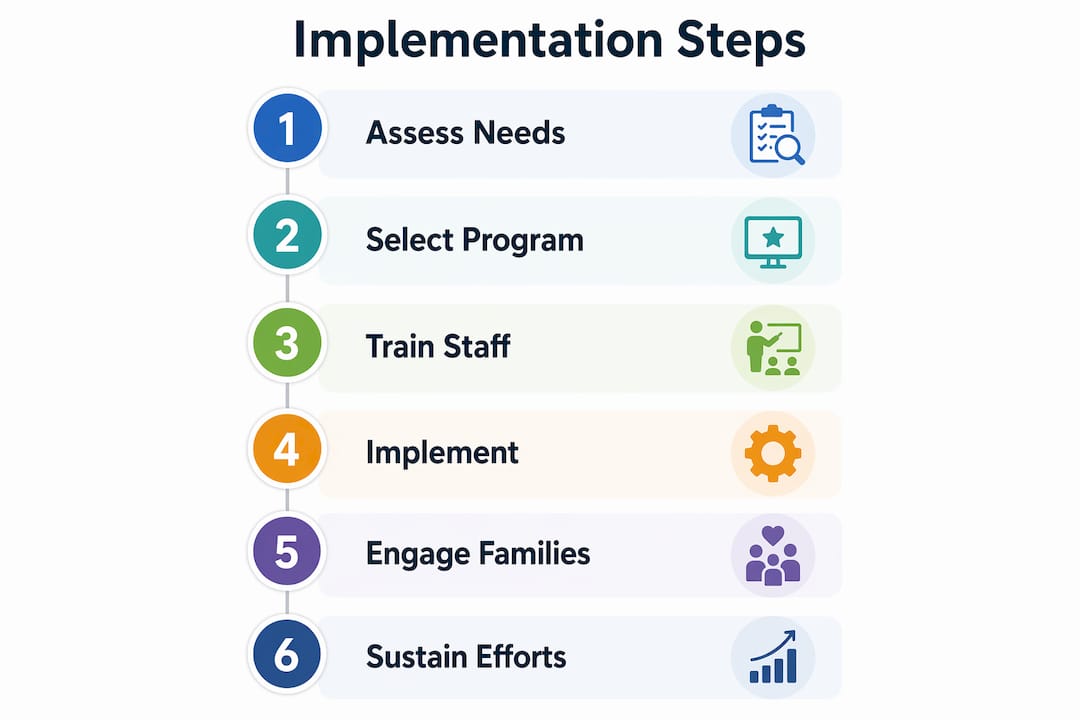
Step 1: Assess student needs and school readiness. Before selecting any program, collect data. Use validated screening tools to identify which students need support and at what tier. Simultaneously, assess whether the school has the staff capacity, training infrastructure, and administrative buy-in to sustain the program. A school that lacks both a trained counselor and a supportive principal is not ready for a Tier 3 intensive program, regardless of how strong the evidence base is.

Step 2: Select an evidence-based program that fits the context. Match the program to the identified need and the school’s realistic capacity. Programs requiring minimal training and resources, such as computer-assisted CBT formats, tend to achieve higher successful adoption in school settings than those demanding extensive clinical expertise. The best program is the one the school can actually implement well, not the one with the highest effect size in a controlled trial.
Step 3: Train staff thoroughly before launch. Training should include didactic instruction, role-play practice, and hands-on support with any materials or technology the program uses. One-time professional development workshops are rarely sufficient. Staff need opportunities to practice, ask questions, and receive feedback before they deliver the program to students.
Step 4: Implement with fidelity and monitor progress. Track whether the program is being delivered as designed. Use brief fidelity checklists, supervisor observations, or self-report logs. Simultaneously, monitor student outcomes using the same measures used at baseline. If a student is not responding after a reasonable period, the team needs data to make that call rather than waiting until the end of the year.
Step 5: Involve families from the start. Parent engagement is not a courtesy. It is a documented factor in intervention effectiveness. Families who understand what the school is doing and why are more likely to reinforce skills at home, communicate relevant changes in the child’s environment, and maintain trust in the process.
Step 6: Plan for sustainability. Build in booster sessions, schedule periodic team reviews, and document what worked. Schools that treat implementation as a one-time event rather than an ongoing practice lose their gains quickly. Assign a staff member to own the program’s continuity across school years, including during staff turnover.
Pro Tip: Spending more time on pre-implementation activities, including needs assessment, staff training, and stakeholder alignment, predicts better outcomes during the implementation phase. Schools that rush to launch often spend more time troubleshooting problems that preparation would have prevented.
Common challenges in school-based intervention and how to address them
Even well-designed programs run into real-world obstacles. Knowing the most common ones in advance makes them easier to manage.
Challenge: Insufficient staff training. Many schools adopt evidence-based programs but underinvest in training. Staff who feel underprepared deliver programs inconsistently, which dilutes outcomes. The solution is structured, multi-session training with ongoing coaching rather than a single workshop. Pairing new implementers with experienced mentors accelerates skill development.
Challenge: Implementation drift. Over time, staff modify programs in ways that feel more comfortable but deviate from the evidence-based design. Regular fidelity checks and brief refresher training prevent drift from becoming the default. A practical guide to teaching mental health in schools can help educators understand why fidelity matters and how to maintain it without feeling constrained.
Challenge: Resource and time constraints. School schedules are packed. Finding time for small group sessions, individual counseling, and team meetings requires deliberate scheduling, not wishful thinking. Schools that embed intervention time into the master schedule rather than treating it as an add-on protect it from being cut when other demands arise.
Challenge: Identifying the right students. Universal screening catches students who would otherwise be missed, but many schools still rely on teacher referral alone, which tends to over-identify externalizing behaviors and under-identify internalizing ones like anxiety and depression. Implementing a validated screening tool at least once per year improves identification accuracy.
Challenge: Sustaining family engagement. Initial parent meetings often go well; follow-through is harder. Schools that communicate proactively, use plain language rather than clinical jargon, and offer flexible meeting times see better family participation. Translating materials for non-English-speaking families is not optional when those families are present in the school.
Challenge: Lack of longitudinal data. Most schools track short-term outcomes but rarely follow students across years to assess whether gains hold. Building a simple data system that tracks intervention history alongside academic and behavioral outcomes over time gives teams the information they need to make better decisions. The field itself lacks sufficient longitudinal studies on sustained impact, which means schools that collect their own data are ahead of the curve.
Examples of specific school-based intervention programs
Knowing the names of well-researched programs helps parents and educators ask informed questions and evaluate what a school is actually offering.
Positive Behavioral Interventions and Supports (PBIS): A Tier 1 schoolwide framework that establishes clear behavioral expectations, teaches them explicitly, and uses data to identify students who need additional support. PBIS is one of the most widely implemented frameworks in U.S. schools and has a strong evidence base for reducing office discipline referrals and improving school climate.
Second Step: A classroom-based SEL curriculum for PreK through grade 8 that teaches empathy, emotion management, problem-solving, and skills for learning. It meets the SAFE criteria and is one of the more rigorously studied universal programs in the field.
Coping Cat: A manualized CBT program for children ages 7–13 with anxiety disorders, delivered in individual or group format by a trained clinician. Camp Cope-A-Lot is its computer-assisted school version, designed specifically to reduce the training burden on school staff while maintaining the core CBT components.
Incredible Years: A multicomponent program with separate curricula for children, parents, and teachers. The child component targets social skills and emotional regulation; the teacher component builds classroom management skills. It has strong evidence for reducing conduct problems in early elementary students.
First Step to Success: An early intervention program for kindergarteners showing early signs of antisocial behavior. It involves a behavioral coach, the classroom teacher, and parents working together over roughly 50 school days. The program’s structured, time-limited format makes it practical for school settings.
Social Skills Training (SST) groups: Not a single program but a broad category of small-group interventions that teach specific social skills through modeling, role-play, and feedback. SST groups are commonly used at Tier 2 for students with social difficulties, including those with ASD, ADHD, or anxiety.
Daily Behavior Report Cards (DBRCs): A Tier 2 tool that sets individualized behavioral goals, tracks them throughout the school day, and communicates results to parents. DBRCs are low-cost, highly customizable, and supported by a solid evidence base for improving classroom behavior and home-school communication.
Educational mental health activities that bridge school and home settings can extend the reach of these programs beyond the school day, reinforcing skills in the environment where students spend the most time.
Legal and ethical considerations in school-based interventions
School-based interventions do not operate in a legal vacuum. Several federal laws directly govern what schools must do, what they are permitted to do, and how they must protect students in the process.
The Individuals with Disabilities Education Act (IDEA) requires public schools to provide a free appropriate public education (FAPE) to students with disabilities, including those with autism, emotional disturbance, and other health impairments. This includes the development of an Individualized Education Program (IEP) that specifies the services, supports, and accommodations the school will provide. Behavioral intervention plans (BIPs) are required when a student’s behavior impedes their learning or the learning of others.
Section 504 of the Rehabilitation Act covers students who do not qualify for special education under IDEA but whose disability substantially limits a major life activity, including learning. A 504 plan can provide accommodations like extended time, preferential seating, or access to counseling without the full IEP process.
The Family Educational Rights and Privacy Act (FERPA) protects the privacy of student education records. Schools must obtain written consent before sharing a student’s records with outside providers, including community mental health agencies. This has practical implications for coordinating care between school-based and community-based services.
Informed consent and assent: Before implementing a formal intervention, especially one involving mental health treatment, schools should obtain informed consent from parents or guardians. For older students, assent, meaning the student’s own agreement to participate, is an ethical best practice even when not legally required. Students who understand and agree to the intervention tend to engage more genuinely.
Cultural and linguistic responsiveness: Ethical implementation requires that interventions be appropriate for the cultural backgrounds of the students they serve. Programs developed and validated primarily with white, middle-class populations may not translate directly to students from different cultural contexts. Schools have an ethical obligation to consider cultural fit when selecting programs and to adapt delivery, not content, to be linguistically accessible to all families.
Avoiding harmful practices: Some interventions that were once common in schools, including certain forms of physical restraint and seclusion, are now restricted or prohibited under state law in many jurisdictions. Schools must stay current with state regulations and ensure that any behavioral intervention plan avoids practices that could cause physical or psychological harm.
Key Takeaways
School-based interventions are most effective when they match student need to the right tier, are delivered with fidelity by trained staff, and involve families as active partners throughout the process.
| Point | Details |
|---|---|
| MTSS tiers structure support | Tier 1 serves all students, Tier 2 targets at-risk students, and Tier 3 provides intensive individual services. |
| SEL programs show measurable gains | A meta-analysis of 213 programs found effect sizes of g=0.57 for social-emotional skills and g=0.27 for academic achievement. |
| Most students go unsupported | Approximately 25% of students have notable mental health needs, yet 70–80% receive no formal support. |
| Fidelity drives outcomes | Programs delivered inconsistently produce little measurable benefit; pre-implementation training and ongoing monitoring are the fix. |
| Autism requires tailored approaches | ABA, occupational therapy, speech therapy, and IEP-based supports address the specific developmental needs of students with ASD. |