
TL;DR:
- Preparing a written autism evaluation request and gathering prior assessments are crucial for initiating school enrollment under IDEA. The evaluation process involves multiple steps, including parent consent, assessments, and eligibility determination, which must be completed within federal timelines. Once a child’s eligibility is confirmed, an IEP is developed and reviewed annually to ensure appropriate educational support.
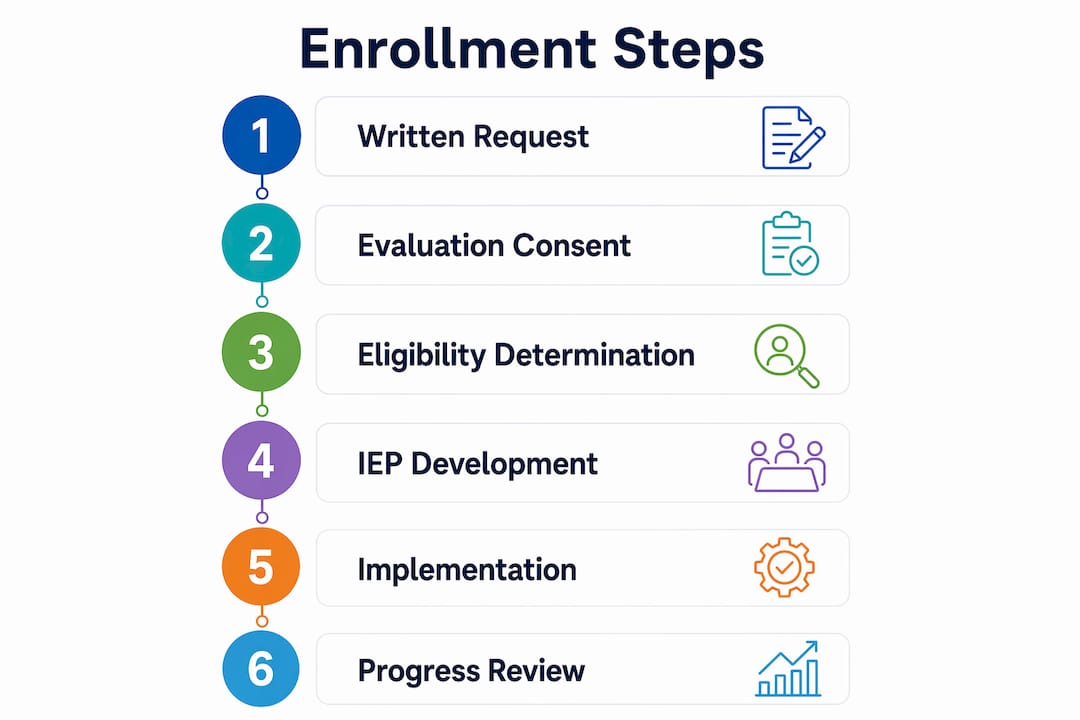
Autism school enrollment steps follow a federally mandated process that begins with a written evaluation request and ends with a fully implemented Individualized Education Program (IEP). The formal term for this process is special education enrollment under the Individuals with Disabilities Education Act (IDEA). Approximately 7.5 million U.S. students, about 15% of all school-age children, receive special education services under IDEA. That scale means school districts have well-established procedures, and knowing each step puts you in control of the outcome for your child.
What documents and prerequisites do you need before starting enrollment?
Preparation before you contact the school district makes every subsequent step faster and less stressful. The two most critical items are a formal medical autism diagnosis from a licensed clinician and any prior evaluations or therapy records your child has accumulated. These documents do not guarantee IEP eligibility on their own, but they give the school’s evaluation team a strong starting point.

The enrollment process officially begins when you submit a written request for a special education evaluation. Written parent requests trigger evaluation timelines and procedural protections under 34 CFR §300.111, the federal Child Find obligation. Send this request via certified mail or email with a read receipt so you have a documented timestamp. That timestamp is legally significant because it starts the clock on the school district’s response window.
Pro Tip: Send your written evaluation request via certified mail or email with a read receipt. This creates a documented record that triggers mandatory federal deadlines the school district must meet.
The table below summarizes the key documents to gather before you contact the school district.
| Document | Why It Matters |
|---|---|
| Medical autism diagnosis | Establishes clinical basis for evaluation |
| Prior therapy or evaluation records | Provides baseline data for the school team |
| Written evaluation request | Officially triggers IDEA timelines and protections |
| Prior written notice (PWN) | School’s formal response confirming or denying evaluation |
| Signed parental consent form | Required before the district can begin testing |
Once the district receives your request, it must send you a prior written notice explaining whether it agrees to evaluate your child. If it agrees, you will receive a consent form. Sign and return it promptly, because the federal evaluation clock does not start until the district receives your signed consent.
How does the special education evaluation and eligibility process work?
The evaluation phase is where the school district determines whether your child qualifies for special education services. Federal IDEA guidance requires the initial evaluation to be completed within 60 calendar days of receiving parental consent, though some states set shorter deadlines. Check your state’s specific timeline, because a handful of states require completion in as few as 45 days.
A critical fact many parents miss: a medical autism diagnosis alone does not guarantee IEP eligibility. The school’s multidisciplinary team must independently confirm that the disability adversely affects your child’s educational performance and that specialized instruction is required. A child can have a confirmed autism diagnosis and still be found ineligible if the team determines the disability does not affect learning in a way that requires special education services.
The evaluation itself draws on multiple sources of information. The team uses standardized assessments, direct observation, teacher input, and your own detailed knowledge of your child’s behavior and learning patterns. Your input as a parent carries legal weight in this process, not just advisory weight.
The main evaluation steps proceed in this order:
- Parental consent received. The 60-day federal clock starts.
- Multidisciplinary team assembled. Specialists in psychology, speech, and education are assigned.
- Assessments conducted. Standardized tests, classroom observations, and record reviews are completed.
- Parent and teacher input collected. Written questionnaires and interviews are standard.
- Evaluation report drafted. The team compiles findings into a written report.
- Eligibility meeting held. Parents and the team review the report together and make an eligibility determination.
To qualify for an IEP, your child must meet two conditions: the disability must fall under one of the 13 federal categories (autism is one), and the disability must adversely affect educational performance in a way that requires specialized instruction. Meeting only one condition is not enough.
Pro Tip: Bring a written list of your observations about your child’s learning, communication, and behavior to the eligibility meeting. The team is required to consider your input, and documented examples carry more weight than verbal descriptions.
What are the steps for developing your child’s IEP?
An IEP is a legally binding document that defines your child’s educational program for the coming year. The initial IEP meeting must occur within 30 days of the eligibility determination. That is a tight window, so ask the school to schedule the meeting before the eligibility meeting concludes.
The IEP document itself must include several federally required components:
- Present levels of performance. A description of how your child currently functions academically and functionally.
- Annual measurable goals. Specific, trackable targets for the coming year.
- Special education services. The type, frequency, and duration of services your child will receive.
- Accommodations and modifications. Changes to the learning environment or curriculum.
- Placement decision. The least restrictive environment appropriate for your child’s needs.
- Transition planning. Required starting at age 16, covering post-school goals.
Your role in the IEP meeting is that of a full team member, not a passive observer. Parents have the right to bring advocates or attorneys to IEP meetings and are never required to sign the IEP document at the meeting itself. Taking the document home for review before signing is standard practice and fully within your rights.
Requesting the meeting agenda and the list of attendees in advance helps you prepare questions and avoid being caught off guard by unfamiliar participants. A well-prepared parent is a more effective advocate. You can also find detailed guidance on IEP advocacy strategies to strengthen your position before the meeting.
Pro Tip: Never feel pressured to sign the IEP at the meeting. Take it home, review every goal and service line, and consult an advocate if anything is unclear. Your signature is consent, and consent has legal consequences.
A common misconception is that signing the IEP means you agree with everything in it. You can consent to placement while formally disagreeing with specific goals or services. Document any disagreements in writing and attach them to the IEP record.
What ongoing steps happen after enrollment and IEP implementation?
Enrollment does not end when the IEP is signed. The process continues through annual reviews, triennial reevaluations, and ongoing progress monitoring. Annual IEP reviews and triennial reevaluations are federally mandated to confirm that your child’s educational needs remain appropriately met. Reevaluations must occur at least every three years unless both parents and the district agree in writing that a reevaluation is unnecessary.
The ongoing process involves several recurring responsibilities for parents:
- Monitor progress reports. Schools must report on IEP goal progress as often as they report grades to general education parents.
- Attend annual IEP reviews. Use these meetings to update goals, adjust services, and address any placement concerns.
- Request reevaluation when needed. You do not have to wait three years. If your child’s needs change significantly, you can request a new evaluation at any time.
- Exercise your IEE right. Parents retain the right to request an Independent Educational Evaluation if they disagree with the school’s evaluation findings. An IEE is conducted by a qualified examiner outside the district, sometimes at public expense.
- Keep all records. Maintain a binder or digital folder with every evaluation report, IEP, progress note, and piece of written communication.
The table below outlines the key post-enrollment milestones and their federal timelines.
| Milestone | Federal Requirement |
|---|---|
| Progress reporting | As frequent as general education report cards |
| Annual IEP review | Once every 12 months |
| Triennial reevaluation | At least every 3 years |
| Parent-requested reevaluation | Anytime, with written request |
| Independent Educational Evaluation | Upon written parental request if disagreement exists |
Consistent documentation is the most underused tool parents have. Every phone call with a school official should be followed by a brief email summarizing what was discussed. That paper trail protects your child if disputes arise later. For more on special education strategies that support long-term progress, Autismdoctorsearch provides additional resources tailored to families navigating these ongoing steps.
Key Takeaways
Successful autism school enrollment requires a written evaluation request, a school-conducted eligibility determination, and a signed IEP developed within 30 days of confirmed eligibility, all governed by federal IDEA timelines.
| Point | Details |
|---|---|
| Start with a written request | Send a formal evaluation request via certified mail to trigger federal IDEA timelines. |
| Medical diagnosis is not enough | The school’s multidisciplinary team must independently confirm educational impact and need for specialized instruction. |
| IEP meeting within 30 days | The initial IEP must be developed within 30 days of the eligibility determination. |
| You can take the IEP home | Parents are never required to sign the IEP at the meeting; review it thoroughly before consenting. |
| Annual reviews are mandatory | IEPs must be reviewed every 12 months, and full reevaluations must occur at least every 3 years. |
What I’ve learned from watching parents navigate this process
The single biggest mistake I see parents make is treating the IEP meeting like a parent-teacher conference. It is not. It is a legal proceeding with binding outcomes, and the school district’s team arrives prepared. You should too.
Documentation is the difference between a parent who gets results and one who gets promises. Every verbal commitment a school makes should be confirmed in writing within 24 hours. A simple follow-up email that says “I’m confirming our discussion today where the team agreed to add speech therapy twice weekly” creates a record that is very difficult to walk back. Parents who understand this dynamic consistently get better outcomes for their children.
The emotional weight of this process is real, and I do not minimize it. Sitting in a room where professionals discuss your child’s deficits is hard. But the parents who stay focused on the legal framework, ask for everything in writing, and bring an advocate when they feel outmatched are the ones who secure the services their children actually need. Connect with a local parent training and information center, which every state is required to fund under IDEA, for free support and coaching before your first IEP meeting.
One more thing: do not skip the triennial reevaluation. Children with autism change significantly over time, and an outdated evaluation can lock your child into services that no longer fit. Request updated assessments proactively, and consider autism care specialists who can provide independent clinical perspective to complement the school’s findings.
— Keith
How Autismdoctorsearch supports families during enrollment
School enrollment is one piece of your child’s support system. Therapy services, including Applied Behavior Analysis (ABA), occupational therapy, and speech therapy, often run alongside the IEP and directly reinforce school-based goals. Autismdoctorsearch maintains an up-to-date directory of vetted providers across all major therapy categories, making it straightforward to find qualified support in your area. Parents can browse autism therapy services listed on Autismdoctorsearch to identify providers whose specialties align with their child’s IEP goals. Having the right clinical team working in parallel with the school program gives children with autism the best chance of meaningful progress.
FAQ
What triggers the special education evaluation timeline?
The 60-day federal evaluation clock starts the moment the school district receives your signed parental consent form. Submitting a written evaluation request via certified mail or email with a read receipt establishes the documented date that initiates the process.
Does my child’s autism diagnosis guarantee IEP eligibility?
No. A medical autism diagnosis is necessary but not sufficient. The school’s multidisciplinary team must independently confirm that the disability adversely affects educational performance and that specialized instruction is required.
Can I bring someone with me to the IEP meeting?
Yes. Parents have the legal right to bring an advocate, attorney, or any knowledgeable support person to any IEP meeting. You do not need the school’s permission to do so.
What is an Independent Educational Evaluation?
An Independent Educational Evaluation (IEE) is an assessment conducted by a qualified examiner outside the school district. Parents can request one if they disagree with the school’s evaluation findings, and in many cases the district must fund it.
How often does the IEP get reviewed?
The IEP must be reviewed at least once every 12 months at an annual review meeting. A full reevaluation of eligibility and needs must occur at least every three years, though parents can request one sooner if their child’s needs change significantly.