TL;DR:
- Finding the right special education approach for a child with autism requires assessing their unique strengths and needs through repeated, environment-spanning skill generalization.
- An effective IEP legally binds tailored goals, accommodations, and reviews, making it essential for educators and families to collaborate actively.
- Blended strategies like TEACCH, ABA, and personalized IEPs, guided by ongoing parent advocacy, optimize progress tailored to each child’s evolving development.
Finding the right special education approach for your child with autism shouldn’t feel like searching for a needle in a haystack, but for most families, that’s exactly what it’s like. You’ve probably heard terms like ABA, TEACCH, and IEP thrown around at school meetings, read contradictory articles online, and still walked away wondering what would actually work for your specific child. This guide cuts through the noise by presenting practical, evidence-based special education strategies with real examples, honest comparisons, and clear guidance on how to evaluate what fits your child’s unique strengths and needs.
Table of Contents
- How to evaluate special education options for autism
- Individualized Education Programs (IEPs): Real-world applications
- Structured teaching (TEACCH): Visual and environmental supports
- Applied Behavior Analysis (ABA): Step-by-step skill building
- Comparing popular special education strategies: Which works best?
- Why special education is not one-size-fits-all: Lessons from experience
- Find autism-specialized education and therapy resources near you
- Frequently asked questions
Key Takeaways
| Point | Details |
|---|---|
| Individualization is key | Special education strategies like IEPs must be tailored for each child’s unique strengths and needs to work effectively. |
| Visual and routine-based support | Structured teaching approaches such as TEACCH help many autistic students through predictable routines and visual organization. |
| Research evidence matters | Both ABA and TEACCH have proven benefits, but understanding evidence and critiques helps families make informed choices. |
| Blended approaches work best | Combining methods and adapting over time often yields stronger, more sustainable results for children with autism. |
| Parents are advocates | Active, informed parent participation is essential for special education success and for adapting plans to real-world changes. |
How to evaluate special education options for autism
Before diving into specific strategies, it helps to know what you’re looking for. Not every method works for every child, and the research is clear: autism is a spectrum, meaning two children with the same diagnosis can have vastly different strengths, challenges, and learning styles.
Start with these four evaluation questions:
- What are your child’s current strengths, and which areas need growth?
- Does your child learn better visually, through repetition, or through social interaction?
- How does your child handle transitions, new environments, and unfamiliar people?
- Is progress happening, or has learning plateaued?
One of the most critical issues families and educators face is the problem of skill generalization. A child might master a skill in one setting, say, a therapist’s office, but struggle to apply it at home or school. Skill generalization requires deliberately practicing skills across multiple environments and with multiple people, not just the primary instructor.
Additionally, developmental regression, where a child loses previously mastered skills, should never be ignored. It typically signals an unmet sensory need, a change in routine, or an emotional stressor that needs immediate attention.
Pro Tip: Keep a simple progress log at home. Note which skills your child demonstrates independently across different settings. Share this with your child’s education team so adjustments happen sooner rather than later.
These criteria apply whether you’re evaluating an IEP, a classroom teaching method, or a private therapy program. Knowing your child’s profile helps you use the special education tips for parents that actually apply to your situation rather than generic advice that misses the mark.
Individualized Education Programs (IEPs): Real-world applications
The Individualized Education Program is the cornerstone of special education for children with autism in the United States. Every eligible student has a legal right to one. IEPs are legally binding documents tailored specifically to your child, outlining measurable goals, classroom accommodations, and related services like speech therapy or occupational therapy.
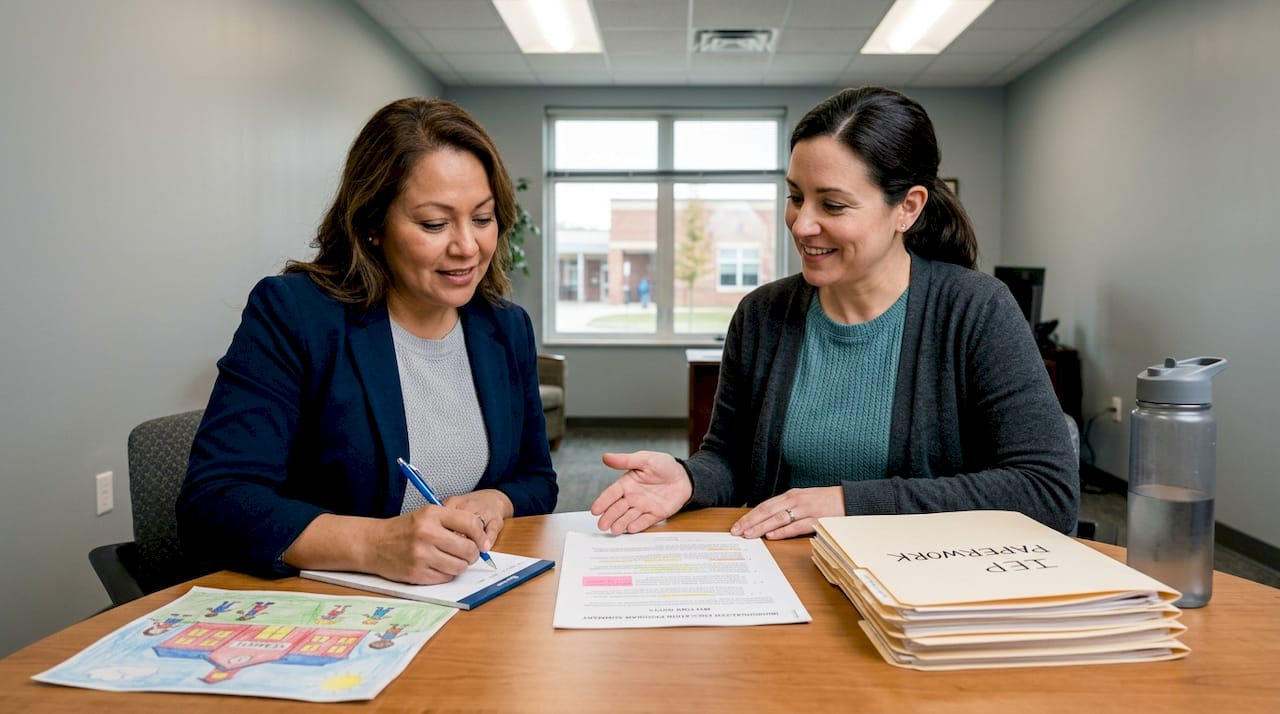
What makes an IEP powerful is how specific it can be. A vague goal like “improve communication” helps no one. A strong IEP goal looks like this: “When given a picture prompt, the student will initiate a conversation with a peer for five turns, three times per week, across two settings, with 80% accuracy over four consecutive weeks.” That goal is measurable. You know exactly when your child has met it.
How IEPs come together in practice:
- Evaluation: Your child is assessed by a multidisciplinary team including teachers, speech therapists, and psychologists.
- Meeting: Parents, teachers, and specialists collaborate to write the IEP. You are a core member of this team, not just a bystander.
- Goal setting: Goals are written in SMART format. Specific, Measurable, Achievable, Relevant, and Time-bound.
- Accommodations: These might include extended time on tests, preferential seating, noise-canceling headphones, visual schedule boards, or a quiet space for sensory breaks.
- Review: IEPs are formally reviewed annually, but you can request a review at any time if your child isn’t making expected progress.
Common accommodations included in IEPs for children with autism often involve visual supports like picture boards, first-then charts, and color-coded routines. Speech and language therapy targets both expressive and receptive language. Sensory adjustments, like dimmed lighting or fidget tools, reduce environmental barriers to learning.
You can get more practical guidance on navigating IEP success tips to make sure your child’s plan actually gets implemented well, not just written well. For families looking for programs that already integrate strong inclusive autism supports, locating the right school environment makes all the difference.
Pro Tip: Before every IEP meeting, prepare a one-page summary of your observations at home. Teachers see your child for six hours a day; you see the full picture. Your input changes the document.
Structured teaching (TEACCH): Visual and environmental supports
If your child learns better when they know exactly what to expect, structured teaching methods may be a strong match. TEACCH, which stands for Treatment and Education of Autistic and Communication Handicapped Children, was developed at the University of North Carolina and is now used in schools and clinics across the country.
TEACCH uses visual cues, organized workspaces, and predictable routines to increase independence and reduce anxiety. The method is built around a core insight: when the environment communicates clearly, the child doesn’t have to rely as much on verbal instructions, which is a major barrier for many autistic students.
Practical TEACCH examples in real classrooms:
- Color-coded bins on a desk tell a student which task comes first, second, and third without requiring a teacher prompt.
- A picture schedule on the wall shows the sequence of the day from arrival to dismissal.
- A visual menu for snack time lets a nonverbal child make choices independently.
- A “finished” box reduces anxiety by clearly showing the child when a task is complete.
In terms of evidence, TEACCH shows small effects on overall skill development but moderate positive effects on social behavior and reducing maladaptive behavior. This makes it particularly effective for students who exhibit anxiety-driven behavior or who struggle in unstructured environments.
| TEACCH component | Purpose | Example |
|---|---|---|
| Visual schedule | Reduces anxiety around transitions | Picture cards showing daily routine |
| Organized workspace | Supports task completion | Left-to-right bin system |
| Structured tasks | Builds independent work habits | Matching or sorting activities |
| Clear “finished” signal | Reduces uncertainty | Completed work basket |
One edge case worth noting: children who struggle with transitions may resist even well-designed visual schedules at first. The key is gradual introduction, starting with just two steps before expanding to a full-day schedule.
Pro Tip: You can bring TEACCH principles home without any special training. A simple morning routine chart with photos of your child completing each step (brush teeth, get dressed, eat breakfast) builds the same independence skills in a familiar environment.
Applied Behavior Analysis (ABA): Step-by-step skill building
Applied Behavior Analysis is one of the most researched interventions for autism. It works by breaking complex skills into smaller, manageable steps, using positive reinforcement to build those skills systematically, and collecting data at every stage to measure progress.
ABA meta-analyses show moderate to large effects on adaptive behaviors, with language outcomes showing an effect size of SMD=0.42 and daily living skills at SMD=0.36. In plain terms: structured ABA programs tend to produce real, measurable improvements, particularly in communication and self-care.
How ABA looks step by step for a real skill:
- Target skill: Teaching a child to independently request a preferred item.
- Task analysis: Break it into micro-steps: look at item, point to item, vocalize or use AAC device, wait for response.
- Reinforcement: Every successful step is immediately rewarded with something meaningful to the child.
- Data collection: The therapist records accuracy at each step during every session.
- Generalization: The skill is then practiced with different people, in different settings, to ensure it sticks.
However, ABA has a complicated reputation, and as a parent, you deserve the full picture. ABA faces criticism from neurodiversity advocates who argue that some programs focus on eliminating autistic traits rather than building genuine skills, which can promote masking over authentic self-expression. Quality matters enormously in ABA. A program focused on compliance-based drills looks very different from one built around child-led play and natural environment teaching.
“The best ABA is indistinguishable from good teaching. The worst is indistinguishable from compliance training. Know the difference before you enroll your child.” — Paraphrased from current ABA reform discussions in the autism community.
Families looking for thoughtful, quality-driven providers can explore ABA providers for autism or search for high-quality ABA services that align with both effectiveness and ethical, child-centered practice.
Comparing popular special education strategies: Which works best?
Now that you understand each approach on its own, here’s how they stack up side by side.
| Strategy | Core approach | Strongest evidence for | Potential drawbacks | Best fit |
|---|---|---|---|---|
| IEP | Individualized legal plan | All areas; framework for all supports | Quality depends on school team | Every student with autism |
| TEACCH | Visual, structured environment | Social behavior, anxiety reduction | Less effective without consistency | Students needing predictability |
| ABA | Behavioral skill steps, reinforcement | Language, adaptive skills | Risk of masking if poorly implemented | Students with behavioral or skill gaps |
No single strategy wins across the board. ABA is effective per meta-analyses but critiqued ethically, while TEACCH shows moderate effects on social and maladaptive behavior with fewer ethical concerns in current practice. IEPs are not a strategy by themselves, but they are the vehicle that makes any strategy legally binding and consistently delivered.
What to consider when choosing:
- A child who thrives on routine and visual clarity is likely to respond well to TEACCH.
- A child with significant language delays or behavioral challenges may benefit most from structured ABA with a skilled, ethical provider.
- Every child benefits from a well-written IEP regardless of which therapy approaches supplement it.
- Family values and comfort with the approach matter. If you’re uncomfortable with a method, it won’t be implemented consistently at home.
The most effective education plans for children with autism tend to blend elements from multiple approaches, guided by what that specific child shows you they need.
Why special education is not one-size-fits-all: Lessons from experience
Here is something the research papers don’t always say plainly: the families who see the most growth in their children are rarely the ones who found the “best” method. They’re the ones who stayed curious, questioned when things weren’t working, and refused to let any professional tell them their child had reached a ceiling.
We’ve seen parents handed a fully laminated TEACCH system that sat unused because nobody taught the child how to use it. We’ve seen ABA programs run for years with perfect data sheets and zero real-world skill transfer. We’ve seen IEPs with beautiful SMART goals that were never actually addressed in the classroom.
The method matters less than the execution, the relationships, and the ongoing dialogue between families and providers. A child who feels safe with a teacher will learn from almost any approach. A child who feels coerced will shut down inside the most evidence-based program in the world.
Rigid adherence to one approach also misses something important. Autism doesn’t stay static. A strategy that was perfect at age five may need to evolve significantly by age nine. The children who make the most meaningful progress tend to have families who treat the education plan as a living document, not a policy manual.
Parent advocacy is not optional in this process. It is the single most powerful variable in long-term outcomes. Knowing your rights, asking pointed questions, requesting data, and celebrating unconventional wins are skills you can build. The real-world special education strategies that matter most come from parents who learned to trust their knowledge of their child while building collaborative relationships with the professionals around them.
Find autism-specialized education and therapy resources near you
Understanding these strategies is a great first step, but applying them requires connecting with the right providers and programs for your child’s specific needs. At Autism Doctor Search, we maintain an up-to-date directory of resources across ABA therapy, special education schools, occupational therapy, and more, so you can search by location and find professionals who specialize in exactly what your child needs.
Whether you’re ready to find autism therapy services in your area, compare ABA therapy providers who align with your family’s values, or explore special schools for autism that go beyond traditional classrooms, our directory gives you a curated starting point. You deserve resources that are matched to your child, not generic referrals.
Frequently asked questions
What is a practical example of a SMART goal in a special education IEP for autism?
A SMART goal for autism might read: “The student will initiate a conversation with a peer for five turns, three times per week across two settings, with 80% accuracy over four consecutive weeks,” making progress specific and trackable.
Is TEACCH more effective than ABA for children with autism?
They serve different purposes. ABA versus TEACCH outcomes show ABA has stronger evidence for language and adaptive skills, while TEACCH has moderate effects on social behavior and suits students who need structured, predictable environments.
Why do some experts and advocates criticize ABA therapy?
ABA criticism from advocates centers on concerns that some programs prioritize eliminating autistic behaviors over authentic development, which can encourage masking; families should evaluate provider philosophy carefully before committing.
How can I ensure my child’s special education plan is working?
Review measurable goal data at least quarterly, observe your child’s behavior across home and school settings, and formally request an IEP revision meeting if milestones are consistently not being met. Your voice in that process carries legal weight.