


TL;DR:
- The DSM-5 merged Asperger’s into Autism Spectrum Disorder, recognizing it as a continuous range of presentations.
- Support needs differ widely among children with ASD, emphasizing personalized evaluation and interventions.
Most parents raising a child who seems “different” in social situations have heard both terms thrown around at pediatrician visits, school meetings, and online forums. Autism. Asperger’s. High-functioning. Spectrum. The terminology shifts depending on who is speaking, what decade their training was in, and what resource you’re reading. That confusion is not your fault. The official definitions actually changed, and many professionals, schools, and support groups are still catching up. This guide will walk you through exactly what changed, what it means for your child’s diagnosis, and how to focus your energy on what truly matters: getting your child the right support.
Table of Contents
- How did autism and Asperger’s diagnoses change?
- What is Autism Spectrum Disorder (ASD)?
- Profiles once called Asperger’s: What do they mean for support?
- Getting an autism diagnosis: What families need to know
- Why the labels matter less than support
- Find personalized autism support and resources
- Frequently asked questions
Key Takeaways
| Point | Details |
|---|---|
| Autism and Asperger’s unified | Asperger’s is no longer diagnosed separately; both are now part of Autism Spectrum Disorder. |
| Tailored support matters | Support and interventions should be based on an individual child’s needs, not old labels. |
| Early diagnosis is critical | Timely evaluation helps families access resources and therapies sooner. |
| Spectrum means diversity | Autistic children have a wide range of abilities and support needs. |
How did autism and Asperger’s diagnoses change?
For many years, Asperger’s syndrome and autism were treated as separate conditions. Parents whose children spoke fluently, showed strong intellectual ability, but struggled socially were often told their child had “Asperger’s,” not autism. That distinction felt meaningful. It shaped school plans, therapy approaches, and even how families understood their children.
Then the rules changed.
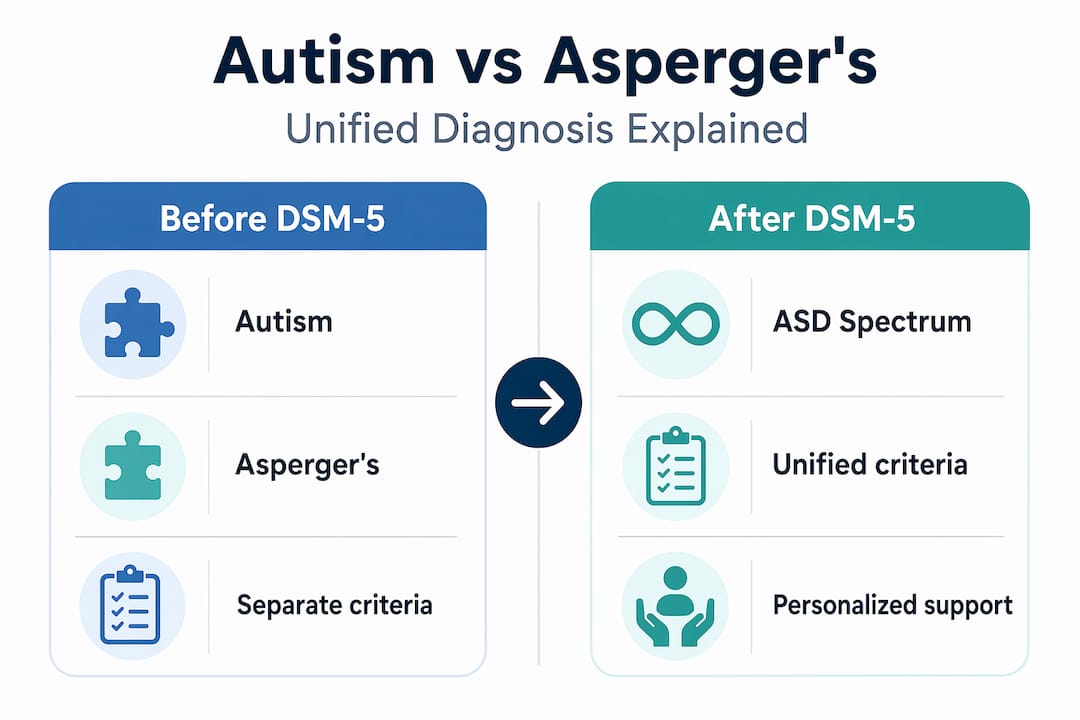
In 2013, the American Psychiatric Association released the fifth edition of the Diagnostic and Statistical Manual of Mental Disorders, known as the DSM-5. The updated DSM-5-TR (text revision) continued this approach. Asperger’s disorder is no longer a separate diagnosis. It is now officially subsumed under Autism Spectrum Disorder (ASD), along with childhood disintegrative disorder and other previously distinct conditions.
Here is a comparison of how the diagnostic categories shifted:
| Old DSM-IV terms | DSM-5 / DSM-5-TR classification |
|---|---|
| Autistic Disorder | Autism Spectrum Disorder (ASD) |
| Asperger’s Disorder | Autism Spectrum Disorder (ASD) |
| Childhood Disintegrative Disorder | Autism Spectrum Disorder (ASD) |
| Pervasive Developmental Disorder (PDD-NOS) | Autism Spectrum Disorder (ASD) |
This shift was not cosmetic. It was a deliberate move to recognize that autism and Asperger’s are not two fundamentally different conditions but rather different presentations within one continuous spectrum. The evidence showed more similarities than differences in brain structure, genetics, and long-term development.
What does this mean in practice? A child who would have received an Asperger’s diagnosis before 2013 now receives an ASD diagnosis. You may still hear clinicians or teachers use the term “Asperger’s” informally to describe a profile or communication style. Some families connect with organizations like Asperger’s Alliance that use identity-first language around this profile. That is perfectly valid. Culturally and personally, the term carries meaning. Diagnostically, however, it no longer exists as a separate category.
Key takeaway: If your child currently carries an Asperger’s diagnosis from before 2013, that history is still relevant. It informs their profile and support needs. But going forward, any new evaluation will use ASD criteria.
What is Autism Spectrum Disorder (ASD)?
ASD is defined by two core feature areas. The first is persistent challenges in social communication and social interaction. The second is restricted, repetitive patterns of behavior, interests, or activities. According to NIMH, people with ASD often have difficulty with social communication and interaction, restricted interests, repetitive behaviors, and symptoms that affect daily functioning.
These are the official criteria. But it is equally important to understand what the word “spectrum” means in real life. A spectrum does not mean “a little autistic” to “very autistic” along a single straight line. It means a wide and varied set of profiles. Two children, both with an ASD diagnosis, can look completely different from each other.
Here is a practical breakdown of how ASD features may look across different children:
| Feature area | Presentation that was once “Asperger’s” | Presentation that was once “classic autism” |
|---|---|---|
| Verbal communication | Fluent, sometimes advanced vocabulary | Limited or nonverbal |
| Social interaction | Difficulty reading social cues, wants connection | May prefer solitary activity, limited eye contact |
| Repetitive behaviors | Intense, focused interests on specific topics | Repetitive movements, strict routines |
| Cognitive ability | Average to above-average | Ranges widely |
| Early language delay | Typically absent | Often present |
Common features of ASD that families observe:
- Difficulty starting or maintaining back-and-forth conversation
- Missing nonverbal cues like tone of voice, facial expressions, or body language
- Intense focus on specific topics or objects that others may not share
- Strong preference for predictable routines and significant distress when they change
- Sensory sensitivities, including reactions to sounds, textures, or lights
- Challenges understanding unwritten social rules in friendships or group settings
The scale of the challenge is significant. About 1 in 31 children aged 8 years in the United States have been identified with ASD, based on the CDC’s most recent surveillance data from 2022. That is a number that has grown steadily over the past two decades, partly because awareness has improved and more children are being identified and evaluated earlier.
For families who want a deeper foundation before their child’s evaluation, the ASD prevalence family guide offers a practical overview of what these numbers mean for communities and schools.
Profiles once called Asperger’s: What do they mean for support?
Many parents whose children are verbal, academically on track, and socially motivated but struggling still wonder whether “autism” really fits their child. It can feel jarring to see that word on a report when their child is telling complex stories or showing a deep passion for astronomy or history. Here is the most important thing to understand: the label does not determine the support. The individual profile does.

ASD criteria now officially subsume what was once called Asperger’s, but a child’s specific profile still guides every therapy and educational decision. A child who is highly verbal and intellectually able but struggles to navigate friendships, manage anxiety, or handle unexpected changes still has real and significant support needs. Those needs just look different from those of a child who is nonverbal and requires intensive behavioral support.
Here is how families can approach support for a child with a former Asperger’s profile:
- Prioritize a comprehensive evaluation. Make sure your child is assessed by a professional who evaluates social communication, sensory processing, executive function, and anxiety, not just academic ability.
- Ask about social skills therapy. Children with this profile often benefit most from targeted social communication strategies, sometimes through group-based programs or speech-language therapy.
- Explore school accommodations. Even without a significant academic gap, your child may need formal support through an IEP (Individualized Education Program) or a 504 plan for flexibility in assignments, sensory accommodations, or social coaching.
- Address co-occurring conditions. Anxiety, ADHD, and sensory processing differences are especially common among children with profiles once described as Asperger’s. Treating those alongside social communication support often produces better outcomes.
- Connect with specialized resources. Organizations like the Center for Children with Special Needs offer tailored programming for children across the spectrum, including those with complex but less visible profiles.
Pro Tip: When meeting with your child’s school team, bring a written summary of your child’s specific strengths and challenges rather than relying on the diagnostic label alone. A teacher who knows “my child understands instructions best when given one step at a time, needs quiet space for sensory breaks, and benefits from visual schedules” will do more than a teacher who just sees “ASD” in a file.
Understanding what autism-friendly classroom features look like can also help you ask the right questions at school meetings and advocate more effectively.
Remember: “High-functioning” is not a diagnostic term. It is a shorthand that varies widely and can actually mask support needs. A child who appears to be managing well at school may be exhausted and struggling significantly at home. Always look at the full picture.
Getting an autism diagnosis: What families need to know
The evaluation process for ASD can feel overwhelming, especially if you are not sure where to start or what to expect. Let’s walk through it clearly.
- Start with your pediatrician. At well-child visits, pediatricians use screening tools like the M-CHAT-R (Modified Checklist for Autism in Toddlers, Revised) to flag children who may need further evaluation. If your child is school-aged and you have concerns, you can still request a referral at any age.
- Request a comprehensive developmental evaluation. A full ASD evaluation typically involves a developmental pediatrician, child psychologist, or a multidisciplinary team. They will observe your child, interview you about developmental history, and use standardized tools like the ADOS-2 (Autism Diagnostic Observation Schedule).
- Do not wait for a perfect moment. ASD can usually be reliably diagnosed by age 2, and symptoms are often visible in the first two years of life. Early identification directly enables earlier access to therapies and resources.
- Understand what the evaluation does not include. There is no blood test or X-ray that diagnoses ASD. Diagnosis is based entirely on behavioral observation and developmental history. Any provider who promises a biological test for autism diagnosis is not following established guidelines.
- Use the report to drive action. The evaluation report is more than a label. It should include specific recommendations for therapy, school support, and follow-up assessments. Ask your evaluator to walk you through it and explain how each recommendation connects to what they observed.
Pro Tip: If your child is already school-aged and you cannot access a private evaluation quickly due to cost or waitlists, contact your local school district directly. Under federal law (IDEA), public schools are required to evaluate children suspected of having a disability at no cost to families. This is an underused pathway that can speed up access to support significantly.
Early diagnosis helps families begin the right supports sooner, which is why acting on concerns quickly matters so much. For a fuller picture of what comes after diagnosis, the autism support strategy guide is a practical resource for next steps. Families looking for culturally specific perspectives may also find value in exploring the autism developmental disorders overview available through our directory.
Why the labels matter less than support
Here is an honest opinion: the debate over “autism vs Asperger’s” has, in many cases, distracted families from the work that actually helps children.
We have seen parents spend months trying to find a provider who will use the word “Asperger’s” because they believe it will unlock different resources or a more favorable school response. We have also seen the opposite, families who resist an ASD diagnosis because they fear stigma, only to watch their child go without support for years. Neither of those paths serves the child well.
The shift to a single ASD diagnosis was meant to simplify and unify, and largely it has. It removes artificial cutoffs that sometimes denied services to children who genuinely needed them. A child who was “too high-functioning” for autism supports under old criteria but obviously struggling could now access services more easily under the ASD umbrella.
What labels cannot do is tell you how to support your specific child. Two children with identical ASD diagnoses may need completely different approaches. One may thrive with ABA (Applied Behavior Analysis) therapy. Another may need social communication therapy and anxiety management above all else. Neither label nor diagnostic category tells you which path to take. Only knowing your child does.
This is why we encourage families to connect with providers and organizations that understand the full range of ASD profiles. Resources focused on support for Asperger’s profiles can be genuinely valuable for families whose children present with highly verbal, intellectually able profiles, precisely because those children’s support needs are sometimes overlooked or minimized.
The most powerful thing you can do is stay curious about your child’s specific experience, not the diagnosis category they fall into.
Find personalized autism support and resources
Navigating therapy options, school placements, and clinical evaluations is a lot to manage on your own. That is exactly why a well-organized directory of autism resources matters. Whether your child needs autism therapy services tailored to their communication profile, specialized programming through a center for special needs autism, or guidance on finding the right school through our autism school guide for parents, Autism Doctor Search connects you with verified providers and resources across ABA therapy, occupational therapy, special education, mental health services, and more. You should not have to figure this out alone, and with the right directory, you do not have to.
Frequently asked questions
Is Asperger’s still diagnosed in 2026?
No, Asperger’s is no longer a separate diagnosis. It is officially part of Autism Spectrum Disorder (ASD) per DSM-5 and DSM-5-TR, though some families and clinicians still use the term informally to describe certain profiles.
How early can autism usually be diagnosed?
Autism can be reliably diagnosed by age 2, and symptoms often appear in the first two years of life, making early evaluation especially valuable.
Can a child with ASD have strong verbal and intellectual skills?
Yes. ASD is a spectrum with a wide range of characteristics, and some children are highly verbal and intellectually able while still having real social communication and support needs.
Is there a blood test or X-ray to diagnose ASD?
No. ASD diagnosis relies entirely on behavioral observation and developmental history evaluated by a qualified professional, not on any laboratory or imaging test.
What does “spectrum” mean in autism?
It means autism varies significantly by individual. Support needs, symptoms, and abilities range widely from person to person, which is why personalized evaluation and individualized support matter so much.


