
Early childhood intervention (EI) is a federally supported system of services for infants and toddlers, from birth through age 2, who have developmental delays or disabilities. Under IDEA Part C, states are required to evaluate eligible children and provide coordinated services, with each child’s supports documented in a legally binding Individualized Family Service Plan (IFSP). If you’re worried about your child’s development right now, don’t wait for a diagnosis. Contact your pediatrician or call your state’s early intervention program directly and ask for a referral.
Table of Contents
- What does early childhood intervention cover?
- Who qualifies for early intervention services?
- What signs should prompt you to ask for a screening?
- How do you start the early intervention process?
- What happens during the evaluation?
- What is an IFSP and what services does it include?
- Where do services happen, and what is the coaching model?
- Who pays for early intervention services?
- What happens when your child turns 3?
- How do you find local services and what resources help?
- Key Takeaways
- Why early action matters more than certainty
- Find local therapy and autism services through Autismdoctorsearch
- Useful sources
What does early childhood intervention cover?
Early childhood intervention addresses five core developmental domains. Services are designed to meet children where they are across all of them, not just the area where a delay is most obvious.
- Cognitive development: problem-solving, learning, memory, and attention
- Physical development: gross motor skills (crawling, walking) and fine motor skills (grasping, hand control)
- Communication: both receptive language (understanding) and expressive language (speaking, gesturing)
- Social-emotional development: relating to caregivers, regulating emotions, and engaging with peers
- Adaptive development: self-care skills like feeding, dressing, and daily routines
The federal age range under IDEA Part C is birth through age 2, meaning services typically end at the child’s third birthday, when transition to preschool-level supports begins. Some states extend certain services or offer parallel programs for children up to age 5 or 6, so it’s worth checking your state’s specific rules.
Why does the early age focus matter? The first three years of life represent a period of rapid brain development. Neural connections form at a pace that slows significantly after early childhood, which means targeted support during this window can have lasting effects on how a child learns, communicates, and relates to others. The role of early childhood services in shaping long-term outcomes is well documented across developmental research.
Who qualifies for early intervention services?
Eligibility under Part C falls into two main categories: a measured developmental delay or a diagnosed physical or mental condition that has a high probability of causing a delay. States set their own specific thresholds, so a child who qualifies in one state might not meet the cutoff in another.
Common examples of delays or conditions that prompt evaluation include:
- Communication domain: limited babbling by 9 months, no single words by 16 months, or loss of previously acquired language
- Motor domain: not sitting independently by 9 months, not crawling by 12 months, or significant asymmetry in movement
- Social-emotional domain: limited eye contact, not responding to name by 12 months, or minimal interest in social interaction
- Adaptive domain: persistent feeding difficulties, trouble transitioning between activities, or limited self-soothing
- Cognitive domain: not imitating actions or sounds, limited exploration of objects, or poor attention to faces
One thing parents often don’t realize: a formal diagnosis is not required to request an evaluation. If your child shows signs of delay in any domain, you can ask for an evaluation based on your concerns alone. States may also use informed clinical opinion alongside standardized assessments, meaning a child who doesn’t hit a numeric cutoff on a test can still be found eligible if qualified evaluators see clear functional concerns.
What signs should prompt you to ask for a screening?
The short answer: trust your instincts and act early. Guidance from Understood.org consistently emphasizes that early, functional support can reduce the need for more intensive services later, and that framing evaluation around what a child can gain, rather than what label they might receive, helps families move forward.
Here are age-banded red flags to watch for:
0–6 months
- Not making eye contact or social smiles by 2 months
- Not responding to sounds or voices
- Very limited movement of arms or legs
6–12 months
- No babbling by 9 months
- Not reaching for objects
- Not responding to their name by 10 months
12–24 months
- No single words by 16 months
- Not pointing or waving by 12 months
- Loss of any previously acquired language or social skills
24–36 months
- Fewer than 50 words by 24 months, or no two-word phrases
- Significant difficulty with transitions or daily routines
- Limited interest in other children
Any one of these is enough reason to ask for a screening. You don’t need to see delays across multiple domains, and you don’t need to be certain something is wrong.
Pro Tip: When you call your pediatrician, you don’t need to frame it as “I think my child has a problem.” Simply say: “I have some developmental concerns and I’d like a referral for an early intervention evaluation.” That’s all it takes to start the process.
How do you start the early intervention process?
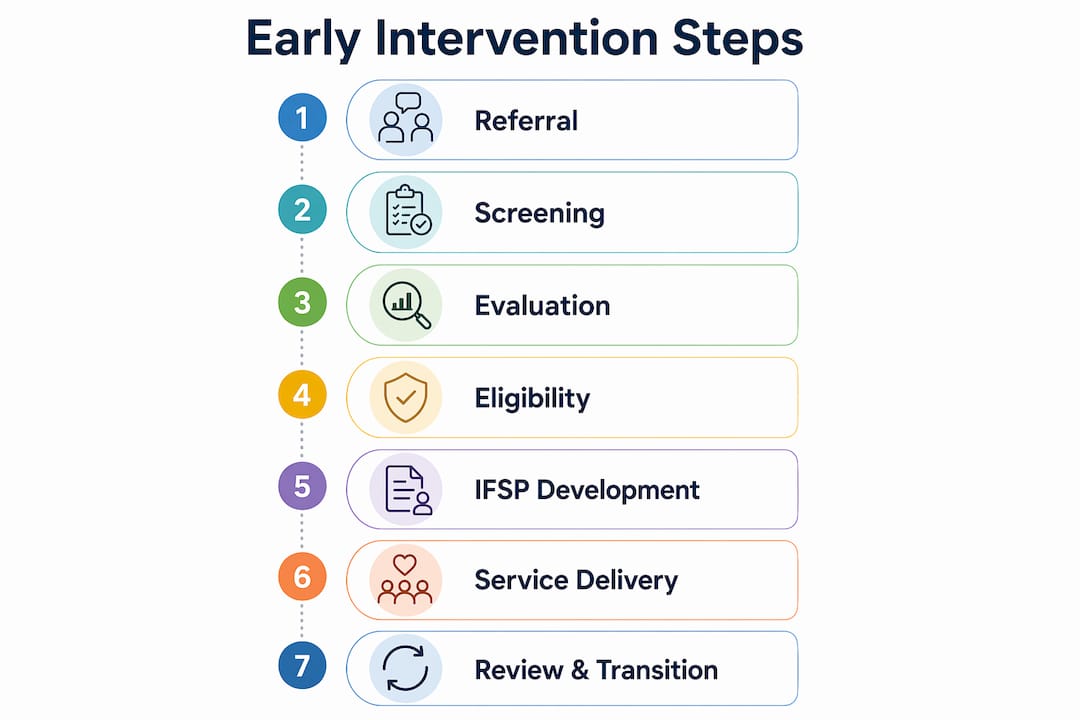
The referral-to-services pathway is structured and time-bound under federal law. Here’s how it works, step by step:
- Make a referral. Anyone can refer a child, including parents, pediatricians, hospital staff, childcare providers, or social workers. You can also self-refer by contacting your state’s EI program directly.
- Intake and initial contact. The EI program contacts the family, typically within a few days of receiving the referral, to explain the process and schedule next steps.
- Give written consent. Before any evaluation begins, you must provide parental informed written consent. No evaluation or service can start without it.
- Multidisciplinary evaluation. A team of qualified professionals evaluates your child across developmental domains.
- Eligibility determination. The team reviews results and determines whether your child qualifies.
- IFSP meeting. If eligible, the team meets with you to develop the Individualized Family Service Plan.
The federal 45-day rule: Under 34 CFR 303.310, the evaluation, assessment, and initial IFSP meeting must all be completed within 45 days of the program receiving the referral. Mark the referral date on your calendar and follow up if you haven’t heard about scheduling within the first two weeks.
Your written consent is required at two key points: before evaluation begins and before services start. You have the right to accept or decline any specific service, and you can withdraw consent at any time.
What happens during the evaluation?
Screening and full evaluation are two different things, and it helps to know which one you’re being offered.

| Screening | Full Evaluation | |
|---|---|---|
| Purpose | Identify children who may need further assessment | Determine eligibility and inform IFSP development |
| Depth | Brief, standardized tools | Comprehensive, multidisciplinary |
| Who conducts it | Pediatrician, nurse, or EI intake staff | Team of qualified specialists |
| Outcome | Pass/refer decision | Eligibility determination and assessment report |
A full multidisciplinary evaluation may involve several specialists, depending on your child’s areas of concern:
- Speech-language pathologist (communication, feeding, language)
- Occupational therapist (fine motor, sensory processing, adaptive skills)
- Physical therapist (gross motor, movement, posture)
- Developmental specialist or early childhood educator
- Psychologist (cognitive development, behavior, social-emotional)
- Audiologist (hearing, auditory processing)
Assessment results are used in two ways: first, to determine whether your child meets your state’s eligibility criteria; second, to identify specific strengths and needs that will shape the outcomes and services written into the IFSP. You receive a copy of the evaluation report, and you have the right to disagree with the findings and request an independent evaluation.
What is an IFSP and what services does it include?
The Individualized Family Service Plan is the legal document that guides everything once your child is found eligible. It’s not a school plan or a clinical treatment protocol. It’s a family-centered, legally binding plan that reflects your child’s development, your family’s priorities, and the services your child will receive, with all the specifics written in.
Under 34 CFR 303.342, the IFSP must be reviewed at least every six months and fully rewritten annually. That review schedule exists because children at this age change quickly, and a plan written in January may need significant updates by July.
Required components of an IFSP
| Component | What it covers |
|---|---|
| Present levels of development | Child’s current functioning across all five domains |
| Family information | Family’s priorities, resources, and concerns |
| Measurable outcomes | Specific goals for the child and family |
| Services | Type, frequency, duration, intensity, and method of delivery |
| Natural environment statement | Where services will be provided, with justification if not in a natural setting |
| Service coordinator | Named person responsible for coordinating and monitoring services |
| Transition plan | Steps for moving to Part B preschool services at age 3 |
“The IFSP is intentionally a ‘family plan.’ Teams collect information about family priorities, routines, and resources so outcomes fit the child’s real-life context rather than only clinical milestones.” — Parent Center Hub IFSP guidance
Common services families receive
EI services vary by child, but the most frequently included supports are:
- Speech-language therapy (communication, feeding, swallowing)
- Occupational therapy (fine motor, sensory, adaptive skills)
- Physical therapy (gross motor, movement)
- Service coordination (navigating the system, connecting to resources)
- Family training and home visits (coaching caregivers on daily strategies)
- Social work services
- Audiology
- Nutrition services
The IDEA regulations at 34 CFR 303.344 require that each service listed in the IFSP include the projected start date, frequency, duration, intensity, and method of delivery. If any of those details are missing from your child’s plan, ask the team to fill them in before you sign.
Where do services happen, and what is the coaching model?
Under IDEA Part C, services must be provided in “natural environments” to the maximum extent possible. That’s a legal standard, not just a preference. Natural environments include the home, a childcare setting, a playground, a library, or any place where the child typically spends time with family.
What this looks like in practice: a speech therapist doesn’t just work with your child for 45 minutes and leave. They coach you, the caregiver, on how to embed language-building strategies into bath time, mealtimes, and play. The family-centered coaching model treats parents as the primary agents of change, because you’re with your child far more hours each day than any therapist can be.
If a clinic-only approach is proposed and your child’s needs could reasonably be addressed in a natural setting, you have the right to ask for justification and request alternatives. The natural environment standard is explicit on this point.
Practical ways to get the most from home visits:
- Write down two or three specific situations where you’re struggling (e.g., mealtimes, transitions, bedtime) and share them at the start of each visit
- Ask the therapist to demonstrate a strategy, then try it yourself while they observe and give feedback
- Keep a simple log between visits: what you tried, what worked, what didn’t
- Bring your child’s actual daily routine into the conversation, not just the “problem” moments
Pro Tip: Embedding strategies into daily routines, rather than treating therapy as a separate activity, is what parent coaching research consistently shows produces the strongest gains. Ask your therapist: “What’s one thing I can do during breakfast this week?”
Who pays for early intervention services?
Cost is one of the first things parents worry about, and the answer is more reassuring than most expect. Many EI services are provided at no cost to families under Part C, though the specifics depend on your state.
Primary funding sources include:
- IDEA Part C federal and state funds: The federal government appropriated $540 million for Part C in FY2025. States supplement this with their own funds and are required to make services available to all eligible children.
- Medicaid/EPSDT: Early and Periodic Screening, Diagnostic and Treatment (EPSDT) coverage through Medicaid can pay for many EI services for eligible children.
- Private insurance: Some states require EI programs to bill private insurance first, though states cannot deny services if insurance doesn’t cover them.
- State supplement programs: Many states have additional funds that cover services not reimbursed by other sources.
Ask your service coordinator directly: “What will my family be billed for, and what is covered?” Service coordinators are required to help families understand and navigate funding, and connecting with one early is one of the most practical steps you can take. The ECTA Center describes service coordinators as the practical anchor for families navigating multiple agencies, and that’s accurate.
What happens when your child turns 3?
Transition planning doesn’t start at age 3. It starts well before the child’s third birthday, and the steps must be written into the IFSP itself. Federal guidance from Head Start recommends beginning transition planning at least six months before the third birthday.
Key transition activities to expect:
- A formal referral to the local education agency (LEA) for Part B preschool evaluation
- A summary of your child’s progress and current needs shared with the receiving program
- Meetings with the preschool team to discuss potential placement and services
- A transition conference that includes both EI and preschool representatives
- In some states, the option to extend Part C services past age 3 under certain conditions
The shift from Part C to Part B is significant. Part B services are governed by an Individualized Education Program (IEP) rather than an IFSP, and the focus shifts from family-centered coaching to school-based instruction. Understanding why diagnosis age matters can help you advocate for the right level of support during this transition.
Advocacy tip: before the transition conference, review your child’s IFSP and confirm that transition dates, referral steps, and responsible parties are all clearly written in. Vague language like “transition will be addressed” is not enough. Ask for specific dates and named contacts.
How do you find local services and what resources help?
Getting started is often the hardest part. Here’s a practical checklist for your first intake meeting:
- Birth certificate and insurance card
- Medical records, including any developmental screenings your pediatrician has done
- Notes on specific behaviors or concerns you’ve observed (dates and examples help)
- Questions written down in advance (see the early intervention checklist for parents for a ready-made list)
Trusted U.S. resources for finding your state program and understanding your rights:
- Parent Center Hub: State-by-state EI program contacts, IFSP guides, and family rights summaries
- ECTA Center: Technical assistance and state eligibility maps for Part C
- Understood.org: Plain-language guides for families navigating learning and developmental differences
- IDEA Part C regulations: The full federal rules, including timelines and required IFSP content
Once your child’s IFSP identifies specific service needs, the Autismdoctorsearch directory can help you locate local providers, including speech therapists, occupational therapists, ABA providers, and autism-focused clinics, to supplement or follow up on state EI services. Browse local assessment and therapy providers to see what’s available in your area.
Key Takeaways
Early childhood intervention under IDEA Part C gives children from birth through age 2 a federally protected right to evaluation and services, with the entire process from referral to initial IFSP meeting required to be completed within 45 days.
| Point | Details |
|---|---|
| No diagnosis needed | You can request an EI evaluation based on developmental concerns alone, without a formal diagnosis. |
| 45-day federal timeline | Under 34 CFR 303.310, evaluation and the initial IFSP meeting must happen within 45 days of referral. |
| IFSP review schedule | The IFSP is reviewed every six months and fully rewritten annually to reflect your child’s progress. |
| Services in natural settings | EI services are legally required to occur in natural environments like home or childcare whenever possible. |
| Autismdoctorsearch directory | Use the directory to find local speech therapists, OT providers, and ABA clinics after your IFSP identifies needs. |
Why early action matters more than certainty
The conventional wisdom in parenting circles is to “wait and see” when a child seems a little behind. I understand the impulse. Nobody wants to pathologize normal variation, and the fear of labeling a child too early is real. But the evidence points in one direction: the families who act on early concerns, even uncertain ones, consistently give their children more time in the window when intervention has the greatest effect.
What most guides don’t say plainly enough is that the EI evaluation itself is not a verdict. It’s information. A child can go through a full multidisciplinary evaluation and come out ineligible, which is genuinely useful to know. Or they can be found eligible and start receiving support that changes the trajectory of how they communicate, move, and connect with the people around them. Either outcome is better than waiting.
The coaching model deserves more attention than it usually gets. Parents who are coached to embed strategies into daily routines aren’t just helping their child during the therapy window. They’re building a different way of interacting with their child that persists long after EI ends. That’s the real leverage point, and it’s why the family-centered approach in Part C is structured the way it is.
Find local therapy and autism services through Autismdoctorsearch
Once your child’s IFSP identifies specific service needs, finding a qualified local provider quickly matters. Autismdoctorsearch gives you a searchable directory of autism-focused and therapy-related providers across the U.S., including ABA therapy centers, occupational therapists, speech-language providers, and medical clinics. If your IFSP recommends speech therapy or behavioral support and you want to compare local options or find a provider outside the state EI system, the directory is a practical starting point. Search autism therapy services near you to find providers in your area, and bring your results to the next IFSP meeting to discuss how they fit alongside your child’s state-funded services.
Useful sources
- IDEA Part C regulations (34 CFR Part 303) — Full federal rules governing early intervention, including natural environment standards and eligibility criteria
- 34 CFR 303.310 — Federal 45-day timeline — The specific regulation requiring evaluation and IFSP meeting within 45 days of referral
- 34 CFR 303.342 — IFSP review and timing — Six-month review and annual rewrite requirements
- 34 CFR 303.344 — Content of an IFSP — Required components including service details and transition planning
- Parent Center Hub — EI overview and IFSP guidance — State program contacts, family rights, and plain-language IFSP guides
- ECTA Center — Part C overview — Technical assistance, state eligibility maps, and interagency coordination resources
- Understood.org — Family guidance — Practical, accessible guides for families navigating developmental and learning differences
- PACER Center — What is Part C and what is an IFSP? — Family-friendly explanation of IFSP components and service coordinator role
- Head Start — IFSP tips and transition guidance — Practical IFSP guidance including transition planning timelines
- Autismdoctorsearch directory — Searchable directory of local autism therapy, OT, ABA, and special education providers across the U.S.