
TL;DR:
- Early childhood services support children from birth to age 3 through targeted interventions and family coaching. These services improve development in communication, cognition, and social-emotional skills by utilizing natural settings and parent involvement. Early referral, high-quality therapy, and proactive transition planning maximize the benefits for children with delays or autism.
Early childhood services are specialized programs designed to support children’s developmental progress through targeted interventions and family-centered coaching, with the most critical window running from birth to age 3. Under IDEA Part C, these programs deliver speech-language therapy, occupational therapy, physical therapy, and parent training directly in the home or natural environment. For parents of children with autism or developmental delays, understanding what these services do and how to access them is the difference between catching a challenge early and losing irreplaceable developmental time.
What is the role of early childhood services in child development?
Early childhood services target the period of greatest brain plasticity, making them the most effective tool available for children with developmental delays. The brain forms more neural connections in the first three years of life than at any other point. Intervening during this window produces gains that are simply not replicable later.

Federal law mandates that Early Intervention (EI) services include speech-language therapy, occupational therapy, physical therapy, developmental therapy, parent training, audiology, vision services, and social work. These are delivered in natural environments, meaning your home, a daycare setting, or a community space where your child already spends time. That setting matters because children learn and generalize skills best in familiar surroundings.
The family-centered model is the defining feature of modern early childhood programs. Therapists do not just work with your child. They coach you to embed strategies into daily routines like mealtimes, bath time, and play. This approach reduces family stress and builds your confidence as your child’s primary teacher.
How do early childhood services support cognitive, social, and emotional development?
Early childhood services target three interconnected developmental areas: cognition, social-emotional skills, and communication. Progress in one area consistently supports the others.
Cognitive growth through play and problem-solving
Therapists use structured play to build attention, memory, and problem-solving. A child who learns to take turns in a simple board game is also practicing impulse control and working memory. These are the same skills that predict academic readiness. Children who received EI services before age 3 showed higher third-grade test scores in English language arts and math in a study of 13,022 children. That finding confirms that early intervention produces measurable academic benefits years after services end.
Social-emotional skill building
Children with autism often struggle with joint attention, the ability to share focus on an object or event with another person. Therapists target this skill directly because it underpins language acquisition and social connection. Interactive therapy sessions teach children to read social cues, regulate emotions, and initiate communication. These gains reduce behavioral challenges at home and in preschool settings.
Language and communication development
Speech-language therapy is the most commonly requested EI service for children with autism. Therapists work on both receptive language (understanding what others say) and expressive language (communicating needs and ideas). Early and consistent speech therapy produces the largest gains in children who start before age 2. For children who are nonverbal, therapists introduce augmentative and alternative communication (AAC) tools to give them a reliable way to express themselves.
Key developmental areas addressed by early childhood services:
- Joint attention and social referencing for children with autism spectrum disorder
- Receptive and expressive language through speech-language therapy
- Fine and gross motor skills through occupational therapy and physical therapy
- Sensory processing to reduce meltdowns and improve daily functioning
- Cognitive flexibility through structured play and problem-solving activities
- Parent coaching to reinforce skills between therapy sessions
Pro Tip: Ask your child’s therapist to demonstrate one technique at each session that you can practice at home every day. Daily repetition in natural settings accelerates skill generalization far faster than weekly clinic visits alone.
What is the structure and process of early childhood services?
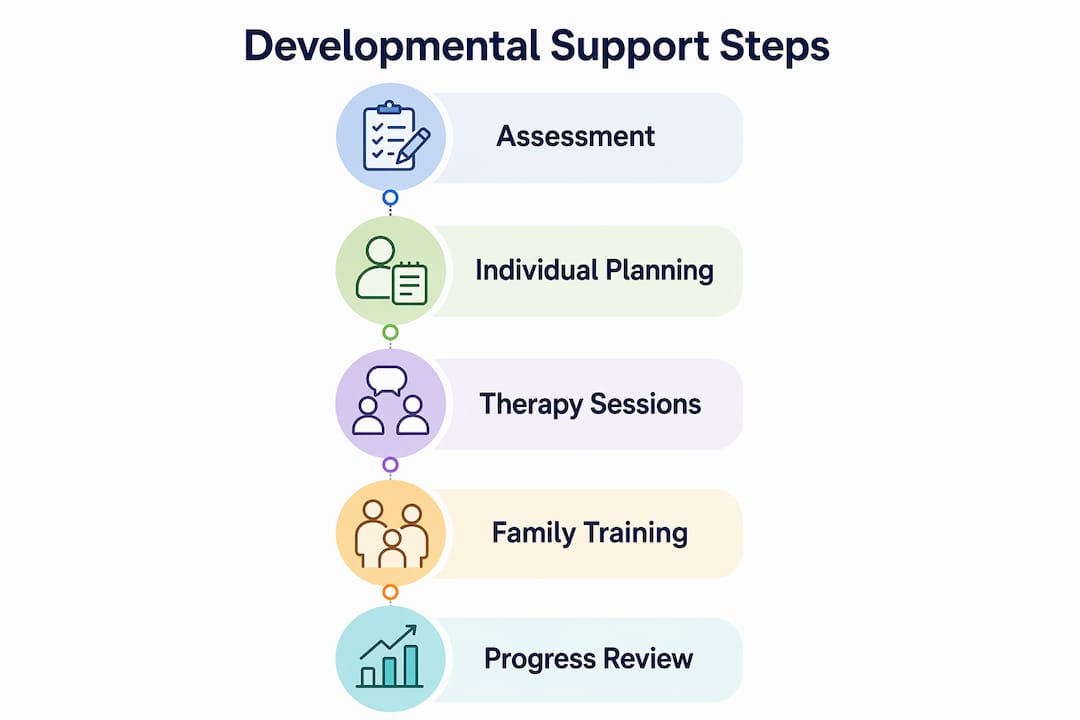
The EI process follows a defined sequence under IDEA Part C, and knowing each step helps you move through it without delays.
-
Referral. Any caregiver can self-refer directly to the state EI program without a doctor’s referral. Call your state’s program, which may go by different names depending on where you live. The referral triggers a mandatory evaluation timeline.
-
Evaluation. The state must complete a multidisciplinary evaluation within 45 days of referral. This evaluation is free and covers all developmental domains: cognitive, communication, physical, social-emotional, and adaptive behavior. You do not need insurance approval.
-
Eligibility determination. If your child qualifies, the team schedules an Individualized Family Service Plan (IFSP) meeting. Eligibility is based on a documented developmental delay or a diagnosed condition with a high probability of delay, such as autism spectrum disorder.
-
IFSP development. The IFSP is a written plan that outlines your child’s current abilities, family priorities, measurable goals, and the specific services your child will receive. You are a full member of the IFSP team. Your input on daily routines and family priorities shapes the entire plan.
-
Service delivery. Services begin as soon as possible after the IFSP is signed. Therapists come to your home, your child’s daycare, or another natural environment. Sessions focus on coaching you alongside direct work with your child.
-
Transition planning at age 3. EI services end when your child turns 3. Transition planning must start at least 90 days before the third birthday, but starting six months early gives you more time to prepare. At age 3, your child moves from an IFSP to a school-based Individualized Education Program (IEP), which operates under different eligibility rules and a different team.
The “age 3 cliff” is real. Many families are caught off guard when EI ends and school-based services do not automatically continue at the same level. Service coordinators play a critical role in preparing families for this transition, but proactive parent advocacy is the most reliable safeguard against gaps.
Pro Tip: Request your child’s transition meeting at least six months before their third birthday. Use that time to visit potential preschool programs and ask the school district for a full evaluation before EI services end.
What makes early childhood services effective for children with autism?
Effectiveness in autism early intervention comes from quality and fit, not just hours of therapy. A 2026 study in Frontiers in Psychiatry found that intervention quality and child-specific characteristics influence developmental outcomes more than total intervention hours. That finding challenges the assumption that more therapy time automatically means better results.
Two evidence-based approaches dominate the research:
- Early Intensive Behavioral Intervention (EIBI): Structured, data-driven therapy targeting specific skills through repeated practice. Meta-analyses of 105 studies show effect sizes of 0.5 to 0.76 across IQ, adaptive skills, and language for children who start early.
- Naturalistic Developmental Behavioral Interventions (NDBIs): Therapy embedded in play and daily routines, following the child’s lead while targeting specific developmental goals. NDBIs produce strong gains in communication and social skills with lower family burden.
The field is moving decisively toward parent-mediated strategies embedded in natural daily activities. This shift reduces family stress and improves skill generalization because children practice in the same contexts where they need those skills.
Parent empowerment is not a side benefit. It is a core outcome. A 2026 systematic review found that parents of preschool children with autism report high satisfaction with individualized interventions that strengthen their knowledge, confidence, and relationship with their child. When you understand why a strategy works, you use it consistently. Consistent use is what drives progress.
“Empowerment through knowledge and coaching is as important as direct child therapy in early intervention programs. Parents who understand the ‘why’ behind each strategy become their child’s most effective therapist.”
The autism remediation approaches that produce the best outcomes combine structured behavioral techniques with naturalistic, play-based delivery. The key variable is how well the approach fits your child’s specific profile, not which brand of therapy it carries.
Pro Tip: Ask your child’s therapist to explain the evidence base for each strategy they use. A good therapist welcomes that question and uses it to strengthen your partnership.
How can parents and caregivers maximize the benefits of early childhood services?
You are the most consistent presence in your child’s life. That makes you the most powerful factor in their progress. These steps help you get the most from EI services:
- Refer early. Do not wait for a formal diagnosis. Any caregiver can self-refer to the state EI program. Suspicion of a delay is enough to trigger a free evaluation.
- Attend every session actively. Watch, ask questions, and practice techniques alongside the therapist. Passive observation produces far less benefit than active participation.
- Implement strategies daily. Therapists typically visit once or twice a week. The real work happens in the hours between sessions. Use mealtimes, bath time, and play to practice target skills.
- Document your child’s progress. Keep a simple log of new words, behaviors, or skills. This record helps the IFSP team adjust goals and gives you concrete evidence of growth.
- Advocate at transition. Start asking about the age 3 transition process at least six months early. Request a school district evaluation before EI ends to avoid a gap in services.
- Seek family support resources to understand autism more deeply. The more you know, the more effectively you can collaborate with your child’s team.
The most common mistake families make is underutilizing services. Missed sessions, passive attendance, and delayed referrals all reduce outcomes. EI services are time-limited and free. Use every session fully.
Key Takeaways
Early childhood services produce the strongest developmental gains when they start before age 3, combine evidence-based therapy with daily parent coaching, and include proactive planning for the transition to school-based support.
| Point | Details |
|---|---|
| Start before age 3 | Brain plasticity peaks in the first three years; early referral produces the largest and most lasting gains. |
| Quality beats quantity | Intervention fit and parent-coaching quality drive outcomes more than total therapy hours. |
| Parents are co-therapists | Daily practice of therapist-taught strategies at home accelerates skill generalization significantly. |
| Plan the age 3 transition early | Request transition meetings six months before the third birthday to prevent gaps between EI and school services. |
| Self-referral is available | No doctor’s referral is needed; any caregiver can contact the state EI program directly for a free evaluation. |
What I’ve learned from watching families navigate early intervention
The families who get the most out of early childhood services share one trait: they show up as active participants, not passive recipients. I have seen parents transform from anxious observers into confident coaches within a few months of consistent engagement. That shift changes everything for the child.
The system is not always easy to navigate. State programs have different names, eligibility rules vary, and the age 3 transition can feel like falling off a cliff. But the families who start early, ask hard questions, and push for the right services consistently see better outcomes than those who wait for a professional to tell them what to do next.
What the research now confirms is something experienced practitioners have known for years: parent training for autism is not supplementary. It is central. The shift toward naturalistic, home-based models reflects a growing recognition that you, the caregiver, are the intervention. Therapists provide the tools and the coaching. You provide the repetition, the relationship, and the daily context that makes skills stick.
My strongest advice is this: do not wait for certainty. If something feels off in your child’s development, make the call today. The evaluation is free, the process is designed for families like yours, and the window you are protecting is one you cannot reopen.
— Keith
Autism therapy resources for families on Autismdoctorsearch
Autismdoctorsearch maintains a current directory of autism therapy providers, early intervention specialists, and family support programs across the United States. Whether you are looking for ABA therapy, occupational therapy, speech services, or parent training programs, the directory connects you with qualified local providers quickly. Finding the right provider early is one of the most concrete steps you can take right now. Browse the full list of autism therapy services on Autismdoctorsearch to find providers in your area who specialize in early childhood and family-centered care. The directory is updated regularly so you always see current, active listings.
FAQ
What are early childhood services under IDEA Part C?
Early childhood services under IDEA Part C are federally mandated programs for children from birth to age 3 who have developmental delays or qualifying conditions. Services include speech therapy, occupational therapy, physical therapy, and parent training, delivered in the home or natural environment at no cost to families.
Do I need a doctor’s referral to access Early Intervention?
No referral is needed. Any caregiver can contact their state’s EI program directly, and the evaluation is free. Many families do not realize this and wait unnecessarily for a pediatrician to initiate the process.
How effective is early intervention for children with autism?
Meta-analyses of 105 studies show effect sizes of 0.5 to 0.76 across IQ, adaptive skills, and language for children with autism who receive EIBI or NDBI approaches early and consistently. Children who received EI before age 3 also showed higher standardized test scores in third grade.
What happens to services when my child turns 3?
EI services end at age 3, and your child transitions from an IFSP to a school-based IEP. Eligibility rules change, and the team changes. Starting transition planning at least six months before the third birthday reduces the risk of a gap in services.
How do I know if my child qualifies for early childhood services?
Eligibility is based on a documented developmental delay in one or more areas, or a diagnosed condition with a high probability of delay. A multidisciplinary evaluation team assesses your child across cognitive, communication, physical, social-emotional, and adaptive domains. The evaluation is free and must be completed within 45 days of referral.