
TL;DR:
- Effective autism documentation management involves systematically organizing healthcare and educational records to improve advocacy and care transitions. Caregivers should maintain essential documents such as diagnostic reports, IEPs, therapy notes, and communication logs, utilizing a hybrid system of binders and digital folders for accessibility. Proactively updating and organizing records ensures legal rights are protected, reduces caregiver anxiety, and enhances collaboration with providers.
Autism documentation management is the practice of systematically organizing, tracking, and maintaining all healthcare and educational records related to your child’s autism care. Parents who build structured systems for these records gain a measurable advantage in IEP meetings, therapy transitions, and medical appointments. Without an organized approach, critical information gets buried in email threads, lost between providers, or discovered too late to influence a care decision. This guide covers the documents you need, the systems that work, your legal rights under HIPAA, and the routines that keep everything current.
What documents are essential for autism documentation management?
The foundation of any autism record keeping system is knowing exactly what to collect. Caregivers who treat documentation as a living archive, rather than a filing afterthought, consistently report smoother transitions between providers and stronger positions in advocacy meetings.
The core document categories every caregiver should maintain include:
- Diagnostic reports. The original evaluation report, any re-evaluations, and psychological assessments. These establish the clinical baseline and are frequently requested by new providers and school districts. Understanding how to interpret these reports is covered in Autismdoctorsearch’s guide to autism evaluations.
- IEPs and 504 plans. Keep every version, not just the current one. Historical IEPs show progress over time and are legally significant if disputes arise. Place the current IEP first, then prior versions chronologically.
- Therapy records. Session notes, behavior intervention plans, and progress summaries from ABA, occupational therapy, speech therapy, and any other services. These records document what works and what does not.
- Medical records. Physician notes, medication logs, specialist referrals, and lab results. These are particularly important when coordinating between a pediatrician and a developmental specialist.
- Progress reports. School-issued and therapy-issued progress reports, filed by year. They provide the longitudinal view that single snapshots cannot.
- Communication logs. Written records of phone calls, emails, and in-person conversations with teachers, therapists, and administrators. Logged communications build credibility and evidence for advocacy, avoiding the last-minute scramble that undermines caregiver positions.
Maintaining both current and historical versions of each document type matters more than most caregivers realize. A school district that disputes a prior agreement cannot easily do so when you hold dated, signed copies of every IEP going back five years.
How do you organize autism records: binder vs. digital?

Caregivers generally choose between three approaches: a physical binder, a digital system, or a hybrid of both. Each has real strengths and genuine limitations.
The autism care binder method
An autism care binder centralizes critical documentation, making it easy to reference during professional visits and care handoffs. The standard binder structure uses tabbed sections: diagnostic history, current IEP or 504, therapy records, medical records, progress reports, and communication logs. The binder’s main value is that it functions as a single source of truth. You stop repeating your child’s full history at every new appointment because the binder speaks for you.
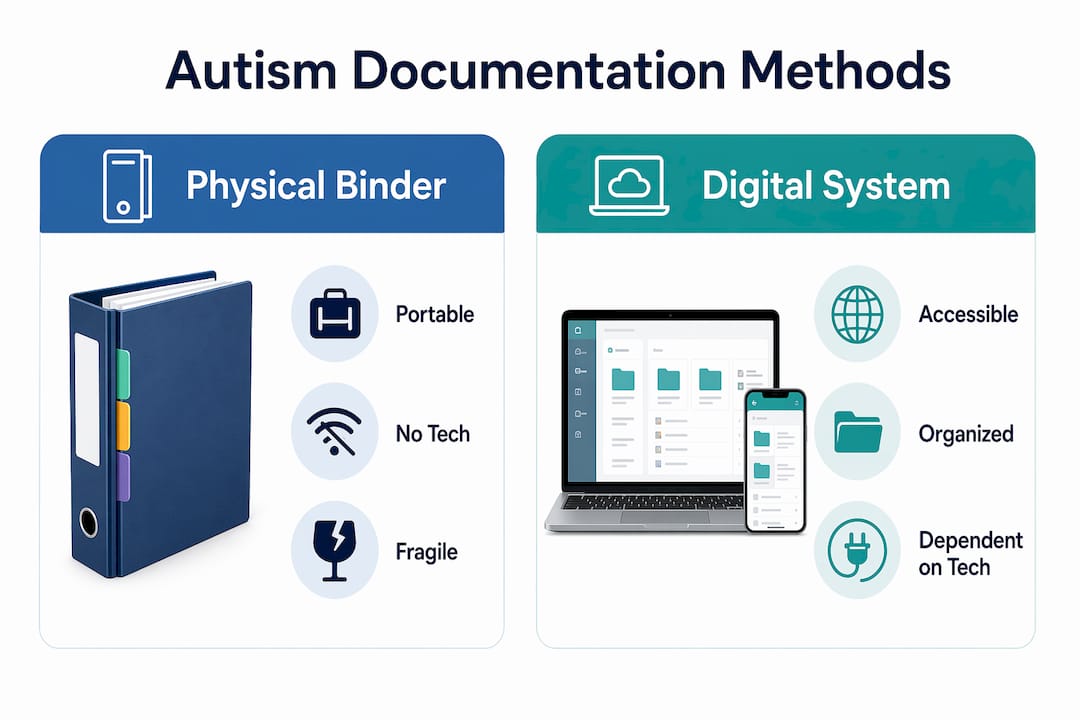
The limitation is physical. Binders get left at home, damaged, or become unwieldy as records accumulate over years. They also cannot be shared remotely with a provider who needs records before an appointment.
Building a digital system
A digital system using cloud storage such as Google Drive, Microsoft OneDrive, or Dropbox mirrors the binder’s folder structure but adds remote access, search capability, and version control. Digital systems with role-based access and audit trails improve security and compliance for autism-related documentation. This matters when records contain sensitive behavioral or mental health information.
One underused technique: split large PDF packets into individual report-level files. Splitting large PDF packets into separate documents makes it far easier to build timelines and pull specific reports before a meeting rather than scrolling through a 60-page combined file.
Comparison: binder vs. digital vs. hybrid
| Method | Strengths | Limitations | Best for |
|---|---|---|---|
| Physical binder | Portable, no tech required, easy to hand over | Bulky, no remote sharing, risk of loss | In-person meetings, low-tech households |
| Digital system | Searchable, shareable, version-controlled | Requires tech comfort, security setup needed | Multi-provider coordination, remote sharing |
| Hybrid | Combines portability with digital backup | Requires maintaining two systems | Most caregivers managing complex records |
Pro Tip: Create a one-page “child summary” document that lives at the front of both your binder and your digital folder. Include your child’s diagnosis, current services, key contacts, and any critical medical alerts. Bring it to every appointment and update it quarterly.
What are your legal rights when accessing autism records?
Legal rights around record access are one of the most misunderstood areas of autism care documentation. Knowing them prevents delays and gives you leverage when providers are slow to respond.
Parents of unemancipated minors have the right under HIPAA to access their child’s protected health information, unless specific exceptions apply. Those exceptions include situations where a minor has consented to treatment independently under state law, or where a provider determines disclosure would harm the child. For most autism-related services, no such exception applies, and you are entitled to full access.
Key legal facts every caregiver should know:
- Response timeline. Providers must respond to records requests within 30 days, with one possible 30-day extension. If a provider misses this window, you have grounds to file a complaint with the Office for Civil Rights.
- Retention periods. Medical record retention varies by state, but HIPAA requires privacy-related documents to be retained for at least six years. Pediatric records are often kept longer, sometimes until several years past the age of majority.
- Portal access problems. A 2026 OCR enforcement review found that patient portals often block parental access to minors’ records by default. If a portal denies you access to your child’s records, request paper copies directly and document the denial in writing.
- State law variations. Some states grant minors independent rights to certain records, particularly mental health records, at ages younger than 18. Know your state’s rules before assuming full access.
Your rights under HIPAA are a floor, not a ceiling. State laws can expand those rights but cannot reduce them below the federal standard. Always request records in writing and keep copies of every request you send.
For guidance on advocating for your child’s rights within the education system, Autismdoctorsearch has a dedicated resource covering the specific steps that produce results.
Best practices for keeping autism documentation current
Effective autism documentation systems require routine, preventative workflows rather than reactive, last-minute efforts. The caregivers who are most prepared at IEP meetings are not the ones who scrambled the night before. They are the ones who processed each document the week it arrived.
Follow these practices to build a sustainable routine:
- Process new documents immediately. When a progress report, therapy note, or evaluation arrives, scan it if it is paper, name the file with the date and document type, and file it in the correct folder the same day. Piles are the enemy of organized records.
- Log every significant communication. After any phone call or meeting with a teacher, therapist, or administrator, write a brief summary: date, who you spoke with, what was discussed, and any commitments made. This log becomes your evidence trail.
- Review and purge quarterly. Set a calendar reminder every three months to remove duplicate files, archive outdated drafts, and confirm that the current IEP and therapy plan are the most recent versions in the active folder.
- Organize around decision points, not just sources. Group records by IEP goals, behavior plans, or service transitions rather than only by provider or date. Organizing documentation around decision points enhances the operational use of records over organizing by source or chronology alone.
- Maintain version control. When an IEP is amended or a behavior plan is updated, keep the prior version with a clear date label. Never overwrite the original. This is especially important for tracking changes and agreements over time.
Pro Tip: Before any IEP or therapy review meeting, pull your one-page child summary and the three most recent progress reports. Prepare two or three specific questions based on what the data shows. Caregivers who arrive with data consistently get better outcomes than those who rely on memory alone.
Parents often start collecting records only during disputes. Habitual documentation builds a stronger advocacy foundation than reactive record gathering, because it captures the full picture rather than just the crisis moments. For more on coordinating records across multiple providers, Autismdoctorsearch’s guide on coordinating autism therapies covers the practical steps in detail.
Key takeaways
Effective autism documentation management requires a structured system, legal awareness, and consistent routines that work before a crisis, not after one.
| Point | Details |
|---|---|
| Collect all document types | Maintain diagnostic reports, IEPs, therapy notes, medical records, progress reports, and communication logs. |
| Choose the right system | Use a binder for portability, a digital system for sharing and search, or a hybrid for complex records. |
| Know your HIPAA rights | Providers must respond to records requests within 30 days; parental access to minor records is federally protected. |
| Process documents immediately | File and name each document the day it arrives to prevent backlogs and missing records. |
| Organize by decision point | Group records around IEP goals and behavior plans, not just by date or provider, for faster retrieval. |
Why proactive documentation changed how I think about autism advocacy
Most caregivers I have spoken with describe the same turning point: they walked into an IEP meeting unprepared, got caught off guard by a proposal they did not expect, and left feeling like they had lost ground. The records that would have supported their position existed. They just were not organized in a way that was usable under pressure.
What I have found, working with families navigating autism services, is that the emotional weight of documentation management is real. It feels like one more task on an already impossible list. But the caregivers who build even a basic system, a binder with five tabs or a Google Drive folder with consistent naming, report something specific: they feel less anxious before meetings. Not because the meetings get easier, but because they stop dreading the question they cannot answer.
The discipline of logging communications is the most underrated practice in this space. A single dated email summary after a phone call with a school administrator has, in documented cases, resolved disputes that would otherwise have required formal complaints. You are not building a legal case. You are building a record of good-faith engagement that makes your position credible.
The other shift worth naming: proactive documentation changes the dynamic with providers. When you arrive with organized records, providers treat you differently. They spend less time re-explaining history and more time discussing next steps. That is the real return on the time you invest in keeping records current.
— Keith
Find the right autism services to support your child’s care
Organized records are only part of the picture. Connecting with the right providers makes those records matter. Autismdoctorsearch maintains an up-to-date directory of autism therapy providers, ABA specialists, occupational therapists, and special education resources across the country. Whether you are building a new care team or filling a gap in existing services, the autism therapy listings on Autismdoctorsearch give you a verified starting point. You can also explore special education tips to strengthen how you use your documentation in school settings. The directory is free to search and updated regularly so the information you find reflects what is actually available in your area.
FAQ
What is autism documentation management?
Autism documentation management is the organized collection, storage, and maintenance of all healthcare and educational records related to a child’s autism diagnosis and services. It includes diagnostic reports, IEPs, therapy notes, medical records, and communication logs.
How long should I keep my child’s autism records?
HIPAA requires privacy-related documents to be retained for at least six years, but pediatric records are often kept longer. Many states require retention until several years past the age of majority, so keep all records until your child is well into adulthood.
Can providers deny me access to my child’s autism records?
Under HIPAA, parents of unemancipated minors generally have the right to access their child’s health records. Providers must respond within 30 days. If a patient portal blocks access by default, request paper copies in writing and document the denial.
What is the best way to organize autism documents?
A hybrid system works best for most caregivers: a physical binder for in-person meetings and a digital folder system for remote sharing and search. Organize both around decision points like IEP goals and behavior plans rather than by provider alone.
How do I keep autism records current without it becoming overwhelming?
Process each new document the day it arrives, log significant communications immediately after they happen, and schedule a quarterly review to remove duplicates and confirm current versions are filed correctly. Fifteen minutes per week prevents hours of catch-up before a meeting.