


TL;DR:
- A functional behavior assessment (FBA) identifies why a person exhibits challenging behavior by determining its specific function. It follows a four-stage process: behavior definition, data collection, hypothesis development, and intervention planning, with collaboration from home and school teams. Conducting an FBA before intervention prevents reinforcement of problem behavior and ensures tailored, effective support.
A functional behavior assessment (FBA) is a systematic, data-driven diagnostic process that identifies why a person exhibits challenging behavior by uncovering the specific function that behavior serves within their environment. The FBA is foundational for creating individualized Behavior Intervention Plans (BIPs) for individuals aged 0 to 22, including those with autism. Understanding this process gives parents, educators, and caregivers the clearest possible starting point for designing support that actually works. This guide explains every stage of the functional assessment process, clarifies common misconceptions, and shows you how to collaborate effectively with assessment teams.
What is a functional behavior assessment and why does it matter?
A functional behavior assessment is not a punishment plan or a discipline strategy. It is a diagnostic tool that asks one precise question: what need is this behavior meeting for this person? The four core behavior functions are attention, access to tangibles or preferred activities, escape or avoidance, and automatic or sensory reinforcement. Every challenging behavior, from self-injury to aggression to property destruction, serves at least one of these functions.
This matters because the same behavior in two different children can serve completely different functions. A child who screams during math class may be escaping a difficult task, while another child who screams during the same activity may be seeking teacher attention. Treating both with identical strategies produces inconsistent and often counterproductive results. The FBA prevents that mismatch by identifying the specific driver before any intervention begins.
The IRIS Center at Vanderbilt University describes the goal clearly: understanding behavior functions helps teams replace challenging behavior with more appropriate communication or skills. That reframe is significant. Behavior is not defiance. It is communication, and the FBA decodes the message.
What are the four functions of behavior an FBA identifies?
The four behavior functions form the scientific backbone of every FBA. Each one reflects a fundamental human need, and recognizing them changes how you interpret what you observe.
| Function | What the person is seeking | Example behavior |
|---|---|---|
| Attention | Social interaction, reaction, or acknowledgment | Hitting a sibling to get a parent’s response |
| Escape or avoidance | Relief from a demand, task, or sensory input | Throwing materials to leave a classroom activity |
| Access to tangibles | A preferred item, food, or activity | Tantrum when a tablet is taken away |
| Automatic or sensory | Internal stimulation or relief, no social mediation | Rocking, hand-flapping, or head-banging in isolation |
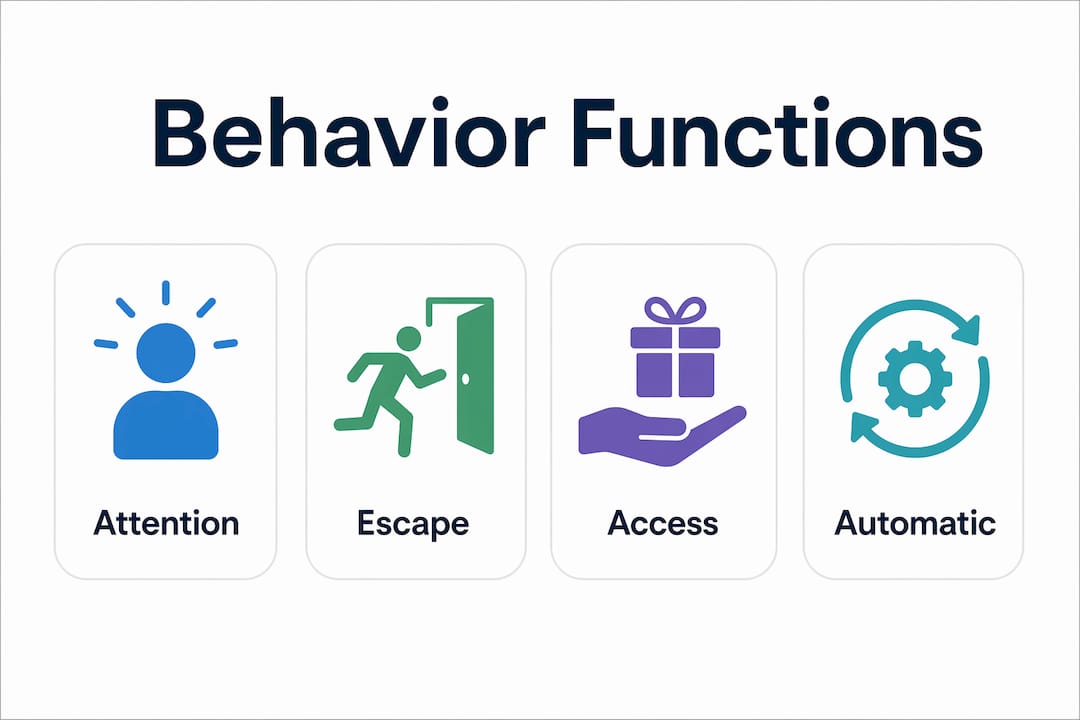
Attention-seeking behavior is the most commonly misidentified function. Parents and teachers often respond to disruptive behavior with reprimands, which, from the child’s perspective, is still attention. That response reinforces the behavior rather than reducing it. Recognizing the function breaks that cycle.
Automatic reinforcement is the most clinically complex function because the behavior produces its own reward without any external response. Sensory-seeking behaviors in autism often fall here, and they require different intervention strategies than socially mediated functions.
Pro Tip: If you are unsure which function drives a behavior, track whether the behavior occurs when the child is alone. Behavior that persists in isolation almost always serves an automatic or sensory function.
How is the functional assessment process conducted step by step?
The FBA follows four structured stages. Each stage builds on the last, and skipping any one of them weakens the accuracy of the final hypothesis.
-
Define the behavior precisely. The team writes a clear, observable, measurable definition of the target behavior. Vague descriptions like “acts out” or “is aggressive” lead to flawed hypotheses. A precise definition reads: “strikes peers with an open hand on the arm or back with enough force to produce a sound.” Behavior definitions must be precise to avoid flawed intervention plans.
-
Collect data across multiple methods. The team gathers information through indirect methods (interviews with parents, teachers, and caregivers), record reviews (school records, prior evaluations, medical history), and direct observation. The standard observation framework is ABC: Antecedent, Behavior, Consequence. The ABC observation method documents what happens immediately before the behavior, the behavior itself, and what follows it. Patterns across multiple ABC observations reveal the likely function.
-
Develop a hypothesis. The team synthesizes all collected data into a written hypothesis statement. A strong hypothesis reads: “When presented with a non-preferred writing task (antecedent), Marcus engages in table-banging (behavior) because it results in removal from the task (consequence: escape).” This statement directly informs what the intervention must address.
-
Create the intervention plan. The hypothesis drives every element of the Behavior Intervention Plan. The plan identifies a replacement behavior that serves the same function through an appropriate channel, adjusts antecedents to reduce triggers, and modifies consequences to stop reinforcing the problem behavior.
FBAs are conducted by school-based teams (special education teachers, school psychologists, behavior specialists) and clinical professionals including Board Certified Behavior Analysts (BCBAs). Collaboration between home and school is not optional. Missing environmental variables from one setting limits accuracy and reduces the chance that interventions will generalize across contexts.
Pro Tip: Ask the assessment team to share the ABC data sheets with you. Reviewing them helps you spot patterns at home that the school setting may not capture, and it makes your input during hypothesis development far more specific.

What distinguishes a functional behavior assessment from a functional analysis?
These two terms are frequently used interchangeably, but they describe different levels of rigor and methodology.
| Dimension | Functional behavior assessment (FBA) | Functional analysis (FA) |
|---|---|---|
| Methodology | Indirect and descriptive; interviews, observation, record review | Experimental; controlled manipulation of environmental conditions |
| Causal evidence | Correlational; identifies probable function | Causal; proves function through systematic testing |
| Setting | Schools, clinics, homes | Primarily clinical or research settings |
| Resource demands | Moderate; feasible for most school teams | High; requires trained clinicians and controlled conditions |
| Common use | Standard practice in special education | Gold standard in clinical behavior analysis |
Functional analysis is the gold standard because it experimentally manipulates conditions to prove, rather than infer, the behavioral function. In a traditional FA, a clinician presents controlled conditions (attention, escape, tangible, alone) and measures behavior rates across each. The condition that produces the highest behavior rate identifies the function.
The practical limitation is significant. FA requires trained clinicians, controlled environments, and time that most school teams do not have. Studies confirm that FA provides more causal evidence than indirect or descriptive FBAs alone, but resource constraints limit widespread use in educational settings. High-quality indirect and descriptive FBAs, combined with function-based interventions, represent the realistic best practice for most families and schools in 2026.
FA methods also vary by design. Traditional FA, trial-based FA, and precursor FA each carry different trade-offs, and clinicians must select based on the individual’s profile and the available evidence base.
Why conduct an FBA before designing behavioral interventions?
Skipping the FBA and jumping directly to intervention is one of the most common and costly mistakes in behavioral support. Implementing interventions without an FBA risks reinforcing problem behaviors and may increase behavior intensity or produce entirely new problematic behaviors. The FBA is a diagnostic step, not an intervention itself.
Consider a child who throws materials to escape a writing task. If the team responds by sending the child to a quiet room, they have just reinforced the escape function. The behavior will increase because it worked. Without the FBA, that pattern is invisible.
The IRIS Center frames this well: FBAs respect student dignity by reframing challenging behavior as communication rather than defiance. This shift matters enormously for families. It removes blame from the child and redirects the team’s energy toward identifying unmet needs and teaching replacement behaviors.
Common pitfalls to avoid when managing challenging behaviors without an FBA:
- Applying consequence-based strategies (time-out, response cost) without knowing the function, which may inadvertently reinforce escape-motivated behavior
- Using reward systems that target the wrong behavior or reinforce the wrong function
- Assuming a behavior that looks identical across settings serves the same function in each
- Relying on a single observation session rather than data collected across multiple days and settings
- Treating the BIP as permanent rather than revisiting it when behavior patterns shift
The dynamic nature of behavior functions means functions can change over time or context. A child who initially sought attention through aggression may shift to an escape function as academic demands increase. Awareness of this prevents teams from relying on outdated hypotheses that no longer reflect the child’s current environment.
How can parents and caregivers collaborate in the FBA process?
Your role in the FBA process is not passive. The data you provide about home routines, social history, and daily triggers is information the school team cannot access on its own. Missing critical antecedents from the home environment limits the accuracy of the final hypothesis and reduces the chance that interventions will hold across settings.
Practical ways to strengthen your collaboration with the assessment team:
- Document specific behavior incidents at home using the ABC format before the assessment begins. Note what happened immediately before the behavior, what the behavior looked like, and what followed it.
- Share your child’s social history, including medical diagnoses, sensory sensitivities, communication profile, sleep patterns, and any recent life changes that may affect behavior.
- Attend all FBA meetings and ask to review the behavior definition before data collection starts. If the definition does not match what you observe at home, say so.
- Request regular updates during the data collection phase, not just at the final meeting.
- After the BIP is created, ask for a written summary of the function hypothesis and the replacement behavior the team is teaching. Reinforce that same replacement behavior at home.
Behavior support works best when the strategies are consistent across every environment the child spends time in. A behavioral intervention plan that only lives at school will produce limited results if home responses contradict it. Your consistency is part of the treatment.
Key takeaways
A functional behavior assessment is the required diagnostic foundation before any behavior intervention plan can be effective, because without identifying the function, any strategy is a guess.
| Point | Details |
|---|---|
| FBA identifies behavior function | Every challenging behavior serves one of four functions: attention, escape, tangibles, or automatic reinforcement. |
| Four-stage process | FBA follows behavior definition, data collection, hypothesis development, and intervention planning in sequence. |
| FBA differs from FA | Functional analysis is more rigorous and causal; FBA is descriptive and more feasible for school and home settings. |
| Skip FBA at your risk | Intervening without an FBA can reinforce the problem behavior and increase its intensity or frequency. |
| Collaboration is required | Home and school data together produce more accurate hypotheses and more durable interventions. |
Why the FBA conversation is harder than it looks
I have spent years reviewing behavior support plans across dozens of school districts and clinical settings, and the single most consistent failure I see is not a lack of resources. It is a lack of patience with the diagnostic process. Teams feel pressure to act fast when a child is hurting themselves or disrupting a classroom. That pressure is real and understandable. But rushing past the FBA to implement a plan that feels intuitive is exactly how you end up six months later with a child whose behavior has escalated and a team that is out of ideas.
The other thing families rarely hear is that an FBA can be emotionally confronting. When the data shows that a child’s self-injury is maintained by caregiver attention, that finding can feel like an accusation. It is not. It means the child found the most effective tool available to them to get a need met. The FBA simply makes that visible so the team can teach a better tool.
I also want to be direct about the limits of a single FBA. Behavior functions shift. A hypothesis that was accurate in second grade may be completely wrong by fourth grade. The dynamic nature of functions is not a flaw in the process. It is a feature that requires ongoing monitoring and a willingness to reassess. The families and educators who get the best outcomes are the ones who treat the FBA as a living document rather than a one-time checkbox.
If you are working with an applied behavior team, push them to explain the hypothesis in plain language. If they cannot, the hypothesis is not solid enough yet.
— Keith
Find autism therapy services that use FBA to guide care
A well-conducted FBA is only as useful as the intervention it informs. Therapy providers who build treatment plans directly from FBA data produce better outcomes than those who apply generic behavior strategies. Autismdoctorsearch maintains a current directory of providers who specialize in function-based care for individuals with autism, including ABA therapy, behavioral intervention services, and special education support. If you are ready to connect with a qualified team that understands the FBA process from assessment through intervention, explore the autism therapy services listed in the Autismdoctorsearch directory. Finding the right provider starts with knowing what to look for, and now you do.
FAQ
What is the main purpose of a functional behavior assessment?
A functional behavior assessment identifies the specific reason a person engages in challenging behavior by determining which of the four behavioral functions the behavior serves. This information is used to design individualized interventions that address the root cause rather than just the surface behavior.
Who conducts a functional behavior assessment in schools?
School-based FBAs are typically conducted by a team that includes a special education teacher, school psychologist, and behavior specialist, often a Board Certified Behavior Analyst (BCBA). Parents and caregivers are considered essential contributors to the process, not just observers.
How long does a functional behavior assessment take?
A thorough FBA typically takes two to six weeks, depending on the complexity of the behavior and the number of settings being observed. Rushing the data collection phase reduces the accuracy of the hypothesis and weakens the resulting intervention plan.
Can a functional behavior assessment be wrong?
Yes. FBAs based on limited data, vague behavior definitions, or observations from only one setting can produce inaccurate hypotheses. Combining indirect assessments, direct observation, and input from both home and school significantly increases accuracy.
What is the difference between an FBA and a BIP?
An FBA is the diagnostic assessment that identifies why a behavior occurs. A Behavior Intervention Plan (BIP) is the written strategy document that follows from the FBA findings. The BIP cannot be effective without a valid FBA to ground it.


