


TL;DR:
- Consistent autism record keeping converts observations into evidence, supporting better therapy and funding outcomes.
- Organized documentation, including behavioral logs and parent narratives, enhances collaboration and advocacy within care teams.
Autism record keeping is the systematic documentation of diagnostic reports, behavioral observations, therapy progress, and related health information collected to support care decisions and advocacy. For parents and caregivers, this practice is not optional paperwork. It is the foundation of effective autism management. Tools like the Penelope app, frameworks like the Individualized Education Program (IEP), and privacy standards like HIPAA all depend on organized, accurate records to function. This article explains why record keeping for autism is critical, what to document, how to organize it, and how to overcome the real barriers that make consistent documentation difficult.
Why record keeping for autism is the most powerful tool you have
The core benefit of autism documentation is simple: it transforms your lived experience into evidence. Memory alone cannot capture the frequency, duration, and context of behaviors across weeks and months. Written records can. Tracking behaviors reveals hidden patterns, such as links between sleep quality and behavior regulation, that caregivers routinely miss because exhaustion filters out subtle signals.

Records also shift the power dynamic in professional meetings. When you walk into an IEP review or a therapy assessment with documented data, you are no longer relying on impressions. You are presenting evidence. That distinction changes how educators and clinicians respond to your input. It also reduces the emotional weight of those meetings because you are not trying to recall everything on the spot.
The benefits of autism record keeping extend to funding and service approvals. Records emphasizing functional impact rather than diagnostic labels are more likely to secure appropriate service plans. A note that says “cannot tolerate transitions between activities without a 10-minute visual schedule” communicates real-world need far more effectively than a diagnosis code alone.
- Records support evidence-based decisions in therapy and education settings
- Behavioral logs identify triggers and patterns that memory cannot reliably capture
- Documentation improves communication with healthcare providers and educators
- Organized records reduce stress before IEP reviews and medical appointments
- Functional language in records strengthens funding and service approval outcomes
Pro Tip: Start a single shared folder, physical or digital, labeled by year. Add every report, letter, and therapy note as it arrives. Spending two minutes filing a document now saves two hours searching for it before a critical meeting.
What documents and records should parents actually keep?
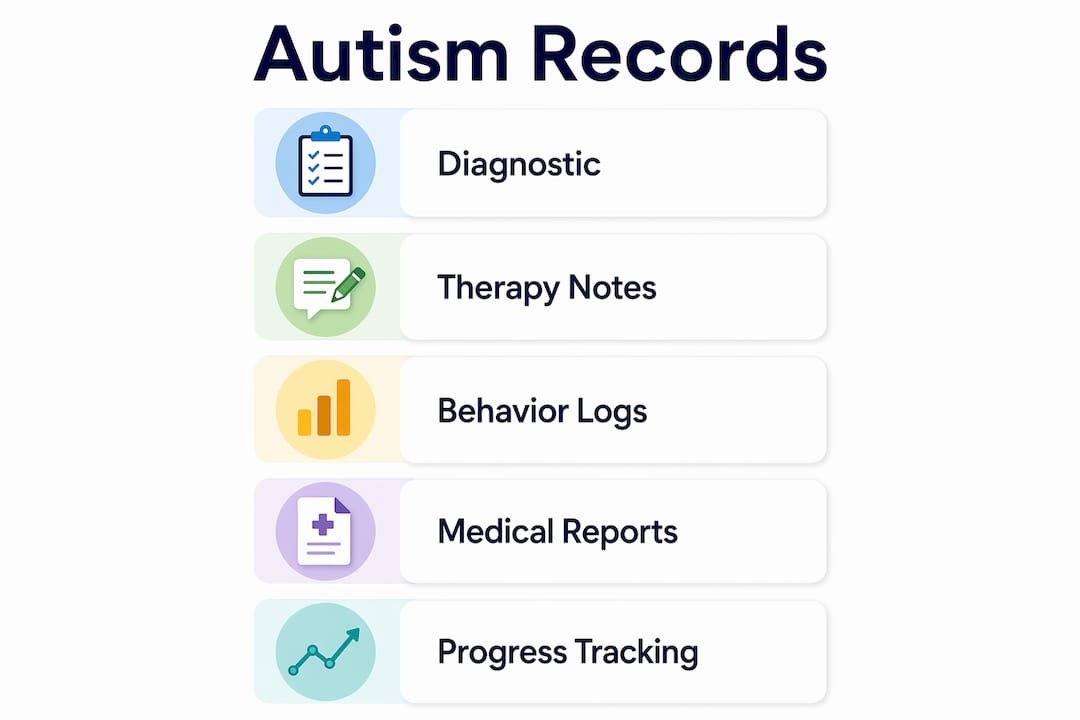
The importance of autism documentation becomes concrete when you know exactly what to collect. The core categories are diagnostic reports and evaluation summaries, therapy notes and progress reports, IEP documentation, behavioral logs, mood and sleep tracking, medication records, and legal or consent forms related to treatment and privacy.
HIPAA mandates that healthcare providers retain compliance-related documentation for at least six years, and pediatric records may be kept until years after the child reaches majority age. That means your own copies should match that timeline. Do not discard older evaluations. Early assessments often become critical reference points when services are reviewed or disputed years later.
For behavioral logs, the format matters. Timestamped logs of behaviors and sleep give clinicians actionable data on frequency and duration rather than anecdotes. A log entry that reads “Tuesday 7:14 PM, 20-minute meltdown following unexpected schedule change, resolved with visual timer” is clinically useful. “Had a bad evening” is not.
| Document type | Purpose | Ideal storage method |
|---|---|---|
| Diagnostic reports and evaluations | Baseline data for all future planning | Locked digital folder or physical binder |
| IEP and therapy progress notes | Track goals, accommodations, and outcomes | Chronological binder with tabbed sections |
| Behavioral and mood logs | Identify patterns, triggers, and improvements | App like Penelope or dated notebook |
| Medication and health records | Monitor side effects and health changes | Shared digital file with medical team |
| Legal and consent forms | Protect privacy and document authorizations | Secure digital storage with backup |
Clinical guidelines recommend documenting observations within 72 hours to preserve accuracy, while adverse events should be recorded immediately. That 72-hour window is a practical standard worth adopting for all behavioral observations, not just clinical ones.
Pro Tip: Include a “strengths and successes” section in every behavioral log. Note what worked, not just what went wrong. This strengths-based parent narrative becomes your most persuasive document in IEP and therapy meetings.
How does good record keeping improve therapy outcomes and IEP results?
Detailed records empower you to build a coherent developmental narrative, and that narrative carries real weight. A structured parent narrative often influences IEP and therapy meetings more than raw data alone by linking observations to functional goals. Clinicians and educators respond to stories that connect data points to daily life. Raw numbers without context are easy to dismiss.
Measurement data, specifically frequency, duration, and identified triggers, gives therapy teams the information they need to adjust behavioral supports between sessions. If your Applied Behavior Analysis (ABA) therapist knows that meltdowns spike on days following less than seven hours of sleep, they can adjust session intensity accordingly. That kind of precision is only possible with consistent records.
Translating observations into functional language also improves funding outcomes. Instead of writing “struggles with social interaction,” write “requires adult prompting to initiate peer conversation in groups of more than three.” The second version describes a real-world need that a service plan can address directly.
Here is how strong records improve specific outcomes:
- Therapy teams adjust intervention plans faster when frequency and duration data is available
- IEP goals become measurable and specific when grounded in documented observations
- Funding applications succeed at higher rates when records describe functional impact
- Strengths-based documentation reinforces positive identity and motivates support teams
- Miscommunication between providers decreases when everyone references the same documented history
Multidisciplinary autism care depends on shared, accurate information. When an occupational therapist, speech therapist, and ABA provider all reference the same behavioral log, they coordinate instead of duplicating effort. Records are the connective tissue of that collaboration.
What challenges do parents face with autism record keeping and how to solve them?
The most common barrier to maintaining autism records is not lack of motivation. It is time, emotional fatigue, and information overload. Caregivers managing complex daily needs often reach the end of the day with nothing left for documentation. The solution is not to document everything. It is to document the right things, briefly and consistently.
Here is a practical approach to overcoming the most common obstacles:
- Set a five-minute daily window. Use the same time each day, such as after the child’s bedtime routine, to write three to five observations. Consistency matters more than completeness.
- Use structured templates. A simple template with fields for time, behavior, trigger, duration, and response removes the cognitive load of deciding what to write. Apps like Penelope provide ready-made formats.
- Separate data from emotion. Write what happened, not how it made you feel. Emotional language in records can unintentionally undermine your credibility with professionals.
- Prioritize key categories. Focus on sleep, behavior, and therapy response. These three categories give clinicians the most useful data and prevent record keeping from becoming overwhelming.
- Secure your records properly. Digital files should use password protection or encrypted storage. Physical binders should be stored out of general household access. HIPAA privacy standards apply to providers, but your own records deserve the same protection.
Deficit-focused or negative language in records can alienate families and result in poorer outcomes. Neurodiversity-affirming language, which describes behavior in neutral or strengths-based terms, improves engagement from service providers and educators. Replacing “refuses to cooperate” with “requires additional processing time before transitions” changes how a support team interprets and responds to the same behavior.
Pro Tip: Review your records quarterly. Look for patterns you may have missed week to week. A quarterly review often reveals progress that felt invisible in the daily grind, and that evidence becomes powerful in your next IEP or therapy meeting.
You can find detailed guidance on tracking treatment progress in the Autismdoctorsearch resource library, which covers caregiver-led methods for behavior pattern documentation.
Key takeaways
Effective autism record keeping transforms scattered observations into evidence that drives better therapy outcomes, stronger IEP results, and successful funding approvals.
| Point | Details |
|---|---|
| Document functional impact | Describe real-world needs, not just diagnoses, to secure services and funding. |
| Use timestamped behavioral logs | Record frequency, duration, and triggers within 72 hours for clinical accuracy. |
| Build a strengths-based narrative | Include successes and accommodations alongside challenges in every record set. |
| Organize by category and date | Use tabbed binders or digital folders to make records retrievable before meetings. |
| Apply neurodiversity-affirming language | Neutral, strengths-based language improves outcomes and professional engagement. |
What I have learned after years of watching families navigate this
The caregivers I have seen make the most progress in IEP meetings and therapy reviews are almost never the ones with the most credentials. They are the ones with the best records. A parent who arrives with a three-month behavioral log, a clear parent narrative, and a list of what has worked is treated as a partner in the room. A parent who arrives with memory alone is often treated as a witness.
What surprises most families is how quickly records reveal progress they had stopped noticing. When you are living inside the daily demands of autism caregiving, improvement can feel invisible. A log from six months ago often shows a child who needed 45 minutes to recover from a transition. Today it takes 10. That is not a small thing. It is the kind of evidence that changes what services get funded and what goals get set.
The other shift I have seen records create is emotional. When you document strengths alongside struggles, you start to see your child differently on paper. That participant-centered narrative does not just help professionals. It helps you. It becomes a record of who your child is, not just what they find difficult. That distinction matters more than any clinical framework.
— Keith
Find the right autism therapy providers through Autismdoctorsearch
Autismdoctorsearch connects families with qualified autism therapy providers who rely on structured documentation to deliver individualized care. The providers listed in the directory work with behavioral logs, IEP documentation, and progress records as standard practice. That means when you arrive prepared with your own records, you are working with professionals who know how to use them. Browse the autism therapy services directory to find providers in your area who prioritize evidence-based, family-centered care. Your records are the starting point. The right provider helps you build on them.
FAQ
Why is record keeping important for autism care?
Record keeping for autism creates an objective, documented history of behaviors, therapies, and progress that memory alone cannot reliably provide. This documentation supports better decisions in therapy, education, and funding contexts.
What should I include in an autism behavioral log?
A behavioral log should include the time, specific behavior, identified trigger, duration, and caregiver response. Timestamped entries give clinicians actionable data rather than general impressions.
How long should I keep autism-related records?
HIPAA requires providers to retain compliance documentation for at least six years, and pediatric records may be held until after the child reaches majority age. Parents should maintain their own copies on the same timeline.
How does a parent narrative differ from a behavioral log?
A behavioral log records specific events with data. A parent narrative is a structured developmental story that connects observations to functional goals, and it often carries more persuasive weight in IEP and therapy meetings.
What is the best way to organize autism records?
Use a tabbed binder or digital folder system organized by category, such as diagnostics, therapy notes, IEP documents, and behavioral logs, and sort each section chronologically. Review and update records at least quarterly to capture patterns and progress.


