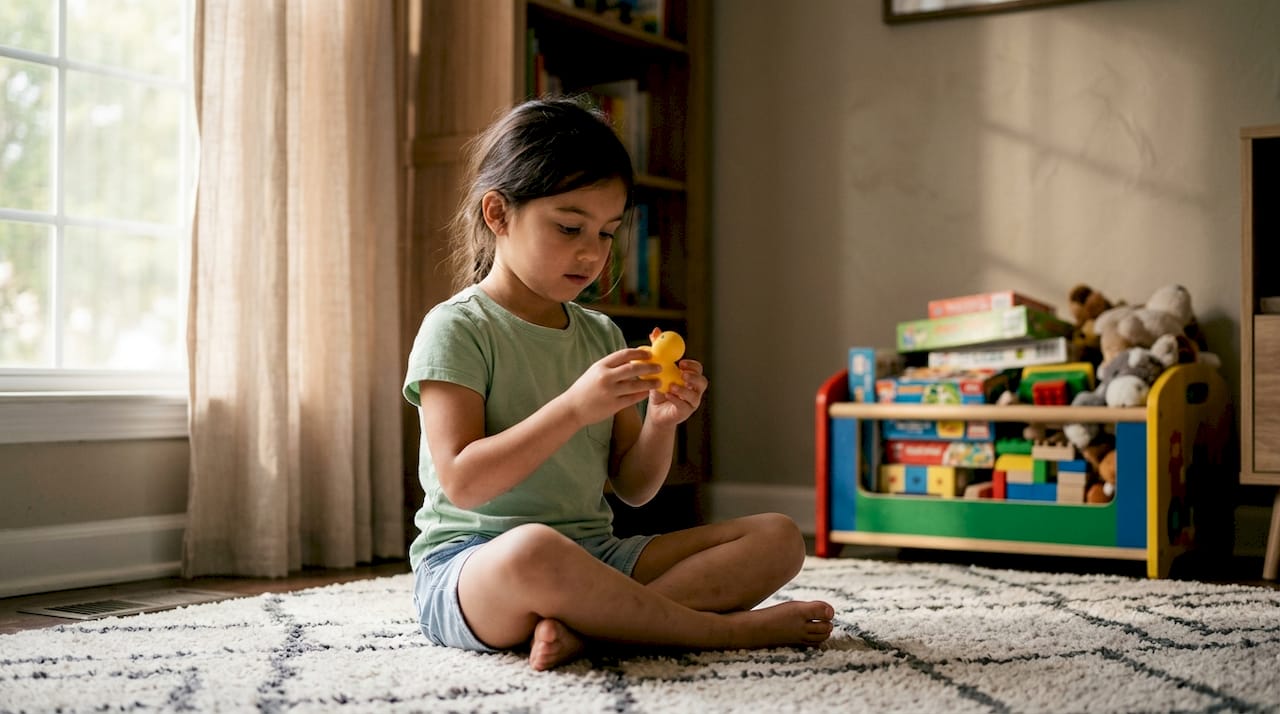
Stimming is repetitive self-stimulatory behavior that people use to regulate sensations, emotions, or attention. It shows up across all neurotypes, but it plays a particularly central role in autism, where it counts toward the DSM-5-TR diagnostic criteria for restricted, repetitive behaviors. Here is what you need to know right away:
- Diagnostic relevance: The DSM-5-TR lists stereotyped or repetitive motor movements, use of objects, or speech as one of four restricted, repetitive behavior domains required for an autism diagnosis.
- Primary functions: Stimming helps people manage sensory overload, express emotion, self-soothe, and maintain focus. A 2019 survey of autistic adults found that 80% reported stimming helped reduce anxiety and calm them. The same survey reported that 72% of autistic adults had been told to stop stimming by others.
- When to seek help: Most stimming is harmless. Consider a professional assessment when a behavior causes physical injury, prevents eating or sleeping, or escalates suddenly without a clear trigger.
Table of Contents
- What is stimming in clinical and everyday terms?
- What are the main types of stimming behaviors?
- Why do people stim? The functions and mechanisms behind it
- When does stimming become a concern?
- How can caregivers and clinicians support someone who stims?
- How does stimming change across childhood, adolescence, and adulthood?
- Why masking stims causes real harm
- What the research and DSM-5-TR say about stimming
- Key Takeaways
- Stimming deserves understanding, not erasure
- Find local autism therapy and support services near you
- Useful sources and further reading
What is stimming in clinical and everyday terms?
Stimming is short for “self-stimulatory behavior,” a term used in clinical literature to describe repetitive, patterned actions that generate sensory input. In formal diagnostic language, these behaviors fall under the broader category of stereotypy or restricted, repetitive behaviors (RRBs) — the umbrella the DSM-5-TR uses when evaluating autism spectrum disorder.
The clinical framing can make stimming sound pathological, but that picture is incomplete. Nail-biting, hair twirling, and finger drumming are all forms of stimming, and they are common in neurotypical people too. The difference in autism is often one of frequency, intensity, and how central the behavior is to daily functioning.
Stimming can be voluntary or completely automatic. Someone might consciously rock back and forth to settle nerves before a difficult conversation, or they might not notice they are tapping their foot until someone points it out. Both count.
That framing matters because the instinct to stop stimming, especially in children, is widespread. According to the same Ohio State survey, 72% of autistic adults had been told to stop stimming by others. Understanding what the behavior is doing for a person is always the right first question.
What are the main types of stimming behaviors?
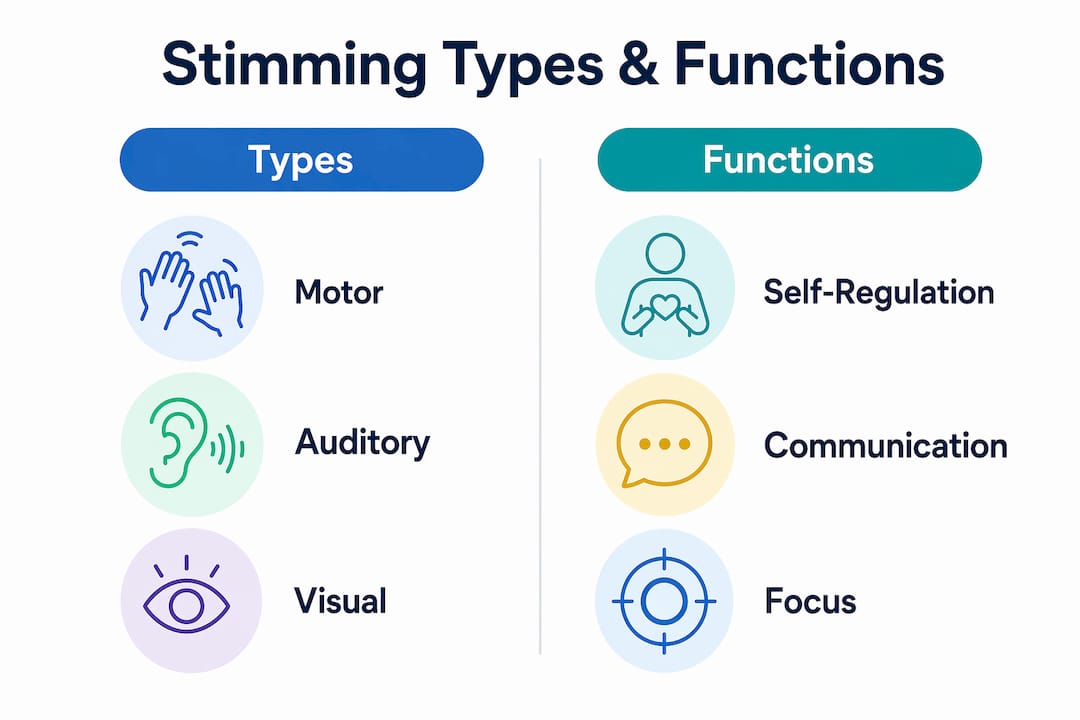
Stimming behaviors span every sensory system. One person might rely heavily on movement; another might gravitate toward sound or touch. Most people who stim use more than one type, and the same person’s stims can shift depending on mood, environment, or age.
- Motor stims: Repetitive body movements. Hand flapping, rocking, spinning, jumping, finger flicking, or pacing. These are among the most visible and commonly recognized stims.
- Auditory/vocal stims: Humming, repeating words or phrases (echolalia), clicking the tongue, making rhythmic sounds, or replaying audio clips mentally.
- Visual stims: Staring at spinning objects, watching lights flicker, moving fingers in front of the eyes, or fixating on patterns.
- Tactile stims: Rubbing skin, scratching surfaces, squeezing objects, or seeking specific fabric textures.
- Oral/gustatory stims: Chewing on clothing, pencils, or chew jewelry; licking objects; grinding teeth. For children with oral sensory needs, sensory-friendly oral care tools can reduce discomfort around daily routines like toothbrushing.
- Olfactory stims: Smelling objects, people, or food repeatedly before interacting with them.
- Vestibular stims: Spinning in circles, swinging, bouncing on a trampoline, or tilting the head.
- Object use stims: Lining up toys, flipping objects, spinning wheels on toy cars, or repeatedly opening and closing containers.
| Stim type | Common examples | Typical context |
|---|---|---|
| Motor | Hand flapping, rocking | Excitement, anxiety, sensory overload |
| Auditory/vocal | Humming, echolalia | Focus, self-soothing, joy |
| Visual | Watching spinning objects | Sensory-seeking, calming |
| Tactile | Rubbing fabric, squeezing | Stress relief, grounding |
| Oral | Chewing, teeth grinding | Sensory-seeking, concentration |
| Vestibular | Swinging, spinning | Regulation, excitement |
Overlap is the norm. A child who rocks may also hum at the same time, combining vestibular and auditory input into a single regulatory routine.
Why do people stim? The functions and mechanisms behind it
Stimming is not random. It serves real, identifiable purposes, and understanding those purposes changes how caregivers and clinicians respond.
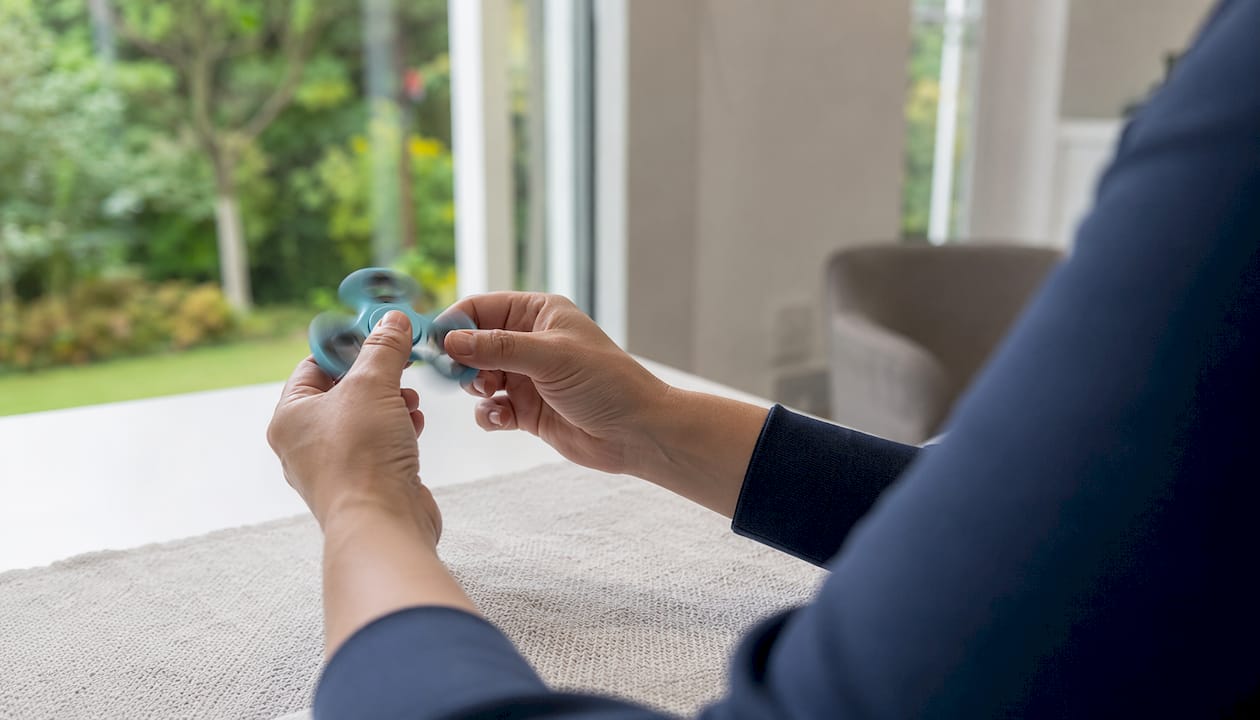
Self-regulation is the most commonly cited function. When sensory input feels overwhelming or when emotions run high, stimming provides a predictable, controllable sensory experience that helps the nervous system settle. Rocking during a stressful wait, for example, is not a sign of distress spiraling out of control; it is often the thing keeping distress manageable.
Sensory seeking and avoidance are two sides of the same coin. Some stims add stimulation to an under-responsive system (jumping, spinning). Others create a competing sensory signal that drowns out an aversive one (humming to block out a loud, unpredictable environment).
Communication and emotional expression are less obvious functions but equally real. Hand flapping during excitement, for instance, is not a symptom to suppress; it is joy made visible. Stimming can also signal internal states to caregivers who learn to read the patterns.
Focus and organization round out the picture. Many people report that stimming helps them concentrate. The rhythmic quality of a repetitive behavior can anchor attention the way background music does for some people.
On the neuroscience side, one hypothesis holds that rhythmic sensory input from stimming may entrain cortical rhythms in sensory areas, providing predictable input that lowers sensory prediction error. In plain terms: the brain may use the steady, self-generated signal of a stim to better predict and filter incoming sensory information, reducing overload. Research also shows that stereotyped movements correlate with anxiety and tend to increase after stressful triggers, which fits the self-regulation model well.
When does stimming become a concern?
The short answer: when it causes harm or significantly interferes with daily life. The vast majority of stims do neither.
Red flags that warrant a professional assessment include:
- Self-injurious behaviors: Head banging against hard surfaces, biting oneself hard enough to break skin, hitting, or scratching to the point of injury.
- Interference with basic needs: Stims that prevent eating, sleeping, or maintaining hygiene consistently.
- Sudden escalation: A sharp increase in frequency or intensity without an obvious environmental trigger can indicate a new stressor, a medical issue (pain, illness), or a change in sensory processing that needs attention.
- Distress signals: Stimming that appears to be driven by panic rather than regulation, especially when the person cannot be redirected or calmed.
Context matters enormously. A stim that appears only in one specific environment (a loud school cafeteria, for example) tells a different story than one that is present across every setting regardless of what is happening. The former points to a sensory trigger that can often be addressed directly; the latter may reflect a more pervasive regulatory challenge.
Pro Tip: Keep a brief log for one to two weeks before any professional consultation. Note the time, setting, what happened just before the stim, and how long it lasted. That context is far more useful to a clinician than a general description of the behavior.
If you are unsure whether a behavior crosses the line, a developmental pediatrician, child psychiatrist, or autism support center can help you evaluate it in context.
How can caregivers and clinicians support someone who stims?
The starting point is acceptance. Stimming is not a behavioral problem to be eliminated; it is a communication and regulation strategy to be understood. From there, support becomes much more targeted.
- Validate the behavior. Acknowledge that the stim is serving a purpose. Avoid reacting with alarm, embarrassment, or correction in public settings, which adds social stress on top of whatever the person is already managing.
- Identify triggers. Watch for patterns. Does the stim increase before transitions? In noisy spaces? After school? Triggers point directly to the underlying need.
- Adjust the environment. Reduce sensory overload where possible: noise-canceling headphones, dimmer lighting, a quiet break space, or predictable routines. Visual supports at home can also reduce the uncertainty that drives anxiety-based stimming.
- Offer safer alternatives only when necessary. If a stim is harmful (biting skin, head banging), work with an occupational therapist or behavioral specialist to find a functionally equivalent replacement that meets the same sensory need without injury. A chew necklace for a child who bites their arm, for example.
- Pursue therapy for underlying needs, not for the stim itself. Occupational therapy addresses sensory processing directly. Behavioral supports can help identify communicative functions. Mental health care is appropriate when co-occurring anxiety or depression is driving escalation.
Pro Tip: Avoid pressuring someone to suppress their stims in public. The short-term social smoothness is not worth the cognitive and emotional cost of masking, which research links to higher stress and worse mental health outcomes over time.
For families looking for structured autism support strategies, the principle is consistent: address the need, not the symptom.

How does stimming change across childhood, adolescence, and adulthood?
Stimming typically appears early. Many parents notice repetitive behaviors by age 2 or 3, often before a formal diagnosis. At this stage, stims tend to be large and visible: full-body rocking, spinning, hand flapping, or mouthing objects.
Through middle childhood, stims often become more specific and entrenched. A child who rocked as a toddler might develop a more precise finger-flicking routine by age 8. School environments add a new layer of complexity because many stims draw peer attention, and children begin to feel social pressure to suppress them.
Adolescence is when masking often intensifies. The social stakes rise, and many autistic teens work hard to hide their stims, sometimes at significant mental health cost. Adults may have developed a repertoire of socially acceptable stims (fidget tools, doodling, chewing gum) that meet the same needs with less visibility.
Support looks different at each stage. For school-age children, an Individualized Education Program (IEP) can include sensory accommodations and staff training. Adolescents benefit from self-advocacy coaching so they can communicate their own needs. Adults in the workplace may need quiet spaces, flexible schedules, or permission to use fidget tools without stigma. Families exploring school-based options can find relevant resources through special education programs designed for autistic learners.
Why masking stims causes real harm
Masking is the deliberate suppression of natural behaviors, including stimming, to appear more neurotypical in social settings. It is exhausting, and the evidence on its consequences is not ambiguous.
Research consistently links masking to higher stress, increased cognitive load, and worse mental health outcomes in autistic people. The SAGE Journals research on autistic experiences documents that social pressure to suppress stimming is widespread and that the experience of being told to stop is associated with negative self-perception and increased anxiety. Forced suppression does not eliminate the underlying need; it just removes the coping tool while leaving the stressor in place.
The Ohio State survey found that 72% of autistic adults had been told to stop stimming by others, reflecting how normalized this pressure is despite the harm it causes.
Practical steps to reduce stigma:
- Normalize stimming in classrooms and workplaces by framing it as a regulation strategy, not a disruption.
- Train teachers, coaches, and coworkers on what stimming is and why suppression is harmful.
- Provide discreet sensory tools (fidget items, chew jewelry, noise-canceling headphones) so people can stim in socially acceptable ways without having to mask entirely.
- Avoid commenting on or correcting stims in public unless safety is at risk.
Pro Tip: For educators and employers, the most effective accommodation is often the simplest: give the person a designated quiet space and permission to use sensory tools. That alone removes the need to mask for hours at a time.
What the research and DSM-5-TR say about stimming
The DSM-5-TR places stimming within Criterion B for autism spectrum disorder, specifically under “stereotyped or repetitive motor movements, use of objects, or speech.” Examples include simple motor stereotypies, lining up toys, flipping objects, echolalia, and idiosyncratic phrases. An autism diagnosis requires at least two of four restricted, repetitive behavior types, and stimming behaviors can satisfy one of those criteria.
The CDC’s clinical guidance on ASD diagnosis reflects this framework directly, listing repetitive motor movements and sensory reactivity as core diagnostic markers. The NCBI StatPearls review of autism spectrum disorder reinforces that these behaviors appear in early childhood and vary widely in form and severity across individuals.
| Source | Key finding | Relevance |
|---|---|---|
| DSM-5-TR / CDC | Stereotyped/repetitive motor movements count toward ASD Criterion B | Diagnostic framework for stimming |
| Ohio State Health (2019 survey) | 80% of autistic adults said stimming reduced anxiety | Evidence for regulatory function |
| ScienceDirect review | Stereotypies correlate with anxiety; increase after stress | Mechanistic and clinical context |
| SAGE Journals | Suppression linked to increased stress and negative self-perception | Ethical and mental health implications |
Prevalence data on stimming in autism is difficult to pin to a single figure because the behaviors are so varied and definitions differ across studies. What the research does consistently show is that stimming is nearly universal in autistic populations, present across all ages, and experienced by most autistic people as functional rather than distressing when it is not being suppressed.
Key Takeaways
Stimming is a functional, often essential behavior that serves regulatory, communicative, and sensory purposes, and the evidence strongly favors acceptance over suppression in most cases.
| Point | Details |
|---|---|
| Stimming is functional | In a 2019 survey, 80% of autistic adults reported stimming helped reduce anxiety and calm them. |
| It spans all neurotypes | Nail-biting, hair twirling, and finger drumming are stimming behaviors common in neurotypical people too. |
| Intervene only for harm | Seek professional help when stimming causes injury, prevents basic needs, or escalates suddenly without a clear trigger. |
| Masking causes real damage | Forced suppression of stims is linked to higher stress, cognitive load, and worse mental health outcomes in autistic people. |
| Autismdoctorsearch can help | The directory connects families with local occupational therapists, ABA providers, and autism clinics across the U.S. |
Stimming deserves understanding, not erasure
The conversation around stimming has shifted considerably over the past decade, and the direction of that shift matters. For a long time, the clinical goal was reduction: count the stims, measure their frequency, and design programs to make them stop. That approach treated the behavior as the problem rather than asking what the behavior was solving.
What the evidence actually shows is more interesting and more useful. Stimming is a window into a person’s internal state. When someone’s stims escalate, that is information. When a new stim appears, that is information. When stimming disappears entirely after years of being present, that is sometimes information too, and not always good news. It may mean the person has learned to mask so effectively that the coping tool is gone, along with the relief it provided.
The more productive frame is curiosity. What is this behavior doing for this person, right now, in this environment? That question leads somewhere. Reflexive suppression does not.
Families and clinicians who adopt that stance tend to build better relationships with the autistic people they support, and those relationships are where real progress happens. Autismdoctorsearch exists to help connect families with providers who share that perspective, from occupational therapists trained in sensory integration to behavioral specialists who prioritize function over compliance.
Find local autism therapy and support services near you
When stimming raises questions you cannot answer alone, the right specialist makes all the difference. Autismdoctorsearch is a directory built specifically for families navigating autism in the U.S., covering ABA therapy, occupational therapy, mental health services, medical clinics, special education schools, and non-profit organizations.
You can search by therapy type or location to find providers in your area. Whether you are looking for a sensory-focused occupational therapist, a behavioral health clinic, or a center that offers comprehensive assessment, the directory gives you a starting point that is specific to autism care rather than general health searches.
Find autism therapy services near you and filter by the type of support your family needs.
Useful sources and further reading
The following sources informed this article and are worth consulting directly for deeper reading or clinical reference.
- CDC: Clinical Testing and Diagnosis for ASD — Primary source for DSM-5-TR diagnostic criteria as applied in clinical practice.
- NCBI StatPearls: Autism Spectrum Disorder — Peer-reviewed clinical overview of ASD presentation, diagnosis, and intervention.
- Ohio State Health: Stimming as an Essential Coping Mechanism — Clinician commentary and 2019 survey findings on stimming functions and suppression.
- CHOP Research Institute: Stimming — What Is It and Does It Matter? — Accessible clinical explainer from the Children’s Hospital of Philadelphia.
- ScienceDirect: Rethinking Stereotypies in Autism — Peer-reviewed review of mechanistic theories and clinical evidence on stereotyped behaviors.
- SAGE Journals: Autistic Experiences and Perceptions of Stimming — Qualitative research centering autistic self-report on stimming, masking, and social pressure.
- PsychCentral: Does Stimming Relieve Anxiety? — Accessible overview of stimming across neurotypes, including non-autistic populations.
- American Psychiatric Association: DSM-5-TR — The primary diagnostic reference for restricted, repetitive behaviors in autism.
This article is general information, not medical or clinical advice. For a formal assessment or personalized guidance, consult a licensed clinician or developmental specialist familiar with your or your child’s specific situation.