

TL;DR:
- Routine provides essential safety and reduces stress in children with autism by creating predictable frameworks. It helps manage anxiety, improve emotional regulation, and build independence through stages of internalization and gradual flexibility. Over-rigidity increases stress, so caregivers should balance consistency with adaptable strategies to support lasting progress.
Routine is a neurological necessity for children with autism, not a preference or a quirk. For autistic children, predictable structure lowers cortisol, reduces cognitive overload, and creates the safety their nervous systems require to function. Understanding why routine is important in autism changes how you respond to your child’s resistance to change. It shifts the frame from “stubbornness” to “biology.” This guide draws on recent research and practical strategies to help you build routines that support your child’s growth, emotional regulation, and independence.
Why is routine important for autism?
The autistic brain processes every small event as high-stakes, requiring conscious interpretation rather than automatic filtering. Neurotypical brains automate most daily transitions. An autistic brain does not. Getting dressed, switching from play to lunch, or leaving the house each demand significant mental effort. Routine reduces that burden by turning familiar sequences into internalized scripts.
When those scripts are missing, the brain defaults to a stress response. Unpredictability triggers cortisol release, the same hormone associated with physical pain and threat. Routine lowers cortisol spikes by giving the nervous system a reliable framework to follow. That is why a child who melts down every morning at school drop-off often calms significantly once a consistent goodbye ritual is established.
A march 2026 study published in Frontiers in Psychiatry analyzed routines across children with ASD, ADHD, and neurotypical groups. Daily routines strongly associate with lower internalized and externalized behavioral challenges in children with ASD. That finding confirms what many caregivers already sense: a predictable day produces a calmer child.
Pro Tip: Start with just one anchor routine, such as a consistent morning sequence, before expanding to the full day. Small wins build momentum and show your child that predictability is safe.
How do routines reduce anxiety and behavioral challenges in autism?
Behavioral challenges in autistic children are rarely about defiance. They are almost always a signal that the nervous system is overwhelmed. Routine acts as a reliable script for the nervous system, keeping anxiety within manageable limits. When that script is disrupted, the result is not misbehavior. It is a biological stress response.
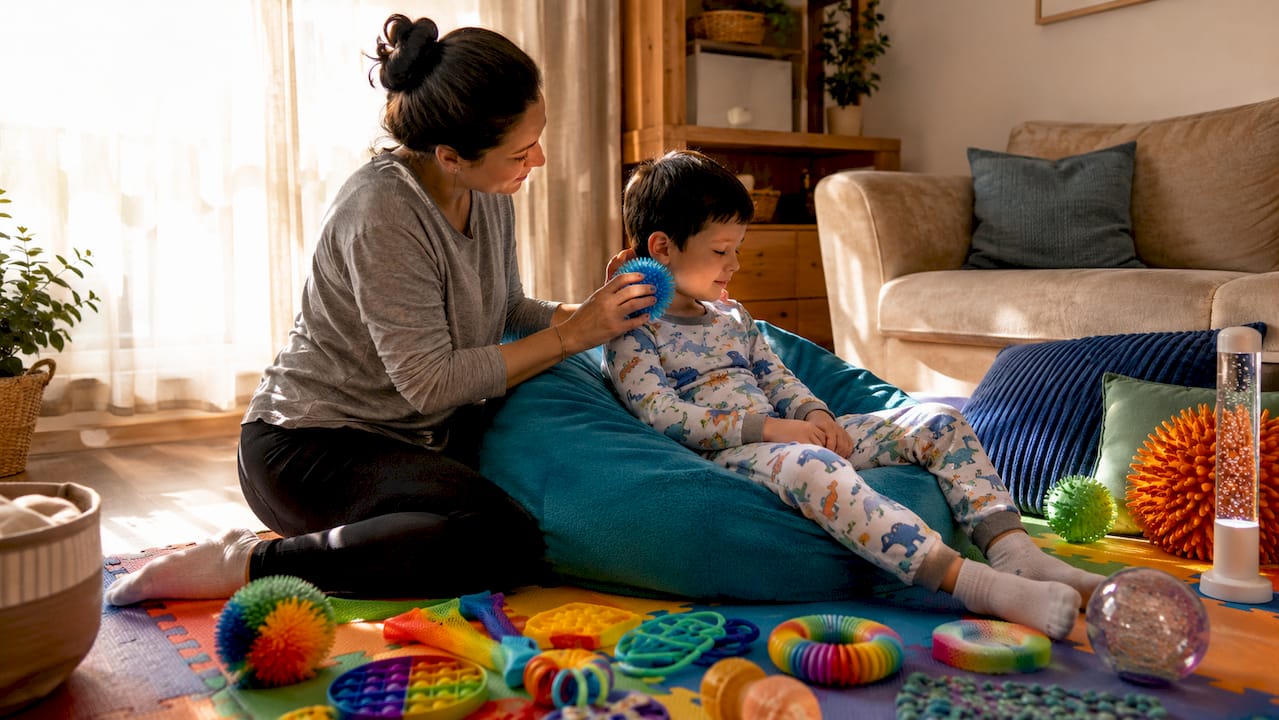
Autistic brains also filter less sensory information than neurotypical brains. Every sound, texture, and social cue competes for attention simultaneously. Routine reduces this cognitive burden by making predictable events automatic, freeing mental resources for learning and connection. A child who knows exactly what comes after breakfast can focus on eating rather than bracing for the unknown.
The benefits of structured routine in autism extend to sleep, appetite, and social behavior. Children with consistent daily schedules show fewer nighttime disruptions and more stable moods throughout the day. Predictability at bedtime, for example, signals the brain to begin winding down, which supports melatonin production and sleep onset. These are not small gains. Sleep quality directly affects behavior, learning, and emotional regulation the following day.
Pro Tip: Use a visual timer during transitions, such as a Time Timer clock, to give your child a concrete signal that a change is coming. Visible countdowns reduce the shock of sudden shifts.
How do routines support emotional regulation and transitions?
Transitions are among the hardest moments for autistic children. Moving from one activity to another requires the brain to stop, reorient, and restart. Transitions cause neurological stress similar to physical pain, which explains why a child who is happily playing can become distressed the moment you announce it is time to leave. The problem is not the destination. It is the stop-start demand itself.
Predictable routines act as scaffolding around those transitions. When a child knows that playtime always ends with a five-minute warning, then cleanup, then snack, the brain can begin preparing before the transition arrives. Pre-warning signals prepare the brain biologically for change, reducing the cortisol spike that triggers meltdowns. The warning is not just courtesy. It is neurological preparation.
Practical tools that support this process include:
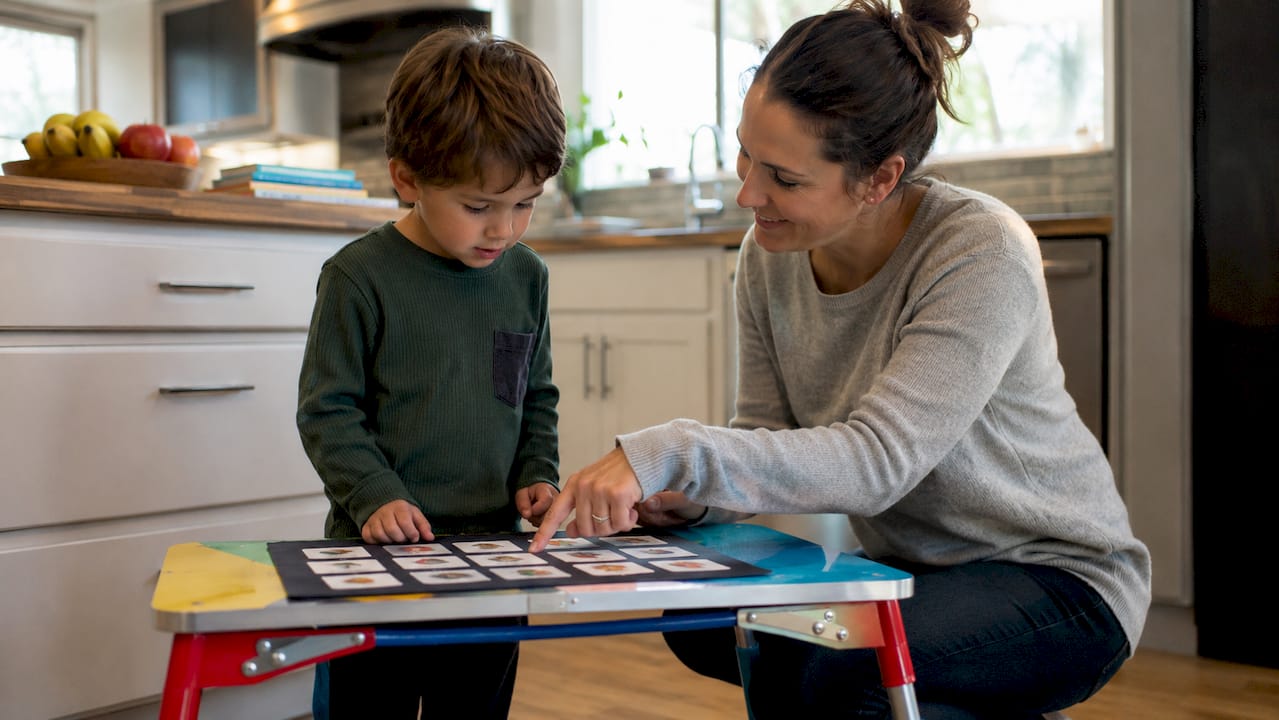
- Visual schedules: Picture-based or icon-based boards showing the day’s sequence, used widely in Applied Behavior Analysis (ABA) therapy settings
- Countdown warnings: Verbal or visual five-minute and two-minute alerts before any transition
- First-then boards: Simple two-step visuals that show what comes now and what comes next, reducing uncertainty
- Consistent language: Using the same words every time for the same transition, so the phrase itself becomes a calming cue
- Transition objects: A small item a child carries from one activity to the next, providing physical continuity
The goal is not to eliminate all surprise. It is to build flexibility gradually by first establishing safety, then slowly introducing small, manageable variations within that safe structure.
How do routines build independence in autistic children?
Consistent routines transform from external prompts into internalized scripts over time. A child who needs a caregiver to guide every step of the morning routine at age five may be completing that same routine independently at age eight. Routine automates transitions, replacing constant prompting with self-guided sequences. That shift is one of the most meaningful gains a caregiver can support.
Independence built through routine follows a clear progression:
- Caregiver-led: The adult guides each step verbally or physically, establishing the sequence
- Visual-supported: The child follows a posted visual schedule with minimal verbal prompting
- Prompted independence: The child initiates steps but needs occasional reminders at transition points
- Self-directed: The child completes the routine without prompts, using the internalized sequence
Each stage builds on the last. Skipping ahead too quickly undermines the process. Staying at each stage until the child is genuinely comfortable is more effective than rushing toward independence. Occupational therapists who specialize in autism, such as those listed through Autismdoctorsearch’s support resources, often use this exact progression in structured therapy.
Self-esteem follows independence closely. A child who can navigate their own morning without constant correction feels capable. That sense of competence carries into school, social settings, and new challenges. Routine is the foundation that makes that confidence possible.
How to balance consistency and flexibility in autism routines?
The most common mistake caregivers make is treating routine as an end in itself rather than a tool. Over-rigid enforcement increases stress rather than reducing it. A routine that cannot bend at all becomes its own source of anxiety, because real life will inevitably disrupt it.
The table below shows the difference between a routine used as a safety tool versus one that has become a control mechanism.
| Approach | Safety-focused routine | Rigidity-driven routine |
|---|---|---|
| Purpose | Reduces anxiety and builds predictability | Avoids all change at any cost |
| Response to disruption | Uses backup plans and advance warnings | Causes significant distress with any deviation |
| Flexibility | Introduces small variations gradually | Resists any modification |
| Child outcome | Builds resilience and independence | Increases dependency and fragility |
| Caregiver role | Guides and supports adaptation | Enforces sameness to prevent meltdowns |
Unexpected changes cause distress due to cognitive inflexibility, but that inflexibility can be addressed with the right strategies. Backup plans, rehearsed in advance, give children a script for when the expected routine does not happen. “If the park is closed, we go to the library instead” becomes a known alternative rather than a crisis. Practicing small, predictable variations within a stable routine teaches the nervous system that change can be safe.
Key Takeaways
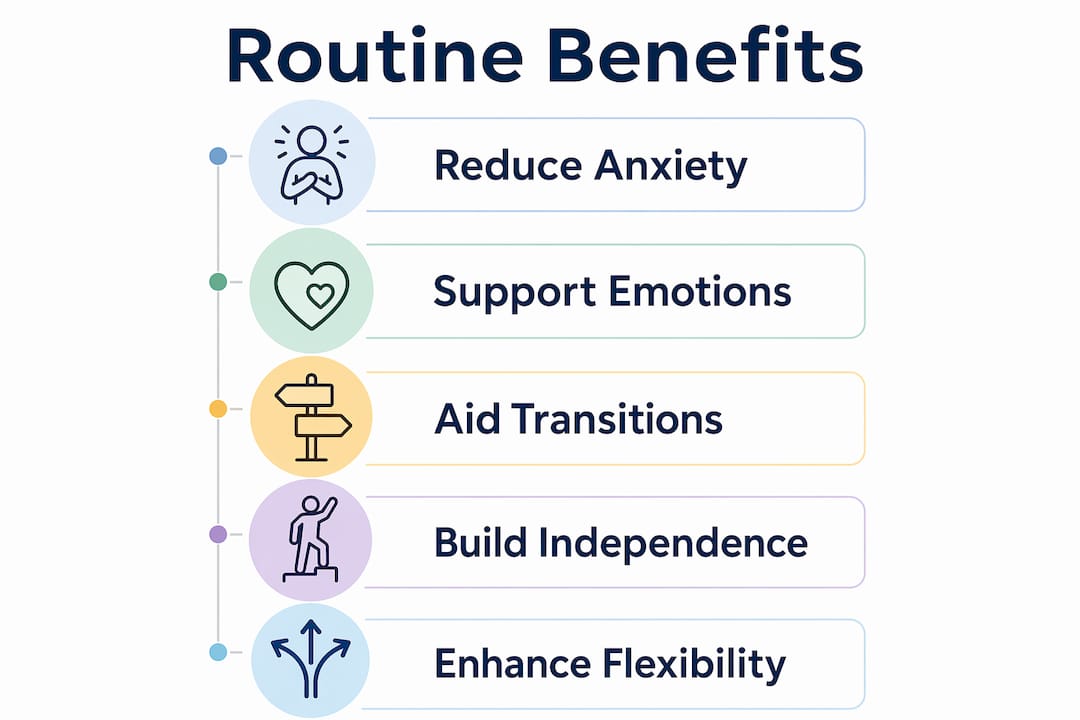
Structured daily routines are the single most effective tool caregivers have for reducing anxiety, supporting emotional regulation, and building independence in autistic children.
| Point | Details |
|---|---|
| Routine reduces anxiety | Predictable sequences lower cortisol and keep the nervous system within manageable limits. |
| Transitions need preparation | Pre-warnings and visual schedules reduce meltdowns by preparing the brain before change arrives. |
| Independence builds gradually | Routines shift from caregiver-led to self-directed through consistent, stage-by-stage practice. |
| Flexibility matters | Over-rigid routines increase stress; introduce small variations within stable structure to build resilience. |
| Behavior signals biology | Resistance to change is nervous system dysregulation, not defiance, and routine is the response. |
What I’ve learned about routine that most guides get wrong
Most caregiver guides treat routine as a scheduling problem. Get the right chart, post it on the fridge, done. That framing misses the deeper point entirely.
Routine is a form of communication. When a child insists on the same route to school every single day, they are not being stubborn. That insistence is the nervous system communicating its need for safety. Treating it as defiance and overriding it without preparation does not teach flexibility. It teaches the child that their environment is unpredictable and unsafe.
The families I have seen make the most progress are the ones who approach routine with empathy first. They enforce consistency not because the schedule says so, but because they understand what unpredictability costs their child neurologically. They also know when to bend. A child who is sick, overtired, or overwhelmed needs grace, not a rigid schedule. The role of family in autism care is not to enforce a program. It is to create a felt sense of safety that the child can carry into the world.
The goal is always empowerment. A routine that serves your child is one they eventually own themselves.
— Keith
Autismdoctorsearch: finding the right support for your family
Building effective routines is easier with professional guidance. Behavioral therapists, occupational therapists, and ABA specialists all use structured routine frameworks as core tools in autism therapy. Autismdoctorsearch maintains a complete, up-to-date directory of autism resources across the United States, including autism therapy services that specialize in routine-based behavioral interventions for children with ASD. Whether you are looking for an ABA provider, an occupational therapist, or a special education school, Autismdoctorsearch connects your family with vetted professionals who understand the importance of structure and daily routine for autistic children. Finding the right specialist is one of the most direct steps you can take toward lasting progress.
FAQ
Why does my autistic child get so upset when routines change?
Unexpected changes trigger a cortisol stress response in autistic children because their brains process every event consciously rather than automatically. The distress is a biological reaction, not defiance.
What is the best daily routine for an autistic child?
The most effective daily routine for autism is one that is consistent, visually supported, and includes advance warnings before transitions. Predictability at morning, mealtime, and bedtime produces the greatest reduction in anxiety.
How do visual schedules help autistic children?
Visual schedules give autistic children a concrete, predictable map of the day, reducing uncertainty and the cognitive load of anticipating what comes next. They are a standard tool in ABA therapy and occupational therapy settings.
Can routines be too rigid for autistic children?
Yes. Over-rigid routines that cannot accommodate any variation increase stress rather than reduce it. The goal is a stable structure with gradually introduced flexibility, supported by backup plans and pre-warnings.
How long does it take for a routine to become effective?
Most children show reduced anxiety within two to four weeks of a consistent routine, though the timeline varies by child. Consistency and caregiver follow-through are the strongest predictors of how quickly the routine takes hold.


