


TL;DR:
- Autism emergency contacts create a structured plan for quick access during crises. Proper setup includes personalized ID cards with clear communication tips, multiple contacts across settings, and redundant storage methods. Regular updates and widespread sharing ensure responders have accurate, immediate information to act safely and effectively.
Autism emergency contacts are a structured set of people, phone numbers, and communication instructions that first responders and caregivers can access instantly during a crisis. Setting up autism emergency contacts means more than writing a phone number on a card. It means building a complete, autism-specific protocol that tells responders exactly who to call, how to communicate, and what to expect. This guide covers every step: creating emergency ID cards, organizing primary and backup contacts, integrating crisis lines like 988 and 911, and keeping your plan current across all settings.
How to set up autism emergency contacts: what to include
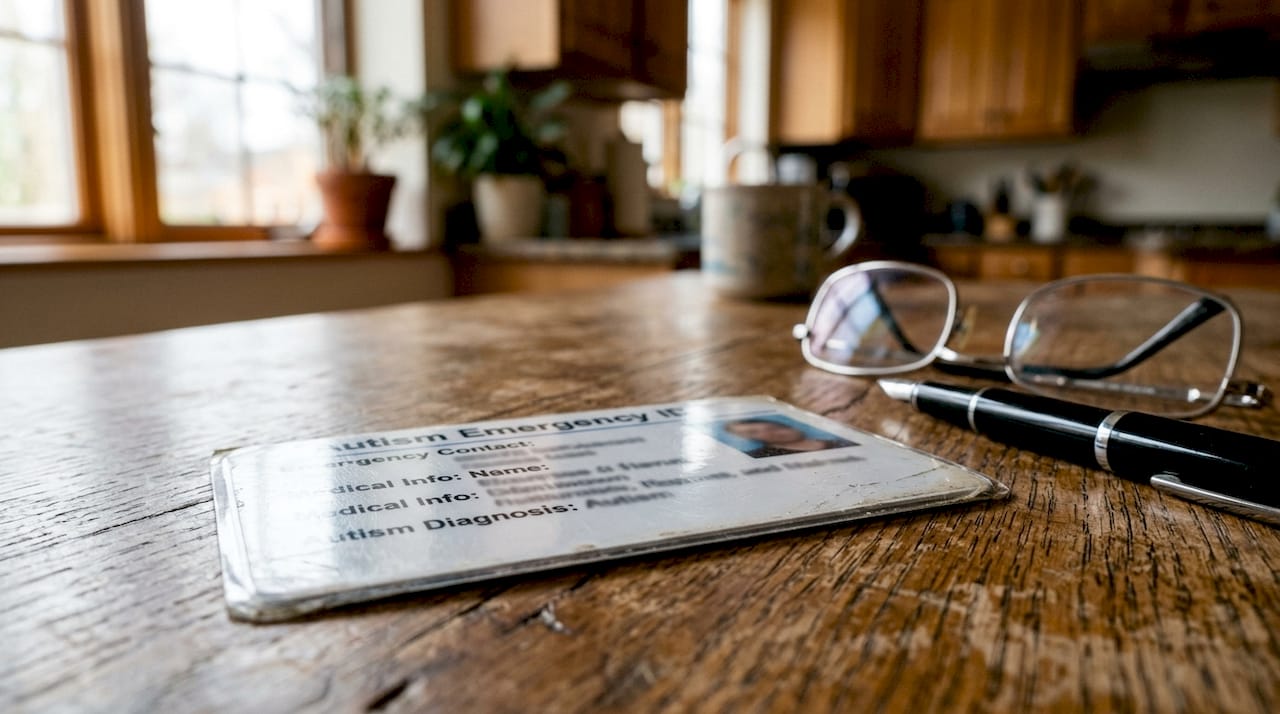
The foundation of any autism emergency contact plan is a well-designed identification tool that a responder can read and act on in under 60 seconds. Families commonly create wallet-size emergency ID cards listing the autistic person’s name, two to three emergency contacts with phone numbers, and autism-specific communication tips. That format works because it gives responders everything they need without requiring them to ask questions the person may not be able to answer.
What belongs on an emergency ID card
Every card should include these core elements:
- Full name of the autistic individual
- Two to three emergency contacts with names, relationships, and phone numbers
- Diagnosis disclosure: a clear statement such as “I am autistic and may have difficulty communicating under stress”
- Communication tips written as direct instructions (see below)
- Medical alerts: allergies, medications, or sensory sensitivities relevant to first response
- A recent photo on the back, which helps responders confirm identity if the person cannot speak
The communication tips section is where most cards fall short. Writing tips as “do this / don’t do this” instructions helps responders act correctly under stress. Effective phrasing sounds like: “Speak slowly and softly. Give extra time to respond. Warn before any physical contact. Do not shout or crowd the person.” Vague language like “be patient” does not give a responder a concrete action.
Pro Tip: Laminate the wallet card and attach a second copy to the inside cover of a small binder that stays at home. The binder version can include more detail, including a full behavior profile and medication list.
Emergency contact formats beyond the wallet card
| Format | Best use | Key advantage |
|---|---|---|
| Wallet ID card | Daily carry, community outings | Immediate access for any responder |
| Medical alert bracelet or ID tag | Nonverbal individuals, wandering risk | Visible even if the person is separated from belongings |
| Blue Envelope (vehicle) | Autistic drivers during traffic stops | Alerts officers to communication needs and includes contact info |
| Home binder | Detailed reference for paramedics | Holds full medical history and crisis plan |
| Digital phone lock screen | Teens and adults with smartphones | Accessible without unlocking the device |
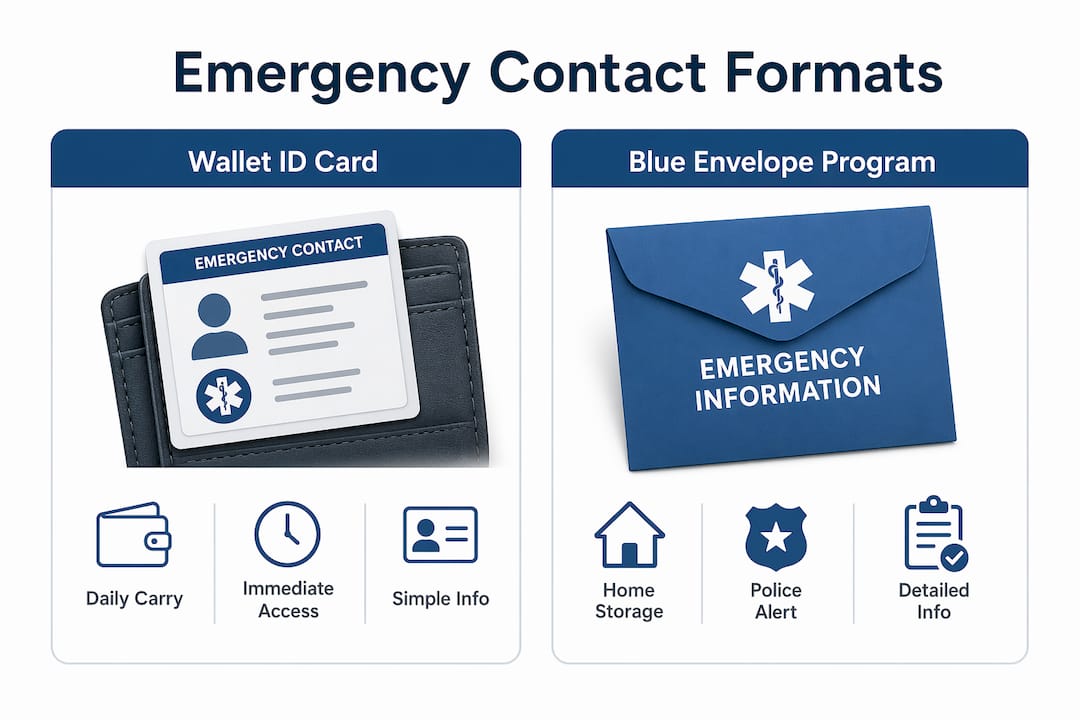
Massachusetts’ Blue Envelope Program is one of the strongest real-world models for this approach. The envelope alerts police officers that the driver may need more time and includes contact information and step-by-step interaction instructions. Several other states have adopted similar programs, making it worth checking whether your state offers one.
Understanding autism communication challenges helps you write better card language. The clearer your phrasing, the faster a responder can act.
How do you organize primary and backup emergency contacts?
A single emergency contact is not enough. Phones die, people travel, and crises happen at inconvenient times. Effective autism crisis plans designate both primary and backup contacts and distribute the plan across home, school, and community settings.
The right way to organize contacts is by setting, not just by relationship. Here is a practical structure:
- Home setting: Primary contact is the parent or primary caregiver. Backup contact is a neighbor, grandparent, or trusted family friend who can arrive quickly.
- School setting: Primary contact is the parent or guardian. Backup contact is a second parent, relative, or designated school liaison who has authority to make decisions.
- Community or therapy setting: Primary contact is the parent or guardian. Backup is the ABA therapist, occupational therapist, or program coordinator who knows the person’s behavior profile.
- Medical setting: Primary contact is the parent or guardian. Backup is the person’s primary care physician or a designated medical proxy.
- Vehicle or transit: The Blue Envelope or equivalent document serves as the first point of contact, with the driver’s emergency contacts listed inside.
Each contact entry should include a full name, relationship to the autistic person, a primary phone number, and an alternate number. A contact who cannot be reached in 90 seconds is not a reliable backup.
Pro Tip: Store a printed copy of all contacts in a sealed plastic sleeve inside the autistic person’s backpack or bag. Update it every six months or whenever a contact’s information changes.
Autism crisis plans should be reviewed every six months or more often if the person’s needs change significantly. Share the updated plan with every teacher, therapist, and caregiver who works with the individual. A plan that only the primary caregiver knows about provides no protection when that caregiver is unavailable.
Connecting with autism support specialists can help you identify which contacts and settings matter most for your specific situation.
When should you call 988 vs. 911 during an autism crisis?
The choice between 988 and 911 is one of the most important decisions in any autism emergency plan. Getting it wrong can escalate a behavioral crisis into a dangerous law enforcement encounter.
SAMHSA defines 988 as a 24/7 crisis support line for behavioral and emotional crises. Caregivers and individuals in crisis can call or text 988 at any time. The 988 Suicide and Crisis Lifeline connects callers to trained counselors who provide support without automatically dispatching police. That distinction matters enormously for autistic individuals, who may display behaviors that look threatening but are not.
Caregivers should call 988 when:
- The autistic person is experiencing a severe meltdown with no immediate physical danger to others
- There is a risk of self-harm but no acute medical emergency
- The caregiver needs guidance on how to de-escalate the situation
- The person is in emotional distress and needs crisis counseling support
Call 911 when:
- There is an immediate medical emergency (injury, seizure, loss of consciousness)
- The person or others face a direct physical safety threat
- The person has wandered and cannot be located
“988 counselors provide support distinct from 911. 988 avoids law enforcement intervention unless medically necessary.” — SAMHSA
Police responding to autism crisis calls perform better when dispatchers have advance information about the person’s needs. When you call 911, tell the dispatcher immediately: “My family member is autistic. They may not make eye contact or respond to verbal commands. Please send an officer trained in crisis response if available.” That single sentence can change how the call is handled.
Best practices for maintaining and sharing your autism crisis contact list
Building the plan is step one. Keeping it accurate and widely distributed is what makes it work in a real emergency.
Redundancy in emergency contact information is vital. Store contact details in at least three accessible locations: on the person’s ID or wearable, in a caregiver-held list, and with every organization that supervises the individual. A single point of failure, like a lost wallet or a dead phone, should never be enough to leave a responder without guidance.
Practical steps for maintaining your plan:
- Review every six months. Set a calendar reminder in january and july each year to check that all phone numbers, addresses, and contact names are current.
- Share with every setting. Give a copy to the school’s front office, the therapy provider, the pediatrician’s office, and any after-school program.
- Use multiple formats. Keep a digital version in a password-protected note on your phone and a printed version at home.
- Register with local emergency services. Many police departments and fire stations accept voluntary autism registry forms that flag an address as home to an autistic individual.
- Brief new caregivers immediately. Any new babysitter, respite worker, or family member who spends time with the autistic person should receive a copy before their first visit.
| Storage method | Strengths | Limitations |
|---|---|---|
| Printed wallet card | Always accessible, no battery needed | Can be lost or damaged |
| Medical alert wearable | Visible even if separated from belongings | Limited information space |
| Phone lock screen note | Easy to update, always on the person | Requires phone to be present and charged |
| Home binder | Full detail, accessible to paramedics | Not portable |
| School or therapy file | Available to staff in that setting | Not accessible outside that location |
Proper autism documentation management ties all of these formats together into a system that stays current and consistent. A well-maintained file means any caregiver can step in with confidence.
Key takeaways
A complete autism emergency contact plan requires personalized ID tools, setting-specific contacts, clear crisis line guidance, and redundant storage across multiple formats and locations.
| Point | Details |
|---|---|
| Build a complete ID card | Include name, two to three contacts, communication tips, and medical alerts on every card. |
| Organize by setting | Designate primary and backup contacts for home, school, community, and medical environments. |
| Know 988 vs. 911 | Use 988 for behavioral crises and 911 for medical emergencies or immediate physical threats. |
| Store contacts redundantly | Keep contact info on the person, with caregivers, and at every organization that supervises them. |
| Review every six months | Update all contacts and redistribute the plan whenever information or needs change. |
What I’ve learned from watching families get this wrong
Most caregivers I’ve worked with build a solid emergency contact card once and never touch it again. That single habit undoes everything else they did right. A phone number that changed two years ago is worse than no number at all. It gives a responder false confidence and wastes critical minutes.
The second mistake is writing communication tips that are too vague to use. “Be patient” and “he has autism” tell a stressed officer nothing. The cards that actually work read like a checklist: speak slowly, do not touch without warning, give 10 seconds to respond, do not interpret silence as defiance. Emergency cards combining contact info with brief, jargon-free tips give responders the tools to act, not just the awareness that a problem exists.
The third mistake is keeping the plan private. Caregivers sometimes worry about stigma or privacy, so they hold back from sharing the plan with schools or neighbors. That instinct is understandable. It is also dangerous. The plan only works if the people who might encounter a crisis have it in hand before the crisis happens. Share it widely. The autism information resources at Autismdoctorsearch can help you frame that conversation with schools and community providers in a way that protects dignity while maximizing safety.
— Keith
Autism Doctor Search resources for emergency planning support
Autismdoctorsearch connects caregivers with vetted therapy providers, behavioral health specialists, and support organizations who can help personalize an autism emergency plan. A trained ABA therapist or behavioral health counselor can review your crisis contact list, identify gaps in your communication tips, and help you prepare for setting-specific scenarios. The directory includes providers who specialize in crisis response preparation, so you are not building this plan alone. Browse autism therapy services on Autismdoctorsearch to find a local specialist who can walk through your emergency protocols with you. Providers listed through Autismdoctorsearch also include child and family support services that work directly with caregivers on safety planning.
FAQ
What goes on an autism emergency ID card?
An autism emergency ID card includes the person’s name, two to three emergency contacts with phone numbers, a brief autism disclosure, and specific communication instructions for responders. Medical alerts such as allergies or medications should also appear on the card.
How often should I update autism emergency contacts?
Crisis plans should be reviewed every six months or sooner if the person’s needs, medications, or caregivers change. Set a recurring calendar reminder to check every contact number and redistribute updated copies to all settings.
When should I call 988 instead of 911 for an autism crisis?
Call 988 for behavioral or emotional crises where there is no immediate physical danger. Call 911 when there is a medical emergency, a direct physical safety threat, or the person has wandered and cannot be located.
How many emergency contacts should an autism crisis plan include?
Each setting should have at least one primary and one backup contact. Across home, school, and community settings, most plans include four to six total contacts to cover gaps when a primary contact is unreachable.
What is the Blue Envelope Program?
The Blue Envelope Program is a Massachusetts initiative that provides autistic drivers with a designated envelope containing emergency contacts and communication tips for police interactions during traffic stops or accidents. Several other states have adopted similar programs.


