

TL;DR:
- Special education schools provide individualized instruction and support tailored to children with disabilities. They use autism-informed strategies, sensory environments, and coordinated services to promote academic and social progress. Parents should focus on staff expertise, consistency, and progress tracking when choosing the right placement.
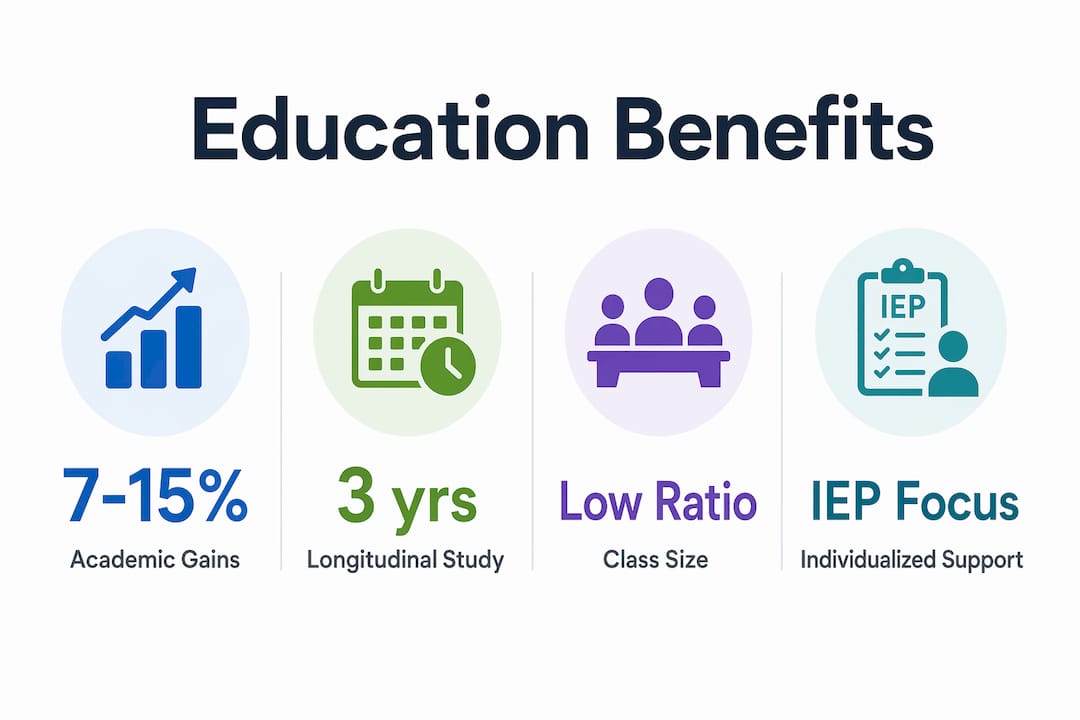
Special education schools are specialized learning environments designed to meet the unique needs of children with disabilities through individualized instruction and targeted support. For parents of autistic children, understanding the role of special education schools means knowing exactly what these settings provide, how they differ from mainstream classrooms, and what outcomes you can realistically expect. These schools operate under legal frameworks like the Individuals with Disabilities Education Act (IDEA) in the United States, which mandates that every eligible child receives a free and appropriate public education through a written Individualized Education Program (IEP). The evidence is clear: special education substantially improves learning, with students gaining 7–15 percentile points over three years after individualized supports begin.
What is the role of special education schools for autistic children?
Special education, formally defined as individualized, systematically monitored instruction with adapted materials and accessible settings, exists to help learners achieve self-sufficiency and meaningful progress. The term “special education school” refers to a dedicated setting where this instruction is the primary focus, rather than a supplementary service added to a general classroom. These schools operationalize a child’s IEP or, in England, an Education, Health and Care Plan (EHCP), translating legal entitlements into daily teaching practice.
The core goal is not simply to place a child in a different building. It is to deliver specialized instruction, related services, and environmental supports that a mainstream setting cannot consistently provide. For autistic children, this often means structured sensory environments, communication supports, and trained staff who understand autism-specific learning profiles. Autismdoctorsearch lists verified special education schools and placement options to help families compare what is available in their area.
How do special schools customize learning for autistic students?
Special education schools build every instructional decision around the individual child’s IEP. Autism-informed strategies must be consistent across all parts of the school day, including transitions and unstructured times like lunch, to produce real skill generalization. That consistency is what separates a well-run special school from one that applies strategies only during formal lessons.
Curriculum adaptations in these settings typically include:
- Modified pacing and sequencing: lessons broken into smaller steps with frequent review
- Visual supports: schedules, task boards, and picture-based communication systems
- Augmentative and Alternative Communication (AAC): devices or symbol systems for nonverbal or minimally verbal students
- Sensory-informed classroom design: reduced visual clutter, designated calm spaces, and flexible seating
- Embedded therapy: speech-language therapy and occupational therapy woven into classroom routines rather than delivered only in pull-out sessions
Specialist staff are central to this model. Special education teachers hold credentials specific to disability categories. Speech-language pathologists, occupational therapists, behavior analysts, and paraprofessionals work as a coordinated team. Each professional’s input feeds back into the IEP review cycle, so the plan evolves as the child grows.
Pro Tip: Ask any school you visit how autism strategies are applied during lunch, recess, and hallway transitions. If the answer is vague, the school may only be applying supports during structured lessons, which limits generalization to real-world situations.
For a deeper look at what works in the classroom, Autismdoctorsearch covers evidence-based strategies used by effective special education programs.
What are the academic and psychosocial benefits of special education schools?
Research consistently shows that special education placement produces measurable academic gains. A 2026 NBER working paper tracking students across three U.S. states found that students with special education identification gained 7–15 percentile points over three years after individualized supports began. That is a substantive improvement, not a marginal one.
The psychosocial picture is equally compelling. A three-year longitudinal study of 119 autistic pupils aged 11–14 found that autistic pupils in specialist resource centres showed higher academic attainment and stronger school belonging than autistic peers in mainstream settings without specialist support. The mechanism behind these gains matters: relational inclusion, meaning perceived teacher support and a genuine sense of belonging, drives outcomes more than placement label alone.
Pro Tip: When reviewing a school’s outcomes data, always ask for individualized progress reports, not just school-wide averages. Averaged outcome data do not guarantee fit for your specific child.
| Outcome area | Finding | What it means for your child |
|---|---|---|
| Academic gains | 7–15 percentile point improvement over 3 years | Individualized supports produce real, measurable learning progress |
| School belonging | Higher in specialist resource centres vs. mainstream without support | Placement quality affects emotional safety, not just academics |
| Teacher relationships | Relational inclusion is a primary driver of positive outcomes | Strong teacher-student bonds matter as much as curriculum design |
| Psychosocial well-being | Specialist settings reduce isolation and improve attendance | Social and emotional health supports academic engagement |
The impact on autistic pupils’ school experience is not limited to test scores. Children who feel safe, understood, and supported by their teachers attend school more consistently and engage more deeply with learning.
What types of special education programs and services are available?
Special education schools offer a coordinated set of programs and services that general schools cannot replicate at the same intensity. These services are written directly into each child’s IEP and reviewed at least annually.
Typical services available in a well-resourced special education school include:
- Speech-language therapy: targeting communication, language processing, and social communication skills
- Occupational therapy: building fine motor skills, sensory processing, and daily living skills
- Applied Behavior Analysis (ABA): structured behavioral intervention to teach new skills and reduce barriers to learning
- Social skills groups: structured peer interaction with adult facilitation
- Assistive technology: from low-tech picture boards to high-tech speech-generating devices
- Behavioral support plans: individualized plans addressing challenging behaviors with proactive strategies
- Counseling services: supporting emotional regulation and mental health
High adult-to-student ratios are a defining feature of these settings. Smaller class sizes allow teachers and aides to respond to each child’s needs in real time. This level of attention is difficult to replicate in a mainstream classroom of 25 or more students.
Coordination is the key word. Services are not delivered in isolation. A speech-language pathologist shares communication goals with the classroom teacher so that vocabulary targets practiced in therapy are reinforced throughout the school day. This cross-professional coordination is what makes special education schools structurally different from mainstream schools with add-on support.
How do special education schools support inclusion and prepare for adulthood?
A common misconception is that special education schools are segregated environments that work against inclusion. The reality is more precise. Inclusion in special schools encompasses broader goals than simply providing belonging. It includes preparing autistic students for life beyond school, with an emphasis on independence and self-determination.
The Preparation for Adulthood (PfA) framework, used widely in England and reflected in transition planning requirements under IDEA in the United States, organizes this work around four domains:
- Employment: work experience, vocational skills, and career exploration starting in secondary school
- Independent living: cooking, budgeting, transportation, and self-care skills embedded in daily school routines
- Community participation: supported access to community settings, social groups, and civic life
- Health: self-advocacy for medical needs and understanding personal health management
Special education schools address these domains through structured transition planning, typically beginning at age 14 in the U.S. and earlier in some states. Transition plans are written into the IEP and involve the student directly, building self-determination skills alongside academic ones.
Social integration within a special school also matters. Schools that organize joint activities with mainstream peers, community outings, and student-led projects give autistic children practice in real-world social contexts. The goal is not to keep children separate but to build the skills and confidence they need to participate in broader community life.
For parents weighing placement options, Autismdoctorsearch provides a detailed guide to special schools for autism that covers inclusion practices and transition planning across different school types.
How do you evaluate and choose a special education school for your child?
Choosing the right school requires more than reviewing a brochure. The quality of implementation matters far more than the school’s stated philosophy.
- Verify autism-specific expertise. Ask whether staff hold credentials in autism education, ABA, or related fields. A school with general special education training is not the same as one with autism-specific expertise.
- Observe strategy consistency. Visit during lunch, transitions, and recess, not just during a formal lesson. Autism-informed practices must generalize across the entire school day to be effective.
- Assess relational inclusion. Watch how teachers interact with students. Do children appear comfortable and engaged? Do staff know each child’s communication style and preferences?
- Review progress monitoring. Ask how the school tracks each child’s IEP goals. Monthly data collection is a minimum standard. Schools that rely on annual reviews alone cannot catch regression early.
- Evaluate family communication. A strong school communicates with parents weekly, not just at IEP meetings. Ask how the school shares daily updates and responds to parent concerns.
Pro Tip: Bring your child’s current IEP to every school visit and ask the principal to walk you through how each goal would be addressed in their setting. Vague answers are a red flag.
For practical guidance on navigating the system, Autismdoctorsearch offers tips every autism parent needs when working through special education placements.
Key takeaways
Special education schools deliver the most benefit when individualized instruction, relational inclusion, and consistent autism-informed strategies work together across the entire school day.
| Point | Details |
|---|---|
| IEPs drive everything | Every service and curriculum adaptation must connect directly to the child’s written IEP goals. |
| Relational inclusion matters | Teacher support and school belonging produce better outcomes than placement label alone. |
| Academic gains are real | Students with individualized supports gain 7–15 percentile points over three years on average. |
| Consistency across the day | Autism strategies must apply during transitions and unstructured time, not only formal lessons. |
| Transition planning starts early | Preparation for adulthood begins at age 14 or earlier and covers employment, independence, and community life. |
What I’ve learned from watching families navigate special education
Parents often come to me after years of fighting for services in mainstream settings, exhausted and unsure whether a special school is giving up or moving forward. My honest view: the question is never about the label on the building. It is about whether the people inside that building know your child, apply strategies consistently, and track progress rigorously.
The research on relational inclusion changed how I think about school visits. I used to focus on curriculum materials and therapy schedules. Now I watch how a teacher greets a student who is having a hard morning. That interaction tells me more about a school’s quality than any program document.
The academic outcome data are genuinely encouraging. Gains of 7–15 percentile points are not trivial. But I always remind parents that population averages do not predict individual results. Request your child’s specific progress data at every IEP meeting. If the school cannot produce it, that is the real problem.
The families I have seen thrive are the ones who treat the IEP as a living document, not a filing requirement. They ask hard questions, show up for observations, and hold schools accountable to the plan. Special education schools can unlock real potential, but only when parents stay engaged and informed.
— Keith
Finding the right therapy and education support for your child
Special education schools work best when paired with coordinated therapy services outside the classroom. Speech therapy, occupational therapy, and ABA services reinforce school-based goals and accelerate progress when providers communicate with each other. Autismdoctorsearch maintains an up-to-date directory of verified autism therapy services across the United States, making it straightforward to find providers who specialize in working alongside school teams. You can also search for ABA therapy providers and occupational therapists who understand the specific demands of special education settings. Use the Autismdoctorsearch directory to build a coordinated support team that works with your child’s school, not separately from it.
FAQ
What is the main role of special education schools?
Special education schools provide individualized instruction and related services, such as speech therapy and behavioral support, tailored to each child’s IEP. Their core role is to deliver specialized teaching that enables children with disabilities to make meaningful educational progress.
How do special education schools help autistic children specifically?
Special education schools use autism-informed strategies, low student-to-teacher ratios, communication supports, and sensory-friendly environments to address the specific learning profiles of autistic students. These settings apply supports consistently across the entire school day, including unstructured times.
Do special education schools produce better academic outcomes?
A 2026 NBER study found that students with individualized special education supports gained 7–15 percentile points over three years. Outcomes vary by child, so parents should request individualized progress data rather than relying on school-wide averages.
What is the difference between an IEP and an EHCP?
An IEP (Individualized Education Program) is the U.S. legal document mandating specialized services for eligible students under IDEA. An EHCP (Education, Health and Care Plan) is the equivalent framework used in England. Both legally bind schools to deliver specific supports tailored to the individual child.
How do I know if a special education school is right for my child?
Observe how staff apply autism strategies during transitions and unstructured time, not only during formal lessons. Ask how the school tracks IEP goal progress and how often it communicates with families. Strong relational inclusion, consistent strategy use, and rigorous data collection are the clearest signs of a quality placement.


