
TL;DR:
- The 2026 autism guidelines emphasize functional definitions, standardized assessments, and behavioral-first treatments. These updates aim to reduce diagnostic delays, improve service quality, and prioritize evidence-based, nonpharmacological interventions. Families should verify provider credentials carefully as evolving standards increasingly focus on qualified, credentialed professionals.
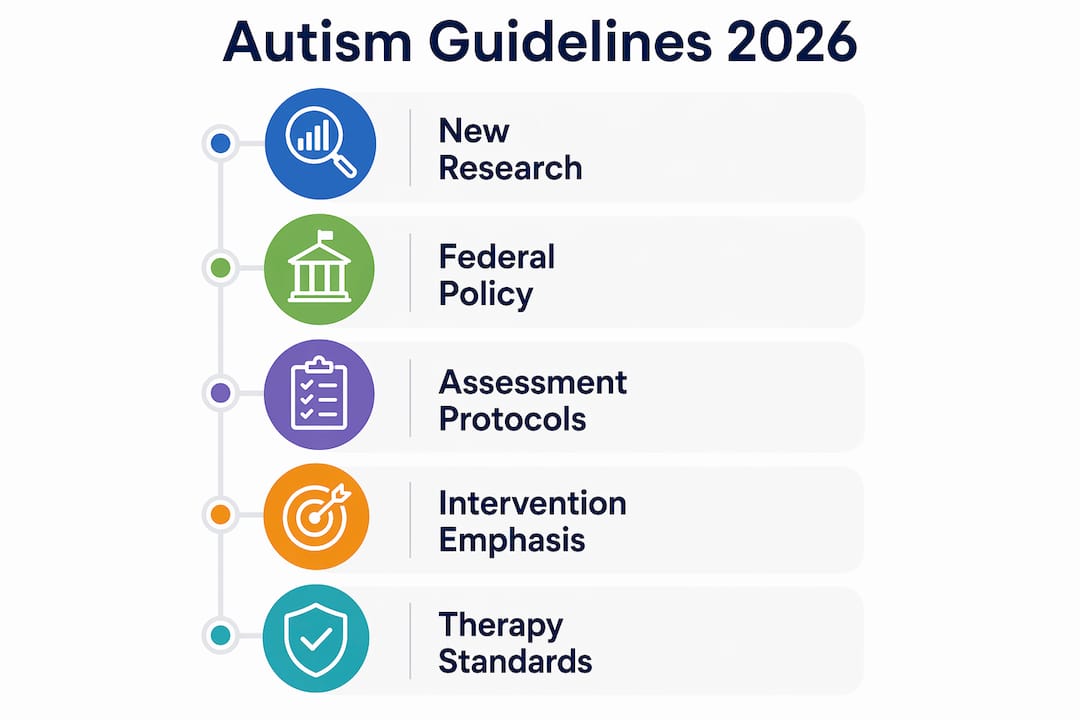
The 2026 autism guideline updates are defined by three converging forces: new research evidence, federal policy shifts, and a growing demand for standardized care across diagnosis, therapy, and safety. For parents, caregivers, and educators, these changes are not abstract policy documents. They directly affect how quickly a child gets diagnosed, which therapies get covered, and what protections exist for individuals with higher support needs. Understanding why these updates happened is the first step toward using them to your advantage.
Why updated autism guidelines 2026 reflect a turning point in care
The new autism guidelines 2026 represent a deliberate move away from fragmented, inconsistent practice toward evidence-aligned standards. Three major forces drove this shift simultaneously.

Federal policy redefinition. The Interagency Autism Coordinating Committee (IACC) advanced a new priority in April 2026: formally defining “profound autism” based on functional criteria rather than IQ scores. This matters because resource allocation has historically been tied to cognitive testing, which often fails to capture the real-world support needs of individuals with minimal functional speech or continuous supervision requirements. The IACC’s push also addressed comorbid medical care and safety risks, including wandering and elopement, with federal recommendations to activate the Integrated Public Alert and Warning System (IPAWS) for at-risk children.
Research evidence favoring behavioral approaches. A landmark 2026 Nature Mental Health meta-analysis of 149 clinical trials found that nonpharmacological and behavioral interventions produced an effect size of Hedges’ g=0.70 on core autism symptoms, compared to g=0.20 for pharmacological treatments. That gap is not marginal. It tells clinicians, policymakers, and families that behavioral and psychosocial supports are the primary tools that move the needle, and that medication alone should not be the default response to autism-related challenges.
Emerging diagnostic technology. A Molecular Psychiatry study identified urinary metabolites with 90% sensitivity and 100% specificity for autism identification in children aged 2 to 11. Non-invasive screening at this accuracy level could dramatically shorten the diagnostic timeline, which currently stretches years for many families.
“Updated definitions like ‘profound autism’ guide resource allocation by functional need rather than IQ scores, reflecting a shift in policy focus that could reshape how services are funded and delivered across the country.”
How do new assessment protocols improve early and accurate diagnosis?
Ireland’s 2026 Autism Assessment and Intervention Pathway Protocol offers the clearest working model of what standardized, tiered assessment looks like in practice. Launched in May 2026 by the Health Service Executive (HSE), the protocol assigns children to assessment routes based on presentation complexity, recognizing that some autism presentations are more straightforward to identify than others. The practical result is a system where a child with clear, early indicators moves through assessment faster than one with a complex, overlapping profile.
The protocol addresses a problem that families in many countries recognize immediately: diagnostic delays caused by administrative fragmentation and inconsistent referral standards. In Ireland, those delays triggered legal actions before the new system was introduced. The redesigned approach unifies processes across primary care, mental health, and disability services, reducing the number of times a family has to re-explain their child’s history to a new provider.
For families in the United States, this model signals where domestic assessment reform is heading. Here is what a well-structured tiered assessment pathway typically delivers:
- Standardized referral criteria so that a pediatrician in one state applies the same threshold as one in another.
- Complexity-matched evaluation routes that prevent over-assessment of straightforward cases and under-assessment of complex ones.
- Cross-service coordination between primary care, schools, and specialty clinics so that no single provider becomes a bottleneck.
- Reduced wait times by triaging cases based on urgency and presentation rather than first-come, first-served scheduling.
- Clearer family communication at each stage, so caregivers understand what happens next and why.
Pro Tip: When requesting an autism evaluation, ask your child’s pediatrician specifically whether their practice uses a standardized referral protocol. If they do not, request a direct referral to a specialist who does. Understanding the autism screening process before your first appointment saves time and reduces confusion.
Why is there a stronger emphasis on nonpharmacological interventions?
The 2026 Nature Mental Health meta-analysis did not just confirm that behavioral interventions work. It quantified how much better they work compared to medication, and it identified the conditions under which results vary. Smaller sample sizes, shorter trial durations, and cultural context all influence reported effect sizes, which means that a study showing strong medication results in one setting may not replicate in another. This finding pushes clinicians toward rigorous trial standards and away from generalizing drug outcomes across populations.
For parents and educators, the practical implication is direct. Behavioral and psychosocial approaches, including Applied Behavior Analysis (ABA), communication supports, and social skills training, are now backed by the strongest available evidence base. Medication may still play a role in managing specific comorbid conditions like anxiety or sleep disorders, but it is not the primary intervention for core autism symptoms under the updated guidance.
| Intervention type | Effect size (Hedges’ g) | Primary application |
|---|---|---|
| Nonpharmacological/behavioral | 0.70 | Core autism symptoms, communication, social skills |
| Pharmacological | 0.20 | Comorbid conditions (anxiety, sleep, irritability) |
The gap between these two numbers should inform every conversation you have with a provider about your child’s treatment plan. A therapist or physician who defaults to medication without first exhausting behavioral options is working against the current evidence.
Pro Tip: Ask any provider recommending a pharmacological approach to show you the specific evidence for that medication’s effect on your child’s primary challenges, not just autism in general. Families benefit most when evidence-backed behavioral treatments are prioritized over unproven pharmacological options.
What changes are being made to therapy standards and provider oversight?
ABA therapy has grown rapidly as Medicaid coverage expanded, and that growth created a quality problem. Without standardized credentialing requirements, supervision ratios, or background check protocols, the field became inconsistent in ways that directly affect children. In 2026, proposals emerged to address this gap through federal credentialing standards for ABA providers within Medicaid, driven in part by advocacy from organizations like the Association for Behavioral Health and Wellness (ABHW).
The core issues being addressed include:
- Supervision ratios: How many clients a Board Certified Behavior Analyst (BCBA) can oversee at one time directly affects the quality of each child’s program. Proposed standards would cap these ratios to prevent therapist overload.
- Delegation protocols: Clear rules about which tasks a BCBA can delegate to a Registered Behavior Technician (RBT) protect treatment fidelity and reduce the risk of unsupervised, low-quality sessions.
- Background check requirements: Standardized screening for all direct-care staff addresses a safety gap that has been inconsistently enforced across states.
- Credentialing verification: Families currently have limited tools to confirm that a provider’s credentials are current and legitimate. Centralized verification systems would change that.
These changes matter because treatment fidelity is the difference between ABA that produces measurable outcomes and ABA that fills hours without progress. Standardizing oversight is not bureaucratic box-checking. It is the mechanism that protects your child’s time, your family’s resources, and the integrity of the therapy itself. Families looking for qualified providers can use the autism behavioral therapist guide to understand what credentials to look for before committing to a provider.
Key takeaways
The 2026 autism guideline updates are driven by evidence, not politics, and they shift the field toward functional definitions, standardized assessment, and behavioral-first treatment with verified provider oversight.
| Point | Details |
|---|---|
| Profound autism definition | The IACC now defines profound autism by functional need, not IQ, reshaping how resources are allocated. |
| Behavioral interventions lead | A 149-trial meta-analysis found behavioral approaches produce 3.5x larger effect sizes than pharmacological ones. |
| Tiered assessment reduces delays | Ireland’s 2026 protocol shows that complexity-matched referral pathways cut wait times and legal disputes. |
| ABA credentialing reform | Proposed Medicaid standards for supervision ratios and background checks directly protect therapy quality. |
| Diagnostic technology advancing | Urine-based screening with 90% sensitivity could make early identification faster and less invasive. |
What these updates mean on the ground
The “profound autism” designation is the part of the 2026 updates I find most consequential, and also most likely to be misapplied. When a functional label determines resource access, the definition of that label becomes a political and financial battleground. Families whose children fall just outside the criteria risk being told they do not qualify for services that would genuinely help. That is not a hypothetical concern. It has happened with every diagnostic category that gates funding.
What I would tell any parent right now is this: document everything. Functional criteria require functional evidence. Keep records of your child’s daily support needs, communication challenges, and safety incidents. That documentation becomes your case when a provider or insurer questions eligibility under the new standards.
The shift toward behavioral interventions is genuinely good news, but only if the providers delivering those interventions are qualified. The credentialing reform proposals are a step in the right direction, but they are still proposals. Until federal standards are finalized, the burden of verification falls on families. Ask for credentials. Check BACB certification status directly. Do not assume that Medicaid coverage of a provider equals quality assurance.
The 2026 updates also signal something broader: the field is maturing. Guidelines exist because the evidence base is strong enough to set standards. That is progress worth recognizing, even while pushing for faster implementation.
— Keith
Find qualified autism providers aligned with 2026 standards
Autismdoctorsearch maintains a directory of verified autism therapy providers, including ABA specialists, occupational therapists, and mental health services that align with the credentialing and evidence standards reflected in the 2026 guideline updates. As oversight requirements tighten and families need more confidence in provider qualifications, having a reliable starting point matters. Browse autism therapy services on Autismdoctorsearch to find providers in your area who meet current best-practice standards. You can also explore how to match autism needs to services to make sure the support your child receives fits their specific profile and the latest clinical recommendations.
FAQ
Why were autism guidelines updated in 2026?
The 2026 autism guideline updates reflect new research evidence, including a major meta-analysis of 149 trials, federal policy priorities around defining profound autism, and growing demand for standardized therapy credentialing and assessment pathways.
What is the “profound autism” designation in the 2026 guidelines?
Profound autism is defined by functional criteria such as minimal functional speech and continuous supervision needs, rather than IQ scores. The IACC advanced this definition in April 2026 to guide more accurate resource allocation.
How do the new 2026 autism diagnosis criteria affect families?
Standardized, tiered assessment protocols reduce diagnostic delays and variability, giving families clearer referral pathways and faster access to evaluation. Ireland’s 2026 Autism Protocol is the leading working model of this approach.
Are behavioral therapies now preferred over medication under the 2026 guidelines?
A 2026 Nature Mental Health meta-analysis confirmed that behavioral and psychosocial interventions produce significantly larger effect sizes (g=0.70) than pharmacological treatments (g=0.20) for core autism symptoms, making them the evidence-based first choice.
What should parents look for in an ABA provider under the new 2026 standards?
Look for a Board Certified Behavior Analyst (BCBA) with current BACB certification, clear supervision ratios, and documented delegation protocols. Proposed 2026 Medicaid standards are pushing providers toward these requirements, but verification remains a family responsibility until federal rules are finalized.