
TL;DR:
- Genetic counseling in autism translates complex DNA results into clear, actionable information for families and care teams. It supports pre- and post-test understanding, risk assessment, and guides personalized medical management and family planning. Despite rapid genetic advances, access remains limited, underscoring the need to integrate counseling as a standard part of autism evaluation.
Genetic counseling for autism is the clinical process that translates complex DNA test results into clear, usable information for families and care teams. The role of genetic counseling in autism extends well beyond reading a lab report. It covers pretest preparation, emotional support, family risk assessment, and posttest guidance on what findings actually mean for your child’s care and your family’s future. Only 41% of adults with autism have documented genetic testing, which means the majority of families are making care decisions without the full picture. This article explains what genetic counseling does, which tests are involved, and how the results shape real decisions.
What is the role of genetic counseling in autism evaluation?
Genetic counseling in autism serves as the interpretive layer between raw test data and meaningful clinical action. A board-certified genetic counselor reviews your family history, explains what specific tests can and cannot detect, and prepares you for the range of possible outcomes before a single sample is collected. That pretest conversation alone reduces anxiety and sets realistic expectations, which matters when results can take weeks and carry significant implications.

After results arrive, the counselor translates clinical language into plain terms. A finding like “pathogenic variant in SHANK3” means something very different to a molecular biologist than to a parent sitting across a desk. Counselors prepare families before testing and clarify results after, including what findings mean for siblings and extended family members who may carry the same variant without a current diagnosis.
The autism clinical assessment process integrates genetic counseling as one component of a broader evaluation that includes developmental, behavioral, and medical assessments. Genetic counseling does not replace any of those steps. It adds a layer of biological context that can sharpen every other clinical decision.
What genetic tests are commonly used in autism evaluation?
The three main test categories used in autism genetic evaluation are chromosomal microarray, exome sequencing, and targeted gene panels. Each differs in what it detects, how much of the genome it covers, and what clinical questions it answers best.
| Test Type | What It Detects | Best Used For | Key Limitation |
|---|---|---|---|
| Chromosomal microarray (CMA) | Copy number variants, deletions, duplications | First-tier evaluation in children | Misses single-gene point mutations |
| Exome sequencing (ES) | Single-gene variants across protein-coding regions | Cases with negative CMA or complex presentation | Higher cost; variants of uncertain significance common |
| Genome sequencing (GS) | Variants across entire genome including non-coding regions | Research and complex unresolved cases | Interpretation still evolving |
| Targeted gene panels | Variants in specific autism-linked genes | Focused follow-up after broader testing | Limited to known gene list |
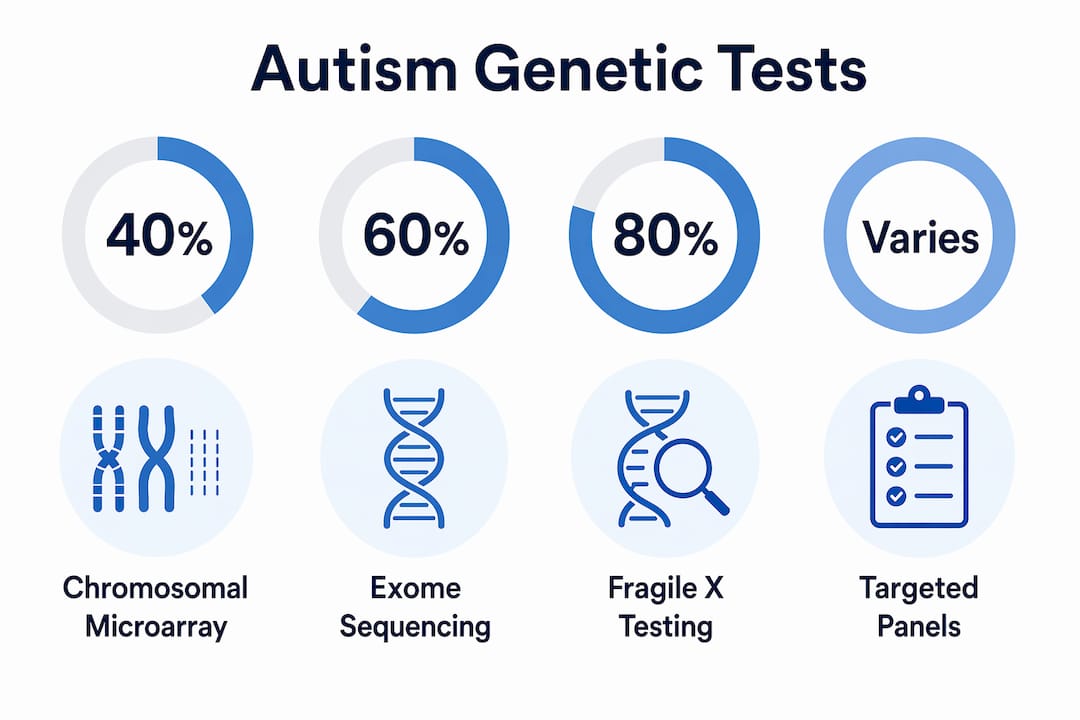
Chromosomal microarray and exome sequencing are first-tier tests recommended by the American College of Medical Genetics and Genomics (ACMG) for autism evaluation in children and youth. The 2010 ACMG statement established microarray as the standard; 2019 and 2021 consensus guidelines added exome sequencing as a co-equal first-tier option for neurodevelopmental disorders. That shift reflects how rapidly gene discovery has expanded, with hundreds of autism-linked mutations now identifiable that older tests simply could not find.
Older tests like microarray and Fragile X panels may not detect many variants now identifiable by exome or genome sequencing. This is why reviewing prior testing history is a critical first step in any counseling session before recommending repeat testing.
Pro Tip: If your child received genetic testing more than five years ago, ask a genetic counselor to review those results. Testing technology has advanced significantly, and a prior negative result does not mean current testing would find nothing new.
How does genetic counseling help families interpret test results?
Interpreting autism genetic test results without professional guidance is genuinely difficult, even for physicians outside genetics. Results often include variants of uncertain significance (VUS), which are genetic changes that may or may not contribute to autism but cannot yet be classified definitively. A genetic counselor explains what a VUS means in practical terms, what follow-up steps are appropriate, and when reclassification might occur as research advances.
Pretest counseling typically covers the following topics:
- Review of personal and three-generation family history
- Explanation of which test is recommended and why
- Discussion of possible result types: positive, negative, VUS, incidental findings
- Emotional preparation for ambiguous or unexpected outcomes
- Informed consent, including implications for other family members
- Insurance and privacy considerations under GINA (Genetic Information Nondiscrimination Act)
Posttest counseling addresses a different set of concerns:
- What a positive finding means for the individual’s medical management
- Whether siblings or parents should consider testing
- Recurrence risk for future pregnancies
- Limitations of a negative result and whether additional testing is warranted
- Referrals to specialists, support groups, or clinical trials
Pretest and posttest counseling bridge an ethical and practical communication gap by addressing nuanced result implications that are challenging for patients and many clinicians to interpret independently. The ACOG 2026 committee statement reinforces this as an ethical obligation, not just a clinical courtesy.
Variable expressivity adds another layer of complexity because genetic variants linked to autism may present very differently even within the same family. A parent may carry a variant associated with elevated autistic traits while their child expresses a more significant clinical picture. Counselors explain this variability directly, which prevents families from drawing incorrect conclusions about inheritance or prognosis.
Pro Tip: Ask your genetic counselor specifically about variants of uncertain significance before testing begins. Knowing in advance that ambiguous results are common prevents unnecessary distress when they appear.
What are the practical implications for autism care and family planning?
Genetic findings from autism testing carry direct, concrete implications for medical management, intervention planning, and reproductive decisions. The steps most families take after receiving results follow a predictable sequence.
- Review results with the genetic counselor to confirm understanding of the finding type, its clinical significance, and any immediate medical recommendations.
- Schedule medical follow-up for conditions associated with the identified variant. For example, a 22q11.2 deletion diagnosis triggers cardiac, immunological, and endocrine surveillance that would not otherwise be standard.
- Share relevant findings with the care team, including developmental pediatricians, neurologists, and behavioral therapists, so intervention plans reflect the full clinical picture.
- Assess family members who may carry the same variant, particularly siblings and parents, based on the inheritance pattern identified.
- Explore clinical trial eligibility if the finding points to a specific gene or pathway. Genetic testing helps explain developmental differences and supports enrollment in targeted research studies, which can open access to emerging treatments.
- Discuss reproductive options with the counselor if family planning is a consideration. Options range from preconception carrier testing to prenatal diagnosis and preimplantation genetic testing.
One point families consistently underestimate: a negative genetic result does not exclude a genetic contribution to autism. Negative results do not rule out genetic causes because current technology cannot detect all variant types, and many autism-associated genes remain undiscovered. Genetic counselors explain this limitation explicitly so families do not interpret a negative result as a closed door.
Genetic counseling aligns findings with intervention planning to prevent what clinicians call “genetics-driven detours,” where families delay behavioral and developmental therapies while waiting for genetic answers. The counselor’s job is to make clear that genetics informs care. It does not pause it.
Understanding how family dynamics shape autism care is equally important once genetic results are in hand, particularly when findings have implications for multiple family members.
What challenges and ethical considerations surround genetic counseling in autism?
Genetic counseling in autism is not without friction. The science is advancing faster than clinical infrastructure, and families face real challenges in accessing qualified counselors, interpreting ambiguous results, and managing the emotional weight of genetic information.
| Benefit | Challenge or Risk |
|---|---|
| Identifies syndrome-level diagnoses with targeted management | Many findings are variants of uncertain significance with no clear action |
| Guides medical surveillance for co-occurring conditions | Access to board-certified genetic counselors is limited in many regions |
| Informs family recurrence risk and reproductive planning | Results can create anxiety, guilt, or family conflict around inheritance |
| Supports clinical trial eligibility and personalized care | Insurance coverage for genetic testing varies and can be a barrier |
| Clarifies negative results and sets realistic expectations | Negative results may still leave families without a clear genetic explanation |
Complex inheritance patterns create particular counseling challenges. Autism does not follow simple dominant or recessive inheritance in most cases. Many variants show incomplete penetrance, meaning not everyone who carries the variant develops autism. A 2026 Genome Biology study found that male carriers of certain gene variants show more severe symptoms, while parents carrying the same variants may show only elevated autistic traits. Communicating this nuance without causing undue alarm requires skill and experience.
The ethical dimension is equally significant. ACOG’s 2026 committee statement identifies informed consent, result interpretation, and ethical communication as professional obligations tied to genetic testing. Ordering a genetic test without counseling support leaves families exposed to results they cannot interpret and decisions they are not equipped to make alone. For complex cases, referral to a medical geneticist or a genetics center affiliated with a children’s hospital is the appropriate standard of care.
Key takeaways
Genetic counseling in autism is the essential clinical bridge between raw DNA data and decisions that actually improve care, reduce medical risk, and support informed family planning.
| Point | Details |
|---|---|
| Counseling precedes and follows testing | Pretest and posttest sessions are both required to ensure informed consent and result understanding. |
| Microarray and exome sequencing are first-tier tests | ACMG and 2021 consensus guidelines recommend both as standard first-line options for autism evaluation. |
| Negative results are not definitive | A negative genetic test does not exclude genetic contribution; counselors explain this limitation directly. |
| Findings guide medical management | Identified variants trigger specific surveillance protocols and can open clinical trial eligibility. |
| Genetics complements, not replaces, therapy | Genetic findings refine intervention plans but must never delay behavioral and developmental therapies. |
Why genetic counseling in autism deserves more attention than it gets
I have spent years reviewing how families navigate autism evaluations, and the pattern I see most often is this: genetic testing gets ordered, results arrive, and then nothing happens. No counselor. No follow-up conversation. Just a lab report sitting in a patient portal that nobody fully understands.
That gap is the real problem. The science behind autism genetics has moved extraordinarily fast. Exome sequencing now identifies variants that chromosomal microarray, the gold standard a decade ago, simply cannot see. But faster technology without better communication infrastructure does not help families. It just produces more confusion.
What I find genuinely underappreciated is how much genetic counseling does for adults with autism, not just children. The testing gap in adults is striking. Many adults diagnosed years ago were never offered genetic evaluation, and their families made reproductive and medical decisions without information that is now readily available. That is a correctable problem, and more families should be asking for it.
My honest view is that genetic counseling should be treated as a standard component of autism evaluation, not an optional add-on for complex cases. The clinical psychologist’s role in autism diagnosis is well understood. The genetic counselor’s role deserves the same recognition. Genetics does not define a person with autism. But it can explain a great deal, guide smarter medical care, and give families the clarity they need to move forward with confidence.
— Keith
How Autismdoctorsearch connects families to autism care resources
Once genetic counseling clarifies your child’s or your own care needs, the next step is finding the right providers to act on those insights. Autismdoctorsearch maintains a current, searchable directory of autism resources across the United States, including ABA therapy, occupational therapy, medical clinics, and mental health services. Families who have received genetic findings pointing toward specific behavioral or developmental needs can use the directory to locate autism therapy services that align with those clinical recommendations. Genetic counseling tells you what the biology suggests. Autismdoctorsearch helps you find the team to address it.
FAQ
What does a genetic counselor do for autism?
A genetic counselor reviews family history, recommends appropriate genetic tests, prepares families for possible outcomes before testing, and explains results afterward, including implications for siblings and parents. They translate clinical findings into clear guidance for care and family planning.
Is genetic testing recommended for all children with autism?
ACMG guidelines and 2021 consensus recommendations support chromosomal microarray and exome sequencing as first-tier evaluations for children with autism spectrum disorder, particularly when intellectual disability or dysmorphic features are present. A genetic counselor can determine which test is most appropriate based on individual history.
What happens if genetic test results are negative?
A negative result does not rule out a genetic contribution to autism because current technology cannot detect all variant types and many autism-linked genes remain unidentified. Genetic counselors explain this limitation and advise on whether additional or updated testing is warranted.
Can genetic counseling help with family planning?
Yes. Genetic counseling identifies inheritance patterns and recurrence risks that directly inform reproductive decisions. Options discussed may include preconception carrier testing, prenatal diagnosis, or preimplantation genetic testing depending on the specific finding and family circumstances.
How do I find a qualified genetic counselor for autism?
Board-certified genetic counselors are available through children’s hospitals, academic medical centers, and genetics clinics. The National Society of Genetic Counselors (NSGC) maintains a searchable directory. Referrals from a developmental pediatrician or neurologist are a standard starting point.