


TL;DR:
- Special education provides individualized support for children with disabilities to meet their learning needs. Parents need to understand the IEP process, their rights, and how supports are matched to functional barriers. Being well-informed and prepared helps families advocate effectively for their child’s educational success.
Special education is defined as specially designed instruction that adapts content, methodology, or delivery to meet the unique needs of a child with a disability. Under the Individuals with Disabilities Education Act (IDEA), eligible children aged 3 to 21 receive this instruction at no cost to parents, a guarantee known as Free Appropriate Public Education (FAPE). For parents of children with autism, understanding how this system works is the difference between a child who gets the right support and one who falls through the cracks. This guide covers the legal framework, Individualized Education Programs (IEPs), classroom strategies, parental rights, and transition planning so you can walk into any school meeting prepared and confident.
What is special education explained for parents of children with autism?
Special education is not a place. It is a set of services. A child with autism may receive specially designed instruction in a general education classroom, a resource room, a specialized school, or a combination of all three. The setting depends on what the IEP team determines is the Least Restrictive Environment (LRE) appropriate for that child.

IDEA is the federal law that governs all of this. It defines 13 disability categories that qualify a child for services, and autism is one of them. The law requires schools to provide supports that give each eligible child a meaningful educational benefit, not just access to a classroom seat.
The term “special educational needs” is widely used in other countries, but in the United States the standard term is “special education” under IDEA. Both phrases describe the same core concept: individualized support for children whose disabilities affect their ability to learn in a standard setting. Knowing the American terminology helps you communicate clearly with school staff and understand your legal documents.
What is an IEP and why does it matter?
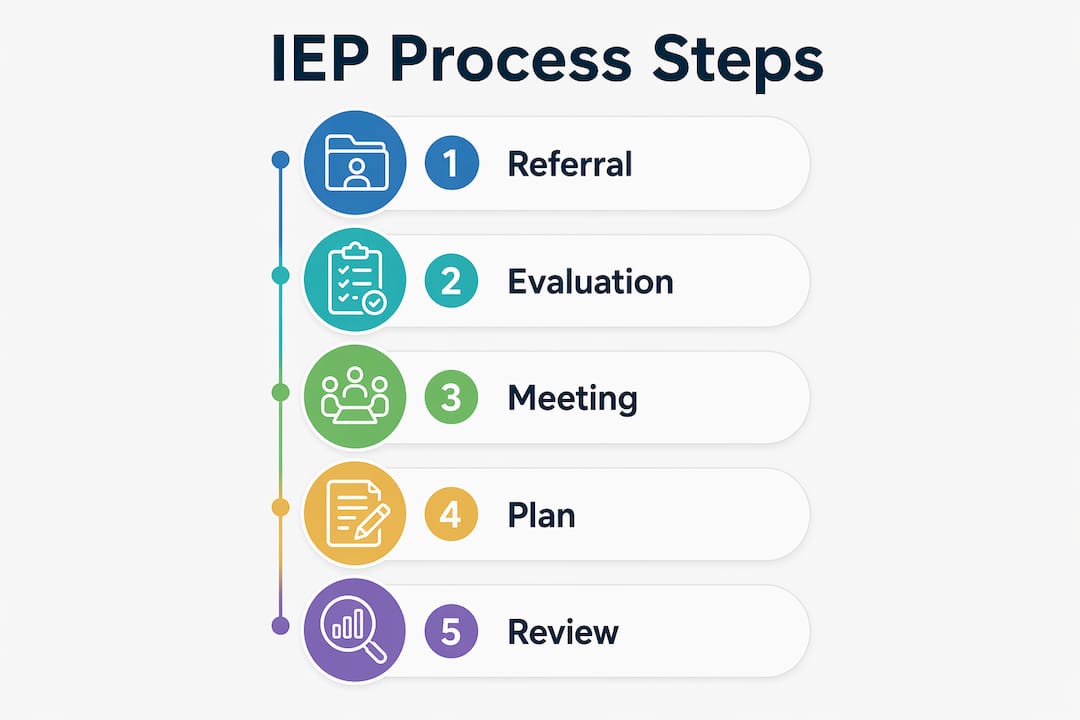
The Individualized Education Program (IEP) is the legal document at the center of every child’s special education plan. It is written by a team that includes general education teachers, special education teachers, a school administrator, related service providers, and you as the parent. Parents are equal members of the IEP team with full legal rights to participate in every decision about identification, evaluation, and placement.
What goes into an IEP?
A complete IEP contains several required components:
- Present levels of performance — a description of how your child currently functions academically and functionally.
- Annual goals — measurable targets the team expects your child to reach within one year.
- Special education services — the specific instruction, therapies, and supports the school will provide.
- Accommodations and modifications — changes to how your child accesses or demonstrates learning.
- Progress monitoring — how and how often the school will report your child’s progress toward goals.
- Placement decision — the setting where services will be delivered, based on LRE.
How does the evaluation process work?
Before an IEP is written, the school must conduct a full and individual evaluation. This assessment covers all areas of suspected disability, including cognitive ability, academic achievement, communication, and adaptive behavior. You must give written consent before any evaluation begins. If the school refuses to evaluate, they must provide that refusal in writing with an explanation.
IEP meetings are annual, but you can request additional meetings at any time if your child’s needs change or if agreed services are not being delivered. That right is worth using.
Pro Tip: Request a draft copy of the IEP goals and evaluation reports 3–5 days before the meeting. Reviewing documents beforehand prevents you from processing complex information on the spot and gives you time to prepare questions.
How do special education strategies and accommodations work in the classroom?
The most effective classroom supports match the specific barrier a child faces, not just the diagnostic label on their file. Matching support to functional barriers produces better outcomes than applying generic autism accommodations across the board. A child who struggles with auditory processing needs different supports than a child who struggles with executive function, even if both have the same diagnosis.
Accommodations vs. modifications: what is the difference?
This distinction matters legally and practically.
| Feature | Accommodation | Modification |
|---|---|---|
| Definition | Changes how a student learns or shows knowledge | Changes what a student is expected to learn |
| Grade-level standard | Maintained | Altered |
| Examples | Extended time, visual schedules, speech-to-text | Reduced assignment length, alternate grading scale |
| Impact on diploma | Generally none | May affect standard diploma eligibility |
| Who decides | IEP team | IEP team |
Accommodations level the playing field. Modifications change the game. Most parents of children with autism want accommodations first, because they preserve access to grade-level content.
Effective teaching strategies for students with autism
Research-backed strategies used in special education classrooms include:
- Explicit instruction: Breaking skills into small, clearly taught steps with frequent checks for understanding.
- Visual supports: Picture schedules, graphic organizers, and color-coded materials reduce reliance on verbal processing.
- Predictable routines: Consistent daily structures lower anxiety and free up cognitive resources for learning.
- Sensory zones: Designated calm spaces or sensory tools reduce dysregulation before it disrupts learning.
- Speech-to-text tools: Programs like Google Docs Voice Typing or dedicated AAC devices support students with written expression challenges.
The Multi-Tiered System of Supports (MTSS) framework organizes these strategies by intensity. 80% of students succeed with universal Tier 1 supports, 15% need targeted Tier 2 interventions, and 5% require the intensive Tier 3 support that typically leads to an IEP evaluation. MTSS data is often used as evidence during the IEP eligibility process.
Pro Tip: Ask your child’s teacher which specific strategies are written into the IEP versus which ones are informal classroom practices. Only IEP-listed supports are legally required.
What are parents’ rights in the special education system?
Federal law gives parents of children with disabilities a defined set of rights, and schools are required to provide you with a written copy called the Procedural Safeguards Notice at least once per year. Knowing these rights before you need them is the most practical form of preparation.
Your core rights include:
- Right to evaluation: You can request a school evaluation at any time, in writing. The school has a set timeline to respond.
- Right to informed consent: The school cannot evaluate your child, change their placement, or begin services without your written agreement.
- Right to participation: You must be invited to and included in all IEP meetings. Schools cannot hold meetings without you.
- Right to records: You can request copies of all educational records, including evaluations and IEP documents.
- Right to dispute: If you disagree with the school’s decisions, you can request mediation, a due process hearing, or file a state complaint.
Prior Written Notice (PWN) is one of the most underused protections. Schools must provide PWN whenever they propose or refuse to change your child’s identification, evaluation, or placement. PWN stops schools from making unilateral decisions without a written explanation you can review and challenge.
Request all communications in writing throughout the process. Verbal agreements made in hallways or phone calls are difficult to enforce. A written email trail creates accountability on both sides.
Pro Tip: Bring a trusted support person to IEP meetings. A second set of ears catches details you might miss when you are emotionally invested in the conversation.
Shifting from a reactive to a collaborative role produces better IEP outcomes. Schools respond well to parents who come prepared with specific questions, documented observations, and a clear understanding of their child’s needs. That posture signals partnership, not confrontation, and it gets results.
How does transition planning support long-term success for students with autism?
Transition planning is the part of special education that prepares students for life after high school. Transition services must be included in the IEP no later than age 16, though many families and advocates recommend starting earlier for students with autism.
Effective transition planning covers three domains:
- Postsecondary education or training — goals related to community college, vocational programs, or supported learning environments.
- Employment — job skills, internship experiences, and supported employment options tailored to the student’s strengths.
- Independent living — daily living skills like cooking, budgeting, transportation, and community participation.
The student’s voice matters in transition planning. IEP teams are required to invite the student to their own transition meetings. For many students with autism, this is their first formal experience with self-advocacy skills, and those skills predict long-term academic and life success. Parents can reinforce self-advocacy at home by practicing how to ask for help, describe personal needs, and communicate preferences.
Related services like occupational therapy, speech-language therapy, and Applied Behavior Analysis (ABA) therapy often continue through the transition years and directly support these goals. Connecting with specialized autism support services early gives families more time to build the right team before high school ends.
Key takeaways
Special education under IDEA is a legal right, not a school favor, and parents who understand the IEP process, their rights, and available strategies are the most effective advocates for their children.
| Point | Details |
|---|---|
| IDEA guarantees free services | Eligible children aged 3–21 receive special education at no cost under federal law. |
| IEP is the legal foundation | Every service, goal, and accommodation must be written into the IEP to be legally enforceable. |
| Match supports to barriers | Effective strategies address specific functional challenges, not just diagnostic categories. |
| Parents hold real legal power | Rights to consent, records, PWN, and due process give parents meaningful control over decisions. |
| Transition planning starts at 16 | IEPs must include postsecondary, employment, and daily living goals no later than age 16. |
What I have learned after years of watching families navigate this system
The parents who get the best outcomes for their children are not the loudest ones in the room. They are the most prepared. They read the evaluation reports before the meeting. They know what PWN is. They ask for services in writing. That preparation signals to educators that this family is paying attention, and it changes how the school responds.
The most common mistake I see is parents treating the IEP meeting as a presentation to sit through rather than a negotiation to participate in. Schools draft IEPs in advance. You are allowed to disagree with what is on the page. You are allowed to ask for more services, different goals, or a different placement. The word “no” from a school administrator is not the final answer. It is the beginning of a conversation backed by federal law.
One thing that rarely gets said: the diagnostic label matters less than the functional description. An IEP that says “student has autism” tells educators almost nothing useful. An IEP that says “student becomes dysregulated when transitions occur without warning and needs a visual schedule and five-minute advance notice” tells them exactly what to do. Push for that level of specificity in every goal and every accommodation.
For parents just starting this process, find one other parent who has been through it. The informal knowledge network among special education families is more practical than most official guides. And if you need professional support, developmental disability services can connect you with specialists who understand both the medical and educational sides of your child’s needs.
— Keith
Finding the right autism therapy and education support
Autismdoctorsearch maintains a current directory of autism-specific therapy providers and special education resources across the United States. If your child’s IEP includes ABA therapy, occupational therapy, or speech-language services, finding a qualified local provider is the next concrete step. The directory covers autism therapy services including ABA providers, occupational therapists, mental health services, and special education schools. For families looking specifically at ABA, The Missing Piece ABA Therapy is listed with full provider details. Use Autismdoctorsearch to locate vetted professionals who work directly with children in special education settings.
FAQ
What does IDEA stand for and why does it matter?
IDEA stands for the Individuals with Disabilities Education Act. It is the federal law that requires public schools to provide free, appropriate special education services to eligible children aged 3–21.
Can a school refuse to evaluate my child for special education?
A school can decline an evaluation request, but they must provide that refusal in writing with a clear explanation. You have the right to challenge that decision through mediation or a due process hearing.
What is the difference between a 504 plan and an IEP?
A 504 plan provides accommodations within general education but does not include specialized instruction or the same level of legal protections as an IEP. An IEP is appropriate when a child needs specially designed instruction, not just access adjustments.
How often is an IEP reviewed?
IEPs are reviewed at least once per year. Parents can request additional meetings at any time if their child’s needs change or if services outlined in the IEP are not being delivered as written.
At what age does transition planning begin in an IEP?
Federal law requires transition planning to begin no later than age 16. Many advocates recommend starting earlier for students with autism to allow more time to build employment, daily living, and postsecondary education goals.


