TL;DR:
- A medical home for autism integrates all health, behavioral, educational, and community services around the child, with the primary care pediatrician leading care coordination. This model reduces family burden, speeds access to services, and ensures children receive comprehensive, cross-sector care. Active parental engagement and clear communication are essential to maximize the benefits of a true medical home.
A medical home for autism is defined as a primary care model that integrates, coordinates, and personalizes all health, behavioral, educational, and community services around a child and their family. The American Academy of Pediatrics (AAP) endorses this model as the standard of care for children with autism spectrum disorder (ASD), recognizing that no single provider or clinic can address every dimension of a child’s needs alone. The medical home functions as a coordination hub, not just a clinical site. For families navigating ABA therapy, school services, specialist appointments, and mental health supports simultaneously, this distinction changes everything.
How does the medical home function in autism care coordination?
The role of medical home in autism care starts with the primary care pediatrician (PCP), who leads the care plan and maintains communication across every system involved in a child’s life. AAP guidance makes clear that this means ongoing engagement with anticipatory guidance and individualized strategies, not pausing care after an autism diagnosis is confirmed. The PCP does not hand off responsibility. They hold the thread connecting behavioral health, schools, and community services.
The medical home performs several concrete functions that many families do not realize fall under primary care’s scope:
- Developmental surveillance at 9, 18, and 30 months, with autism-specific screening at 18 and 24 months during routine health supervision visits. Early identification directly affects how quickly a child accesses intervention services.
- Referral coordination to specialists, behavioral health providers, and early intervention programs. Pediatricians serve as gateways to specialist care, and their referral decisions determine how quickly families reach diagnostic and therapeutic services.
- Monitoring co-occurring conditions including sleep disorders, gastrointestinal issues, anxiety, and ADHD, which are common in autistic children and require ongoing management separate from core ASD treatment.
- Individualized care plans that document goals, current treatments, medications, and upcoming referrals in one accessible record shared across providers.
- Preventing treatment conflicts by maintaining a single source of truth. California Medi-Cal guidance explicitly identifies PCP-led coordination as the mechanism that reduces duplicative tests and contraindicated treatments.
Pro Tip: Ask your child’s pediatrician directly whether they consider themselves the medical home lead for your child’s autism care. If they are uncertain, that is a signal to request a formal care coordination conversation or seek a practice that offers this structure.
The medical home also operationalizes developmental surveillance by linking screening data directly to referrals and follow-up care. This makes the role an ongoing system rather than a series of disconnected checkups.
What are the benefits of the medical home model compared to fragmented care?
Fragmented care is the default for most families of autistic children. Without a coordinating structure, parents manage separate appointments with neurologists, behavioral therapists, speech-language pathologists, occupational therapists, and school teams, each operating with incomplete information about the others. Research frames caregivers as “proxy interventionists,” managing care across systems at significant emotional and logistical cost. The medical home model exists specifically to redistribute that burden.
The concrete benefits include:
- Reduced family workload. When the medical home coordinates referrals and shares records across providers, parents spend less time repeating their child’s history at every appointment.
- Faster access to services. A PCP who actively manages referral pathways gets families into early intervention and specialist care sooner than a system where families self-navigate.
- Fewer conflicting treatments. Shared care plans and medication lists prevent one provider from prescribing something that conflicts with another provider’s approach.
- Culturally competent care. Effective medical homes adapt communication and care planning to the family’s language, cultural background, and values, not just the child’s clinical profile.
- Continuity across the lifespan. The New Jersey Autism Medical Home Center of Excellence, a 2026 initiative, specifically targets cross-sector coordination to improve outcomes from early childhood through adulthood.
“Families act as proxy interventionists managing care across systems; medical homes that truly coordinate can buffer families from high emotional and logistical burdens.” — NJ Autism Medical Home Center of Excellence
The difference between coordinated and fragmented care is not just convenience. Children who receive care through a functioning medical home are more likely to have their co-occurring conditions identified and treated, their educational plans aligned with their medical needs, and their families supported rather than overwhelmed.
What are the key components of an effective medical home for autism?
Not every practice that calls itself a medical home delivers the same level of coordination. The National Medical Home Autism Initiative identifies specific functions that must be embedded within regular practice for the model to work. Knowing these components helps you evaluate whether your child’s current care meets the standard.
| Component | What it looks like in practice |
|---|---|
| Developmental surveillance and screening | Standardized tools used at every recommended age, with results linked to referral decisions |
| Family-centered care | Families participate in goal setting and care plan development, not just receive instructions |
| Team-based coordination | A dedicated care manager or coordinator handles cross-sector communication, not just the physician |
| Integrated services | Behavioral health, education, and community services are included in the care plan, not treated as separate tracks |
| Data-driven quality improvement | The practice tracks outcomes and adjusts care protocols based on measurable results |
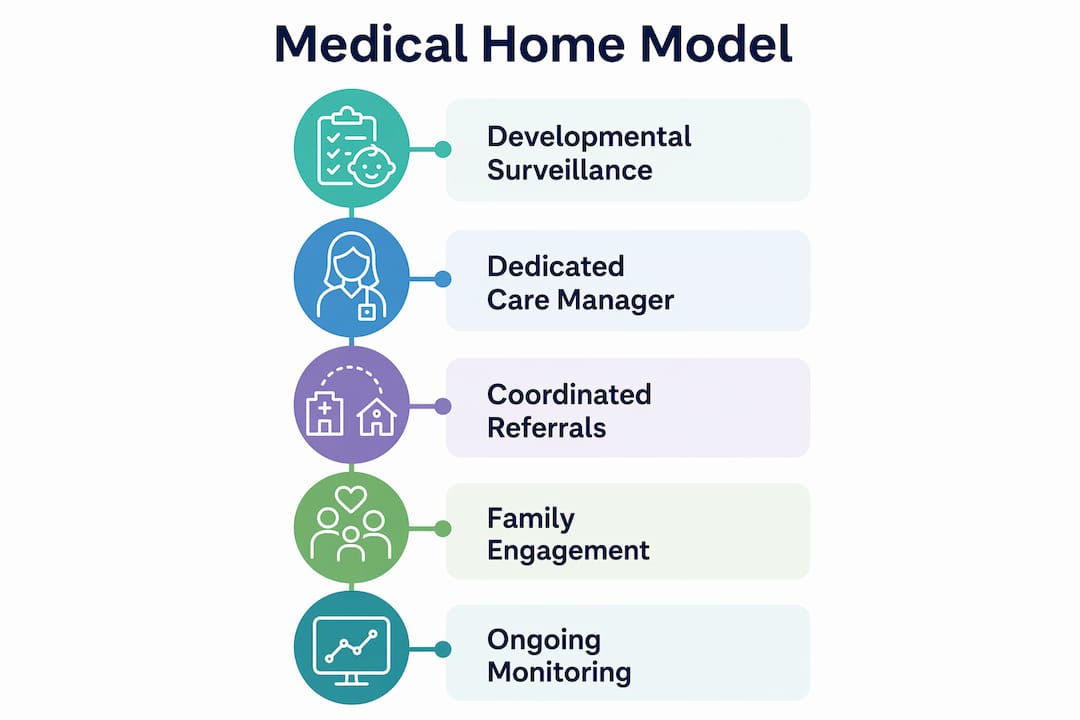
The most important distinction is whether coordination includes medical, behavioral health, educational, and community services together. A practice that manages only medical care while leaving families to coordinate everything else is not functioning as a true medical home for autism. The core challenge in autism care is its cross-sector nature, and effective medical homes address this directly.
Dedicated care managers are a feature that separates high-performing medical homes from average ones. A care manager handles the logistics of scheduling, information sharing, and follow-up that a physician cannot realistically manage during a 20-minute visit. Families with access to a care manager report significantly lower coordination burden and better continuity between appointments.
How can parents engage with the medical home model effectively?
Your active participation makes the medical home work better for your child. The model is designed as a partnership, not a service you receive passively. Medical homes that truly coordinate provide structured pathways that reduce cognitive and emotional load for families, but only when families engage with those pathways.
Here are specific ways to engage:
- Name your medical home lead. Ask your child’s pediatrician to formally serve as the care coordinator. If the practice does not offer this, ask for a referral to a developmental pediatrician or autism-focused primary care practice that does.
- Communicate all concerns openly. Report sleep problems, behavioral changes, gastrointestinal symptoms, and school challenges at every visit. These details shape the care plan and trigger referrals your child may need.
- Maintain your own records. Keep a running document of current medications, active therapies, upcoming appointments, and recent evaluations. Share this at every visit. Shared care plans require that medication lists and test results flow between providers, and your records fill gaps when systems fail.
- Participate in goal setting. You know your child’s daily life better than any clinician. Bring specific goals to appointments rather than waiting to be told what the plan is.
- Use community resources through the medical home. Ask your care coordinator about local autism support services, respite care, family training programs, and autism support resources that the practice can connect you to directly.
Pro Tip: Before each appointment, write down three specific observations about your child’s behavior, development, or health since the last visit. Pediatricians make better referral and care decisions when they have concrete, recent examples rather than general concerns.
Understanding co-regulation strategies for caregivers also strengthens your ability to support your child between appointments, which is where most of the real work happens. The medical home gives you the structure. Your daily engagement fills it with meaning.
Key takeaways
A well-functioning medical home for autism reduces family burden, prevents fragmented care, and improves developmental outcomes by placing a primary care pediatrician at the center of coordinated, cross-sector services.
| Point | Details |
|---|---|
| PCP leads coordination | The primary care pediatrician manages referrals, care plans, and communication across all providers. |
| Screening drives early access | AAP-recommended screenings at 18 and 24 months connect children to services before delays compound. |
| Fragmented care harms families | Without coordination, caregivers absorb the full logistical and emotional burden of managing multiple systems. |
| True medical homes span sectors | Effective models integrate medical, behavioral, educational, and community services, not medical care alone. |
| Family engagement is required | Active participation in goal setting and record sharing makes the medical home model function as designed. |
Why the medical home model is the most underused tool in autism care
I have spent years reviewing how families navigate autism care, and the pattern I see most often is this: families are doing the coordination work that the medical home is supposed to do. They are the ones calling the school to relay what the neurologist said. They are the ones telling the behavioral therapist what the pediatrician prescribed. They are carrying the entire information load across systems that do not talk to each other.
The medical home model exists to fix exactly this problem. But in practice, many families have never been told it exists, or they have a pediatrician who considers the role fulfilled by annual checkups. That gap between what the model promises and what families actually receive is the most consequential problem in autism care coordination today.
What I find encouraging is the direction of policy in 2026. Initiatives like the New Jersey Autism Medical Home Center of Excellence represent a shift toward accountability, where practices must demonstrate cross-sector coordination, not just claim it. That is progress worth knowing about.
My honest advice: do not wait for the system to offer you a medical home. Ask for it by name. Ask your pediatrician who coordinates your child’s care across behavioral health, education, and community services. If the answer is unclear, that is your signal to find a practice that takes this role seriously. You can also explore neurodiversity-affirming occupational therapy as one of the integrated services a strong medical home should be connecting you to. The families who get the best outcomes are the ones who treat the medical home as a tool they actively use, not a label on their insurance card.
— Keith
Find autism care providers through Autismdoctorsearch
Autismdoctorsearch maintains one of the most current directories of autism resources for families across the United States. Whether you are looking for ABA therapy providers, occupational therapists, medical clinics, or mental health services to integrate into your child’s care plan, the directory connects you directly to vetted options. Explore autism therapy services that work alongside your child’s primary care team, or find specialized providers like The Missing Piece ABA Therapy to support behavioral goals within a coordinated medical home plan. The right providers, connected to the right care plan, make the medical home model work.
FAQ
What is the role of medical home in autism care?
The medical home coordinates all health, behavioral, educational, and community services for a child with autism under the leadership of a primary care pediatrician. It functions as a hub that prevents fragmented care and reduces the coordination burden on families.
What does a pediatrician do in autism care coordination?
Pediatricians conduct developmental screenings, initiate referrals to specialists and early intervention, monitor co-occurring conditions, and maintain the shared care plan that connects all providers. The AAP designates this ongoing coordination role as a core pediatric responsibility.
How is a medical home different from a regular doctor’s office?
A medical home goes beyond clinical visits by actively coordinating care across behavioral health, education, and community services. A standard practice manages medical appointments; a medical home manages the full picture of a child’s needs across every system.
What should I look for in a medical home for my autistic child?
Look for a practice that offers a dedicated care coordinator, conducts autism-specific screenings at recommended ages, includes behavioral and educational services in the care plan, and invites you to participate in goal setting. Coordination across all four sectors, medical, behavioral, educational, and community, is the defining feature.
Can the medical home model help reduce caregiver stress?
Yes. Research identifies caregivers of autistic children as proxy interventionists managing care across multiple systems at high emotional cost. Medical homes that provide structured coordination pathways directly reduce this burden by handling information sharing, referrals, and follow-up that families would otherwise manage alone.