

TL;DR:
- Choosing appropriate after-school programs for autistic children requires assessing program types, quality features, and individual needs. Effective programs prioritize structured routines, trained staff, and intentional peer interactions to foster social, emotional, and communication growth. Ongoing evaluation and caregiver input are vital to ensure the program continues to meet your child’s evolving needs.
The hours between the final school bell and dinnertime can feel like uncharted territory for families of autistic children. Without the predictability of a classroom routine, some children experience a spike in anxiety, sensory overload, or withdrawal during that afternoon window. Yet those same hours also hold real potential: time to build friendships, practice communication, explore movement, and grow confidence in a lower-stakes setting. This guide walks you through the main program types, the research behind them, a practical evaluation framework, and the honest truths that most checklists leave out, so you can make a well-informed choice that actually fits your child.
Table of Contents
- Understanding after-school program types for autistic children
- What to look for: Essential features of a quality program
- Step-by-step: How to evaluate and match a program to your child
- What the research says: Expected outcomes and real-world results
- A realistic perspective on choosing after-school programs for autism
- Connect with trusted autism programs and therapy resources
- Frequently asked questions
Key Takeaways
| Point | Details |
|---|---|
| Match programs to needs | Evaluate options based on your child’s unique strengths, challenges, and goals. |
| Staff training matters | Evidence shows programs led by trained staff have greater impact on social and emotional growth. |
| Structure improves outcomes | More structured programs typically show better support for social skills and participation. |
| Ask and observe | Visit programs, ask about routines and data collection, and trust your own observations. |
| Progress varies | Improvements are often small but meaningful, so set realistic expectations. |
Understanding after-school program types for autistic children
Not every after-school option is designed with autistic children in mind, and the ones that are vary widely in their goals, structure, and evidence base. Knowing the landscape helps you start the search with a clear picture of what each model is built to do.
The four main program types that families typically encounter are:
- Structured social skills groups focus on teaching specific communication and interaction skills through scripted or semi-scripted activities, role play, and coached peer interaction. Programs like KONTAKT, PEERS, and similar clinic-based groups fall here.
- Sensory integration and sports programs use movement, tactile input, and physical challenge to support body awareness, regulation, and incidental social interaction. Think adaptive swim teams, martial arts programs, or sensory gymnastics.
- Academic enrichment programs extend learning support, often blending tutoring with executive function coaching. These work well for children whose biggest after-school stressor is unfinished homework or the leap from school-based supports to independent work.
- Hybrid or naturalistic models blend elements of the above. An after-school club at a community recreation center with a trained inclusion aide, for example, may weave social coaching into a cooking or robotics class.
Research on all four types points in the same direction: structure, peer interaction planning, staff training, and implementation fidelity are the variables that move the needle most. Systematic review evidence confirms that after-school programs can produce small but positive gains in social and emotional learning, with outcomes depending heavily on program quality, design, duration, and how faithfully staff carry out the intended model.
| Program type | Primary goal | Best fit for | Typical format |
|---|---|---|---|
| Social skills group | Communication and peer interaction | Children with social skill deficits | Small group, clinic or school |
| Sensory/sports | Regulation and physical participation | Sensory-seeking or active children | Gym, pool, outdoor space |
| Academic enrichment | Homework and executive function | Children who struggle post-school | Tutoring center or home-based |
| Hybrid/naturalistic | Broad developmental support | Children with multiple support needs | Community center, recreation site |
Pro Tip: Start your search by writing down your child’s top two or three after-school challenges. If transition meltdowns are the issue, a sensory-based physical program may calm the nervous system. If loneliness is the driver, a structured social group is a better fit. Let the problem guide the model, not the other way around.
You can also browse structured therapy programs and ABA-based remediation options to see what providers in your area actually offer, which often differs from what brochures describe. A broader look at how to identify the best programs can help you frame your search before you contact a single provider.
What to look for: Essential features of a quality program
Once you know the spectrum of program types, the next step is understanding what separates high-quality, effective options from the rest. A polished website and a warm welcome call tell you very little. The features below are the ones that actually predict whether a program will help your child grow.
Must-have features of a quality after-school program:
- Clear eligibility and participation policies. Strong programs are transparent about who they serve, what behavioral or communication supports they can provide, and what they cannot accommodate. Vague answers are a red flag.
- Staff training in autism-specific supports. Ask directly: how many hours of autism-specific training do staff members receive? Are they trained in AAC (augmentative and alternative communication), visual schedules, or de-escalation techniques?
- Evidence-aligned structure and routine. Predictable daily schedules, visual supports, and clear transition cues are standard in quality programs, not optional add-ons.
- A written peer interaction plan. Incidental peer contact is not the same as supported socialization. Quality programs deliberately engineer positive peer interactions, not just hope they happen.
- Data collection and progress communication. Programs that track progress and share it with families are more accountable and more likely to catch problems early.
- Fidelity to their stated model. Ask how the program ensures that staff actually deliver the approach as designed, especially when they are short-staffed or dealing with challenging days.
Systematic review findings highlight that quality, design fidelity, and meaningful peer and adult interactions are the core moderators of after-school SEL (social and emotional learning) outcomes for neurodiverse learners. This means a program’s intentions matter far less than whether those intentions are reliably carried out day after day.
Red flags to watch for:
- Staff who cannot name the specific strategies they use for sensory or behavioral challenges
- No clear plan for communicating with parents when difficulties arise
- Groups that are too large for the support level the program claims to provide
- Providers who resist observation visits or trial days
Pro Tip: Ask to speak with a current family, not a reference they hand-picked, but someone you locate through a parent group or school network. Real parent feedback about how staff handle hard days is worth more than any clinical psychological service review or promotional testimonial.
Finding programs that meet these standards is easier when you work from a curated resource. The best autism programs guide offers a searchable framework you can cross-reference as you evaluate providers.
Step-by-step: How to evaluate and match a program to your child
With these features and criteria in mind, let’s move into a practical, stepwise process for analyzing your program options. This framework is designed to reduce decision fatigue and make the comparison process concrete.
Step 1: Define your child’s current functional profile. Before you look at a single program, document your child’s ability to follow multi-step directions, handle transitions between activities, tolerate noise and movement in a group, and communicate needs in real time. This profile is your filter.
Step 2: List your family’s non-negotiables. Transportation, cost caps, hours of operation, and your child’s energy level after a school day all narrow the field before you even start evaluating quality.
Step 3: Request program profiles in writing. Ask each provider for a one-page summary of their structure, staff ratios, training credentials, and how they handle common challenges like sensory overload or refusal to participate.
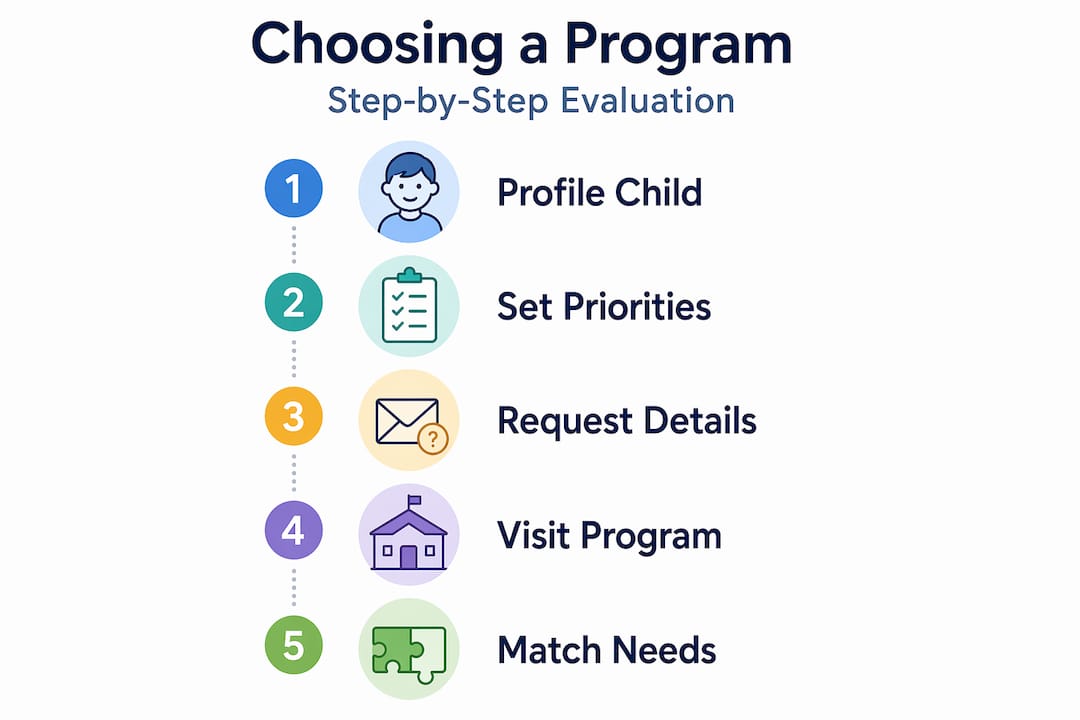
Step 4: Schedule an observation. A 30-minute in-person visit, or a video tour if remote, is worth ten phone calls. Watch how staff respond to children who are dysregulated, not just the children who are thriving.
Step 5: Ask targeted questions. Strong programs welcome hard questions. Weak ones deflect. Use this list:
- What is your staff-to-child ratio on a typical day?
- How do you handle a child who becomes overwhelmed mid-session?
- How often do families receive progress updates?
- Have you served children with a similar profile to my child before?
- What does a typical 60-minute session look like, minute by minute?
Step 6: Use a decision matrix. Score each program you’re considering across four dimensions: fit to your child’s needs, staff qualifications, structural quality, and family logistics. A simple 1 to 5 scale turns a gut feeling into a defensible comparison.
| Evaluation dimension | Program A | Program B | Program C |
|---|---|---|---|
| Fit to child’s needs | 4 | 3 | 5 |
| Staff autism training | 5 | 2 | 4 |
| Structural quality | 4 | 3 | 4 |
| Family logistics | 3 | 5 | 2 |
| Total score | 16 | 13 | 15 |
“When evaluating an after-school option, look for explicit fit to your child’s current functional needs, because reputable programs often publish clear eligibility and participation criteria for their autism-specific after-school programming.”
TEACCH-informed approaches are worth asking about specifically if your child relies heavily on visual routines or struggles with open-ended tasks, since structured visual supports in after-school settings have shown improvements in social behavior even when academic gains are modest.
For families researching local options, the center for autism support directory is a practical starting point that lists verified providers alongside their service descriptions. You may also consider requesting a diagnostic youth assessment to sharpen your child’s functional profile before you begin program visits.
What the research says: Expected outcomes and real-world results
Understanding what real change looks like, and what it does not look like, can help you set realistic expectations as you move forward. The research on after-school outcomes for autistic children is encouraging in some areas and sobering in others.
What the evidence supports:
- Social skills gains are the most consistently reported outcome across program types, though effect sizes are often modest. Children in structured groups show measurable improvements in initiating and responding to peer interactions.
- Social responsiveness and participation improve meaningfully in physical activity contexts. A 12-week sensory integration sports program reported improvements on standardized social responsiveness measures alongside higher attendance and integration metrics.
- Language and communication outcomes improve with ABA-aligned after-school approaches, particularly when intervention intensity is sufficient. A meta-analysis of ABA-based interventions found significant improvements across multiple domains compared to control groups, with intensity of intervention influencing language-specific effects.
- Daily living skills show small but real gains in high-quality ABA contexts, though these are among the slower-moving outcomes and require sustained, consistent programming to materialize.
- Self-perception and confidence are harder to measure but frequently reported by families as among the most meaningful changes their children experience in inclusive, well-run programs.
What the evidence cautions against:
- Expecting rapid transformation. Most gains in social and communication skills build gradually over weeks and months, not days.
- Assuming a program that works for one child will work for another with the same diagnosis. Individual fit is the most powerful predictor of success.
- Overlooking practical barriers. The ABA intervention meta-analysis specifically flags financial constraints and variability in staff training quality as real-world barriers that limit outcomes even in otherwise well-designed programs.
Families interested in exploring structured social skills programs or reviewing ABA intervention options can use the directory to filter by program type and location, which saves significant research time.
A realistic perspective on choosing after-school programs for autism
Here is something most guides will not say plainly: the perfect after-school program for your autistic child probably does not exist. Not because providers are failing, but because children are complex, needs shift, and no program can replicate the finely tuned individualization of a good IEP team working specifically for your child.
What this means in practice is that your job is not to find the flawless program. Your job is to find a program where the staff are genuinely committed, where the structure is strong enough to support your child’s current needs, and where you feel that your voice as a caregiver is actually heard and acted on. Those three things matter far more than whether the program uses the trendiest intervention model or has the most impressive brochure.
Trust your observations more than you trust descriptions. A staff member who makes eye contact with a struggling child, shifts the activity without fanfare, and knows that child’s name and triggers after two weeks is showing you something a credentials page cannot. Dropout rates and waitlist lengths also tell quiet stories. A program with a 60 percent annual turnover in staff will struggle to maintain the relationship continuity that autistic children often need to feel safe.
It is also entirely okay, and actually developmentally healthy, to change programs as your child grows. A structured social skills clinic that was perfect at age seven may feel constraining and infantilizing at twelve. A child who needed a one-on-one aide at ten may thrive in a small-group sports setting at fourteen. Treat program selection as an ongoing process, not a single decision.
The insider strategies for choosing programs resource we’ve built is designed to support exactly this kind of evolving, informed decision-making.
Connect with trusted autism programs and therapy resources
If you’re ready to explore your options or need additional guidance, the Autism Doctor Search directory is the place to begin. We’ve built a current, detailed catalog of verified providers across the full range of after-school and therapeutic support options, from autism therapy services to specialized ABA therapy support and child-centered enrichment through child-ology program search. Our directory is updated regularly so you’re not working from outdated listings or closed programs. Each entry includes service descriptions, contact details, and program specifics so you can compare options before you ever make a call. Your child deserves a program that fits. We help you find it faster.
Frequently asked questions
What after-school programs are most effective for autistic children?
Programs with structured routines, trained staff, and deliberate peer interaction planning show the strongest evidence for social skills gains, with structured group formats outperforming less structured alternatives in comparison studies.
How can I tell if a program is the right fit for my child’s needs?
Review the program’s published eligibility criteria, ask staff directly about their autism-specific training, and observe how they handle sensory or behavioral challenges during a visit. Reputable programs are transparent about both what they offer and what they cannot accommodate.
Do after-school sports help children with autism develop social skills?
Yes, especially when the physical activity is designed with sensory integration in mind. A sensory-integrated sports program showed measurable increases in social responsiveness and participation rates after 12 weeks of structured training.
Will my child’s daily living skills improve in after-school programs?
ABA-aligned programs report small but real improvements in daily living skills, though these gains depend heavily on program intensity and consistency. Meta-analysis findings confirm significant but modest effects compared to control conditions.
What barriers should families watch for in after-school options?
Cost, inconsistent staff qualifications, and gaps in program fidelity are the most common barriers families encounter. Research on ABA interventions specifically identifies financial constraints and training variability as factors that limit real-world outcomes even in strong program models.


