
TL;DR:
- Myths about autism, like vaccine links and parenting causes, are unsupported by current research.
- Believing misinformation can delay early intervention and negatively impact children’s emotional well-being.
- Parents should rely on credible sources, advocate actively, and embrace ongoing learning to support their child effectively.
You may have heard that autism is caused by vaccines, that children with autism can’t feel empathy, or that a strict diet will “cure” it. These myths are everywhere, and they cause real harm. Many parents and caregivers encounter persistent myths about autism, leading to confusion and decisions that don’t actually help their child. This guide cuts through the noise. Using current research and plain language, we’ll walk through the most common misconceptions, explain what the evidence actually says, and give you practical tools to advocate for your child with confidence.
Table of Contents
- Why myths about autism persist
- The most common autism myths: Fact vs. fiction
- How myths impact families and children
- Tools for parents: Beating misinformation about autism
- The real work: What most autism myth-busting guides miss
- Connect with reliable autism support services
- Frequently asked questions
Key Takeaways
| Point | Details |
|---|---|
| Myths are widespread | Many misconceptions about autism persist and can hinder families from getting support. |
| Truth matters | Understanding and acting on evidence-based facts leads to better outcomes for children with autism. |
| Every child is unique | There is no one-size-fits-all; autism varies widely from child to child. |
| Parents can be advocates | Learning to identify truth and advocate helps children access needed resources and acceptance. |
Why myths about autism persist
Myths don’t survive because people are careless. They survive because they fill a gap. When families first receive an autism diagnosis, they’re often overwhelmed and searching for answers fast. That urgency makes them vulnerable to misinformation, especially when it comes from people they trust.
Some of the most common sources of autism myths include:
- Outdated research that has since been retracted or corrected, but still circulates online
- Media portrayals that show autism as either a superpower or a tragedy, rarely anything in between
- Well-meaning relatives who share stories or “remedies” based on personal anecdote
- Social media algorithms that amplify emotionally charged content, true or not
- Old clinical language that painted autism in a negative or limiting light
Social media deserves special attention here. A single viral post claiming a link between a food additive and autism can reach millions of people before any correction is issued. Misinformation about autism is prevalent in both media and informal discussions, and the speed of sharing makes it nearly impossible to contain once it spreads.
“The loudest voice in the room is not always the most informed one. When it comes to your child’s health, slow down and check the source.”
This matters because acting on a myth can mean delaying real support. It can mean spending money on unproven treatments. It can mean your child misses the window for early intervention that could genuinely change their trajectory.
Stay current by following latest autism news from credible sources, and explore why understanding matters for your family’s long-term wellbeing.
Pro Tip: When evaluating any autism claim, ask three questions: Who published it? Is it peer-reviewed or just a personal story? Has it been updated in the last five years? If you can’t answer all three, dig deeper before acting on it.
The most common autism myths: Fact vs. fiction
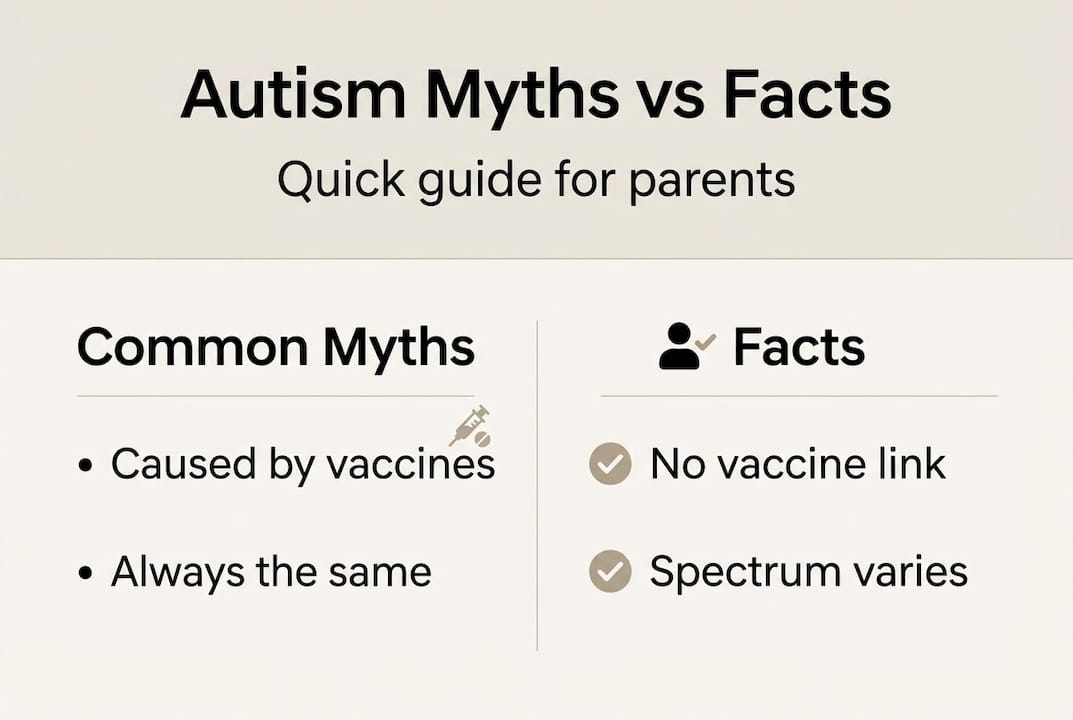
Let’s lay them out clearly. Common autism myths include false connections with vaccines, misunderstandings of cognitive ability, and mischaracterization of social behaviors. Here’s a side-by-side look at what people believe versus what the evidence shows.
| Myth | Fact |
|---|---|
| Vaccines cause autism | No scientific study has established this link. The original 1998 paper was retracted. |
| People with autism lack empathy | Many autistic individuals feel emotions deeply; they may express them differently. |
| Autism only affects boys | Autism occurs across all genders; girls are often underdiagnosed due to different presentations. |
| All autistic people have intellectual disabilities | Autism exists on a wide spectrum; many individuals have average or above-average intelligence. |
| Autism can be cured | Autism is a neurological difference, not a disease. Support focuses on quality of life, not elimination. |
Now let’s walk through the most persistent myths step by step.
- Vaccines cause autism. This myth originated from a single, fraudulent study. Every large-scale study since has found no connection. Acting on this myth puts children at risk for preventable diseases.
- Children with autism don’t want friends. Many autistic children deeply want social connection. The challenge is often in navigating social rules that weren’t designed with them in mind.
- If a child can speak, they don’t have autism. Autism presents across a wide range of communication styles. Verbal ability alone does not rule out an autism diagnosis.
- Autism is caused by bad parenting. This is one of the most damaging myths. Autism is neurological in origin, not the result of parenting choices.
- Autistic children can’t learn or progress. With the right support, children with autism make meaningful progress. Early intervention is especially powerful.
For a deeper look at explaining autism behaviors to others, and to understand autism causes and symptoms in plain terms, these resources are a strong starting point.
Pro Tip: When someone repeats a myth in front of you, try saying: “I used to think that too, but the research actually shows something different.” It’s non-confrontational and opens a door without putting anyone on the defensive.
How myths impact families and children
Understanding what’s true is only part of the story. What actually happens when myths are believed? The consequences are real and sometimes severe.
Belief in autism myths can delay intervention and access to appropriate resources for children. That delay matters enormously because the brain is most responsive to support during early childhood. A child who starts therapy at age two has a very different outcome than one who starts at age seven because a parent spent years chasing an unproven treatment.

Here’s a comparison of outcomes based on whether families have accurate information:
| Informed families | Misinformed families |
|---|---|
| Seek early diagnosis and intervention | Often delay seeking diagnosis |
| Access appropriate therapies (ABA, OT, speech) | May pursue unproven or harmful treatments |
| Build realistic expectations and goals | May have unrealistic or overly limiting expectations |
| Develop strong advocacy skills | May feel helpless or overwhelmed |
| Connect with support networks | Often feel isolated |
Beyond the practical delays, myths also affect children emotionally. When a child hears that they “don’t feel things” or “can’t learn,” those words can become internalized. Children pick up more than we realize.
Emotional and social impacts on children when myths go unchallenged include:
- Reduced self-esteem from being described as broken or less capable
- Missed social opportunities because others assume they don’t want connection
- Increased anxiety when their real needs aren’t understood or addressed
- Strained family relationships when siblings or extended family operate on false beliefs
- Barriers to appropriate school support when educators hold misconceptions
For families navigating these challenges, connecting with family support and autism resources can make a significant difference in how your household functions day to day.
Tools for parents: Beating misinformation about autism
After seeing the real impact of myths, here’s what you can do to become an empowered advocate for your child. Parents who use evidence-based resources are better equipped to support their children with autism. That’s not just a feel-good statement. It translates directly into better outcomes.
Here are practical steps you can take right now:
- Bookmark credible sources. Organizations like the CDC, AAP, and Autism Science Foundation publish regularly updated, research-backed information. Add them to your browser today.
- Talk to your child’s medical team. Your pediatrician or developmental specialist should be your first call when you hear a new claim about autism. They can help you separate fact from fiction quickly.
- Join parent networks with a critical eye. Parent communities are invaluable for emotional support, but be cautious about medical advice shared in these spaces. Verify before you act.
- Educate your extended family proactively. Don’t wait for a myth to surface at a family dinner. Share a reliable article or resource before the conversation happens.
- Advocate at school. Request an IEP meeting if you believe your child’s teachers are operating on misconceptions. You have the right to ensure your child’s education is grounded in accurate understanding.
- Model critical thinking for your child. As your child grows, teach them to question what they hear about autism, including what they hear about themselves.
For guidance on researching autism treatments and connecting with autism advocacy resources, both are excellent places to build your knowledge base.
Pro Tip: Set a monthly reminder to check one reputable autism research outlet. Even 15 minutes a month keeps you ahead of emerging misinformation and aware of new support options for your child.
The real work: What most autism myth-busting guides miss
Most myth-busting articles hand you a list of facts and call it a day. But facts alone don’t change how you parent, how you talk to your child’s teacher, or how you feel at 2 a.m. when you’re worried about the future.
The real work is emotional. It’s learning to hold two things at once: your child has real challenges and your child has real strengths. It’s resisting the urge to find a simple explanation or a single solution, because autism doesn’t work that way. No single approach fits all children with autism; ongoing adaptation matters.
What helps most in the real world isn’t just knowing the facts. It’s building a habit of curiosity over certainty. Parents who thrive as advocates are the ones who stay open to learning, who update their approach as their child grows, and who extend the same patience to themselves that they give their child.
Myth-busting is not a one-time event. It’s a practice. And the most powerful version of it happens not in arguments with strangers online, but in quiet, consistent real-life advocacy for your child every single day.
Connect with reliable autism support services
Translating understanding into action starts with connecting to the right support. Knowing the facts about autism is a strong foundation, but your child also needs real-world services delivered by qualified professionals. At Autism Doctor Search, we maintain an up-to-date directory of trusted providers so you don’t have to search blindly. Explore autism therapy services and autism therapeutics to find ABA therapy, occupational therapists, mental health services, and more in your area. If you’re thinking about educational placements, our guide to special schools for autism can help you understand your options and ask the right questions.
Frequently asked questions
Is autism caused by parenting or vaccines?
No connection between vaccines and autism has been demonstrated, and parenting style does not cause autism. Both claims have been thoroughly investigated and consistently disproven by large-scale research.
Can children with autism go to regular schools?
Support and early intervention allow children with autism to thrive in a variety of educational settings, including mainstream classrooms with appropriate accommodations and an individualized education plan.
Are all people with autism alike?
Autism is a spectrum with diverse abilities and needs, meaning no two autistic individuals are the same. Strengths, challenges, communication styles, and support needs vary widely from person to person.
Where can I find reliable autism resources?
Autism Doctor Search provides reputable autism information and provider directories, making it a practical starting point alongside your child’s medical team for finding accurate guidance and local services.