


TL;DR:
- Discussing autism at work is a strategic choice that can secure necessary support and improve job satisfaction. It requires careful timing, choosing the right audience, and preparing a clear message focused on strengths, challenges, and accommodations. Ongoing communication and documentation are essential for maintaining effective support and preventing misunderstandings.
Knowing how to discuss autism at work is a skill that directly shapes your access to support, your job satisfaction, and your long-term career success. Autism spectrum disorder (ASD) affects 1 in 36 children identified in the U.S., meaning the workforce is more neurodiverse than most employers recognize. The Americans with Disabilities Act (ADA) protects your right to request accommodations without disclosing a specific diagnosis. Disclosure is a personal decision, not a requirement. This guide gives you a clear, step-by-step framework for talking about autism at work on your own terms.
When and to whom should you disclose your autism at work?
Disclosure timing is one of the most consequential decisions you will make as an autistic employee. Get it right, and you gain access to support. Get it wrong, and you may face bias before you have had a chance to prove your value.
You have four main windows for disclosure:
- During the application process. You can request accommodations for interviews, such as written questions in advance or a quieter room. You do not have to name autism specifically.
- After a job offer, before your start date. This gives HR time to prepare accommodations before day one, which reduces friction.
- After you start, once you feel settled. Many employees wait until they understand the culture and have built some trust with their manager.
- Only when a specific need arises. You may never disclose formally and instead frame requests around functional needs.
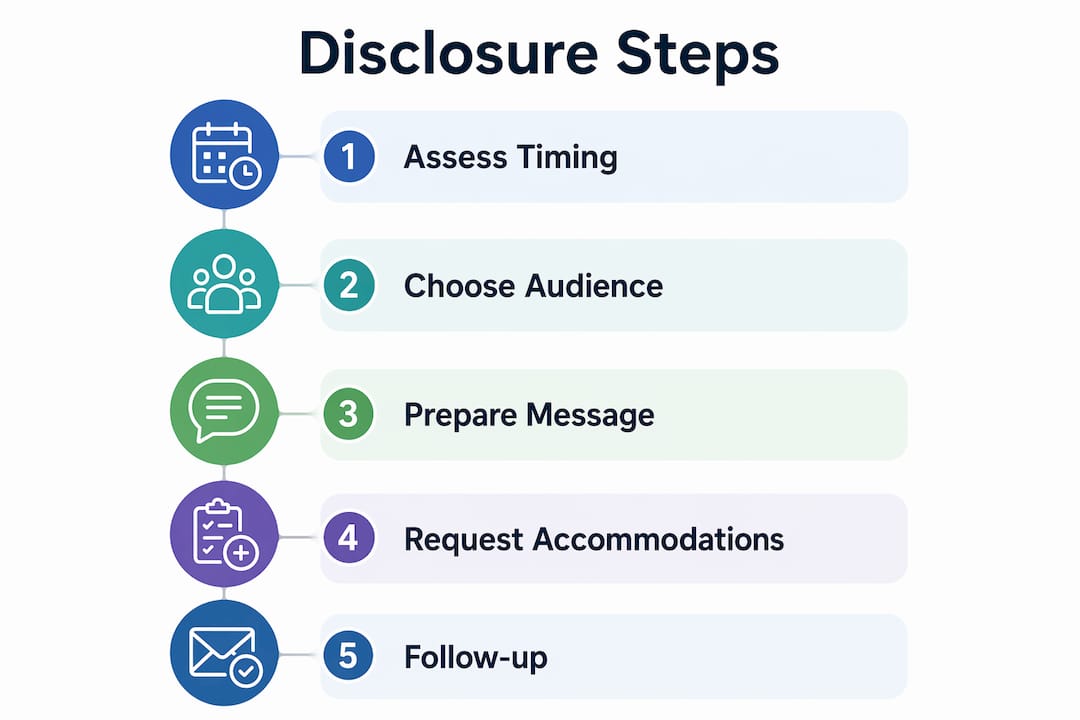
Choosing your audience matters as much as timing. Your manager controls your day-to-day environment and is often the most practical person to tell. HR provides formal documentation and legal protection. A trusted colleague can offer informal support without triggering official processes.
Ableism and stigma persist in many workplaces, which makes disclosure a strategic choice rather than a moral obligation. Assess your organization’s culture honestly before deciding who to tell and when.

Pro Tip: Write down your three top priorities before any disclosure conversation. Knowing whether you care most about privacy, speed of accommodation, or team understanding will clarify exactly who to tell and when.
How to prepare your communication about autism for the workplace
A clear, prepared message reduces misunderstanding and keeps the conversation focused on solutions. Autistic employees who go into disclosure conversations without a plan often either overshare or stay so vague that nothing changes.
Build your message in three parts:
- Your strengths. Name two or three specific skills you bring to the role. This reframes the conversation from deficit to contribution. For example: “I have strong attention to detail and I catch errors that others miss.”
- Your specific challenges and their workplace impact. Be concrete. “I find it hard to process verbal instructions quickly in meetings” is more useful than “I struggle with communication.” Concrete descriptions lead to concrete solutions.
- Your accommodation requests. Link each request directly to job performance. “Written follow-up emails after meetings help me execute tasks accurately” tells your manager exactly what you need and why it benefits the team.
You do not have to share your formal diagnosis. Disclosing functional needs is legally sufficient under ADA guidelines. Saying “I have a neurological condition that affects how I process sensory input” is enough to trigger the accommodation process.
Anticipate the questions your manager or HR is likely to ask. Common ones include: “What does this mean for your work?” and “What do you need from us?” Prepare short, direct answers to both. Practice the conversation out loud, ideally with a trusted friend, therapist, or support group member.
Pro Tip: Use plain, literal language in your disclosure message. Avoid metaphors or vague phrases like “I just work differently.” Specificity builds credibility and makes it easier for your employer to act.
Autismdoctorsearch lists autism support and training resources that can help you prepare for these conversations with professional guidance.
What accommodations can you request and how do they link to job performance?
Reasonable accommodations are adjustments that let you perform your job effectively. They are not special treatment. They are the tools that put you on equal footing with colleagues who do not face the same barriers.
Common accommodations for autistic employees include:
- Noise-canceling headphones or a quiet workspace to reduce sensory overload during focused tasks
- Written instructions and meeting summaries to support accurate task execution
- Flexible start times or remote work options to reduce commute-related sensory stress
- Advance notice of schedule changes to allow time to adjust
- Clear, structured feedback delivered in writing rather than verbally in real time
- Reduced interruptions through designated focus blocks or a private workspace
Autistic employees with appropriate accommodations show up to 90% higher job retention rates than those without. That number reflects a simple truth: when people can do their jobs well, they stay.
You can request many of these accommodations without ever using the word “autism.” Needs-based requests like asking for noise-canceling headphones or written instructions often succeed on their own merits, without triggering potential bias.
| Accommodation | Job performance benefit |
|---|---|
| Written task instructions | Reduces errors and clarifies expectations |
| Quiet workspace or headphones | Improves focus and output quality |
| Flexible scheduling | Reduces absenteeism and burnout |
| Advance notice of changes | Supports planning and reduces anxiety-driven errors |
| Structured written feedback | Accelerates skill development and reduces guesswork |
After any accommodation discussion, send a follow-up email summarizing what was agreed. This creates a paper trail that protects both you and your employer. If an accommodation is later denied or ignored, that documentation becomes your evidence.
How to handle challenges and common mistakes when discussing autism at work
Even a well-prepared disclosure conversation can go sideways. Knowing the common pitfalls in advance keeps you from making them.
The most frequent mistakes autistic employees make when talking about autism in the workplace:
- Oversharing medical history. Your diagnosis details are private. Stick to functional needs and workplace impact.
- Being too vague. “I just need a little flexibility” gives your employer nothing to act on. Name the specific accommodation.
- Expecting one conversation to fix everything. Disclosure is the start of an ongoing dialogue, not a one-time event.
- Skipping documentation. Verbal agreements disappear. Always follow up in writing.
- Disclosing to the wrong person first. A colleague who gossips can spread information before you are ready. Choose your first disclosure carefully.
Stigma is real. Disclosure done thoughtfully is a form of self-advocacy that can counter both external bias and internalized ableism. If a conversation goes poorly, you have options. HR can mediate. The Job Accommodation Network (JAN) offers free guidance on ADA rights. An employment attorney can advise you if discrimination occurs.
Managing your emotional response is part of the process. Disclosure can feel exposing, even when it goes well. Debrief afterward with a therapist, mentor, or support group. Processing the experience helps you refine your approach for future conversations.
Pro Tip: Practice your disclosure script with a mentor or autism support group before the real conversation. Rehearsing out loud reduces anxiety and sharpens your message.
How to foster ongoing communication and build an inclusive workplace culture
Disclosure is not the finish line. The conversations that follow matter just as much as the initial one.
Sustaining communication after disclosure keeps accommodations working and prevents misunderstandings from building up. Practical steps include:
- Schedule brief check-ins with your manager every few weeks to confirm accommodations are working and flag any new needs.
- Share resources selectively. If your team is receptive, pointing them toward autism awareness training or neuroinclusion guides can shift the culture without putting all the burden on you.
- Encourage literal, concrete communication from colleagues. Research shows that communication between autistic and non-autistic people improves when non-autistic partners use direct language and give advance notice of changes. This is a bilateral responsibility, not a one-sided adjustment.
- Recognize allyship when it happens. Acknowledging when a colleague gets it right reinforces the behavior and builds goodwill.
Accommodation success depends heavily on supportive supervisors and an inclusive organizational culture. If your manager is not on board, escalating to HR or requesting autism sensitivity training for the team are legitimate next steps. Organizations like Autism Included provide resources specifically designed to help teams build neuroinclusive communication practices.
Key takeaways
Effective workplace disclosure combines clear communication, strategic timing, and documented accommodation requests to protect your rights and improve your job performance.
| Point | Details |
|---|---|
| Disclosure is a personal choice | Approximately 43% of autistic employees do not disclose; you decide if, when, and to whom. |
| Prepare a three-part message | Lead with strengths, name specific challenges, and link each accommodation to job performance. |
| ADA protects your privacy | You can request accommodations based on functional needs without revealing your diagnosis. |
| Document every agreement | Follow-up emails after accommodation discussions create a paper trail that protects you. |
| Ongoing dialogue drives results | Accommodation success depends on sustained communication and a supportive supervisor. |
The disclosure conversation most employees get wrong
Disclosure advice almost always focuses on whether to disclose. The harder question is how to frame it once you decide to. I have seen employees prepare for weeks and then walk into the meeting and lead with their diagnosis instead of their needs. The manager hears “autism” and immediately starts managing their own reaction instead of listening to what the employee actually needs.
The shift that changes everything is leading with impact, not identity. “I need written instructions after meetings because verbal-only briefings cause me to miss details” is a completely different conversation than “I have autism and I struggle with communication.” One gives your manager a task. The other gives them a label to process.
Workplace culture is shifting. Neurodiversity awareness is growing, and more employers are actively seeking to retain skilled employees. That shift creates real opportunity for autistic employees who approach disclosure as a negotiation rather than a confession. Your needs are legitimate. Your accommodations benefit the team. Frame it that way, and the conversation changes.
If you are weighing whether to disclose, reading about autism diagnosis and family support can also help you clarify your own understanding before you walk into that meeting.
— Keith
Professional support that strengthens your workplace self-advocacy
Preparing to talk about autism at work is easier when you have professional support behind you. Therapists and ABA specialists who work with autistic adults can help you build communication scripts, practice disclosure conversations, and identify the accommodations that fit your specific work environment. Autismdoctorsearch connects you with vetted autism therapy services across the country, including providers who specialize in adult workplace skills. You can also find ABA therapy providers who focus on communication and self-advocacy for adults. The right professional support does not replace your voice at work. It sharpens it.
FAQ
Do I have to disclose my autism diagnosis to get accommodations?
No. Under ADA guidelines, you can request accommodations based on functional needs without naming your diagnosis. Describing how a condition affects your work is legally sufficient.
When is the best time to disclose autism at work?
The best time depends on your comfort level and your workplace culture. Many employees wait until after they are hired and have assessed the environment, then disclose when a specific need arises.
What are the most common autism accommodations at work?
The most requested accommodations include written instructions, quiet workspaces, noise-canceling headphones, flexible scheduling, and advance notice of schedule changes. Each can be framed around job performance rather than diagnosis.
What should I do if my employer denies my accommodation request?
Request the denial in writing, then consult HR or the Job Accommodation Network (JAN) for guidance. If discrimination is involved, an employment attorney can advise you on your ADA rights.
How do I support an autistic colleague without overstepping?
Use direct, literal language, give advance notice of changes, and follow their lead on how much they want to discuss their needs. Research confirms that communication improves when non-autistic colleagues adapt their communication style rather than expecting autistic employees to do all the adjusting.


