


TL;DR:
- ABA uses structured reinforcement to teach specific skills, while Floortime builds emotional connections through child-led play. Both approaches can benefit children with autism, but the choice depends on individual needs and family goals. Many families successfully combine both therapies for comprehensive developmental support.
The difference between ABA and Floortime therapy is rooted in their core methods: Applied Behavior Analysis (ABA) uses structured reinforcement to teach specific skills, while Floortime builds development through emotional connection and child-led play. Both approaches have strong support from clinical authorities, and both can produce real gains for children with autism. The right choice depends on your child’s profile, your family’s values, and the goals you want therapy to reach. This article breaks down each approach clearly so you can make a confident, informed decision.
What is the difference between ABA vs. Floortime?
ABA, or Applied Behavior Analysis, is defined as a behavior-driven methodology that uses reinforcement and repetition to teach skills and reduce problematic behaviors. It is the most extensively researched autism intervention, recommended by the U.S. Surgeon General, the American Academy of Pediatrics, and the American Psychological Association. That level of institutional backing reflects decades of peer-reviewed research across thousands of children.
Floortime is a play-based, relationship-driven approach that focuses on emotional development through child-led interactions. It is a component of the DIR model, which stands for Developmental, Individual differences, and Relationship-based. Where ABA targets observable behaviors, Floortime targets the emotional and relational foundations that make all learning possible.
The core distinction is this: ABA asks what a child does and works to change it. Floortime asks what a child feels and works to connect with it. Neither framing is wrong. They simply address different layers of development.
What is ABA therapy and how does it work?
ABA therapy is a structured, data-driven intervention designed to increase useful behaviors and decrease harmful ones. Therapists break skills into small, teachable steps and use positive reinforcement to build them one at a time. Every session generates data, and that data drives ongoing adjustments to the therapy plan.
Two professional roles define ABA delivery. A Board Certified Behavior Analyst (BCBA) designs and supervises individualized therapy plans, while a Registered Behavior Technician (RBT) implements direct interventions under BCBA supervision. BCBA certification requires graduate education, supervised fieldwork, and passage of a national exam. That credentialing structure gives ABA a consistent quality floor that parents can rely on.
Common ABA targets include:
- Communication skills: requesting, labeling, and responding to questions
- Self-care routines: dressing, toileting, and mealtime behaviors
- Safety behaviors: responding to “stop,” crossing streets, and recognizing danger
- Social skills: turn-taking, eye contact, and greeting peers
- Reduction of self-injurious or disruptive behaviors
Modern ethical ABA respects each child’s uniqueness and focuses on independence rather than compliance for its own sake. Reinforcement is a systematic teaching method, not a bribe. Many ABA programs now incorporate natural environment teaching, which blends play with behavioral principles to make sessions feel less clinical. You can see practical ABA examples that illustrate how this looks in real family settings.
Pro Tip: Ask any ABA provider how they collect and review data. A provider who can show you weekly graphs and explain what they mean is one who is actually individualizing your child’s program.
What is Floortime therapy and its developmental approach?
Floortime is the intervention component of the DIR model, developed by psychiatrist Stanley Greenspan. The “D” addresses a child’s current developmental level, the “I” accounts for individual sensory and processing differences, and the “R” stands for relationship-based, which is the core driver of change. Growth in children occurs through warm, trusting relationships, not just skill teaching. That principle shapes every Floortime session.

Floortime therapy progresses through six Functional Emotional Developmental Levels (FEDLs). Each level represents a milestone in emotional and cognitive growth, from basic self-regulation and engagement all the way to abstract and reflective thinking. A therapist assesses where a child currently functions and works to build upward from that point. Skipping levels is not the goal. Solidifying each foundation is.
Key elements of a Floortime session include:
- Following the child’s lead: the therapist enters the child’s world rather than redirecting to a task
- Opening and closing circles of communication: back-and-forth exchanges that build shared attention
- Using emotion as the engine: the therapist amplifies affect and excitement to drive engagement
- Building spontaneous communication: language and social skills emerge from genuine interaction, not drills
Parents are primary agents of change in Floortime, coached to engage throughout daily routines. The therapist trains parents to open and close communication circles, turning bath time, meals, and play into therapy opportunities. That integration into daily life is one of Floortime’s most practical strengths.
Pro Tip: In Floortime, “following the child’s lead” does not mean letting them do anything. It means joining their activity with purpose, then gently expanding it. The therapist always has a developmental goal in mind.
How do ABA and Floortime differ in methodology and therapy experience?
The structural differences between ABA and Floortime are significant. ABA sessions are typically therapist-led, with a clear agenda, defined targets, and measurable outcomes tracked session by session. Floortime sessions are child-led, flexible, and measured by the quality of emotional engagement rather than discrete skill counts. Both approaches can be delivered in clinic, home, or school settings, but they feel very different to a child and a parent watching from across the room.
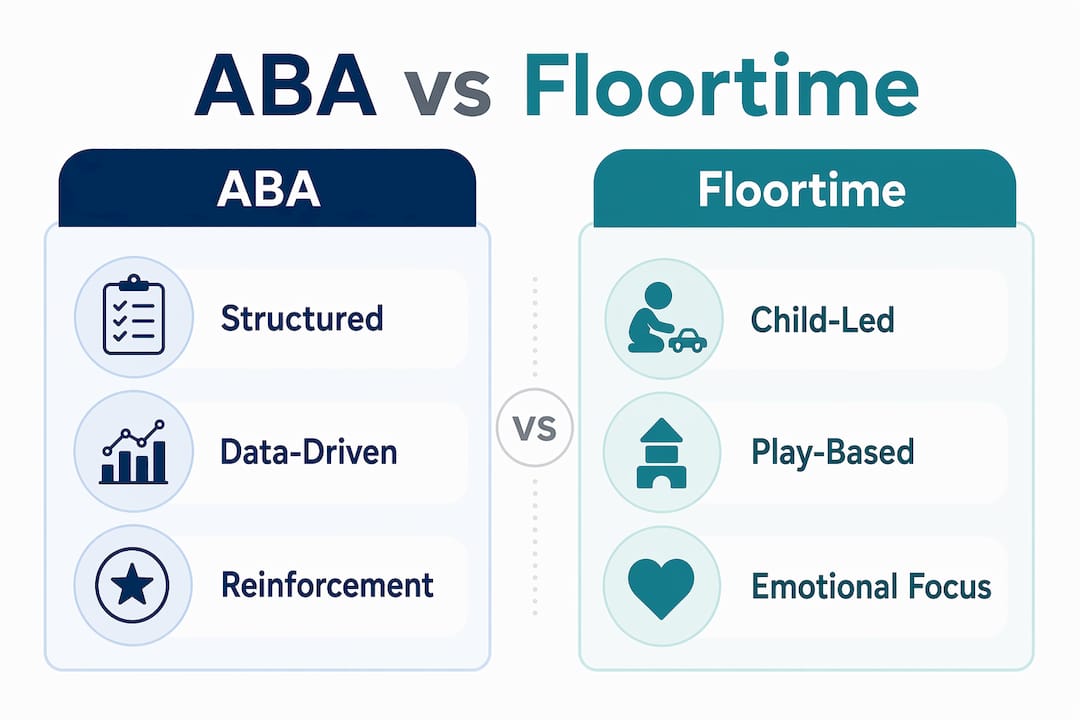
Neither therapy is universally better than the other. The right fit depends on a child’s immediate needs and family goals. ABA suits urgent safety concerns and discrete skill deficits. Floortime suits social-emotional growth and spontaneous communication.
| Attribute | ABA | Floortime |
|---|---|---|
| Session structure | Therapist-led, structured | Child-led, flexible |
| Core focus | Observable behavior change | Emotional and relational development |
| Primary agent | BCBA and RBT professionals | Parents, coached by therapist |
| Teaching method | Reinforcement and prompting | Relationship engagement and play |
| Progress measurement | Data collection and behavioral metrics | Developmental level progression (FEDLs) |
| Best suited for | Skill deficits, safety behaviors | Social-emotional growth, communication |
One nuance worth noting: modern ABA can incorporate natural environment teaching that mirrors Floortime’s play-based style. The fundamental behavioral principles and goals still distinguish the two, but the session experience can overlap more than parents expect. Knowing this helps you ask better questions when you visit a provider.
What are the benefits and limitations of each therapy?
ABA’s evidence base is the strongest of any autism intervention. Its structured approach produces measurable gains in communication, daily living skills, and safety behaviors. For children with significant behavioral challenges or urgent safety needs, ABA’s precision is hard to match.
Floortime’s research base is growing. Studies support gains in social-emotional functioning, spontaneous communication, and parent-child relationship quality. Its child-led model also reduces the risk of compliance-focused therapy that ignores a child’s emotional experience. For families who want therapy woven into daily life rather than delivered in discrete sessions, Floortime fits naturally.
Practical considerations for each approach:
- ABA strengths: strong evidence base, measurable outcomes, credentialed professionals, insurance coverage in most states
- ABA limitations: intensive time commitment, risk of rote compliance if not implemented ethically, less focus on emotional connection
- Floortime strengths: child-led and emotionally safe, integrates into daily routines, builds genuine communication
- Floortime limitations: less standardized credentialing, smaller evidence base, requires high parent involvement
Combining ABA and Floortime can address diverse needs, balancing skill-building with emotional development. Many families coordinate providers from both disciplines to cover different goals. Reading about parent training methods can help you understand how to apply both frameworks at home. You might also find that occupational therapy complements either approach by addressing sensory and motor needs that neither ABA nor Floortime fully covers.
How can parents decide between ABA, Floortime, or a combined approach?
Choosing between these therapies is not a one-time decision. It is an ongoing process that should shift as your child grows and their needs change. A structured decision process helps.
- Assess your child’s current profile. Identify their developmental level, primary challenges, and learning style. A child with urgent safety behaviors needs a different starting point than a child who is socially withdrawn but safe.
- Clarify your family’s goals. Are you prioritizing discrete skill acquisition, emotional connection, daily independence, or all three? Your answer shapes which approach leads and which supports.
- Consult qualified professionals. A BCBA can assess behavioral needs. A DIR-certified therapist can assess developmental levels. Getting both evaluations gives you a complete picture before committing to a single path.
- Review therapy plans in detail. Ask each provider to explain their session structure, how they measure progress, and how they involve you as a parent. Vague answers are a red flag.
- Consider a blended approach. Many families run ABA for skill-building and safety goals while using Floortime principles at home for emotional connection. Coordination between providers matters. Make sure they communicate with each other.
- Revisit the plan every six months. A therapy plan that fit your child at age three may not fit at age five. Build in formal review points and be willing to adjust.
Reviewing therapy outcomes and testimonials from other families in disability services can also help you calibrate realistic expectations before you start.
Key Takeaways
The most effective autism therapy plan matches the child’s developmental profile and family goals, not a single methodology applied universally.
| Point | Details |
|---|---|
| ABA is behavior-driven | ABA uses reinforcement and data to build specific skills and reduce harmful behaviors. |
| Floortime is relationship-driven | Floortime uses emotional connection and child-led play to build communication and social skills. |
| Neither is universally superior | The right therapy depends on your child’s needs, not which approach has more name recognition. |
| Parents drive Floortime outcomes | In Floortime, parents are the primary agents of change, coached to engage during daily routines. |
| Combining both is valid | Many families blend ABA and Floortime to cover skill-building and emotional development simultaneously. |
What I’ve learned from watching families navigate this choice
I have seen parents arrive at this decision exhausted and certain that one therapy is the right answer. They have read the forums, talked to other parents, and already decided before they walk into a provider’s office. That certainty is understandable. It is also worth questioning.
The families I have seen thrive are the ones who stayed curious past the initial choice. They started with ABA because their child had safety behaviors that needed immediate attention, and they added Floortime principles at home because they wanted more than compliance. Or they started with Floortime because their child was emotionally dysregulated and unreachable in structured settings, and they layered in ABA targets once the relationship was solid enough to hold them.
The misconception I hear most often is that ABA and Floortime are opposites, and that choosing one means rejecting the other. They are not opposites. They address different layers of the same child. ABA works on what a child does. Floortime works on who a child is becoming. A child needs both.
My honest advice: do not let the therapy debate distract you from the relationship you are building with your child right now. That relationship is the most powerful intervention available to you. Every therapy works better when a child feels safe and loved by the people around them. Start there, and let the clinical decisions follow.
— Keith
Finding the right autism therapy provider for your child
Autismdoctorsearch maintains a current directory of licensed autism therapy providers across the United States, covering ABA therapy, developmental approaches, mental health services, and more. If you are ready to connect with a qualified professional, the autism therapy services directory lists vetted providers who specialize in individualized evaluations and therapy planning. For families specifically seeking ABA support, specialized ABA providers are listed with details on their approach and service areas. Autismdoctorsearch updates its listings regularly so you always reach providers who are actively accepting new families.
FAQ
What is the main difference between ABA and Floortime?
ABA uses structured reinforcement to teach specific, measurable behaviors, while Floortime uses child-led play and emotional connection to build developmental foundations. ABA is therapist-directed; Floortime is child-directed with parents as the primary agents of change.
Is ABA better than Floortime for autism?
Neither therapy is universally better. ABA suits children with urgent safety concerns or discrete skill deficits, while Floortime suits children who need social-emotional growth and spontaneous communication development.
Can ABA and Floortime be used together?
Yes. Many families combine both approaches, using ABA for structured skill-building and Floortime principles at home for emotional connection. Coordinating providers from both disciplines produces the most balanced outcomes.
Who delivers ABA therapy?
BCBAs design and supervise ABA programs, while RBTs deliver direct interventions under BCBA supervision. BCBA certification requires graduate education, supervised fieldwork, and a national exam.
What are the six FEDLs in Floortime?
The six Functional Emotional Developmental Levels (FEDLs) in the DIR model represent milestones from basic self-regulation and engagement through abstract and reflective thinking. Floortime therapy works to build each level in sequence before advancing to the next.


