
TL;DR:
- Mental health services for autistic individuals are vital for managing co-occurring conditions and supporting families. Access remains limited, with many providers lacking specialized training, but directories and resource agencies can help families find adapted, effective care. Prioritizing evidence-based approaches, caregiver support, and early crisis planning improves overall family well-being.
Mental health services are essential for autistic people and their caregivers because they treat co-occurring conditions like anxiety, depression, and ADHD, support behavioral and emotional regulation, and reduce caregiver stress so the whole family can function. The Interagency Autism Coordinating Committee identifies psychotherapy, behavioral management, and medication management as critical service types for autistic individuals across the lifespan. Yet access remains thin: a survey of 8,184 U.S. facilities found that fewer than half reported providing behavioral health care for children with ASD, and only 12.7% had a clinician with specialized training. The Autism Society and the Autismdoctorsearch directory exist precisely to close that gap.
The immediate roles mental health services play:
- Symptom treatment: Addressing anxiety, depression, ADHD, and trauma that frequently co-occur with autism
- Behavior support and skill-building: Teaching emotional regulation, communication, and coping strategies
- Caregiver mental health: Reducing parental stress, burnout, and depression so caregiving stays sustainable
- Crisis intervention: Providing safety planning and emergency pathways when acute distress occurs
Pro Tip: While you read, open your state’s developmental disabilities agency website and the Autismdoctorsearch directory in separate tabs so you can act on each step immediately.
Table of Contents
- What role do mental health services play for autistic individuals?
- How do mental health services support caregivers and the whole family?
- What does autism-friendly mental health care actually look like?
- How to find and access mental health services in the United States
- How to choose the right provider: what to check and what to ask
- What to expect: timeline, costs, and crisis planning
- Trusted resources and directories to check right now
- Key Takeaways
- What resource centers see, and what actually fixes it
- Autismdoctorsearch: your starting point for adapted care
- Useful sources and further reading
What role do mental health services play for autistic individuals?
The clinical roles span six core functions: diagnostic assessment, adapted psychotherapy (CBT and DBT), medication management, behavioral support, occupational therapy, and crisis intervention. Each addresses a different layer of need, and most autistic people benefit from more than one at a time.
Adapted CBT has the strongest evidence base for anxiety in autistic children and young people. A systematic review and meta-analysis found CBT-based interventions showed effectiveness on both parent- and clinician-reported outcomes, with service-level adaptations improving acceptability. DBT skills training is increasingly used for emotional dysregulation in autistic adolescents and adults.
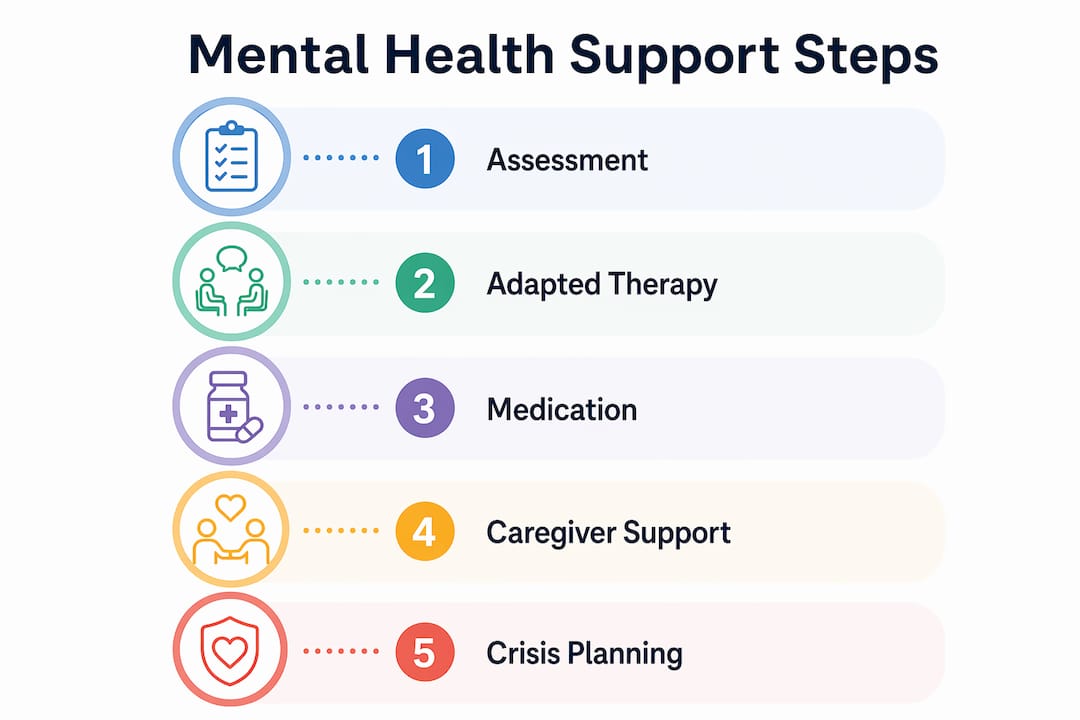
Services also address risks that often go unspoken: suicide risk, masking-related distress, trauma history, and, in older autistic individuals, co-occurring substance use. Trauma-informed care is particularly important because many autistic people have experienced repeated medical or social trauma. A clinician who understands this context will approach assessment and treatment very differently from one who does not.
Workforce shortages and geographic gaps mean rural families often wait months for a first appointment. That reality makes knowing your access pathways, covered in the section below, as important as knowing which service type you need.
How do mental health services support caregivers and the whole family?
Caregiver mental health is not a side issue. It is the foundation that holds everything else up. Research consistently shows that parents and caregivers of autistic individuals experience higher rates of stress, anxiety, and depression compared to the general population, and the effects ripple across the entire family system.
A 2019 survey of 8,184 U.S. mental health facilities found only 43.0% reported providing behavioral health care for children with ASD. That gap falls hardest on families who are already stretched thin.
Caregiver-specific services that make a measurable difference:
- Individual therapy (CBT-adapted): Targets parental stress, depression, and unhelpful thought patterns directly
- Family therapy: Addresses sibling dynamics, partner communication, and shared caregiving load
- Peer support groups: Reduces isolation and provides practical, lived-experience knowledge
- Respite services: Gives primary caregivers scheduled recovery time; respite care is often Medicaid waiver-funded
- Care coordination: A case manager navigates insurance, school systems, and provider networks so you do not have to do it alone
A CBT-based caregiver intervention study found that caregivers of autistic people showed lower burden, fewer somatic symptoms, and reduced depression immediately after the program and at one-month follow-up. The mechanism is practical: caregivers learn communication skills, assertiveness, and coping strategies they can use in real interactions with providers, schools, and their own families. Building emotional resilience strategies into daily routines amplifies those gains over time.
What does autism-friendly mental health care actually look like?

Autism-friendly care is standard evidence-based care adapted for sensory, communication, and routine needs. The adaptations are not exotic; they are practical changes any willing clinician can make.
Common accommodations families should ask about:
- Flexible appointment length (shorter or longer sessions depending on the individual’s tolerance)
- Sensory-friendly waiting areas (low lighting, minimal noise, no strong scents)
- Visual supports and concrete language instead of abstract metaphors
- Slower pacing with explicit structure and predictable session format
- Active caregiver involvement in sessions, especially for children
- Telehealth options for individuals who find travel or waiting rooms distressing
Why these adaptations matter goes beyond comfort. When a client is dysregulated by the environment, symptom measurement is unreliable and therapeutic engagement drops. The IACC’s research synthesis specifically identifies appointment-length flexibility and sensory accommodations as access levers, not just niceties.
Pro Tip: Ask prospective therapists directly: “Do you offer telehealth-only scheduling or evening appointments?” Many clinicians who work well with autism families have built their schedules around caregivers who cannot leave the home during school hours.
How to find and access mental health services in the United States
The fastest, highest-yield routes: your state’s developmental disabilities (DD) agency, Medicaid waiver programs, Autism Society local chapters, and the Autismdoctorsearch directory. Start with whichever matches your most urgent need.
Step-by-step checklist:
- Document your family member’s current diagnosis, co-occurring conditions, and specific behavioral or emotional concerns in writing before any call.
- Contact your state DD agency to ask about Home and Community-Based Services (HCBS) Medicaid waivers, which can cover respite, behavioral supports, and therapy.
- Search the Autismdoctorsearch directory and your local Autism Society chapter for vetted providers near you.
- Call shortlisted providers and ask the adaptation questions from the provider checklist below before booking.
- Create a short-term crisis plan before your first appointment: identify your local mobile crisis team and save the 988 Suicide and Crisis Lifeline number.
| Your situation | Best first contact |
|---|---|
| New diagnosis, no services yet | State DD agency for eligibility screening |
| Urgent behavioral crisis | Local mobile crisis team or 988 Lifeline |
| Insurance or Medicaid questions | State Medicaid office or benefits counselor |
| Need respite care now | State DD agency or Autism Society local chapter |
| Searching for a therapist | Autismdoctorsearch directory or Autism Society chapter |
Medicaid waiver rules vary significantly by state, including waitlist lengths and covered service categories. The Autism Society maintains state-specific resource pages that reflect current local rules.
How to choose the right provider: what to check and what to ask
Prioritize three things above all else: evidence-based methods, a genuine willingness to adapt, and clear communication with your family. Credentials matter, but a licensed clinician who has never worked with an autistic client and refuses to adjust their approach will be less useful than a generalist who asks good questions and learns fast.
Credentials and experience to look for:
- Licensed clinician (LCSW, psychologist, LPC, or LMFT) with documented ASD experience
- Trauma-informed training, especially for older autistic individuals
- AOTA membership or OT licensure when occupational therapy is part of the plan
- BCBA credential for behavioral support services
- Willingness to coordinate with your existing treatment team
Questions to ask intake staff before booking:
- “What sensory accommodations does your office have?”
- “Do you offer telehealth or evening appointments?”
- “How do you collaborate with BCBAs or occupational therapists?”
- “Do you accept Medicaid or offer sliding-scale fees?”
- “What is your current wait time for a first appointment?”
Pro Tip: Ask your child’s BCBA, occupational therapist, or developmental pediatrician for therapist referrals first. These providers maintain informal local networks and often know which clinicians reliably work well with autism families, saving you weeks of cold calls.
What to expect: timeline, costs, and crisis planning
Timelines and costs vary widely, and setting realistic expectations upfront prevents families from giving up too soon. Assessment waitlists of several weeks to several months are common in most U.S. metro areas; rural families often wait longer.
Typical stages: referral and intake paperwork, diagnostic or functional assessment, feedback session and treatment planning, then early treatment sessions. Telehealth and community mental health clinics often have shorter waits than private practices.
Cost considerations to plan for:
- Private pay rates vary by clinician type and region; sliding-scale clinics exist in most states
- Medicaid waivers commonly cover respite, behavioral supports, and some therapy services
- In-network vs. out-of-network status affects your out-of-pocket cost significantly; always verify before the first session
- Some employer EAP (Employee Assistance Programs) cover short-term counseling at no cost
For crisis planning, build an emergency contact list before you need it. Include your local mobile crisis team’s number, the nearest emergency psychiatric facility, and the 988 Suicide and Crisis Lifeline (call or text 988). A mental health support checklist can help you organize these contacts and document your family’s specific crisis warning signs.
Trusted resources and directories to check right now
| Resource | What it helps you find | Why it’s trustworthy |
|---|---|---|
| Autismdoctorsearch directory | Local mental health, ABA, OT, and crisis providers | Curated, up-to-date U.S. autism-specific listings |
| Autism Society local chapters | Vetted local resources, Medicaid waiver guidance | National nonprofit with community-level reach |
| American Occupational Therapy Association | Licensed OTs with autism experience | Professional credentialing body for OT practice |
| Association for Play Therapy | Registered play therapists for children | Credentialing and ethics standards for play therapy |
| Mental Health Association of Rockland County | Community mental health referrals and support | Established local mental health association |
| Developing Minds Therapy Services | Therapy provider with autism-focused services | Listed and verified on Autismdoctorsearch |
When contacting any listed service, ask specifically about autism adaptations and confirm local availability. National organizations set standards; local chapters and listed providers deliver the actual care.
Key Takeaways
Mental health services treat co-occurring conditions, reduce caregiver burden, and enable stable family functioning, making them a non-optional part of autism care, not an add-on.
| Point | Details |
|---|---|
| Adapted care is the standard | Ask every provider about sensory accommodations, telehealth, and flexible session length before booking. |
| Caregiver support is foundational | CBT-based caregiver interventions reduce burden, somatic symptoms, and depression, per published clinical trial evidence. |
| Start with state DD and Medicaid | Contact your state developmental disabilities agency first to unlock Medicaid waiver-funded respite and behavioral supports. |
| Crisis planning cannot wait | Build your emergency contact list, including the 988 Lifeline and local mobile crisis team, before a crisis occurs. |
| Autismdoctorsearch speeds the search | The Autismdoctorsearch directory lets families search vetted U.S. providers by service type, cutting weeks off the provider-finding process. |
What resource centers see, and what actually fixes it
Access failures in autism mental health care follow a predictable pattern: too few trained clinicians, fragmented systems that do not talk to each other, and families left to coordinate everything themselves. Recent review findings confirm that workforce shortages and funding fragmentation remain the two biggest structural barriers, and they hit rural and lower-income families hardest.
High-impact fixes that resource centers and implementation researchers consistently recommend:
- Telehealth expansion: Removes geographic barriers for both caregivers and autistic individuals who cannot travel easily
- Cross-system coordination: Connecting school IEP teams, behavioral health providers, and Medicaid case managers around a single family plan
- Provider training incentives: Funding clinician training in autism-adapted approaches so more generalists can serve this population competently
- Community-partnered models: Programs like Project ECHO Autism build local clinician capacity without requiring families to travel to specialty centers
When you contact a provider, ask directly whether they have completed autism-specific training and whether they coordinate with other members of your care team. Those two questions reveal more about fit than any credential list.
Autismdoctorsearch: your starting point for adapted care
Finding a provider who actually understands autism should not take months of cold calls. Autismdoctorsearch is a curated U.S. directory built specifically for families navigating autism care, covering mental health services, ABA therapy, occupational therapists, crisis providers, and more, all searchable by service type and location.
Listings worth checking right now:
- Developing Minds Therapy Services: therapy provider with autism-focused services
- Acute Behavioral Health: crisis and acute behavioral health services
- Mental Health Association of Rockland County: community mental health referrals
- Association for Play Therapy: credentialed play therapists for children
- American Occupational Therapy Association: OT professionals and guidance
Search the Autismdoctorsearch directory by service type and state, then use the provider checklist from this article to ask the right adaptation questions on your first call.
Useful sources and further reading
- IACC Report to Congress: Research on Supportive Services (2022) — primary synthesis of clinical evidence for autism mental health services, including CBT, DBT, and service adaptations
- PMC: Less Than Half of U.S. Mental Health Treatment Facilities Provide Services for Children with ASD — the 2019 facility survey documenting the 43.0% access statistic
- PMC: Mental Health Services for Autistic Individuals Across the Lifespan — review of workforce gaps, funding fragmentation, and geographic disparities
- Cambridge: Approaches to Improving Mental Health Care for Autistic Children and Young People — systematic review and meta-analysis of CBT-based interventions
- Autism Society: Mental Health Awareness and Caregiver Resources — state-specific resource pages and Medicaid waiver guidance
- PMC: Enhancing Autism Care — Remote Support in Parental Well-being — RCT evidence on remote psychological support for caregivers
- Autismdoctorsearch directory — practical starting point for finding local, autism-adapted providers by service type
Check your state DD agency and Medicaid waiver pages for local eligibility rules, as coverage and waitlists differ significantly across states.