
TL;DR:
- Autistic burnout is a chronic nervous system exhaustion caused by masking, sensory overload, and social demands. It leads to long-lasting skill loss, sensory sensitivity, and emotional regulation issues, often lasting weeks or months. Recovery requires reducing environmental demands, protecting sensory input, and building sustainable lifestyles over time.
Autistic burnout is defined as a chronic state of exhaustion caused by long-term masking, sensory overload, and the sustained effort of navigating a neurotypical world. Unlike ordinary tiredness, it depletes the nervous system at a fundamental level and can last for weeks, months, or even years. The clinical community increasingly recognizes it as distinct from both depression and occupational burnout, though it shares surface features with both. If you or someone you love is autistic and hitting a wall that rest alone cannot fix, understanding this condition is the first step toward real recovery.
What is autistic burnout, and why does it happen?
Autistic burnout is not a mood problem. It is a nervous system capacity collapse triggered by cumulative stress that exceeds an autistic person’s ability to cope. The brain and body essentially go into protective shutdown after spending too long operating beyond their sustainable limits.

The three primary drivers are masking, sensory overload, and social demands. Masking means suppressing natural autistic behaviors to appear neurotypical, which requires enormous cognitive effort every single day. Sensory overload compounds that effort when environments are too loud, too bright, or too unpredictable. Social demands add a third layer of strain, requiring constant interpretation of unspoken rules and expectations.
What makes autistic burnout distinct is the cumulative nature of these stressors. There is rarely one single breaking point. Instead, stress accumulates over months or years without adequate recovery time, until the system can no longer function at its previous level. This is why burnout often surprises both the person experiencing it and the people around them.
What are the common symptoms and signs of autistic burnout?
The signs of autistic burnout go far beyond feeling tired. They affect physical function, cognitive ability, emotional regulation, and communication, often all at once.
Core symptoms include:
- Profound fatigue: Some people sleep 16–18 hours and still wake up exhausted. This is not laziness. The nervous system is genuinely depleted.
- Loss of previously held skills: Tasks that were manageable before, such as cooking, driving, or holding a conversation, may become temporarily impossible.
- Increased sensory sensitivity: Sounds, lights, and textures that were once tolerable can become unbearable during burnout.
- Executive dysfunction: Planning, starting tasks, and making decisions become extremely difficult. Brain fog is common.
- Social withdrawal: The energy required for social interaction disappears. Many people need to isolate completely.
- Emotional dysregulation: Emotional responses become harder to manage. Small frustrations can feel overwhelming.
- Selective mutism: Some people temporarily lose the ability to speak, even if they are not typically nonspeaking.
The loss of skills and sensory tolerance is often long-lasting, which separates autistic burnout from a bad week or a difficult stretch. Recovery is measured in weeks and months, not days. Caregivers should treat these signs as serious signals, not character flaws or regression.
What causes autistic burnout and how does it develop?
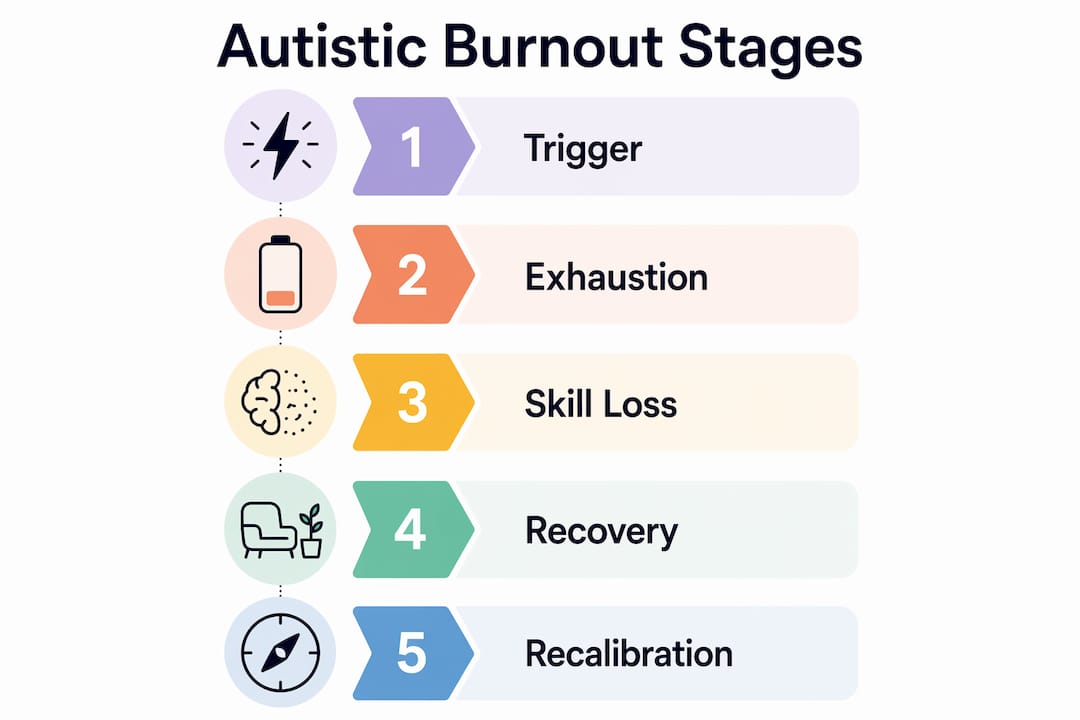
Autistic burnout develops through a predictable process, even if the timeline varies widely between individuals. Understanding the stages helps you catch it earlier.
- Sustained masking: The person spends extended periods suppressing autistic traits to meet social expectations. This is exhausting at a neurological level, not just emotionally.
- Sensory stress accumulation: Repeated exposure to overwhelming environments without adequate recovery builds a sensory debt that the nervous system cannot clear.
- Executive overload: Managing daily life in a world not designed for autistic neurology requires constant extra effort. Over time, this depletes executive function reserves.
- Lack of support or validation: Social invalidation and identity suppression worsen the impact. Late diagnosis and absence of support add to the chronic stress burden.
- Protective shutdown: The nervous system reaches its limit and begins shutting down non-essential functions to preserve core survival needs.
The cumulative effect of chronic stressors without adequate rest drives the exhaustion and loss of function that define burnout. This is fundamentally different from occupational burnout, which is typically tied to a specific workplace context. Autistic burnout is pervasive. It follows the person into every environment because the mismatch between their neurology and the world around them does not stop at the office door.
Pro Tip: Track your energy levels weekly, not daily. Burnout builds slowly, and a weekly log reveals the downward trend before the crash arrives. Note sensory exposures, masking demands, and sleep quality together.
How is autistic burnout different from depression and typical burnout?
Autistic burnout is often misdiagnosed as depression, and the confusion is understandable. Both involve withdrawal, fatigue, and reduced functioning. But the underlying mechanisms and the appropriate responses are different.
| Feature | Autistic burnout | Clinical depression | Occupational burnout |
|---|---|---|---|
| Primary cause | Neurological mismatch and chronic masking | Mood dysregulation, often neurochemical | Workplace stress and overwork |
| Sensory component | Severe sensory overload and intolerance | Rarely a core feature | Rarely a core feature |
| Skill loss | Common, including communication and daily tasks | Uncommon | Uncommon |
| Response to antidepressants | Often ineffective as a standalone treatment | Often effective | Not typically indicated |
| Recovery approach | Nervous system regulation, reduced demands | Therapy, medication, lifestyle | Rest, boundary-setting, job changes |
The nervous system capacity collapse in autistic burnout does not respond to standard antidepressant therapies the way clinical depression does. Treating burnout as depression can delay real recovery and cause additional harm. If a clinician is involved, sharing this distinction directly is worth the effort. Autistic burnout requires reducing environmental demands and rebuilding nervous system safety, not simply adjusting brain chemistry.
Typical occupational burnout also differs in scope. It is usually tied to a specific job or role and resolves when that stressor is removed. Autistic burnout is pervasive because the environment mismatch exists everywhere, not just at work.
What practical strategies help with coping and recovery?
Recovery from autistic burnout requires a triage approach. The goal is not to push through. The goal is to reduce all non-essential demands until the nervous system can stabilize.
Practical coping strategies include:
- Eliminate non-essential tasks: If you have capacity for two tasks, do one. Prioritize basic needs over productivity. Eating, sleeping, and hydrating come before everything else.
- Protect your sensory environment: Use earplugs, dim lighting, and quiet spaces. A sensory-friendly environment reduces the nervous system load significantly.
- Communicate your needs clearly: Tell trusted people what you need, even if that is just silence and space. You do not owe anyone an explanation of your limits.
- Use sensory regulation tools: Sensory diet strategies can help regulate the nervous system during recovery. These include weighted blankets, movement breaks, and controlled sensory input.
- Avoid the “one good day” trap: One day of feeling better does not mean recovery is complete. Returning to full activity too soon causes relapse.
- Focus on becoming calmer, not more energized: During deep burnout, nervous system regulation improves when the goal is calm rather than productivity.
- Build autonomy into recovery: Spending limited energy on activities that feel meaningful and chosen sends positive signals to the nervous system and supports healing.
Recovery also means examining what caused the burnout in the first place. If a job, relationship, or environment is chronically demanding beyond your capacity, returning to it unchanged will restart the cycle. Long-term recovery requires structural changes, not just rest.
Pro Tip: Pacing means working at roughly 70% of your perceived capacity, not 100%. This feels frustratingly slow at first, but it prevents the boom-and-bust cycle that keeps many people stuck in repeated burnout.
What should you expect from the recovery timeline?
Recovery from autistic burnout is nonlinear. Progress does not move in a straight line, and setbacks are a normal part of the process, not signs of failure.
True recovery requires lifestyle recalibration and building a life that matches your neurology rather than conforming to neurotypical norms. That is a significant shift, and it takes time. For some people, recovery takes weeks. For others, it takes years. The severity of the burnout, the availability of support, and the ability to reduce environmental demands all affect the timeline.
One of the hardest truths about autistic burnout is that it can permanently alter functioning levels. Some people find that their baseline capacity after burnout is lower than it was before. This is not a personal failure. It is a physiological reality that calls for compassion, not blame. Adjusting expectations and building a life around a new baseline is a legitimate and healthy response.
Caregivers play a critical role here. Pushing a person in burnout to “try harder” or return to previous levels of activity accelerates the crash. Patience, reduced demands, and consistent support are the most effective tools available. For children and adolescents, autism support strategies tailored to their developmental stage can make a meaningful difference in recovery speed and quality.
Key takeaways
Autistic burnout is a distinct neurological condition requiring reduced demands, sensory protection, and long-term lifestyle recalibration to achieve genuine recovery.
| Point | Details |
|---|---|
| Clear definition | Autistic burnout is chronic nervous system exhaustion from masking, sensory overload, and social demands. |
| Distinct from depression | Burnout features skill loss and sensory collapse; antidepressants alone do not address it effectively. |
| Recovery is nonlinear | Progress takes weeks to years; pacing at 70% capacity prevents relapse cycles. |
| Sensory protection matters | Reducing sensory input and environmental demands is a core recovery strategy, not optional. |
| Structural change is required | Returning to unchanged high-demand environments restarts the burnout cycle. |
What I have learned from watching people navigate autistic burnout
The most damaging misconception I encounter is that autistic burnout is just a bad mood or a phase that willpower can fix. It cannot. The people I have seen recover most effectively are the ones who stopped trying to fight through it and started building a life that genuinely fits their neurology.
Self-advocacy is not optional here. Medical professionals who are unfamiliar with autistic burnout will sometimes label it as depression, anxiety, or even laziness. Knowing the distinction and being able to name it clearly gives you a better chance of getting appropriate support. If a clinician dismisses your experience, find one who does not.
The other thing worth saying plainly: recovery is not about returning to who you were before burnout. It is about building something more sustainable. That reframe is uncomfortable, but it is also freeing. You are not broken. You were operating in conditions that were not built for you, and your nervous system finally said enough. Listening to that signal is not weakness. It is the beginning of something better.
— Keith
Autism therapy resources that support burnout recovery
Autismdoctorsearch maintains a directory of autism-specific therapy services designed to address the sensory, cognitive, and emotional challenges that drive and sustain burnout. Finding the right support, whether that is occupational therapy, behavioral health services, or specialized counseling, makes a measurable difference in recovery outcomes. Autismdoctorsearch connects you with vetted providers who understand autistic neurology, not just general mental health. Browse autism therapy services listed in the directory to find specialists near you who can support sensory regulation, executive function, and long-term nervous system recovery.
FAQ
What is the main cause of autistic burnout?
Autistic burnout is caused by the cumulative effect of chronic masking, sensory overload, and navigating neurotypical social demands without adequate rest or support. It is a nervous system response to sustained environmental mismatch, not a single event.
How long does autistic burnout last?
Autistic burnout can last for days, weeks, months, or years depending on the severity of the triggers and the level of support available. Recovery is nonlinear and often requires significant lifestyle changes.
Is autistic burnout the same as depression?
Autistic burnout and depression share some symptoms but have different causes and require different treatments. Burnout centers on capacity loss and sensory dysregulation, while depression features persistent low mood. Standard antidepressants often do not resolve autistic burnout on their own.
Can autistic burnout cause permanent changes?
Yes. Some people find their functional baseline is permanently lower after a severe burnout episode. Adjusting expectations and building a sustainable lifestyle around a new baseline is a healthy and realistic response.
How can caregivers help someone in autistic burnout?
Caregivers help most by reducing demands, protecting the person’s sensory environment, and avoiding pressure to return to previous activity levels. Understanding the difference between meltdowns and burnout also helps caregivers respond more effectively.