


TL;DR:
- Educational therapy is a personalized approach that targets root learning barriers through assessment and cognitive skill building. It differs from tutoring and classroom teaching by focusing on underlying issues rather than content practice. For children with autism, therapists also support social, emotional, and sensory needs to promote overall development.
Educational therapy is a specialized practice in which trained professionals assess a child’s learning needs and build personalized strategies to help that child succeed academically and beyond. The role of educational therapists sits at the intersection of assessment, cognitive skill building, and real-world application. Unlike a classroom teacher or tutor, an educational therapist targets the root causes of learning difficulties, including executive functioning gaps, processing challenges, and social or emotional barriers. For parents of children with autism and for educators, understanding what these specialists do is the first step toward getting the right support in place.
What do educational therapists do to assess and support children?
Educational therapists assess learning needs using both formal and informal methods, then develop individualized strategies to improve academic skills and related learning functions. The formal side includes standardized tests that measure reading fluency, processing speed, and working memory. Informal methods include observation, interviews with parents, and task analysis during sessions. Together, these tools build a complete picture of how a child learns, not just what they know.

From that assessment, the therapist develops a tailored learning plan. This plan often resembles an individualized education plan (IEP) in structure, with measurable goals reviewed every few months and adjusted based on progress. Goals are specific. A child struggling with organization might work toward independently using a checklist to complete a multi-step homework assignment within a set time.
Educational therapy techniques commonly used in sessions include:
- Breaking tasks into steps: A child learns to chunk a writing assignment into brainstorm, outline, draft, and edit phases rather than facing the whole task at once.
- Working memory training: Therapists use repetition, visual cues, and verbal rehearsal to strengthen a child’s ability to hold and use information during tasks.
- Multisensory instruction: Reading and spelling are taught through sight, sound, and movement together, which strengthens retention across learning styles.
- Explicit tool instruction: Learner-specific tools like checklists and timers are taught directly and practiced in real academic tasks so skills transfer beyond the therapy room.
- Executive functioning support: Therapists teach time management, organization, and planning as practical skills, not abstract concepts.
Pro Tip: Ask the therapist to show you the specific tool or routine your child practiced in each session. When you reinforce the same tool at home, the skill generalizes faster.
How do educational therapists differ from tutors and traditional teachers?
Educational therapy focuses on underlying cognitive barriers to learning, while tutoring emphasizes practice and content mastery. This is the clearest line between the two. A tutor helps a child practice long division. An educational therapist investigates why the child loses track of steps mid-problem and builds the working memory and sequencing skills that make math stick.
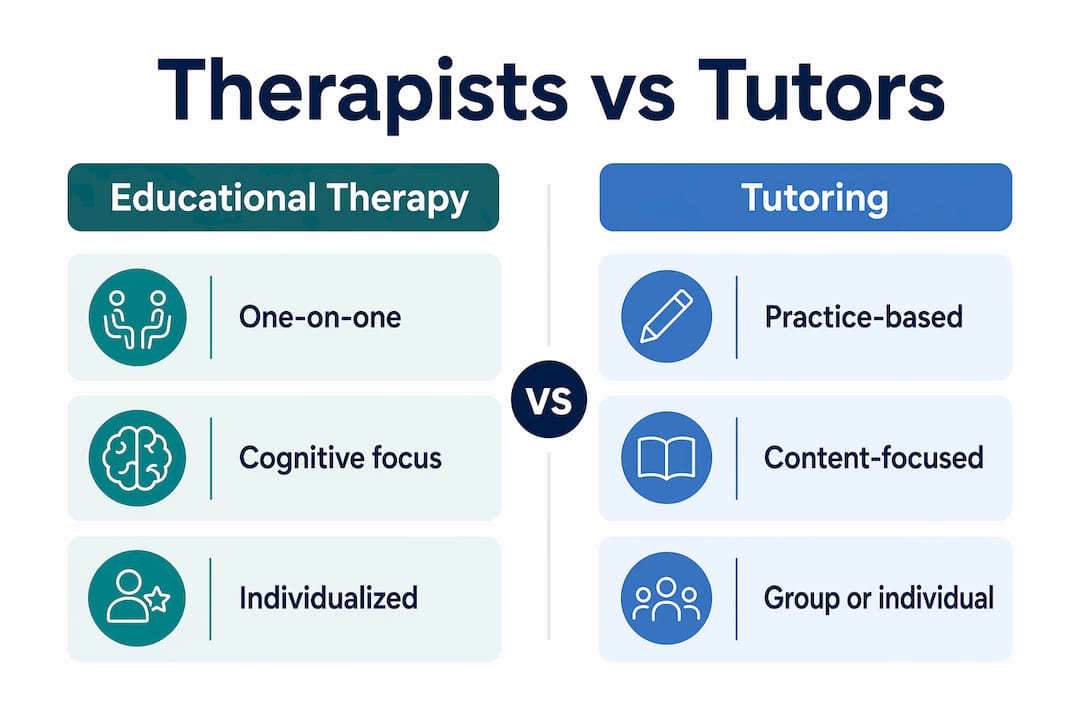
Classroom teaching differs from both. Teachers work with groups, follow a curriculum paced for grade-level standards, and cannot consistently modify instruction for one child’s processing profile. Educational therapists work one-on-one, set their own pace, and adjust every session based on the child’s response.
| Factor | Educational therapy | Tutoring | Classroom teaching |
|---|---|---|---|
| Session size | One-on-one | Usually one-on-one | Group (20–30 students) |
| Primary focus | Cognitive and processing skills | Content practice and review | Curriculum delivery |
| Goal | Fix root learning barriers | Improve grades or test scores | Grade-level achievement |
| Plan type | Individualized, assessment-based | Topic-based | Standardized curriculum |
| Progress tracking | Formal reviews every few months | Informal, grade-based | Report cards, standardized tests |
The mindset shift for families is significant. Moving from content practice to cognitive skill development means accepting that progress may not show up immediately in grades. It shows up first in how a child approaches a problem, manages frustration, or organizes a backpack.
What role do educational therapists play in supporting children with autism?
For children with autism, educational therapists support social skills, communication, emotional regulation, and sensory sensitivities alongside academic goals. This whole-child approach is what separates educational therapy from purely academic intervention. A child who cannot regulate frustration during a reading task will not benefit from phonics instruction alone. The therapist addresses both at once.
Social skill development is a concrete part of this work. Therapists build turn-taking, perspective-taking, and conversation initiation into structured activities during sessions. These are not abstract lessons. A therapist might use a card game to practice waiting, or a collaborative project to practice asking for help. The skill is embedded in a real interaction.
Sensory sensitivities also shape how sessions are designed. A child who is distracted by background noise may need sessions in a quieter space with visual schedules to reduce uncertainty. A child who needs movement breaks to regulate attention will have those built into the session plan. Special education strategies for autism that work in schools often mirror what educational therapists apply in individual sessions.
Key areas educational therapists address for children with autism include:
- Emotional regulation: Teaching children to identify feelings and use specific calming strategies before frustration escalates.
- Sensory accommodation: Adjusting the physical environment and task demands to match the child’s sensory profile.
- Functional communication: Building practical language for requesting help, expressing needs, and navigating social situations.
- Transition support: Preparing children for changes in routine using visual schedules and advance warnings.
- Strength-based learning: Identifying what the child does well and using those strengths as entry points for harder skills.
Pro Tip: When meeting a potential educational therapist, ask how they handle a meltdown or shutdown during a session. Their answer tells you whether they understand sensory and emotional regulation, not just academics.
How do educational therapists collaborate with parents, educators, and other professionals?
Educational therapists collaborate closely with parents and educators to reinforce learning strategies consistently across home and school. This collaboration is not optional. Without it, skills learned in therapy sessions stay in the therapy room. Generalization requires the same strategies appearing in the same form at home and in the classroom.
A typical collaboration cycle looks like this:
- Initial consultation: The therapist meets with parents and, when possible, the classroom teacher to gather background on the child’s history, current challenges, and previous interventions.
- Assessment sharing: After evaluation, the therapist presents findings in plain language, explaining what the results mean for daily learning and what goals will be targeted first.
- Ongoing communication: Educational therapist responsibilities include reporting progress to families and professionals through written updates, phone calls, or brief meetings after sessions.
- School coordination: The therapist shares specific strategies with teachers, such as allowing extra processing time, using visual checklists, or breaking assignments into smaller parts. Teachers do not need to redesign their classrooms. They need one or two targeted adjustments.
- Periodic plan review: Goals are formally reviewed every few months. If a child has mastered a skill, the plan advances. If progress has stalled, the therapist adjusts the approach based on new data.
Parents play an active role in this process. Reinforcing the same organizational routine or calming strategy at home multiplies the impact of each therapy session. The therapist’s job is to teach the skill. The parent’s job is to create the conditions for that skill to be practiced daily.
Key Takeaways
Educational therapists deliver the most measurable impact when assessment, individualized planning, and consistent collaboration across home and school work together as a single system.
| Point | Details |
|---|---|
| Assessment drives the plan | Therapists use formal and informal tools to identify root learning barriers before setting goals. |
| Therapy targets root causes | Educational therapy builds cognitive and processing skills, not just content knowledge. |
| Autism support goes beyond academics | Therapists address emotional regulation, sensory needs, and social communication for children with autism. |
| Collaboration multiplies results | Consistent strategy use at home and school is required for skills to generalize beyond sessions. |
| Plans are living documents | Goals are reviewed every few months and adjusted based on real progress data. |
What I have learned watching educational therapy work up close
The most common mistake I see parents make is treating educational therapy like tutoring with a fancier name. They expect grades to climb within a few weeks. When that does not happen, they pull the child out. That is the wrong metric at the wrong time.
Effective educational therapy shows up first in behavior, not grades. A child who used to shut down at homework now asks for a timer. A child who avoided reading now picks up a book independently. These are the early signals that the cognitive work is taking hold. Grades follow later, sometimes much later.
The therapist-to-plan connection is the clearest quality signal I know. When assessments are clearly linked to individualized targets and plans are revised as the child progresses, the therapy is working as designed. If a therapist cannot explain why a specific goal was chosen based on a specific assessment finding, that is a red flag worth acting on.
For educators, the most practical thing you can do is ask the therapist for two or three classroom-ready strategies after the first month. You do not need the full report. You need the two adjustments that will make the biggest difference for that child in your room. Most educational therapists are glad to provide exactly that.
— Keith
Finding qualified educational therapists through Autismdoctorsearch
Autismdoctorsearch maintains a current directory of autism therapy services and learning support providers across the United States. Parents looking for qualified professionals who specialize in educational therapy and autism support can browse verified autism therapy listings to find providers in their area. The directory also includes child development assessment services for families at the beginning of the evaluation process. Each listing includes contact details and service descriptions so you can reach the right provider without guesswork. Autismdoctorsearch updates its directory regularly to reflect current providers and service availability.
FAQ
What qualifications does an educational therapist need?
Educational therapists typically hold a graduate degree in education, psychology, or a related field, combined with specialized training in learning disabilities and assessment. Certification requirements vary by state and country, so confirming credentials directly with the provider is the most reliable approach.
How is educational therapy different from special education?
Special education is a school-based service delivered within a structured curriculum framework for groups of students. Educational therapy is an individualized, private practice focused on the cognitive and processing skills that underlie academic performance.
How long does educational therapy take to show results?
Progress timelines vary based on the child’s profile and the complexity of the learning barriers being addressed. Most therapists conduct formal goal reviews every few months to measure progress and adjust the plan accordingly.
Can educational therapy help a child with autism who does not have academic delays?
Yes. For children with autism, educational therapy addresses social communication, emotional regulation, and sensory challenges that affect daily functioning, even when academic skills are at or above grade level.
What should parents ask during a first consultation with an educational therapist?
Ask how the therapist links assessment findings to specific goals, how often the plan is reviewed, and how they communicate progress to parents and teachers. Clear answers to these three questions indicate a structured, accountable practice.


