


TL;DR:
- Families can now apply for autism grants by first confirming eligibility for public programs like IDEA and Medicaid. Gathering core documents and identifying local providers quickly increases the chances of securing funding and filling service gaps efficiently.
Yes, you can apply for autism grants right now. The fastest first move is to confirm eligibility for public entitlements like IDEA and Medicaid, then gather your core documents, because private grant applications go much faster once that foundation is in place.
Start here in the next 24–72 hours:
- Contact your school district’s special education office or your state’s early intervention program. You don’t need a formal diagnosis yet. Early intervention services accept parent requests for evaluation directly, so call today.
- Request your child’s latest medical and diagnostic records from every provider. Most offices release records within 5–10 business days with a signed release form.
- Bookmark three to five grant portals: Grants.gov, your state Medicaid waiver office website, and the resource pages for Autism Speaks, the Autism Society, and The Arc.
Public benefits like IDEA and Medicaid are ongoing and renewable. Private grants are competitive and time-limited. Locking in the public layer first means grants fill gaps rather than carry the whole load.
Table of Contents
- What are the main funding sources for autism services?
- How do you find autism grants in your area?
- How to apply for autism grants: a step-by-step process
- What documents do you need for an autism grant application?
- What eligibility rules and disqualifiers should you watch for?
- How do you stack grants with other supports?
- How do you spot autism grant scams?
- Key contacts and resources to bookmark
- Key Takeaways
- What families often get wrong about autism funding
- Autismdoctorsearch helps you find providers and resources fast
- Authoritative sources to bookmark
What are the main funding sources for autism services?
Autism funding falls into three buckets: federal and state public programs, private nonprofit grants, and tax-advantaged savings tools. Knowing which bucket to hit first saves months of effort.
| Funding Source | What It Covers | Who Qualifies |
|---|---|---|
| IDEA Part C | Early intervention services, birth through age 3 | Children under 3 with developmental delays or diagnosed conditions |
| IDEA Part B | Special education and related services, ages 3–21 | School-age children with disabilities |
| Medicaid HCBS Waivers | Home and community-based therapies, respite, equipment | Varies by state; often income- and diagnosis-based |
| SSI (Supplemental Security Income) | Monthly cash benefit for low-income families | Children with qualifying disabilities and limited household income |
| ABLE Accounts | Tax-advantaged savings for disability expenses | Disability onset before age 26; up to $18,000 annually in contributions |
| Nonprofit Grants | Therapy gaps, equipment, crisis support | Varies; typically requires diagnosis and financial need |
Private nonprofit grants typically run in a range of several hundred to a few thousand dollars per award, though some programs offer larger amounts. They’re competitive, often open only once or twice a year, and funds run out fast. ABLE accounts are different: they let families save tax-free for disability-related expenses without putting Medicaid or SSI eligibility at risk—provided the disability began before age 26. Families can contribute up to $18,000 per year to ABLE accounts in 2025/2026. A quick overview of state insurance mandates can clarify what your plan is already required to cover.
How do you find autism grants in your area?
The best sources combine federal portals, state agencies, and local community organizations.
Grants.gov is the federal clearinghouse for government grant programs. Search “autism” or “developmental disabilities” and filter by your state. Most results here are for organizations rather than families, but some state-administered programs do accept individual applications.
Your state Medicaid waiver office is the single most important call you’ll make. Waiver programs vary dramatically by state, and waitlists for some programs run years long. Get on the list now, even if you don’t qualify for regular Medicaid today.
National nonprofits publish their own grant cycles. ACT Today!, for example, posts application windows and preparation checklists on its website so families can prepare before the window opens. The National Autism Association, Autism Speaks, and The Arc all maintain resource pages with grant listings updated regularly.
Local community foundations and United Way chapters are underused. Search “[your county] community foundation grants” and “[your city] United Way emergency assistance.” These small funds often move faster than national programs and have less competition. Call the local chapter directly and ask specifically about disability or family assistance funds.
Pro Tip: When you call a state agency, have your child’s date of birth, diagnosis code (if available), and your household income range ready. The intake worker can screen you for multiple programs in one call instead of routing you through three departments.
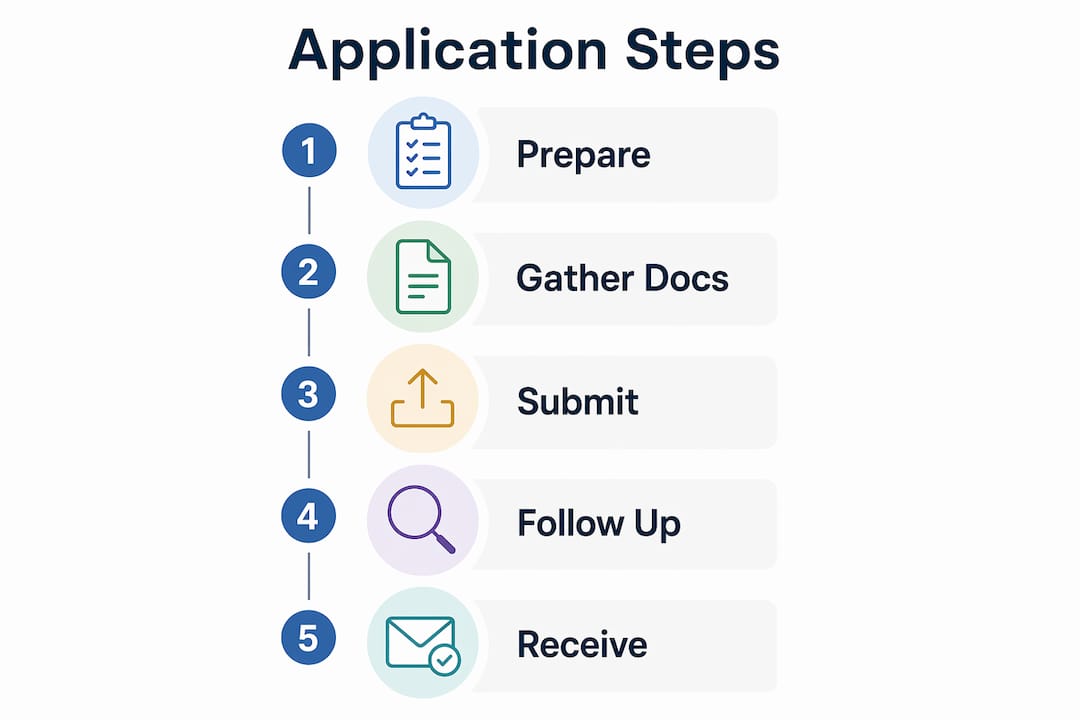
How to apply for autism grants: a step-by-step process
- Screen eligibility first. Before filling out any application, confirm your child meets the age, diagnosis, residency, and income requirements. Wasted applications on programs you don’t qualify for cost time you don’t have.
- Assemble your document folder. Pull together the diagnostic report, most recent IEP or IFSP, provider quotes, last two years of tax returns, and proof of residency. More on the specific documents below.
- Identify your provider. Many grants pay providers directly rather than reimbursing families. Identify a qualified, willing provider before you apply, and get a written treatment plan and cost estimate from them.
- Complete the application carefully. Answer every question. Leave nothing blank. If a field doesn’t apply, write “N/A.” Incomplete applications are the most common reason for rejection.
- Submit and confirm receipt. For online portals, save the confirmation email. For mailed applications, use certified mail. Follow up within five business days if you haven’t received an acknowledgment.
- Follow up and appeal if denied. Most programs have a reconsideration or appeal process. SSI denials are common on the first attempt; appealing with additional documentation and representation consistently improves outcomes.
Application windows for nonprofit grants often open once or twice a year and close within weeks. Decision timelines range from 30 days for small emergency funds to six months or more for larger programs. Build a calendar with every open and close date you find.
Pro Tip: Prepare a one-page family hardship narrative now, before any window opens. Describe your child’s diagnosis, the specific services needed, and why you cannot cover the cost without assistance. This document drops directly into almost every application you’ll submit.

What documents do you need for an autism grant application?
Most programs ask for the same core package. Gather these once and keep them current:
- Diagnostic report: A formal evaluation from a licensed psychologist or physician, usually within the last two to three years. Expired reports are a common disqualifier.
- IEP or IFSP: The current Individualized Education Program (school-age) or Individualized Family Service Plan (under age 3). This shows the services already in place and the gaps a grant would fill.
- Provider quotes and treatment plan: A written estimate from your chosen provider, including service type, frequency, and cost. Many grant applications require this because funds go directly to the provider.
- Proof of income: Last one to two years of federal tax returns, or current pay stubs. Some programs use a percentage of the federal poverty level as a cutoff.
- Proof of residency and identity: A utility bill or lease plus a government-issued ID for the parent or guardian.
To get records quickly, submit a signed medical records release form to every provider at once. For school records, send a written request to the special education director by email and keep a copy. If you need help getting referrals or provider documentation, the autism medical referrals guide on Autismdoctorsearch walks through the process step by step.
What eligibility rules and disqualifiers should you watch for?
Most grant programs share a few standard criteria: a documented autism spectrum disorder diagnosis, demonstrated financial need, state residency, and an age range. Beyond those basics, watch for these common traps:
- Expired diagnostic reports. Many programs require an evaluation dated within 24–36 months. If yours is older, schedule a re-evaluation now.
- Ineligible service types. Some grants cover only specific therapies (ABA, speech, OT) and won’t fund general childcare, transportation, or respite. Read the eligible expenses list before applying.
- Means-tested benefit interactions. Accepting a large lump-sum grant can temporarily affect SSI or Medicaid eligibility if the funds land in a standard bank account. Spending the award within the same calendar month or directing payment to a provider avoids most of this risk.
- Missing provider documentation. If the grant pays providers directly, you must name a pre-approved provider in the application. Applying without one is an automatic rejection at many programs.
The Autism Society’s financial planning resources recommend consulting a special needs attorney or financial advisor before accepting any large award. The interaction between savings, grants, and means-tested programs is genuinely complex, and a one-hour consultation can prevent a costly mistake.
How do you stack grants with other supports?
Private grants work best as targeted patches, not a primary strategy. Build your funding plan in layers:
IDEA school services are free and legally guaranteed. If your child is under 3, the early intervention system provides services at no cost. Ages 3–21, the school district must provide a free appropriate public education, including therapies written into the IEP.
Medicaid HCBS waivers can fund home-based therapies, respite care, and equipment that standard Medicaid doesn’t cover. Waitlists are long in many states, so apply the moment you suspect eligibility.
SSI provides monthly cash that can cover therapy copays, transportation, and supplies. In most states, SSI approval automatically opens Medicaid eligibility.
ABLE accounts let you save for disability expenses without affecting SSI or Medicaid. Families can contribute up to $18,000 per year (2025–2026), and the funds can cover services a waiver won’t pay for. The ABLE account budgeting guide on Autismdoctorsearch explains how to integrate this into a broader family plan.
A private grant then fills what’s left: therapy copays, specialized equipment, or a short-term service gap while a waiver application is pending.
How do you spot autism grant scams?
Legitimate grant programs never charge an application fee. Full stop. Beyond that, watch for:
- Unsolicited emails or social media messages promising guaranteed funding.
- Programs with no published eligibility criteria, no physical address, and no verifiable nonprofit status.
- Requests for your Social Security number or banking information before any formal application process.
To verify a nonprofit, search its name on the IRS Tax Exempt Organization Search at apps.irs.gov or on Charity Navigator. Confirm application windows directly on the organization’s official website, not through a third-party post. If you suspect fraud, report it to the FTC at reportfraud.ftc.gov and to your state attorney general’s consumer protection office.
Key contacts and resources to bookmark
| Resource | Best Used For | How to Reach |
|---|---|---|
| State Medicaid/Waiver Office | Waiver applications and waitlists | medicaid.gov → find your state |
| Social Security Administration | SSI applications and benefits screening | ssa.gov or 1-800-772-1213 |
| Grants.gov | Federal and state grant searches | grants.gov |
| Autism Society | Financial planning resources and local chapters | autismsociety.org |
| Autism Speaks | Grant listings and resource guides | autismspeaks.org |
| The Arc | Advocacy, assistive technology grants, local chapters | thearc.org |
| National Autism Association | Family grants and crisis support | nationalautismassociation.org |
| NEXT for AUTISM | Grants for autistic adults and innovative programs | nextforautism.org |
To find your state waiver office quickly, go to medicaid.gov and click “State Overviews.” For a local autism chapter, search “[your state] Autism Society chapter” or “[your city] The Arc.” Local chapters often know about small community grants that never appear on national portals.
Key Takeaways
Stacking public entitlements first and treating private grants as targeted gap-fillers gives families the most stable, long-term funding foundation for autism services.
| Point | Details |
|---|---|
| Start with public benefits | Confirm IDEA, Medicaid waiver, and SSI eligibility before pursuing private grants. |
| Assemble documents now | Keep a ready folder with diagnosis report, IEP/IFSP, provider quotes, tax returns, and proof of residency. |
| Calendar every grant window | Nonprofit grant windows open and close fast; missing one means waiting another cycle. |
| Protect means-tested benefits | Consult a special needs attorney before accepting large lump-sum awards to avoid SSI or Medicaid disruption. |
| Use Autismdoctorsearch | Search the directory to find local therapy providers, get provider quotes, and locate nonprofit resources near you. |
What families often get wrong about autism funding
The families who struggle most with autism funding aren’t the ones who lack resources. They’re the ones who spend six months chasing private grants while their child sits on a Medicaid waiver waitlist they never joined.
Private grants feel accessible because you can apply from your kitchen table. Public entitlements feel bureaucratic and slow, so families put them off. That’s exactly backwards. A Medicaid HCBS waiver, once approved, can fund years of services. A $1,000 grant covers a few months of copays. Both matter, but the sequencing matters more.
The other thing families underestimate is how much free help is available before any application is submitted. Local Autism Society chapters, The Arc affiliates, and benefits counselors at many school districts will walk you through eligibility screening at no cost. You don’t need to hire anyone to get started. Use those resources first, then bring in a special needs attorney when a large award or complex benefit interaction is on the table.
Autismdoctorsearch helps you find providers and resources fast
One of the most common reasons grant applications stall is missing provider documentation. Many programs require a named provider, a written treatment plan, and a cost estimate before they’ll process an application. Finding a qualified provider who accepts grant payments and can turn around documentation quickly is where families lose weeks.
Autismdoctorsearch maintains a searchable directory of autism therapy providers across the U.S., including ABA therapy centers, occupational therapists, mental health services, and special education schools. You can search by location, filter by service type, and contact providers directly to request quotes. The directory also lists nonprofit organizations and financial planning resources that can support the application process itself. Search the Autismdoctorsearch directory today to find a qualified provider near you and get the documentation your application needs.
Authoritative sources to bookmark
- CDC: Accessing Services for Autism Spectrum Disorder — Use for early intervention eligibility and how to self-refer for evaluation.
- SSA: ABLE Accounts Spotlight — Use for contribution limits and how ABLE interacts with SSI and Medicaid.
- Grants.gov — Use to search federal and state grant programs by category and location.
- Autism Society: Future and Financial Planning — Use for multi-layered financial planning guidance and local chapter referrals.
- Autism Speaks — Use for grant listings, insurance guides, and state-specific resource tools.
- The Arc — Use for advocacy support, assistive technology grants, and local chapter contacts.
- National Autism Association — Use for family grant applications and crisis assistance programs.
- ACT Today! — Use to check current grant application windows and prepare your checklist in advance.
- NEXT for AUTISM — Use for grants supporting autistic adults in home, work, social, and health programs.
- State Medicaid Agencies — Use to find your state waiver office, apply for Medicaid, and join HCBS waiver waitlists.
- Social Security Administration — Use to apply for SSI, screen for benefits, and access the online disability report.
This article provides general information only and is not a substitute for advice from a licensed attorney, financial advisor, or benefits counselor. Confirm current program rules and eligibility requirements with the relevant agency or a qualified professional for your specific situation.


