


Autism-specific nonprofits serve families as navigators, service connectors, advocates, and community anchors — all at once. The Autism Society of America, for example, reaches roughly 500,000 individuals annually through its 70+ affiliate chapters. Before you spend weeks calling clinics cold, a single nonprofit contact can hand you a vetted referral list, walk you through insurance appeals, and connect you to a parent support group in your zip code.
Three things families gain almost immediately:
- Therapy referrals — ABA, occupational therapy, and speech pathology providers your family can actually reach, often with sliding-scale options already negotiated
- Benefits and legal navigation — help decoding Medicaid waivers, SSI eligibility, and IEP rights without hiring an attorney first
- Local peer support — parent-led groups that national databases frequently miss
Pro Tip: Before your first call to any nonprofit, check its listing on Autismdoctorsearch to confirm current services, contact details, and whether it accepts your insurance or offers fee assistance.
Table of Contents
- What role do non-profit organizations actually play for autism families?
- What services do autism nonprofits typically provide?
- How do nonprofits make a practical difference for families?
- Where can you find autism-specific nonprofits and directories?
- How do you evaluate whether a nonprofit is trustworthy?
- What steps should your family take to get services?
- How can you start or strengthen a local autism nonprofit?
- Key Takeaways
- Why local nonprofits and directories both matter
- Autismdoctorsearch connects families to autism nonprofits and services
- Useful sources for families and donors
What role do non-profit organizations actually play for autism families?
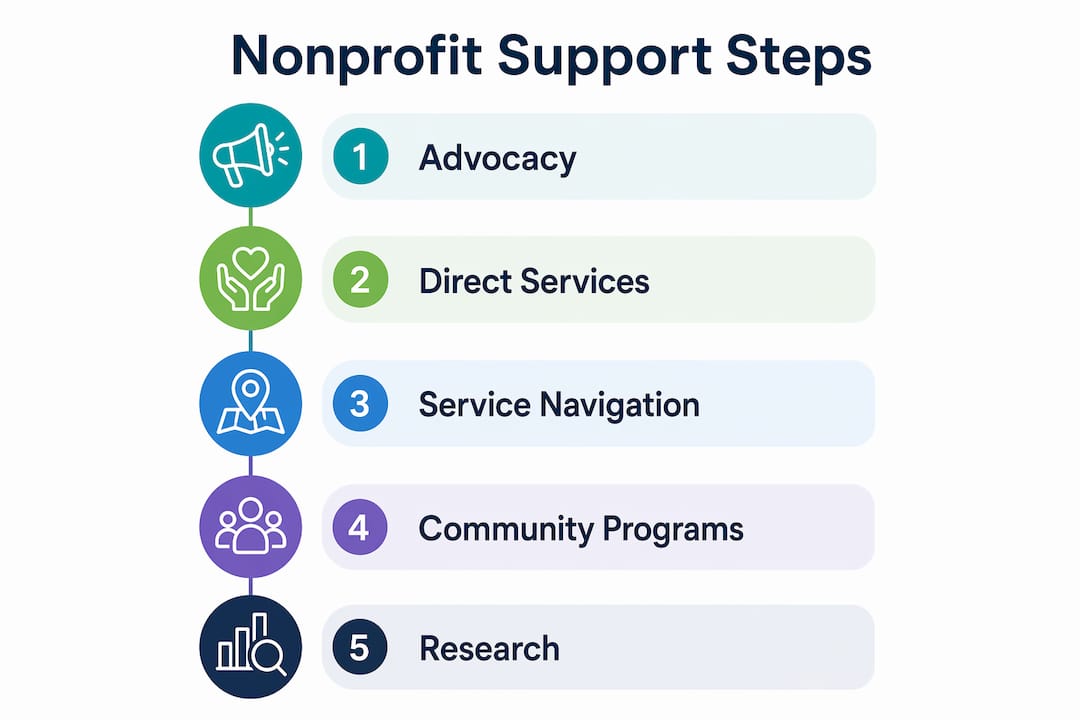
The functions of nonprofit entities in the autism space fall into five distinct categories, and knowing which one a given organization leads with tells you a lot about what it will deliver.
Advocacy means pushing for policy and legal change. The Autistic Self Advocacy Network centers autistic voices in civil rights work, legislative testimony, and leadership training for self-advocates. This is the org you call when a school district denies services or a state Medicaid waiver has a three-year waitlist.
Direct services means the nonprofit itself delivers programs — therapy, respite care, social skills groups, or job coaching. Navigation and information-and-referral means the org connects you to services delivered by others; think of it as a human search engine with local knowledge. Research and training means the organization funds studies, trains clinicians, or educates school staff. Community programs means social events, caregiver workshops, and peer networks that reduce isolation.

Most large organizations blend several of these roles. The Autism Society of America runs advocacy, community programs, and a national affiliate network simultaneously. Smaller orgs tend to specialize, which can actually make them more useful for a specific need.
What services do autism nonprofits typically provide?
Concrete programs vary by organization, but the following appear consistently across the sector:
- Diagnostic navigation — help scheduling evaluations, understanding results, and appealing insurance denials
- Therapy referrals — ABA, occupational therapy, speech-language pathology, and mental health services, often with provider vetting already done
- Caregiver training — workshops on behavior strategies, communication supports, and crisis de-escalation
- Support groups — peer-led and professionally facilitated, for parents and for autistic individuals separately
- Respite care — short-term relief for caregivers, sometimes grant-funded at no cost
- Transition-to-adult services — job coaching, independent living skills, and college support for teens aging out of school-based programs
- School and IEP advocacy — trained advocates who attend meetings and help families understand their rights under IDEA
A cross-sector community education program documented in Frontiers in Public Health trained school staff and caregivers at scale across hundreds of schools, showing how nonprofits can multiply impact by partnering with public institutions rather than working in parallel.
Pro Tip: If waitlists are long and your budget is tight, prioritize organizations that offer caregiver training first. You can implement strategies at home immediately while waiting for direct therapy slots to open.
Funding models matter here. Many autism nonprofits offer sliding-scale fees, scholarship programs, or grant-funded services that cost families nothing out of pocket. Always ask about fee assistance before assuming a program is out of reach.
How do nonprofits make a practical difference for families?
The gap between “knowing a service exists” and “actually accessing it” is where most families lose weeks or months. Nonprofits close that gap in three concrete ways.
First, they translate systems. A parent trying to navigate Medicaid waivers, school IEP timelines, and ABA authorization simultaneously is dealing with three separate bureaucracies. A nonprofit navigator who knows all three can cut that process from months to weeks.
Second, they fill geographic gaps. Parent-founded groups like DC Autism Parents offer resource connection, newsletters, and local workshops that no national database replicates. These groups know which providers have current openings, which ones have long waitlists, and which ones have recently changed their intake process.
Third, they drive policy wins that benefit every family in a state, not just members. Legislative testimony, Medicaid waiver expansions, and school district training mandates all trace back to sustained nonprofit advocacy.
| Impact Area | What Nonprofits Deliver |
|---|---|
| Service navigation | Vetted referral lists, insurance appeal support, waitlist management |
| School advocacy | IEP meeting support, IDEA rights education, district-level training |
| Policy change | State Medicaid waiver expansion, legislative testimony, civil rights litigation |
| Community support | Parent peer groups, respite programs, caregiver workshops |
The importance of nonprofits shows up most clearly at the local level, where a single well-run affiliate chapter can be the difference between a family finding services in two weeks versus two years.
Where can you find autism-specific nonprofits and directories?
Start broad, then narrow. Here is a practical search sequence:
- National organization websites — the Autism Society of America’s affiliate finder and similar tools list chapters by state and county
- Affiliate pages — once you find a national org, go directly to its local chapter page for current programs and contact info
- Searchable directories — Autismdoctorsearch lets you filter by service type (nonprofits, ABA therapy, special education, mental health) and location in one search
- State and regional resource centers — many states fund autism resource centers through Medicaid or developmental disabilities agencies
- Local parent groups and community centers — Facebook groups, school district parent liaisons, and pediatrician offices often know about groups that never appear in formal databases
A good directory listing tells you the organization’s service categories, eligibility requirements, fee structure, and direct contact. If a listing is missing two or more of those, call to confirm before driving across town.
- Look for listings that include a physical address or service area, not just a website
- Confirm the listing was updated within the past 12 months
- Check whether the organization lists specific programs, not just a general mission statement
How do you evaluate whether a nonprofit is trustworthy?
The single most useful financial benchmark: efficient nonprofits spend at least 75% of their budget on programs, leaving no more than 25% for administration and fundraising combined. You can verify this yourself using IRS Form 990 via ProPublica’s Nonprofit Explorer — it is free and takes about five minutes.
What to check on Form 990:
- Page 10, Line 25: divide program services spending (Column B) by total expenses (Column A) to get the program-spend percentage
- Page 7: review executive compensation for anything that seems disproportionate to the org’s size
- Part I, Line 16a: flag heavy reliance on professional fundraisers with low program output
Beyond the numbers, qualitative signals matter just as much. Named board members with relevant expertise (clinicians, educators, autistic self-advocates, legal professionals) signal governance depth. A recent impact statement or newsletter published within the last six months shows the organization is still active and accountable.
| Vetting Marker | What to Look For |
|---|---|
| Program-spend ratio | ≥75% of total expenses going to programs (Form 990, Page 10) |
| Board transparency | Named members with stated expertise listed on the website |
| Recent communications | Newsletter or impact report dated within the past 6 months |
| Affiliate network | Local chapter listed under a national organization |
| Form 990 availability | Accessible via Charity Navigator or GuideStar/Candid |
Aggregate ratings from Charity Navigator and GuideStar are useful starting points, but many effective small community nonprofits are unrated. When a rating is absent, go straight to the program descriptions, outcome examples, and any parent testimonials the organization publishes.
What steps should your family take to get services?
Getting from “I need help” to “I have an appointment” requires a bit of preparation. Here is a practical sequence:
- Gather your documentation first — current diagnostic evaluation, insurance card, most recent IEP or school records, and any prior authorization letters
- Identify two or three organizations using a directory or affiliate finder, not just one, in case the first has a long waitlist
- Call or email with specific questions — ask about eligibility criteria, current waitlist length, fee structure, and what the intake process looks like
- Request a referral from your pediatrician or diagnostician — some programs require a physician referral for insurance billing purposes
- Follow up in writing — after any phone intake, send a brief email confirming what was discussed and next steps
Questions worth asking on first contact:
- What is your current waitlist for [specific service]?
- Do you offer sliding-scale fees or scholarship programs?
- What outcomes do families typically see after completing your program?
- Are you in-network with [your insurance plan]?
Intake timelines vary widely. Diagnostic evaluations through nonprofit-affiliated clinics can take 4–12 weeks depending on demand. ABA therapy authorization through insurance adds another 2–6 weeks on top of that. Starting the paperwork before you feel ready is almost always the right call.
How can you start or strengthen a local autism nonprofit?
If your community lacks adequate support, building something local is more achievable than it sounds. The basics:
- Define a narrow mission — “navigation and peer support for newly diagnosed families in [county]” beats “helping all autistic people” as a starting point
- Form a board of at least three people with complementary skills: someone with lived experience, someone with financial or legal background, and someone with program delivery experience
- Choose your legal structure — a 501©(3) application through the IRS is the standard path; fiscal sponsorship under an existing nonprofit is faster and cheaper for early-stage groups
- Secure initial funding — small grants from community foundations, local corporate partnerships, and individual donations are the most common early sources
For communications, video content amplifies a nonprofit’s mission more cost-effectively than most other formats, particularly for donor outreach and community awareness. Social media video is especially practical for small groups with limited budgets.
Two pitfalls that sink most early-stage nonprofits: mission creep (saying yes to every request until the org loses focus) and weak governance (no formal board meetings, no conflict-of-interest policy, no financial oversight). Both are preventable with a simple annual board calendar and a one-page governance policy adopted in year one.
Key Takeaways
Autism-specific nonprofits are most useful to families when you know exactly what each organization does, how to verify its finances, and how to contact it quickly.
| Point | Details |
|---|---|
| Core nonprofit roles | Advocacy, direct services, navigation, research, and community programs each serve different family needs. |
| Program-spend benchmark | Aim for organizations spending ≥75% of their budget on programs, verifiable via IRS Form 990. |
| Vetting beyond ratings | Check named board members, recent impact statements, and Form 990 when no Charity Navigator rating exists. |
| Finding local services | Use national affiliate pages, state resource centers, and Autismdoctorsearch to locate current, contact-ready listings. |
| Autismdoctorsearch | Search the directory by service type and location to find vetted nonprofits, therapy providers, and special education resources fast. |
Why local nonprofits and directories both matter
The families who find services fastest are rarely the ones who searched hardest. They are the ones who found the right directory or the right local contact on the first try. That is the gap Autismdoctorsearch was built to close.
Maintaining a current, searchable directory of autism resources across the U.S. means that when a family in a new city needs a nonprofit navigator or an ABA provider, they are not starting from scratch. The listings on Autismdoctorsearch include nonprofits, therapy centers, special education schools, and mental health services, with enough detail to make a real first contact. Local affiliate chapters and parent-founded groups are included alongside national organizations, because the most useful resource for a family in rural Ohio is rarely the same as the most useful one for a family in Los Angeles.
Listings are updated regularly to reflect current programs, contact information, and service availability. A directory that sends families to closed programs or outdated phone numbers is worse than no directory at all. That is why nonprofit support for families remains a core focus of what Autismdoctorsearch publishes and maintains.
Autismdoctorsearch connects families to autism nonprofits and services
Searching for an autism nonprofit should take minutes, not weeks. Autismdoctorsearch gives families a single place to find autism therapy services, local nonprofits, special education schools, and mental health providers across the U.S., all in one searchable directory.
Filter by service type, browse nonprofit listings with current contact details, and reach out directly from the listing page. Families can also explore top autism organizations ranked and described for caregivers who want a shortlist before making calls.
Start your search at autismdoctorsearch.com and find a vetted local nonprofit or provider today.
Useful sources for families and donors
- Autism Society 2023 Annual Report — national reach data, affiliate network details, and program examples
- ProPublica: How to evaluate a charity before you donate — step-by-step guide to reading Form 990 and using Nonprofit Explorer
- Charity Navigator: Evaluating charities with no rating — practical checklist for vetting unrated nonprofits using Form 990
- Autistic Self Advocacy Network — What we do — policy, civil rights advocacy, and leadership training for autistic self-advocates
- DC Autism Parents — example of a parent-founded local nonprofit offering navigation, workshops, and peer support
- Frontiers in Public Health: Community education program on ASD — case study on cross-sector training programs at scale
- Dan Marino Foundation: How to evaluate autism charities — practical guidance on program-spend benchmarks and donor due diligence


