


TL;DR:
- Developmental screening uses validated questionnaires to assess if a child is reaching key milestones. It occurs at specific ages with autism screening at 18 and 24 months. Parents should request screening anytime if they notice concerns, and follow-up evaluations ensure early support and intervention.
Developmental screening is a formal, standardized process that uses validated questionnaires to assess whether a child is meeting key milestones in communication, motor skills, social-emotional growth, and problem-solving. It gives pediatricians and caregivers an objective snapshot of a child’s development at specific ages. The American Academy of Pediatrics (AAP) recommends routine screening at 9, 18, and 30 months, with additional autism-specific screening at 18 and 24 months. When a screen identifies a potential delay, it triggers a referral for deeper evaluation, not a diagnosis. Understanding this process puts you in a stronger position to advocate for your child’s needs from the start.
What is developmental screening and when should it happen?
The AAP sets clear intervals for child development screening because developmental windows matter. Screening occurs at 9, 18, and 30 months for general development, with autism-specific screening added at 18 and 24 months. These ages align with critical periods when delays in language, motor control, or social behavior first become detectable.
Each interval targets specific milestones. At 9 months, a pediatrician looks at babbling, object permanence, and early motor skills. At 18 months, the focus shifts to first words, walking, and pointing to communicate. By 30 months, vocabulary, sentence formation, and peer interaction come into sharper focus.
Parents do not have to wait for a scheduled visit. You can request a screening at any well-child appointment if something feels off. A child who stops using words they once knew, avoids eye contact, or seems unusually withdrawn warrants a conversation with the pediatrician right away.
- 9 months: Babbling, reaching, responding to name
- 18 months: First words, walking, pointing, autism screen
- 24 months: Autism screen, two-word phrases, imitation
- 30 months: Sentence use, social play, problem-solving
Pro Tip: Do not wait until the next scheduled well-child visit if you notice a regression or new concern. Call the office and ask for a developmental screening at that visit.
How is developmental screening different from developmental monitoring?
These two terms describe related but distinct activities. Developmental surveillance is continuous observation that happens at every well-child visit. Developmental screening is a formal, periodic evaluation using validated tools at specific ages.
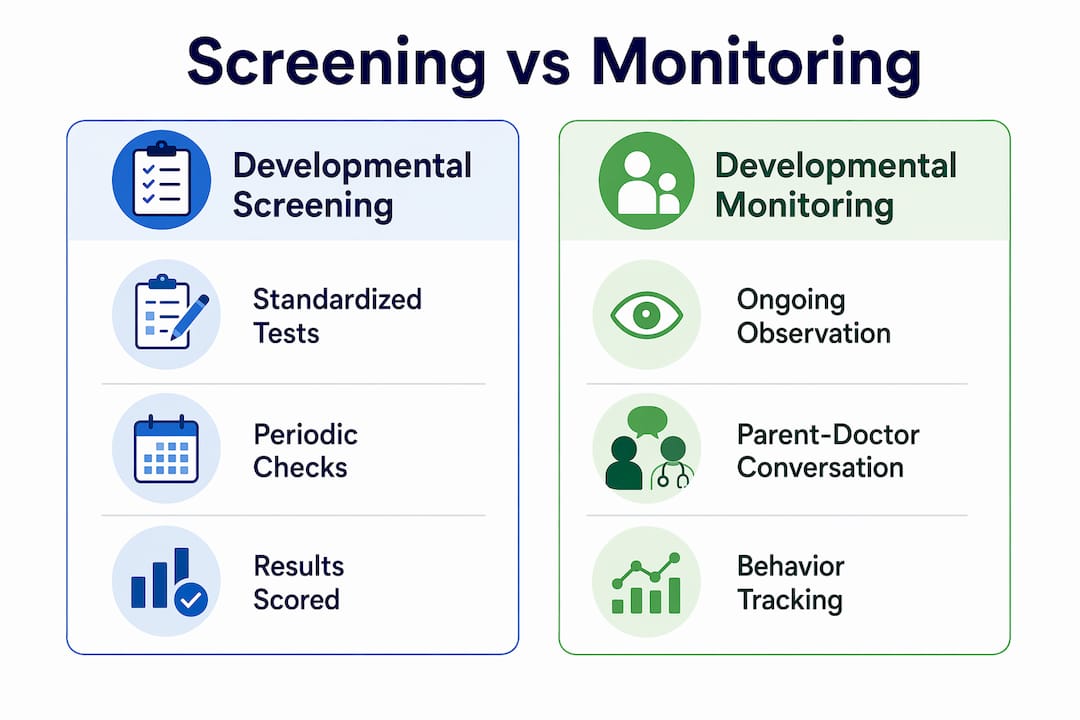
Think of surveillance as the ongoing conversation between you and your child’s doctor. You share what you observe at home. The doctor notes growth patterns over time. Screening, by contrast, uses a structured questionnaire with scored responses to flag children who need a closer look.
Both processes work together. Surveillance catches subtle changes between visits. Screening provides objective data that guides personalized care planning rather than relying on impression alone. Neither replaces the other.
Here is how the two differ in practice:
- Developmental monitoring: Happens at every visit, informal, observation-based, driven by parent report and clinical judgment
- Developmental screening: Happens at set ages, uses validated tools, produces a scored result, and triggers referral if needed
Pro Tip: Before each well-child visit, write down two or three specific behaviors you have noticed at home. Concrete examples help your pediatrician make better use of the monitoring time.
What tools are used in developmental screening?
Screening tools are validated, research-backed parent questionnaires that cover four core developmental domains: language and communication, motor skills, social-emotional behavior, and problem-solving. Most take less than 20 minutes to complete, and many are filled out in the waiting room before the appointment.

The questionnaires ask practical questions. Does your child point to objects to show you something? Can they stack two blocks? Do they respond when you call their name? These questions are not random. Each one maps to a milestone that research has linked to healthy development at a given age.
Screening is designed to be quick and structured, producing a scored result that tells the provider whether a child’s responses fall within the expected range or suggest a need for further evaluation. A score outside the expected range is not a diagnosis. It is a signal to look deeper.
| Domain | What it measures |
|---|---|
| Language and communication | Babbling, word use, sentence formation, following directions |
| Motor skills | Gross motor (walking, jumping) and fine motor (grasping, drawing) |
| Social-emotional behavior | Eye contact, sharing, responding to emotions, play with peers |
| Problem-solving | Object permanence, cause-and-effect play, memory tasks |
| Adaptive behavior | Self-care skills like feeding, dressing, and toileting |
An at-risk result on any domain prompts a referral to a specialist, such as a speech-language pathologist, developmental pediatrician, or occupational therapist. The screening result guides where to look, not what the final answer is.
What happens after a developmental screening?
Two outcomes are possible after a screen. A passing result is reassuring, but ongoing monitoring throughout childhood remains critical because development is not static. An at-risk result means the child needs a comprehensive diagnostic evaluation by a specialist.
Here is what the follow-up process typically looks like:
- At-risk result received. The pediatrician discusses the result with you and explains which domains raised concern.
- Referral issued. The provider refers the child to a specialist, such as a developmental pediatrician, speech therapist, or psychologist, depending on the area of concern.
- Diagnostic evaluation completed. The specialist conducts a thorough assessment using standardized diagnostic tools. This is where a diagnosis, if warranted, is made.
- Early intervention services accessed. For children under 3, IDEA federal law mandates early intervention services at no cost to families. These services include speech therapy, occupational therapy, and developmental support.
- Ongoing monitoring continues. Even after a referral, the pediatrician continues developmental surveillance at every visit.
Parents play a central role at every step. You can request the referral in writing, ask for timelines, and follow up if appointments are delayed. Early intervention support is most effective when it begins as early as possible, so moving quickly matters. Educators in early childhood settings also serve as important observers, since they see children in structured group settings that reveal social and cognitive patterns a clinic visit may miss.
Why does developmental screening matter?
Early detection leads to timely support, and timely support improves long-term outcomes. Approximately 9% of children have developmental disabilities, yet many go unidentified until school age, when intervention becomes harder and more costly.
“Developmental screening provides objective data that guides personalized care and early intervention planning rather than just waiting for obvious problems to appear. Informed parents improve detection and outcomes.”
Despite the clear benefits, barriers exist. Providers face limited office time, reimbursement challenges, and unclear responsibility for who initiates the screen. These structural gaps mean that parents who ask for screening are more likely to get it.
The most direct thing you can do is raise the topic yourself. Ask your child’s doctor: “Has my child been screened using a formal tool?” That single question changes the dynamic. You become a partner in the process rather than a passive participant. For more on how pediatricians shape early detection, the relationship between your child’s primary care provider and developmental outcomes is worth understanding in depth.
Key Takeaways
Developmental screening is the most reliable early tool families have to detect delays before they compound, and parents who ask for it are more likely to receive it.
| Point | Details |
|---|---|
| Screening ages are specific | The AAP recommends formal screening at 9, 18, and 30 months, plus autism screening at 18 and 24 months. |
| Screening is not diagnosis | An at-risk result triggers a specialist referral; it does not confirm a developmental disorder. |
| Monitoring and screening differ | Surveillance happens at every visit; formal screening uses validated tools at set intervals. |
| Parents can request screening anytime | You do not need to wait for a scheduled age if you notice a concern at home or school. |
| Early intervention is federally protected | IDEA mandates free early intervention services for children under 3 with identified delays. |
What I have learned from watching families navigate this process
The biggest misconception I see is that parents treat an at-risk screening result as a verdict. It is not. A screening result is a trigger, not a diagnosis. The families who handle this best are the ones who treat it as information, not a sentence.
What I have also noticed is that parents are often the most accurate observers in the room. You see your child across dozens of contexts every day. A pediatrician sees them for 15 minutes. When you write down specific behaviors before a visit, you give the provider something concrete to work with. That detail changes the quality of the screening conversation.
The other thing worth saying plainly: passing a screen does not mean you stop watching. Development is not a checkbox. A child who passes at 18 months can still show signs of delay at 24 or 30 months. The screen is a snapshot. Your ongoing attention is the full picture.
Work with your child’s care team, not around them. Ask questions. Request the autism-specific screen if it was not offered. If a referral is made, follow through quickly. The window for early intervention is real, and the families who move fast see better outcomes. That is not an opinion. That is what the evidence consistently shows.
— Keith
Finding the right support after a developmental screen
A screening result, whether reassuring or concerning, is the beginning of a process, not the end. Families who receive an at-risk result need fast access to qualified specialists, and finding the right provider quickly makes a real difference. Autismdoctorsearch maintains a current directory of autism therapy and intervention services across the country, including ABA therapy, occupational therapy, mental health services, and special education programs. If your child’s screen flagged a concern, you can browse autism therapy services listed on Autismdoctorsearch to find providers in your area. The directory is built for families who need clear, vetted options without the guesswork of searching alone.
FAQ
What is developmental screening in simple terms?
Developmental screening is a short, structured questionnaire completed by parents or caregivers that checks whether a child is meeting expected milestones in language, motor skills, social behavior, and problem-solving. It identifies children who may need a more detailed evaluation.
At what age should developmental screening start?
The AAP recommends formal developmental screening at 9 months, 18 months, and 30 months, with additional autism-specific screening at 18 and 24 months. Parents can also request a screen at any visit if they notice a concern.
Does a failed developmental screen mean my child has autism or a disability?
No. An at-risk or “fail” result means the child needs a comprehensive evaluation by a specialist. Screening results are not diagnoses; they are signals that prompt further assessment.
What is the difference between developmental screening and a developmental assessment?
Screening is a brief, population-level tool used to identify children who may need further evaluation. A developmental assessment is a thorough, individualized evaluation conducted by a specialist to determine whether a delay or disorder is present.
Can a teacher or caregiver request a developmental screen?
Yes. Educators and caregivers who observe a child regularly can raise concerns with the child’s pediatrician or school district. Parents can formally request a screening at any well-child visit, regardless of the child’s scheduled screening age.


