


TL;DR:
- Special needs advocacy helps families understand their legal rights and secure appropriate services for children with disabilities. It involves trained individuals supporting parents in navigating complex laws like IDEA and Section 504, often before legal proceedings become necessary. Effective advocacy relies on preparation, documentation, respectful communication, and choosing experienced advocates to ensure children receive the services they are entitled to under the law.
Special needs advocacy is the process of helping families understand their legal rights and secure appropriate services for children with disabilities. The formal term used by education law professionals is “special education advocacy,” though both phrases describe the same work. Advocates help parents navigate the Individuals with Disabilities Education Act (IDEA), Section 504 of the Rehabilitation Act, and the often complex systems that govern school services. Without this support, families frequently miss services their child is legally entitled to receive. Understanding what advocacy involves, and how to do it well, is one of the most practical skills a parent can build.
What is special needs advocacy and who provides it?
Special needs advocacy is a structured support process where a trained individual helps families understand rights under IDEA and Section 504, identify service gaps, and resolve disputes without expensive legal proceedings. The advocate acts as a translator between the family and the school system, converting dense legal language into plain decisions a parent can act on. This role is distinct from a special education attorney, though both work in the same legal space.

Advocates and attorneys serve different functions. An attorney represents the family in formal legal proceedings, such as due process hearings. An advocate works earlier in the process, preparing parents for IEP meetings, reviewing evaluation reports, and helping families communicate more effectively with school teams. Most families benefit from an advocate long before they ever need a lawyer.
The people who provide advocacy services come from varied backgrounds. Many are former special education teachers, school psychologists, or parents of children with disabilities who pursued formal training. Advocates serve as crucial bridges, translating complex legal language and school bureaucracy for parents who have no prior experience with the system.
What does special needs advocacy involve day to day?
The practical work of advocacy covers a wide range of tasks, most of which happen before and after IEP meetings rather than during them. A skilled advocate does the following:
- Reviews IEP documents and evaluation reports for legal compliance and service adequacy
- Prepares parents to ask specific, goal-focused questions at meetings
- Attends IEP meetings alongside the family to facilitate productive communication
- Documents all interactions with the school district in writing
- Identifies gaps between what the child needs and what the current plan provides
- Helps families draft formal written requests and follow-up letters
The documentation function is one of the most undervalued parts of advocacy. Detailed written communication creates a paper trail that protects the family if a dispute escalates. Verbal agreements with school staff carry no legal weight. Every commitment the school makes should be confirmed in writing.
Pro Tip: After every meeting or phone call with school staff, send a brief follow-up email summarizing what was discussed and agreed upon. This creates a timestamped record that can be referenced later if the school’s position changes.
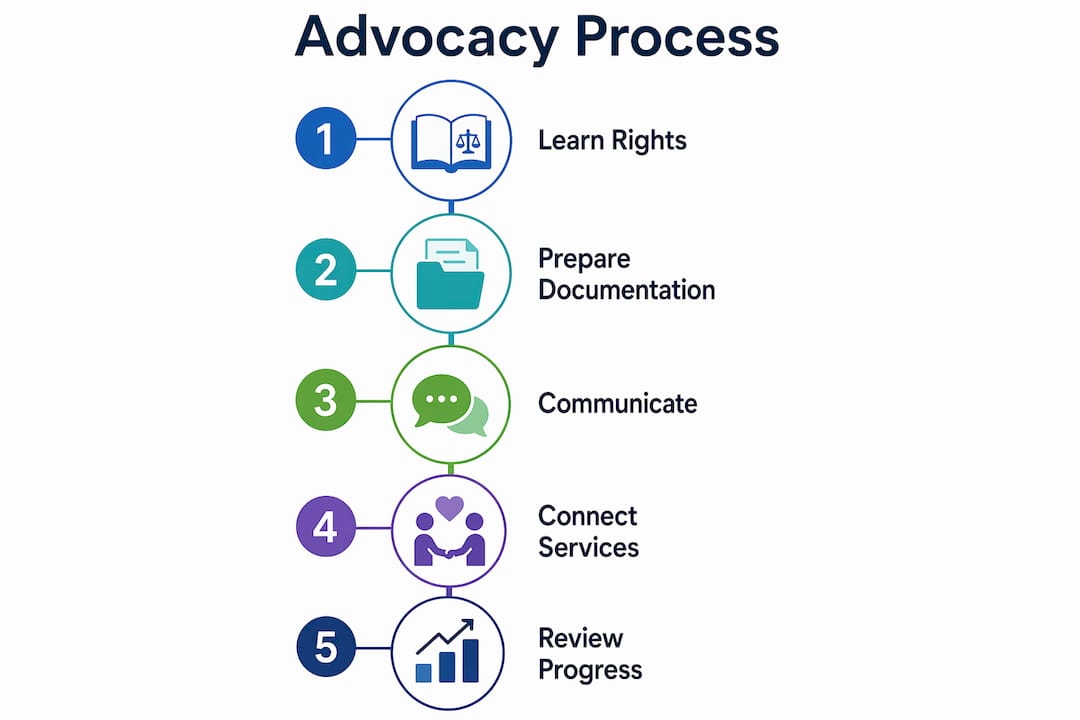
The scope of work also extends to connecting families with therapy and other support services. Advocacy does not exist in isolation. A child’s IEP goals should align with what their occupational therapist, speech therapist, or ABA provider is working on. When those systems communicate, outcomes improve.
How do parents advocate effectively for their child?
Parents are the most consistent advocates their child will ever have. Building a foundation of legal knowledge is the first step. Four terms form the baseline that every parent needs to know:
- IDEA (Individuals with Disabilities Education Act): The federal law guaranteeing eligible children a free appropriate public education.
- FAPE (Free Appropriate Public Education): The legal standard schools must meet. “Appropriate” does not mean the best possible education, but it must be genuinely suited to the child’s needs.
- LRE (Least Restrictive Environment): The requirement that children with disabilities be educated alongside non-disabled peers to the maximum extent appropriate.
- Section 504: A civil rights law covering students who do not qualify for special education but still need accommodations.
Lacking knowledge of these terms risks waiving rights or accepting inadequate service agreements. A parent who does not know what FAPE means cannot effectively challenge a plan that fails to meet it.
Preparation is the second pillar of effective advocacy. Parents should request draft IEPs and evaluations at least 5 business days before any scheduled meeting. Schools rarely send these documents proactively. Submitting a written request in advance gives parents time to review the plan, identify concerns, and prepare specific questions rather than reacting in the moment.
The third pillar is tone. Collaborative advocacy consistently produces better outcomes than confrontation. School teams respond to parents who come prepared, stay focused on the child’s data, and treat staff as partners rather than opponents. Effective parent advocates are consistent, specific, and focus on shared data-driven goals rather than being confrontational. That does not mean accepting inadequate services. It means the conversation stays productive even when the positions are far apart.
Pro Tip: Before any IEP meeting, write down your top three priorities in order. When the meeting runs long or gets tense, returning to that list keeps you focused on what matters most for your child.
Common challenges and misconceptions in special needs advocacy
Several misconceptions cause parents to either underperform or damage their relationships with school teams. Recognizing them early saves significant time and stress.
- Aggression is not strength. Parents who enter meetings in a combative posture often get less, not more. Schools become defensive, communication shuts down, and the child’s needs get buried under conflict. Firmness and preparation are far more effective tools.
- IEP documents are not final until you sign them. An IEP draft presented at a meeting is often a pressure tactic. Parents have the right to pause, take the document home, and refuse to sign until they fully understand and agree with its contents.
- Verbal denials are not legally sufficient. If a district denies services verbally without providing a Prior Written Notice, they are not meeting their legal obligations under IDEA. Parents should demand written documentation of any denial immediately.
- “No” is a starting point, not a final answer. Under IDEA, districts must provide Prior Written Notice detailing the rationale for any denial. That document is the basis for the next conversation, not the end of one.
- There is no national certification for advocates. No formal national licensing exists for special education advocates. This means the quality of advocates varies widely, and vetting based on local district experience is critical.
Measuring progress is another area where parents often focus on compliance rather than outcomes. A school can technically comply with an IEP while a child makes no meaningful progress. The question to ask is not “Is the school following the plan?” but “Is my child actually learning and growing?”
How do you find and choose the right advocate or support resource?
Choosing an advocate requires the same rigor as choosing any professional who works with your child. The table below outlines the key criteria and what to look for in each area.
| Criteria | What to look for |
|---|---|
| Local district experience | Has worked with your specific school district or region before |
| Legal knowledge | Understands IDEA, FAPE, LRE, and Section 504 in depth |
| Communication style | Explains complex terms clearly and keeps parents informed |
| Fee structure | Transparent pricing; rates typically range from $75 to $200 per hour in 2026 |
| References | Can provide families they have worked with as references |
Free or low-cost advocacy support is available through several channels. Parent Training and Information Centers (PTIs), funded under IDEA, exist in every state and provide free advocacy training and support to families. Disability Rights Advocates and Protection and Advocacy organizations also offer free legal and advocacy assistance in many states. These resources are particularly valuable for families who cannot afford private advocates.
When a situation has escalated to a formal due process complaint or litigation, an attorney becomes necessary. Advocates cannot represent families in legal proceedings. Knowing when to make that transition is itself an advocacy skill. For families of children with autism, resources like autism spectrum advocacy services can help identify the right level of support for the current situation.
Structured legislative advocacy programs increase parental civic engagement and knowledge of special education policies significantly within six months. That finding points to something important: advocacy is a skill that grows with practice and training, not a fixed ability parents either have or lack.
Key Takeaways
Special needs advocacy is a learnable, legal, and collaborative process that gives families the tools to secure the services their child is entitled to under federal law.
| Point | Details |
|---|---|
| Core definition | Advocacy helps families understand IDEA and Section 504 rights and secure appropriate services. |
| Legal terms matter | Knowing FAPE, LRE, IDEA, and Section 504 prevents parents from unknowingly waiving rights. |
| Preparation wins | Requesting draft IEPs 5 business days early and setting meeting priorities improves outcomes. |
| Collaboration beats confrontation | Data-driven, respectful advocacy produces better school relationships and service results. |
| Vet your advocate carefully | No national certification exists; local district experience and references are the best filters. |
What I have learned from watching families advocate well and poorly
Keith here. After years of working in the autism and special needs space, the pattern I see most clearly is this: the parents who get the best outcomes are almost never the loudest ones in the room. They are the most prepared.
The families who walk into IEP meetings with organized binders, specific data on their child’s progress, and a written list of priorities consistently outperform families who rely on emotion alone. That is not a criticism of emotion. Watching your child struggle is genuinely painful. But the school team responds to evidence, not frustration.
The other thing I have seen underestimated repeatedly is documentation. Parents who send follow-up emails after every meeting, keep copies of every evaluation, and track every verbal promise have a fundamentally different experience when disputes arise. The school knows the record exists. That changes behavior on both sides.
Advocacy is not a single meeting or a single IEP. It is an ongoing process that runs the entire length of your child’s education. The parents who treat it that way, building skills over time and staying consistent, are the ones whose children get the services they need. For practical steps to get started, the advocacy steps for autistic children guide on Autismdoctorsearch is a solid place to begin.
— Keith
Autismdoctorsearch connects families with the right providers
Finding a qualified advocate is only one part of the picture. Children with special needs often require therapy services that work alongside their IEP goals, including ABA therapy, occupational therapy, and mental health support. Autismdoctorsearch maintains an up-to-date directory of providers across all of these categories, making it easier to find qualified professionals in your area without searching across multiple platforms. Families can browse autism therapy services listed on the site, or connect with specialized support through the Center for Children with Special Needs. The directory also includes nonprofit organizations and special education schools that complement advocacy efforts directly.
FAQ
What is the difference between a special needs advocate and an attorney?
An advocate helps families prepare for IEP meetings, review documents, and communicate with school teams. An attorney represents families in formal legal proceedings like due process hearings.
Is special education advocacy free?
Private advocates charge $75 to $200 per hour in 2026, but free support is available through state Parent Training and Information Centers and Protection and Advocacy organizations funded under federal law.
Can a parent advocate for their child without hiring anyone?
Yes. Parents who learn the basics of IDEA, FAPE, LRE, and Section 504, prepare thoroughly before meetings, and document all interactions can advocate effectively on their own.
What should I do if the school denies a service my child needs?
Request a Prior Written Notice in writing immediately. Under IDEA, the district must document the denial and its rationale. That document is the foundation for any next steps, including bringing in an advocate or attorney.
How do I know if an advocate is qualified?
No national certification exists for special education advocates. Evaluate candidates based on their experience with your local school district, their knowledge of current special education law, and references from families they have worked with.


