


TL;DR:
- Understanding the differences between case managers and care coordinators is crucial for accessing appropriate support for autistic children.
- Case managers provide comprehensive advocacy, assessment, and individualized planning, while care coordinators focus primarily on communication and scheduling.
When your child receives an autism diagnosis, the system of services, therapies, and support programs can feel like a maze with no clear map. Many families hear the terms “case manager” and “care coordinator” used almost interchangeably, but these roles are genuinely different, and mixing them up can mean missing out on critical support. Understanding exactly who does what, and when to ask for each type of help, can change the entire trajectory of your child’s care. This article breaks down those distinctions clearly and gives you practical tools to act on what you learn.
Table of Contents
- Case managers versus care coordinators: What’s the difference?
- What case managers do for families with autistic children
- How case management models work: Program examples
- When does your family need a case manager most?
- Limitations and what families should know
- Our perspective: Why clear role definitions matter more than titles
- Find the right autism support and case management for your family
- Frequently asked questions
Key Takeaways
| Point | Details |
|---|---|
| Know the difference | Understanding the distinction between case managers and care coordinators helps families choose the right support. |
| Look for clear roles | Choose programs that explain who does what, rather than relying on job titles alone. |
| Integrated care is effective | Family-centered, coordinated programs offer better communication and flexibility for autism support. |
| Expect varied outcomes | Not every program guarantees quick results, so set realistic expectations and monitor progress. |
| Ask informed questions | Prepare specific questions about service plans, responsibilities, and support when evaluating case management options. |
Case managers versus care coordinators: What’s the difference?
To clarify where confusion starts, let’s first break down these key terms.
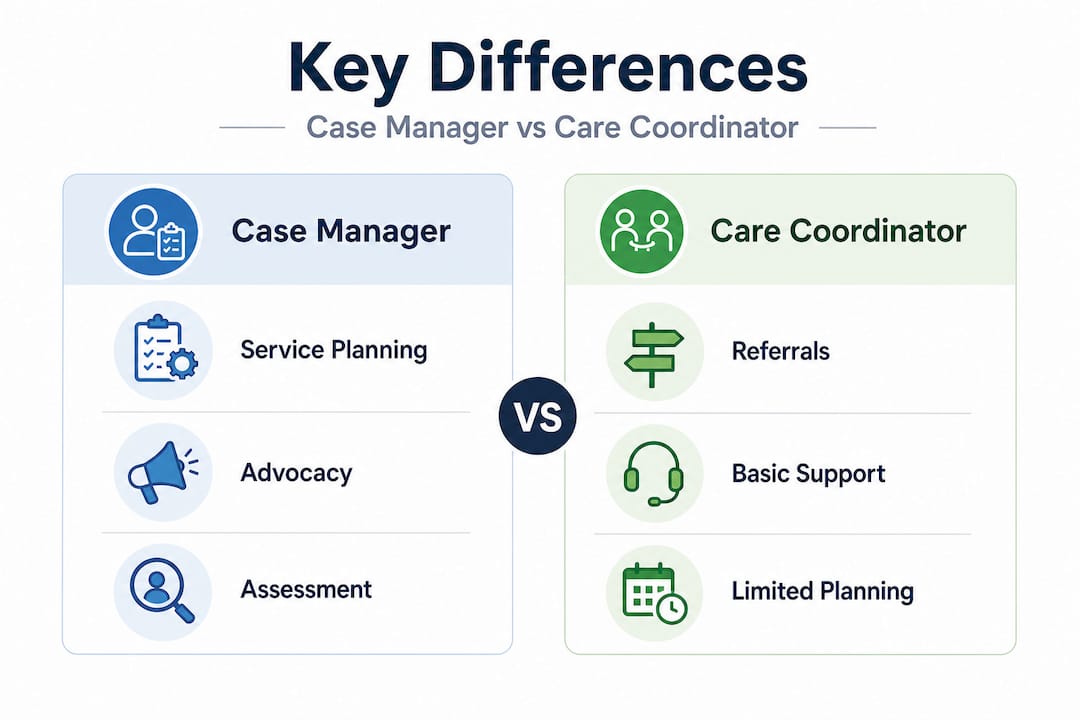
A case manager is a professional with a broad scope of responsibility. That scope typically includes assessing a child’s needs, creating a service plan, facilitating access to services, monitoring progress, and advocating on behalf of the child and family. A care coordinator, on the other hand, tends to focus more narrowly on communication between providers, scheduling, and helping families navigate existing services. Think of it this way: a care coordinator makes sure the pieces talk to each other, while a case manager decides which pieces belong in the puzzle in the first place.
As a scoping review found, case management and care coordination roles overlap but are often distinguished by the level of clinical involvement and decision-making authority. Care coordination is generally viewed as a component within the larger umbrella of case management, not a separate or equal service.
“The terms ‘care coordination’ and ‘case management’ are often used interchangeably, which can blur expectations for families.” This is a real problem. When a family is told their child has a “care coordinator” but they expect the full advocacy and planning power of a case manager, they may go months without proper support because the mismatch was never made clear.
Here is a quick comparison to help you sort out the roles at a glance:
| Feature | Case manager | Care coordinator |
|---|---|---|
| Service planning | Yes, creates full plans | Limited or advisory |
| Advocacy | Strong, includes insurance and school disputes | Typically informational |
| Clinical involvement | Often has clinical training | May be non-clinical |
| Provider communication | Part of broader role | Primary focus |
| Crisis planning | Included in many programs | Rarely a core duty |
| Scope | Broad, multi-system | Narrower, communication-focused |
Families find these roles confusing for understandable reasons. Both professionals attend meetings, speak with providers, and help with paperwork. But the authority and depth of intervention are fundamentally different. Knowing this distinction protects you from accepting less support than your child actually needs.
Key differences at a glance:
- Case managers often hold professional licenses (social work, nursing, etc.)
- Care coordinators may work under a case manager’s supervision
- Care coordination is a task; case management is a full professional role
- The intensity of support should match the complexity of your child’s needs
What case managers do for families with autistic children
Now that you know the distinctions, let’s focus on how case managers create direct value for families.
Case management is described as a broader professional role that can include assessment, planning, facilitation, and advocacy. In everyday terms, that means your case manager is the person who fights for your child when the school district claims it cannot provide a specific service, when insurance denies an ABA therapy claim, or when you are stuck on a six-month waitlist for an occupational therapist.
Here is a real-world scenario many families recognize: imagine your child is transitioning from a self-contained special education classroom to a more inclusive setting. The school has one idea, the therapist has another, and you have your own concerns about how your child will handle the social dynamics. A case manager steps into that gap. They attend the IEP (Individualized Education Program) meeting, review the proposed accommodations, and push back if the plan does not reflect your child’s current needs. They know what services your child is entitled to and how to request them in writing.
How a case manager typically supports your family:
- Conducts a thorough assessment of your child’s strengths, challenges, and service gaps
- Creates or updates an individualized service plan based on your child’s goals
- Coordinates communication between schools, therapists, medical providers, and insurers
- Files appeals or written requests when services are denied or delayed
- Monitors your child’s progress and adjusts the plan as needs change
- Prepares your family for transitions such as moving from pediatric to adult services
Pro Tip: If you are unsure whether you need a case manager or a care coordinator, ask yourself this: “Do I need someone to just keep everyone informed, or do I need someone who can make decisions, file appeals, and advocate directly for my child?” If the answer involves decisions or advocacy, you need a case manager. If it’s more about scheduling and communication, a care coordinator may be sufficient for now.
Understanding communication strategies for autism is also important when working alongside your case manager, since many of the plans they create depend on aligned communication approaches across all providers.
How case management models work: Program examples
To make this more concrete, let’s explore what strong case management really looks like in leading autism programs.
Not all case management programs are built the same way. Some operate as simple referral networks, pointing families toward resources without much ongoing involvement. Others are deeply integrated systems where the case manager is genuinely embedded in the family’s day-to-day care planning. The latter is where families tend to see the most benefit.

Pennsylvania’s Adult Community Autism Program (ACAP) is often cited as a benchmark. Some autism service programs operationalize care management and case coordination as a continuous, one-stop integrated system, and ACAP is a strong example of this model in action. It uses individualized service plans, behavior planning, and crisis support as core features, rather than optional add-ons.
Here is what a strong, integrated case management program typically includes:
| Program feature | Why it matters for your family |
|---|---|
| Individualized service plan | Tailored to your child’s specific needs, not a template |
| Behavior and crisis planning | Prepares the team for difficult moments before they happen |
| Single point of contact | Reduces the communication burden on parents |
| Regular plan reviews | Ensures support keeps pace with your child’s growth |
| Cross-agency coordination | Schools, health providers, and therapy work together |
| Family input built into the process | Your perspective shapes the decisions |
When you are evaluating a case management program, look for concrete answers to these questions:
- Does the program assign one consistent case manager, or does it rotate staff?
- How often does the team review and update the service plan?
- Is behavior or crisis planning included, or does that require a separate referral?
- How does the program coordinate with your child’s school and medical providers?
Pro Tip: Before enrolling in any case management program, ask for a written copy of their service model. If they cannot hand you a document that explains who does what and when, that is a signal the program may not have the structure your family needs.
Strong programs treat coordinating autism therapies as a core responsibility, not a side task. And if you are searching for structured autism support programs in your area, integrated case management is one of the most important features to prioritize.
When does your family need a case manager most?
But does every family need a case manager, or just some? Here’s how to decide.
The honest answer is that not every family needs intensive case management all the time. Care-management roles may shift in scope and intensity depending on what the family needs most at any given point. But there are specific situations where having a case manager is not just helpful, it is essential.
High-impact scenarios where a case manager makes the biggest difference:
- Insurance denials: If your child’s ABA therapy or other services have been denied or reduced, a case manager can guide the appeals process and document medical necessity.
- School transitions: Moving from early intervention to kindergarten, or from middle school to high school, involves shifting regulations and provider changes that a case manager can help navigate.
- Service gaps: When a key provider leaves, a waitlist extends unexpectedly, or a therapy ends, a case manager can identify alternatives quickly.
- Crisis planning: If your child has had a behavioral crisis, a case manager can help build a proactive plan so the entire team is prepared going forward.
- Multiple overlapping needs: When your child requires medical, therapeutic, educational, and behavioral support simultaneously, a case manager holds all of those threads together.
If you hit a bottleneck, do not wait. Contact your child’s pediatrician or autism specialist and ask directly for a referral to case management services. You can also reach out to local autism advocacy resources to find organizations that can connect you with a case manager in your area.
Pro Tip: If your family is managing more than three overlapping service needs at once, such as ABA therapy, special education planning, speech therapy, and medical care, integrated case management is almost certainly the right choice. The coordination load alone justifies it.
Limitations and what families should know
Before you take your next steps, it’s important to understand the limits and realistic expectations around case management for autism.
Case management is a powerful tool, but it is not a guarantee. The field is still building its evidence base. As a scoping review found, the results include program descriptions and conceptual distinctions, but not robust autism-specific empirical benchmarks for outcomes. In plain terms: we know what good case management looks like, but measuring whether it definitively produces better outcomes for every child is still an evolving area of research.
What this means for your family:
- A well-structured program is a strong indicator, but not a guarantee of results
- Program quality varies widely, so asking detailed questions protects you
- Your active involvement in the process strengthens outcomes significantly
- If results are not meeting your expectations, you have the right to request a program review or switch providers
Key takeaway: No current data proves that case management alone produces universal improvements across all autism outcomes. It works best as one part of a broader, well-coordinated support system. If a program promises outcomes it cannot back up, ask for their data.
What to do if the program is not working:
- Request a formal review of your child’s service plan
- Document specific gaps or unmet goals in writing
- Ask whether a different case manager within the same program is available
- Consult with an independent autism advocate to evaluate your options
Our perspective: Why clear role definitions matter more than titles
Beyond the facts and program snapshots, here’s a critical truth we’ve learned supporting families.
Most families spend too much energy arguing over whether they need a “case manager” or a “care coordinator” and not enough energy asking what responsibilities each professional will actually carry out. The title matters far less than the answer to this question: “Who is accountable for what, and how will I know?”
We have seen families enroll in programs with impressive names and vague structures, wait months for progress, and then realize no one had clear ownership of the key decisions. And we have also seen families thrive in programs with modest titles but crystal-clear responsibility charts. The lesson is obvious, but it gets overlooked constantly.
Families may face confusion if programs do not explicitly define responsibilities and decision rights. That confusion has real costs. Delayed services, missed IEP deadlines, and denied insurance claims are all downstream consequences of unclear role definitions at the program level.
Our strong advice: before your family enrolls in any case management or care coordination program, ask for a written responsibility chart. It should list every professional involved, what they are responsible for, who makes which decisions, and how they communicate with you. If that document does not exist, either ask them to create it or find a program that already has one.
This is not being difficult. This is being an informed advocate for your child. Programs with strong structures welcome that question. Those with weak ones will struggle to answer it. That reaction alone tells you a great deal. You can also connect with autism spectrum advocacy organizations who can help you evaluate programs and advocate for clearer responsibility frameworks.
Find the right autism support and case management for your family
Ready to find tailored support for your child or teen? Here’s where to start.
At Autism Doctor Search Directory, we connect families with the specialized resources they need, from ABA therapy and occupational therapists to case management programs and special education schools. You can find autism therapy services in your area or explore options through special needs planning organizations that understand the full picture of your child’s needs. Whether you are just starting out or looking to fill a gap in your current support plan, our directory makes it easy to search autism case managers and other critical providers near you. Finding the right fit starts with knowing what to look for, and now you do.
Frequently asked questions
What are the main responsibilities of an autism case manager?
An autism case manager typically handles assessment, planning, facilitation of services, advocacy, and ongoing care coordination for families navigating complex support systems.
How do I know if my child needs a case manager or a care coordinator?
You likely need a case manager if your child has multiple complex needs or requires formal advocacy; roles may shift in intensity based on what your family needs most at each stage.
Do case management programs guarantee better results for autistic children?
Research shows promising models exist but lacks definitive data proving universal better outcomes for all families, so program quality and active family involvement both matter.
Is care coordination included in all autism case management programs?
Care coordination is a component of case management in many programs, but scopes vary, so always ask your provider for explicit definitions of what is included.
What questions should I ask when choosing a case management program?
Ask about the individualized service plan process, how responsibilities are defined in writing, whether crisis planning is included, and how the program manages communication across all of your child’s providers.


