TL;DR:
- Effective tracking of autism therapy progress creates a clear record of meaningful changes over time, helping families and professionals make informed decisions. Utilizing standardized tools like the ATEC, alongside observations from home and school, provides a comprehensive view of development across different environments. Consistent measurement and interpretation of data foster personalized treatment adjustments, encouraging progress and reducing caregiver anxiety.
Watching your child go through therapy week after week, you naturally wonder: is any of this actually working? That question is one of the most stressful parts of navigating autism treatment, and it is completely valid. Without a clear system for measuring change, it is easy to feel like you are guessing. The good news is that practical, proven tools exist to help you track your child’s progress with confidence. This guide walks you through exactly what to do, what to measure, and how to make sense of what you find.
Table of Contents
- Why tracking progress matters in autism therapy
- What you need before you start: Tools and preparation
- Step-by-step: How to track autism treatment progress effectively
- Interpreting results: What counts as real progress?
- A realistic perspective: Why progress is personal, not just numbers
- Find support and expert services for your autism journey
- Frequently asked questions
Key Takeaways
| Point | Details |
|---|---|
| Track multiple domains | Measure social, communication, and daily living skills for a complete view of progress. |
| Use proven checklists | Parent-friendly tools like ATEC help you spot trends and document real change. |
| Teamwork amplifies results | Input from therapists, teachers, and caregivers makes progress tracking more accurate. |
| Progress isn’t always linear | Expect fluctuations—and focus on long-term growth, not just week-to-week shifts. |
Why tracking progress matters in autism therapy
With the challenge clearly stated, let us see why a good tracking system truly matters for your child’s outcomes.
Progress in autism therapy is rarely a straight line. One week your child might nail a new skill; the next week that same skill seems to vanish. These ups and downs can make it nearly impossible to judge whether a therapy is genuinely helping based on memory and feeling alone. Relying on gut instinct tends to overweight the last few days and miss the broader pattern playing out over months.
Systematic tracking solves that problem by creating a visible record of change over time. When you write things down consistently, small improvements become impossible to ignore. A child who used to have four meltdowns a day now has two. Eye contact during mealtimes has gone from zero to three or four seconds. These are real wins that a feeling-based approach would overlook. Seeing those numbers move also gives families and therapists the evidence needed to make smart decisions about which methods to keep and which to adjust.
Here is why objective tracking is so valuable:
- It shows whether therapy goals are being met on schedule
- It helps therapists fine-tune approaches based on real data, not assumptions
- It gives you something concrete to bring to school meetings or medical appointments
- It reduces caregiver anxiety by replacing uncertainty with information
- It creates accountability across your full support team
As noted in CDC guidance, diagnosis and tracking depend on parent and caregiver observations as well as professional feedback. That means your input is not optional. It is essential data.
“The most powerful advocate in any child’s therapy room is a parent who walks in with organized observations and specific examples. Numbers and patterns speak louder than impressions.”
Connecting with the right autism therapy services is an important first step, but knowing how to monitor results after therapy begins is what keeps treatment on track.
What you need before you start: Tools and preparation
Now that you know why tracking is important, let us cover what you will need to track progress effectively.
Before you record a single data point, gather the right tools. Starting without a baseline, which is a snapshot of where your child is before or at the start of treatment, is like trying to measure how far you have traveled without knowing where you began. Baselines give every future data point meaning.

The ATEC (Autism Treatment Evaluation Checklist) is one of the most widely used parent-completed tools for monitoring change over time. It is free, straightforward, and covers four key areas: speech and language, sociability, sensory and cognitive awareness, and health and behavior. Parents score each section, and a lower total score over time signals improvement. It typically takes about 15 to 20 minutes to complete, making it realistic for busy families.
Beyond the ATEC, here is a summary of the most practical tracking tools available:
| Tool | What it measures | Who completes it |
|---|---|---|
| ATEC | Language, sociability, behavior, health | Parent or caregiver |
| Vineland Adaptive Behavior Scales | Daily living, communication, socialization | Clinician or therapist |
| Behavior Frequency Log | Specific target behaviors (e.g., tantrums, eye contact) | Parent or teacher |
| Therapist Progress Notes | Skill acquisition, session goals | Therapist |
| School IEP Goal Tracker | Academic and social milestones | Special education teacher |
| Sensory Profile | Sensory processing patterns | Parent with clinician input |
Gathering input from across your child’s world matters. A behavior that shows up at home but not at school, or vice versa, tells you something important about context. Ask your child’s teachers, behavioral therapists, occupational therapists, and doctors to contribute observations on a regular schedule.
It is also worth exploring child development assessments to get a formal baseline before tracking begins, and working with autism therapeutics providers who can guide you on which measures fit your child’s specific profile.
Pro Tip: Set a recurring reminder on your phone every Sunday evening to spend 10 minutes updating your tracking log. Consistency matters far more than perfection. A quick weekly update beats a once-a-month deep dive every time.
Step-by-step: How to track autism treatment progress effectively
Once your tools and team are ready, here is exactly how to carry out progress tracking.
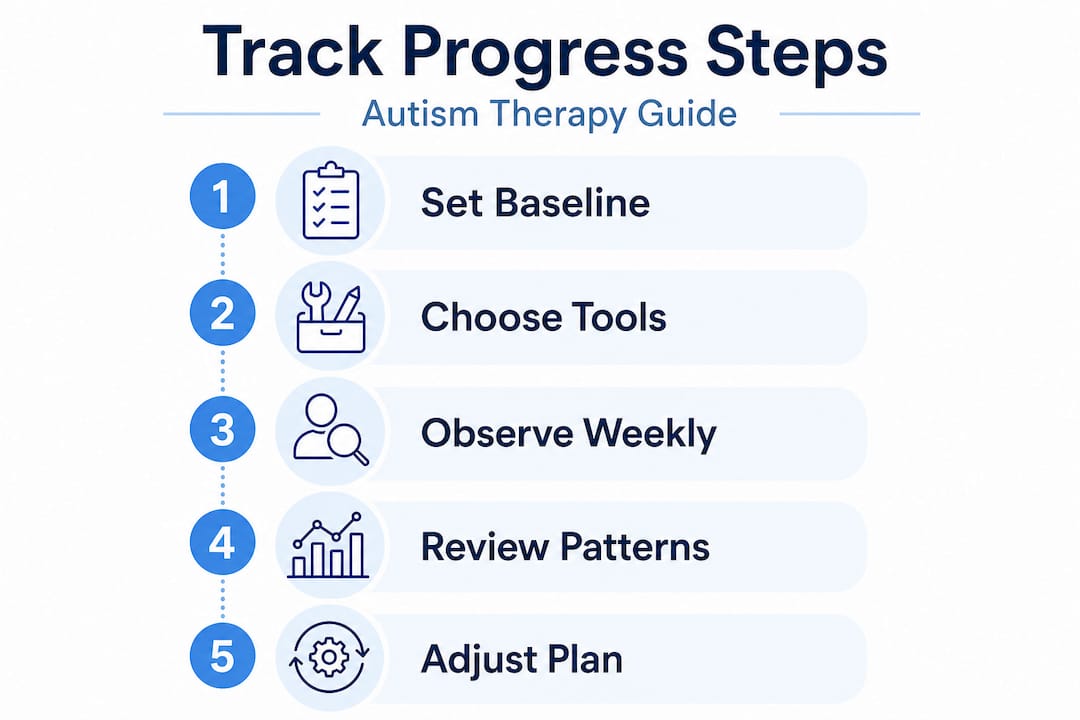
Many parents feel overwhelmed by the idea of tracking, picturing clipboards and spreadsheets and hours of extra work. The reality is much simpler. A clear, repeatable workflow makes this manageable and even informative. Tracking across multiple domains, not just a single rating, is considered best practice in autism care.
Follow these six steps to build a tracking system that actually works:
-
Establish a baseline. Complete the ATEC or your chosen checklist before or at the very start of a new therapy phase. Record the date. This is your reference point for everything that follows.
-
Define 2 to 4 target behaviors or skills. Choose specific, observable things like “uses a three-word sentence to request,” “makes eye contact during greetings,” or “completes morning hygiene routine with one verbal prompt.” Vague goals like “communicates better” are impossible to measure.
-
Choose a frequency for observation. Daily logs work well for behaviors that happen multiple times a day, such as tantrums or verbal requests. Weekly summaries work better for broader skills like social interaction or self-care routines.
-
Record in real time or right after. Memory fades fast. Keep a simple notebook or use a free app to log observations immediately. Note what happened, how many times, and any context that seemed relevant.
-
Complete a full checklist monthly. Use the ATEC or another standardized tool at least once a month to get a broader snapshot. Compare scores from one month to the next to spot trends.
-
Hold a team review every 6 to 8 weeks. Bring your tracking data to a meeting with your child’s therapists and teachers. Review patterns together and adjust therapy goals if needed.
As the ATEC’s developers emphasize, the goal is to track functional gains and target behaviors using structured methods rather than relying on impressions alone.
Here is a quick comparison of the three main observation methods and what each brings to your tracking picture:
| Method | Strengths | Limitations |
|---|---|---|
| Weekly parent observation log | Captures home behavior, routine changes | Subjective, may miss clinical nuances |
| Therapist session ratings | Clinically structured, consistent | Limited to therapy setting only |
| Standardized checklists (e.g., ATEC) | Comparable over time, broad domains | Completed less frequently, broad brush |
Using all three together gives you the fullest picture. For more on working with the right professionals, the guide to finding autism behavioral therapists covers what to look for in a provider. And if your child sees multiple specialists, learning about coordinating autism therapies will help you avoid gaps in communication.
Pro Tip: Create a shared digital folder (Google Drive works well) with your child’s therapist and teacher. Upload monthly ATEC scores and your observation notes. When everyone sees the same data, conversations at team meetings become faster and more productive.
Interpreting results: What counts as real progress?
With regular data in hand, here is how to make sense of the patterns you see.
Once you have been tracking for a few months, you will start to notice patterns. Some will be encouraging. Some will be confusing. Knowing how to interpret what you see is just as important as collecting the data in the first place.
Real progress takes many forms. A five-point drop in your child’s total ATEC score over three months is measurable progress. But so is a new ability to wait calmly in a checkout line, or the first time your child spontaneously told a family member “I love you.” Both types of change matter, and neither one tells the complete story by itself.
Here is what to watch for when reviewing your tracking data:
- Consistent gains in a target skill over four or more weeks signal that a therapy approach is working
- No change for six or more weeks in a focus area may mean the current method needs adjustment
- A regression after illness, a school break, or a schedule change is common and does not erase prior gains
- Progress in one domain before others is typical. Many children show improvements in communication or behavior before gains appear in social skills
As CDC research confirms, ASD symptoms and skills develop nonlinearly, so progress may not be obvious week to week. Parents who understand this are far less likely to abandon an effective therapy too early, or to stick with an ineffective one too long.
Stat to know: Children in early intensive behavioral intervention programs often show the first measurable gains within 3 to 6 months, though the timeline varies widely based on individual needs and starting skills.
Watch for these warning signs that suggest it may be time to reassess the therapy plan: your child shows distress during or after sessions consistently, scores on standardized checklists have not shifted at all after three to four months, or your care team cannot explain what they are measuring or why.
When you have questions about whether your child’s therapy plan is on the right track, a helpful starting point is knowing what to ask your autism doctor at your next appointment.
A realistic perspective: Why progress is personal, not just numbers
Looking deeper, let us discuss why tracking is only one part of the bigger progress picture for your family.
We want to be honest about something that gets lost in conversations about checklists and score sheets. Numbers are useful. They are not the whole truth. We have spoken with many families who felt like failures because their child’s ATEC score barely moved, even while that same child was learning to hug a sibling for the first time, or sleeping through the night after years of disrupted rest. No form captures that.
Progress in autism therapy is deeply personal. It looks different for a four-year-old who is just beginning to point at objects than it does for a twelve-year-old learning to manage sensory overload in a busy school hallway. The goal posts shift as your child grows, and the things that matter most to your family may not appear on any standardized checklist. That is not a flaw in the system. It is a reminder that you are raising a person, not managing a score.
Think of autism communication strategies as a great example. A child who learns one new way to express frustration without a meltdown has made enormous progress, even if that change does not dramatically move a total score. The practical effect on daily family life is significant.
Our perspective, based on working alongside thousands of families navigating autism care, is this: use the numbers as a compass, not a verdict. When scores go up, celebrate. When they hold steady, keep looking for the smaller movements underneath. And when a therapy is not working by any measure, trust your data and your instincts equally. The best decisions in autism care come from combining both.
Find support and expert services for your autism journey
With progress tracking at the core, here is how you can connect with supportive experts to help along the journey.
Tracking progress on your own is powerful, but it works best when paired with a professional team that documents, measures, and communicates outcomes consistently. The right providers do not just deliver therapy. They bring data to every conversation, set measurable goals at the start of each phase, and adjust their approach based on what the numbers and your observations reveal together.
At Autism Doctor Search, you can explore autism therapy services from ABA providers to occupational therapists to special education specialists, all in one place. Families looking specifically for structured behavioral programs will find a curated list of ABA therapy options to compare. For broader medical and therapeutic support, our directory of autism therapeutics providers connects you with clinics and specialists experienced in measuring and reporting treatment outcomes. Finding the right team is one of the most important steps you can take.
Frequently asked questions
How often should I review my child’s autism therapy progress?
Review progress at least every few weeks, or more often when a new therapy starts or new concerns come up. As regular assessments confirm, screenings and assessments should occur at consistent intervals to capture meaningful change.
What if my child’s progress seems to plateau or go backwards?
Plateaus and temporary regressions are a normal part of autism therapy. ASD skills develop nonlinearly, so review your tracking method and bring your data to your care team to decide if adjustments are needed.
Which checklist is best for home tracking?
The ATEC is a parent-completed measure that is free, easy to use, and designed specifically for tracking treatment changes over time, making it the most practical choice for ongoing home monitoring.
Should I rely only on checklists to judge therapy?
No. Combined outcome measurement using checklists alongside professional feedback and your own daily observations gives a far more accurate and useful picture of how therapy is working.
How do I explain tracking results to other family members or teachers?
Share brief written summaries from your observation logs and checklist scores, focusing on specific behaviors that have changed over time. Concrete examples, like “she used to have five tantrums a day; now it is one or two,” communicate progress far better than general statements.