


Start by calling the member services number on your Medicaid or insurance card. That call connects you to your assigned non-emergency medical transportation (NEMT) broker, and everything else flows from there.
Here is what to do in the next 24–72 hours:
- Call member services, ask for your NEMT broker’s name and direct number, and schedule the ride with at least 48–72 hours’ notice. Booking timelines commonly run 48–72 hours for standard trips; rural or specialized vehicle requests often need a week or more.
- Tell the scheduler your child has autism. Say exactly: “This passenger has autism and needs a quiet ride, an escort, and minimal transfers.” Ask that those notes go into the trip record.
- Request a trip confirmation number before you hang up. Record the rep’s name and the time of the call.
- Gather your documents: insurance/Medicaid ID, appointment confirmation from the provider, and a physician’s medical necessity note if your state requires one.
- If Medicaid or NEMT won’t cover the trip, call the Disability Information and Access Line (DIAL) at 1-888-677-1199 or check Autismdoctorsearch for local transport-friendly providers.
Table of Contents
- How does Medicaid NEMT eligibility work for autism transportation?
- Step-by-step: how to book an autism-friendly ride
- What are your options when NEMT or paratransit can’t cover the trip?
- How do you prepare a child with autism for a medical ride?
- What documents do you need, and what should you ask when booking?
- What do you do when something goes wrong?
- Key Takeaways
- Why documentation and local helpers make the biggest difference
- Autismdoctorsearch helps you find the right local providers
- Useful sources and phone numbers to call now
How does Medicaid NEMT eligibility work for autism transportation?
Federal law requires every state Medicaid program to assure necessary NEMT for beneficiaries under Section 1902(a)(4) of the Social Security Act and 42 C.F.R. § 431.53. CMS reinforced this in State Medicaid Director Letter SMD 23-006, which also clarified that behavioral health and autism-specific safety needs can qualify as medical necessity, not just physical mobility limitations.
States have wide flexibility in how they deliver NEMT. Most use a broker or managed care organization (MCO) to coordinate rides, which means your broker’s phone number and procedures depend entirely on your state. Some states run a single statewide broker; others contract regionally. The only way to know who yours is: call member services on your Medicaid card.
Scheduling timelines matter. Standard trips commonly require 48–72 hours’ advance notice. Rural areas or requests for specialized vehicles, such as wheelchair vans or vehicles with trained behavioral-support drivers, often need a full week.
States must also consider behavioral and mental health needs when assigning transport modes. That means autism-specific sensory challenges, safety concerns, and the need for an escort are legitimate grounds for requesting a specialized vehicle or service level. Document them as medical necessity in writing.
| Scenario | Typical notice required | Who to contact |
|---|---|---|
| Standard NEMT ride (urban/suburban) | 48–72 hours | NEMT broker via member services |
| Rural or specialized vehicle request | 5 business days | NEMT broker; confirm with MCO caseworker |
| Wheelchair van or behavioral support driver | 5 business days | Broker + physician note may be required |
| Ride denied or broker unavailable | Immediately | Member services → state Medicaid contact |
Step-by-step: how to book an autism-friendly ride
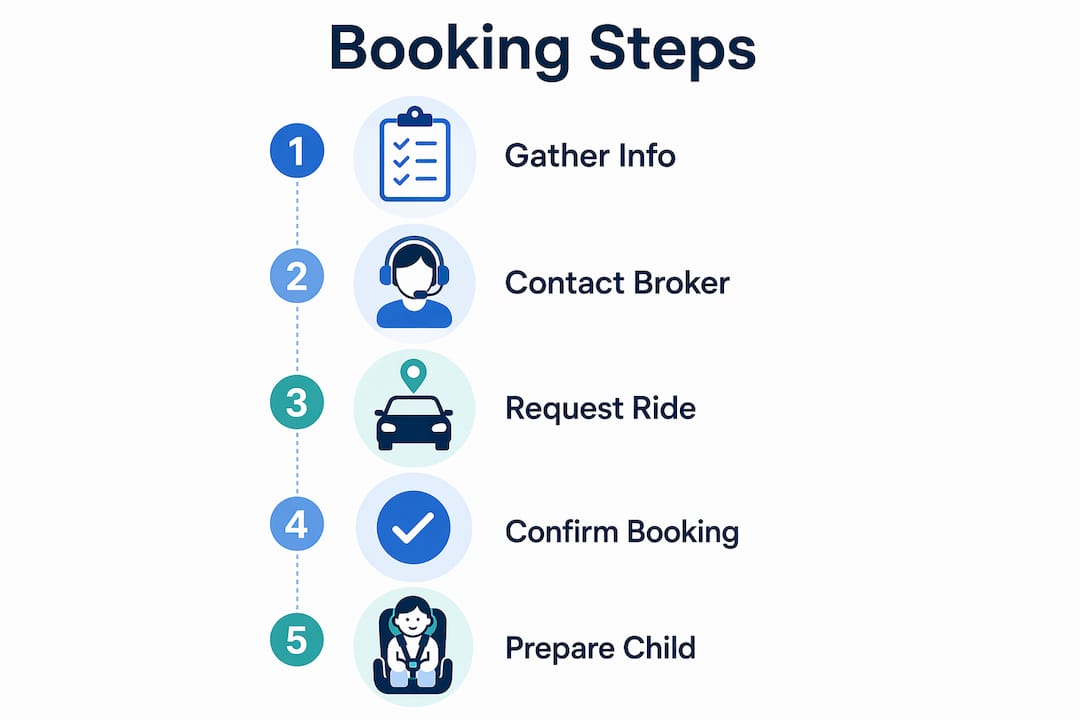
Before you call, pull together: your Medicaid/insurance ID number, the appointment date, time, and full address, and any existing behavioral or mobility support plans.
Step 1. Call member services and ask: “Who is my assigned NEMT broker, and what is their direct number?” Write it down.
Step 2. Call the broker. Use this script:
“I need to schedule a medical transport for [date] at [time]. The passenger has autism and requires a quiet ride, no radio, an escort, and minimal transfers. Please note this in the trip record. Can you confirm the vehicle type and give me a trip confirmation number?”
Step 3. Specify the service level you need: curb-to-curb, door-to-door, or a wheelchair van. Request the same driver for recurring appointments if possible.
Step 4. Ask and record answers to these questions:
- What is the estimated pickup window?
- Are drivers trained for behavioral or sensory needs?
- Is an escort covered, and can the caregiver ride at no cost?
- What is the cancellation policy, and what happens if the driver is late?
Step 5. Confirm the trip. Always get a confirmation number and the rep’s name before ending the call.
Booking checklist to keep by the phone:
- Appointment time and full address
- Pickup address
- Member/Medicaid ID number
- Trip confirmation number
- Escort coverage confirmed (yes/no)
- Behavioral/sensory notes entered in trip record (yes/no)
- Broker’s direct phone number and hours
Pro Tip: If the broker offers an online portal or app, log the trip there and screenshot the confirmation page. A screenshot takes ten seconds and has resolved more than a few no-show disputes.
What are your options when NEMT or paratransit can’t cover the trip?
NEMT covers a lot, but not everything. ADA complementary paratransit only covers areas within 3/4 of a mile of fixed bus or rail routes, which leaves many rural and suburban families without a public option.
“Local experts, such as mobility managers and information and referral specialists, can help you learn about the transportation options in the communities they serve. Contact the local public transit agency or local organizations, such as the Area Agency on Aging, Center for Independent Living, Aging and Disability Resource Center, or Indian Tribal Organization.” — NADTC Transportation Options for Community Service Providers
Mobility managers are the most underused resource in this space. They sit inside local transit agencies and nonprofits, and they know about volunteer driver programs, faith-based transport networks, and community microtransit options that never appear on a broker’s list. Contact your local transit agency or Area Agency on Aging to find one.
Other pathways worth pursuing:
- ACL and DIAL (1-888-677-1199): The Administration for Community Living maintains a national transportation resource hub and connects callers to local Centers for Independent Living. There are over 370 CILs across the U.S. and territories.
- School or therapy transport: If your child has an IEP, transportation may already be a related service. Ask the school district’s special education coordinator.
- Volunteer and faith-based programs: Many require advance scheduling and restrict rides to medical appointments, but they are often free. Your state’s 211 line can identify local programs.
- Autismdoctorsearch listings: Search by city or region to find autism-aware providers whose locations may reduce your travel distance or who can coordinate appointment times around transit availability.
How do you prepare a child with autism for a medical ride?
Set expectations before the day of the trip. A short visual schedule showing pickup, the ride, and drop-off gives your child a predictable sequence to hold onto. Social stories work well for this, especially for children who respond to picture-based routines. You can find guidance on building those in this autism-friendly environment guide.
Sensory supports to pack:
- Noise-canceling headphones or earbuds
- A favorite quiet toy or fidget
- Weighted lap pad if the child uses one
- Sunglasses for light sensitivity
- A preferred snack (confirm with the provider that food is allowed in the vehicle)
On the safety and behavior side, tell the scheduler whether an escort will travel with the child. Confirm curb-to-curb versus door-to-door service, and ask whether the driver has any training in behavioral supports. Put the key notes in the trip record and repeat them verbally when the driver arrives.
- Do request a quiet ride and no radio, in writing and on the call.
- Do confirm the pickup window the day before.
- Don’t assume the driver has read the trip notes. Hand them a one-page summary at the door.
- Don’t skip the practice run if this is a new routine.
Pro Tip: Run a short “practice pickup” at home with a timer and a simple script the day before. Walk through the sequence: wait at the door, get in, ride quietly, arrive. Children who have rehearsed the handoff are noticeably calmer when the real vehicle shows up.
What documents do you need, and what should you ask when booking?

Having the right paperwork ready before you call cuts the back-and-forth significantly. Many states require a Physician Certification Statement (PCS) or prior authorization for certain vehicle types or trip frequencies. State NEMT profiles vary considerably, so check your state’s broker requirements early.
| Document | Who provides it |
|---|---|
| Insurance/Medicaid ID card | Caregiver |
| Appointment confirmation | Healthcare provider |
| Physician medical necessity note | Treating physician |
| Behavioral or mobility support plan | Caregiver or therapy provider |
| Physician Certification Statement (PCS) | Physician (if required by state) |
| Mileage log or reimbursement form | Caregiver (if self-arranging per state rules) |
When you call the broker, ask these exact questions and write down the answers:
- “Is an escort covered, and can the caregiver ride at no additional cost?”
- “What is the pickup window, and how will I be notified of the driver’s arrival?”
- “Will the driver’s trip notes include my child’s behavioral and sensory needs?”
- “Is curb-to-curb or door-to-door service provided for this trip type?”
If a PCS or prior authorization is required, ask the broker for the form and a contact at your provider’s office who can complete it quickly. Good autism documentation management makes this step much faster on repeat appointments.
What do you do when something goes wrong?
Missed rides and late pickups happen. What you do in the first hour determines how fast it gets resolved.
Numbered action plan for the first hour after an incident:
- Call the broker immediately. State your trip confirmation number, the scheduled pickup time, and the current time.
- Ask for the name of the person you are speaking with and write it down with the timestamp.
- Request that the broker dispatch a replacement vehicle or authorize alternate transport.
- If the broker cannot resolve it, call member services on your insurance card and escalate to your MCO caseworker.
- Document everything: names, times, what was said, and any reference numbers given.
Common problems and what to do:
- Ride denied: Ask for the denial reason in writing and request instructions for appeal or prior authorization. Get the member services contact for your MCO.
- Wrong vehicle type (no ramp, wrong securement): Refuse only if the vehicle is genuinely unsafe. Document the issue and insist the broker dispatch an appropriate vehicle or reimburse alternate transport costs.
- Persistent no-shows or repeated denials: Escalate in this order: broker → member services/MCO caseworker → state Medicaid transportation contact → ACL/DIAL at 1-888-677-1199 → state ombudsman or legal advocate.
Keep written records at every step. A dated log with names and confirmation numbers is your strongest tool in any dispute.
Key Takeaways
Arranging autism-friendly transportation requires calling your NEMT broker early, documenting autism-specific needs in the trip record, and having at least one backup pathway ready before the appointment day.
| Point | Details |
|---|---|
| Call member services first | Your Medicaid card’s member services number connects you to your assigned NEMT broker. |
| Book in advance | Standard trips generally need 48–72 hours’ notice; rural or specialized vehicles require booking at least one week ahead. |
| Document autism-specific needs | State sensory, safety, and escort requirements explicitly and confirm they are entered in the trip record. |
| Know your backup options | ACL/DIAL (1-888-677-1199) and local CILs cover gaps when NEMT or paratransit cannot. |
| Use Autismdoctorsearch | Search the directory to find autism-aware local providers and reduce travel complexity. |
Why documentation and local helpers make the biggest difference
Most families focus on finding the ride. The ones who consistently get the right vehicle, the right driver, and the fewest missed appointments focus on something else: the paperwork trail and the local contact who knows the system.
States have real flexibility in how they run NEMT, and brokers manage capacity under pressure. A trip record that says “passenger has autism, needs quiet ride, escort required, door-to-door” gets dispatched differently than a generic booking. That note is not bureaucratic filler. It is the difference between a trained driver showing up at the door and an unprepared one honking at the curb.
Build a one-page “transport packet” you can read from on every call and hand to every driver: child’s name, diagnosis summary, sensory triggers, escort name, emergency contact, and the appointment address. Update it once and reuse it across every broker, every provider, every new school year. Local mobility managers and CIL staff can help you refine it for your state’s specific broker requirements.
Autismdoctorsearch helps you find the right local providers
Finding a therapy clinic or medical provider that sits along your transit corridor, or one that coordinates appointment times around your NEMT availability, cuts the transportation problem in half before you even call the broker.
Autismdoctorsearch is a free directory of autism-specific resources across the U.S., covering ABA therapy, medical clinics, occupational therapists, mental health services, and more. When NEMT covers only certain destinations, choosing a provider already in the directory means you can verify they are autism-aware before you book. Search autism therapy services by city or region, save the provider’s contact details, and use that address when you call the broker. That one step often simplifies the entire scheduling process.
Useful sources and phone numbers to call now
- CMS SMD 23-006 Medicaid Transportation Coverage Guide: The federal policy document explaining NEMT requirements, behavioral health flexibilities, and state plan obligations. Use this to understand your rights and to cite policy when appealing a denial.
- CMS Assurance of Transportation page: Explains how states must describe their NEMT methods and broker/MCO models. Use it to understand your state’s structure.
- NADTC: The National Aging and Disability Transportation Center provides free technical assistance, mobility manager referrals, and resources for families navigating fragmented transit systems.
- ACL Transportation Center: The Administration for Community Living’s hub for transportation resources, including CIL directories and national program links.
- DIAL: 1-888-677-1199 — Call this number to reach the Disability Information and Access Line, a public service of ACL that connects callers to state and local organizations supporting independent living. Use it when NEMT is denied or when you need a local CIL referral.
- MACPAC NEMT overview: Policy context on broker models and scheduling norms.
- CCAM-TAC State NEMT Profiles: State-by-state broker contacts, PCS form requirements, and prior authorization procedures.
- Autismdoctorsearch: Directory of autism-aware providers across the U.S. Use it to find local therapy clinics, medical centers, and community organizations that can serve as transport-friendly appointment destinations or backup contacts.
This article provides general information about transportation options and federal Medicaid policy. It is not legal or medical advice. Confirm your state’s current NEMT rules and eligibility requirements with your state Medicaid office or a qualified advocate.


