TL;DR:
- Telehealth improves access and reduces wait times for autism diagnosis and therapy.
- It offers effective, family-centered care through structured remote assessments and parent coaching.
- Hybrid models combining in-person and telehealth are essential for addressing diverse needs and barriers.
Most parents assume that quality autism care means driving to a clinic, sitting in a waiting room, and hoping the specialist has an opening before your child ages out of the most critical developmental window. That assumption is changing fast. Telehealth now plays a key role in autism services by improving access to diagnosis, therapy, and parent training, particularly for families in rural or underserved areas. Whether your child was recently diagnosed or you’re looking for better ongoing support, understanding what telehealth can and cannot do may be the single most useful thing you read this year.
Table of Contents
- Understanding telehealth’s role in autism care
- How telehealth autism services work
- Is telehealth as effective as in-person autism services?
- Limitations and when to consider hybrid models
- Making the most of telehealth autism services: Practical tips for families
- Why the future of autism care will blend telehealth and in-person
- Find trusted autism telehealth specialists near you
- Frequently asked questions
Key Takeaways
| Point | Details |
|---|---|
| Improved access | Telehealth dramatically reduces wait times for autism diagnosis and services, especially for remote or underserved families. |
| High satisfaction | Over 88 percent of families are satisfied with telehealth autism care and value its convenience. |
| Comparable outcomes | Telehealth delivers results similar to in-person therapy for most children, especially in diagnosis and parent coaching. |
| Best for clear or ongoing cases | Telehealth works best for older children and when the autism diagnosis is clear, but hybrid approaches may be needed for complex situations. |
| Parental empowerment | Parents play a more active, empowered role in telehealth models, learning to embed interventions into everyday home routines. |
Understanding telehealth’s role in autism care
Telehealth is not just video calls. For autism services, it covers a broad range of remote delivery methods including live video sessions with clinicians, app-based learning tools, asynchronous coaching where therapists review recorded home videos and send feedback, and shared data dashboards where your child’s progress is tracked in real time. These aren’t workarounds. They’re purpose-built tools designed to meet families where they are.
The benefits become clear when you look at who is typically left behind by traditional in-person care:
- Families in rural areas with no local specialists
- Parents who cannot take time off work for repeated clinic visits
- Children who become dysregulated by new environments and waiting rooms
- Families on long waitlists that stretch six months to over a year
- Caregivers managing multiple children with different needs at the same time
One of the most significant advantages is how quickly telehealth can reduce those infamous wait times. Caregiver satisfaction rates for telehealth autism services run between 88 and 92 percent, which is striking given how difficult autism care coordination can be for most families. That kind of satisfaction does not happen by accident. It reflects genuine improvements in convenience, responsiveness, and quality.
When learning to navigate autism medical services for your child, telehealth can serve as an entry point that removes some of the most frustrating barriers upfront. Paired with solid parent coaching support, remote services can meaningfully change the trajectory of your family’s experience.
Pro Tip: If your child struggles with transitions or new environments, telehealth may actually produce better engagement than in-person visits, because sessions happen in a familiar, comfortable setting.
How telehealth autism services work
Understanding the mechanics of telehealth helps you know what to expect and how to prepare. The delivery models vary depending on your child’s needs and the type of service being accessed.
Types of telehealth models for autism:
| Model | What it involves | Best for |
|---|---|---|
| Diagnostic assessment | Video-based evaluation tools like TELE-ASD-PEDS (TAP) | Initial evaluations and screenings |
| Parent-mediated therapy | Coaching caregivers to implement ABA, ESDM, or JASPER in routines | Toddlers and early intervention |
| Direct therapy sessions | Live video sessions with a therapist and child | School-age children with stable engagement |
| Asynchronous coaching | Therapist reviews video recordings from home | Ongoing skill-building and generalization |
| Data tracking platforms | Shared dashboards to monitor goals and behaviors | Progress monitoring across all models |
These telehealth delivery mechanics include structured video conferencing assessments, parent coaching in evidence-based approaches like Applied Behavior Analysis, Early Start Denver Model, and JASPER, as well as synchronous and asynchronous guidance supported by shared data platforms. This is not informal video chatting. It is clinical care delivered through a structured, methodical process.
Here is what a typical telehealth evaluation or therapy process looks like step by step:
- Intake and screening: You complete online forms, share developmental history, and upload any previous evaluations.
- Technology check: The provider confirms that your device, internet connection, and camera are adequate for the session.
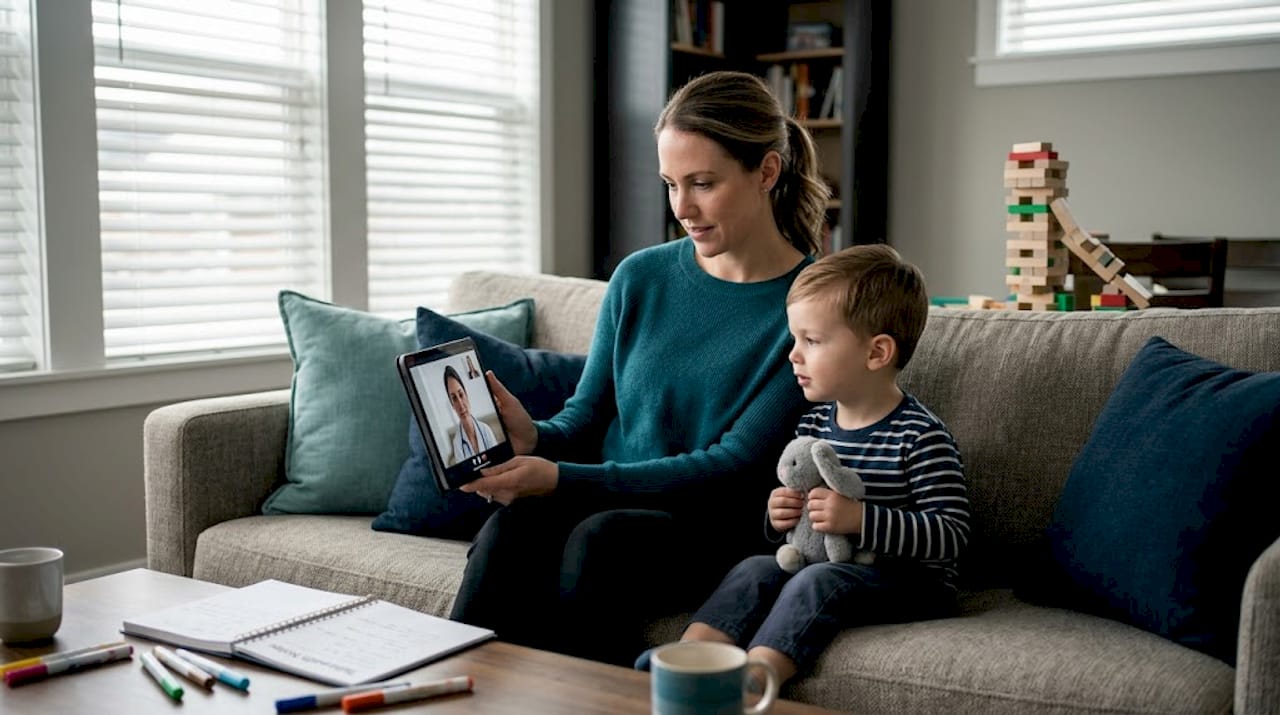
- First assessment session: A clinician conducts a structured observation while you present toys or activities to your child on camera.
- Parent interview: Clinicians ask detailed questions about your child’s behavior, communication, and daily routines.
- Report and diagnosis: Results are shared in a follow-up session with written documentation.
- Therapy planning: A treatment plan is created based on assessment findings, incorporating your home environment.
- Ongoing sessions and data review: Progress is tracked via shared platforms, and the plan is adjusted regularly.
You can explore therapy service options that deliver this kind of structured care remotely, and review available tele-assessment tools designed specifically for autism evaluation.

Pro Tip: Set up your telehealth space before the first session. Use a quiet room with good lighting, have your child’s favorite toys ready, and close unnecessary browser tabs to prevent lag. A smooth technical setup makes a real difference in session quality.
Is telehealth as effective as in-person autism services?
This is the question most parents ask first, and the research answer is more reassuring than many expect. For most children and families, telehealth produces outcomes that are genuinely comparable to in-person care.
When it comes to diagnostic accuracy, in-home tele-assessments show 80 to 94 percent agreement with in-person evaluations, including comparable results in motor skill development and social communication outcomes. Parent training delivered remotely shows similar efficacy to clinic-based training in most controlled studies.
| Outcome area | Telehealth result | In-person result |
|---|---|---|
| Diagnostic accuracy | 80 to 94% agreement | Gold standard |
| Parent training effectiveness | Comparable across most studies | Comparable across most studies |
| Social and communication skills | Measurable gains reported | Measurable gains reported |
| Caregiver satisfaction | 88 to 92% satisfaction | Generally lower due to logistics |
| Wait times | Significantly reduced | Often 6 to 12 months |
“Telehealth offers superior convenience, but in-person may be preferred for complex cases or families needing more direct support.” Springer, 2025
That nuance matters. Telehealth is not universally superior. For children with very complex presentations, severe behavioral challenges, or significant communication barriers, in-person evaluation and therapy may provide a level of clinical precision that remote tools cannot fully replicate. The goal is not to replace every clinic visit. The goal is to use the right tool for the right situation.
Some key considerations when comparing the two approaches:
- Telehealth works well for children who can tolerate screen-based interaction
- It is particularly strong for parent training and coaching components
- Very young toddlers may be harder to evaluate via video due to mobility and attention
- Nonverbal children with complex sensory profiles may need hands-on assessment tools that cannot be replicated remotely
Families who want a blended approach can look into hybrid care models that combine remote and in-person services, and track therapy outcomes over time to see what combination works best for their child.
Limitations and when to consider hybrid models
Being realistic about telehealth’s limitations is not a weakness. It is smart care planning. Not every family will get the same results from a fully remote model, and recognizing that early saves time, money, and stress.
Research shows that telehealth is better suited to older children with clearer ASD presentations, while challenges emerge with younger children, families facing technology access issues, and situations where English proficiency or low socioeconomic status creates additional barriers. This is an equity issue as much as a clinical one.
Common limitations include:
- Technology barriers: Poor internet, outdated devices, and limited digital literacy can all undermine session quality
- Language access: Not all telehealth platforms offer services in languages other than English, which leaves many families without full comprehension
- Younger children: Toddlers under 18 months are especially difficult to evaluate accurately via video
- Complex or nonverbal presentations: Some diagnostic tools require physical presence to administer correctly
- Family environment: Chaotic home environments, limited space, or multiple young children can interfere with session focus
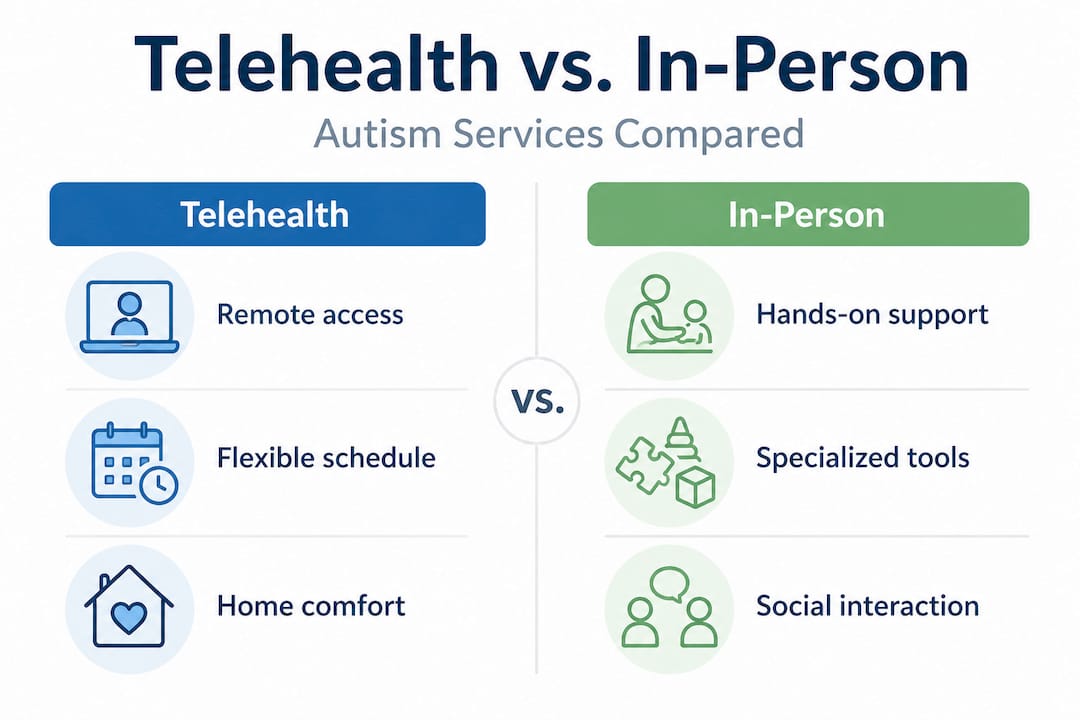
When any of these factors are present, a hybrid model is often the smartest path. Hybrid care means your child receives in-person assessments or targeted therapy for the parts that need hands-on evaluation, while telehealth handles ongoing coaching, parent training, and progress check-ins. Families dealing with edge cases for hybrid care can find specialized providers who build these blended programs from the start.
Pro Tip: Ask potential providers directly: “Do you offer hybrid options if we need in-person sessions?” Providers who answer yes and describe a clear protocol are generally better equipped to handle your child’s evolving needs.
Making the most of telehealth autism services: Practical tips for families
Knowing telehealth works is one thing. Making it work for your child takes intentional preparation. The good news is that telehealth empowers parents through coaching that embeds interventions directly into daily home routines, which actually produces better skill generalization than clinic-only therapy in many cases.
Here is how to get the most out of your family’s telehealth experience:
- Create a dedicated session space. Use the same room each time so your child develops a routine association with the setup. Minimize visual distractions and keep comfort items close.
- Pre-session preparation. Have your child’s preferred toys, snacks, and communication tools within reach. Brief your child in simple language about what is happening, using pictures or a social story if helpful.
- Engage actively as the parent. You are not just present. You are a co-therapist. Take notes, ask clarifying questions, and practice the strategies in between sessions.
- Track progress at home. Use a simple daily log to note behaviors, communication attempts, or skill practice. Share this with your provider before each session.
- Ask the right questions upfront. Before committing to a provider, ask how they handle technology issues, how they measure progress, what your role will be in sessions, and how they adjust the plan if your child is not responding.
- Know when to escalate. If your child’s behaviors are escalating or safety is a concern, contact your provider immediately to discuss whether in-person or emergency support is needed.
Connecting with specialized parent training strategies makes this preparation more structured and effective. Families who arrive at sessions prepared consistently report better outcomes and higher satisfaction.
Pro Tip: Record brief video clips of your child’s behaviors between sessions and share them with your provider. These real-life snapshots help clinicians make far more accurate adjustments than relying on verbal descriptions alone.
Why the future of autism care will blend telehealth and in-person
Here is our honest perspective after watching this space evolve: telehealth is not the finish line for autism services. It is a critical bridge.
The families who benefit most from telehealth are not necessarily those with the best internet connections. They are the ones who receive strong parent coaching and learn to be the primary change-makers in their child’s life. That is the deeper gift of telehealth. It shifts the locus of intervention from the clinic to the home, where real life actually happens.
But we also recognize that technology access, broadband equity, and language support remain genuine gaps. A family without reliable internet or a caregiver who does not speak English fluently faces structural barriers that no app can fix. Ongoing telehealth policy support from organizations like the Society for Developmental and Behavioral Pediatrics is essential, including calls for larger, more diverse research studies to confirm long-term efficacy across different populations.
The realistic future is hybrid and individualized. Your child at age three may need in-person assessment. At age five, they may thrive in remote parent-mediated therapy. At age eight, they may benefit from a combination of in-person occupational therapy and telehealth behavioral coaching. Expecting one model to serve every stage of development is not clinical thinking. It is wishful thinking.
Families and clinicians should plan for this evolution proactively rather than reactively. Providers offering future-ready autism therapy models are building these flexible structures now, and families who ask for them early will have a significant advantage.
Find trusted autism telehealth specialists near you
Finding the right telehealth autism provider does not have to be overwhelming. The Autism Therapy Services directory connects families with vetted specialists who offer remote and hybrid care across a range of disciplines. If your child needs Applied Behavior Analysis, explore board-certified ABA therapy providers who deliver structured telehealth programs built around your home environment. For families seeking comprehensive evaluation tools and specialized remote assessments, Autism Therapeutics specialists offer the clinical rigor your child deserves. Autism Doctor Search makes it simple to compare options, read provider profiles, and connect with the right fit without adding more stress to an already full plate.
Frequently asked questions
How accurate are telehealth autism assessments compared to in-person?
Telehealth autism assessments show 80 to 94 percent agreement with in-person evaluations, making them highly reliable for most children, particularly those with clearer presentations.
Can telehealth provide the same quality of autism therapy as in-person sessions?
Most families report comparable therapy outcomes in motor skills, social communication, and parent training, though in-person or hybrid approaches may be better suited for children with complex or severe presentations.
What challenges might families face when using telehealth for autism services?
Technology issues and diagnostic uncertainty in younger or more complex cases are among the most common challenges, along with language barriers and limited device or internet access for some families.
Is parent involvement more important with telehealth autism services?
Yes, absolutely. Parent coaching is central to telehealth models, training caregivers to embed therapy strategies into everyday routines, which strengthens skill generalization beyond the session itself.