
TL;DR:
- Families should adopt a structured budget combining autism-specific expenses with general household management. Using the 50/30/20 rule helps allocate income to needs, wants, and savings, with specialized tools like ABLE accounts and Trusts protecting assets. Building an emergency fund and early legal planning are essential for long-term financial stability in autism care.
Budgeting autism expenses means combining standard household financial management with autism-specific cost planning across therapies, medical care, legal tools, and long-term savings. The lifetime cost of autism care averages $2.4 million per person. That number makes one thing clear: families need a structured plan, not just good intentions. The 50/30/20 budgeting rule, adapted for autism care, gives you a practical starting point. Specialized tools like ABLE accounts and Special Needs Trusts then protect what you save. This guide walks you through each layer of that plan.
How to budget autism expenses using the 50/30/20 rule
The 50/30/20 budgeting framework allocates 50% of income to needs, 30% to wants, and 20% to savings. Adapted for autism care, each category takes on a more specific meaning than it does in a standard household budget.
The 50% needs category covers therapy co-pays, ABA sessions, occupational therapy, speech therapy, medical appointments, prescription medications, insurance premiums, and any home modifications your child requires. These are non-negotiable expenses that recur every month. Families who track these costs carefully often find they consume more than 50% of income, which means the other categories need to flex.
The 30% wants category includes sensory activities, social skills classes, autism-friendly camps, adaptive sports equipment, and specialized toys that support development. These are not luxuries. They support quality of life and skill-building, but they can be reduced in tight months without immediate harm.
The 20% savings category is where ABLE accounts, emergency funds, and Special Needs Trusts live. This allocation builds the financial buffer that protects your family when costs spike or income drops. Many families underestimate this category until a crisis forces the issue.
Here is how the 50/30/20 rule looks on a $6,000 monthly income:
| Category | Allocation | Monthly Amount | Autism-Related Examples |
|---|---|---|---|
| Needs | 50% | $3,000 | Therapy co-pays, insurance, medications, home modifications |
| Wants | 30% | $1,800 | Sensory camps, social classes, adaptive equipment |
| Savings | 20% | $1,200 | ABLE account contributions, emergency fund, Special Needs Trust |
Pro Tip: If therapy costs push your needs category above 50%, reduce wants to 20% and keep savings at 10% minimum. Never eliminate savings entirely, even in difficult months.
What autism-specific expenses belong in your budget
Families often build budgets around the costs they can see and miss the ones that quietly drain accounts. Direct expenses are the obvious starting point: ABA therapy, occupational therapy (OT), speech therapy, medical specialist visits, medications, and adaptive equipment like weighted blankets, communication devices, or sensory tools.
Hidden costs can account for 20–30% of a household’s total budget. These include lost wages from reduced work hours, higher transportation costs for frequent appointments, and elevated insurance premiums. Many caregivers reduce their work hours or leave the workforce entirely, which compounds the financial pressure over years.
Education-related costs add another layer. Private special education schools, tutoring, assistive technology, and school-based therapy supplements all carry price tags that public funding does not always cover. Special diets, which some families use to manage sensory or gastrointestinal issues, also add meaningful monthly costs.
Expenses families most often overlook include:
- Respite care for caregivers
- Legal fees for setting up Special Needs Trusts
- Transition planning services for young adults
- Mental health support for siblings and parents
- Home safety modifications like door alarms or padded furniture
- Waitlist application fees for state services
Organizing medical, education, and therapy documents is not optional. Accurate records support tax deductions, benefits applications, and legal planning. Use a dedicated folder system, physical or digital, and update it monthly.
Pro Tip: Many autism-related expenses qualify as medical deductions under IRS rules. Track every receipt and consult a tax professional who has experience with special needs families.
Understanding insurance coverage for autism care is one of the fastest ways to reduce out-of-pocket costs before you adjust any other budget line.
How do ABLE accounts and Special Needs Trusts help with autism budgeting?
ABLE accounts and Special Needs Trusts (SNTs) are the two most important financial tools for families managing autism costs. They serve different purposes and work best when used together.

An ABLE account is a tax-advantaged savings account for individuals with disabilities. Contributions are capped at $20,000 per year, and the first $100,000 in the account is excluded from SSI asset limits. Funds grow tax-free and can be spent on a wide range of qualified disability expenses, including housing, transportation, education, and health care. ABLE accounts give families a flexible, accessible way to save for day-to-day and near-term costs without risking government benefits.
A Special Needs Trust holds assets on behalf of a person with a disability without counting those assets toward Medicaid or SSI eligibility. SNTs come in two main types. A first-party trust holds the beneficiary’s own assets, such as a personal injury settlement. A third-party trust holds assets contributed by family members, such as an inheritance or life insurance payout. Third-party trusts are the more common choice for families doing proactive planning.
The key difference between the two tools is this: ABLE accounts handle flexible, everyday spending. SNTs handle long-term asset protection and larger sums. Using both in tandem gives your family coverage across the full financial timeline.
Critical legal considerations include:
- Assets held directly in the beneficiary’s name can disqualify them from SSI and Medicaid
- Direct inheritances must be redirected into an SNT to preserve benefits eligibility
- Custodial accounts do not offer the same protections as a properly structured trust
- An attorney who specializes in special needs planning should draft any trust document
The ABLEities Foundation provides guidance on ABLE account setup and contributions. The Special Needs Planning Institute offers trust and estate planning resources specifically for families in this situation.
Financial literacy for disabled adults and their caregivers directly affects how well these tools get used. Families who understand the rules make fewer costly mistakes.
How to build an emergency fund and plan for long-term autism care costs
An emergency fund covering 6–12 months of living expenses is the baseline for any family managing autism care. Caregiving demands create income disruption risks that most standard financial advice does not account for. A hospitalization, a therapy provider closing, or a school placement change can all trigger sudden large expenses.
Conservative investment strategies are the right fit for autism care savings. Bonds, dividend stocks, and low-volatility funds preserve capital over decades without exposing essential funds to sharp market swings. Growth is secondary to stability when the money must be available for care needs on a fixed timeline.
State service waitlists are long, and early applications with well-organized documentation improve access. Families who apply for Medicaid waivers, SSI, and regional center services as early as possible secure their place in line before costs escalate.
Steps to build and maintain your emergency fund:
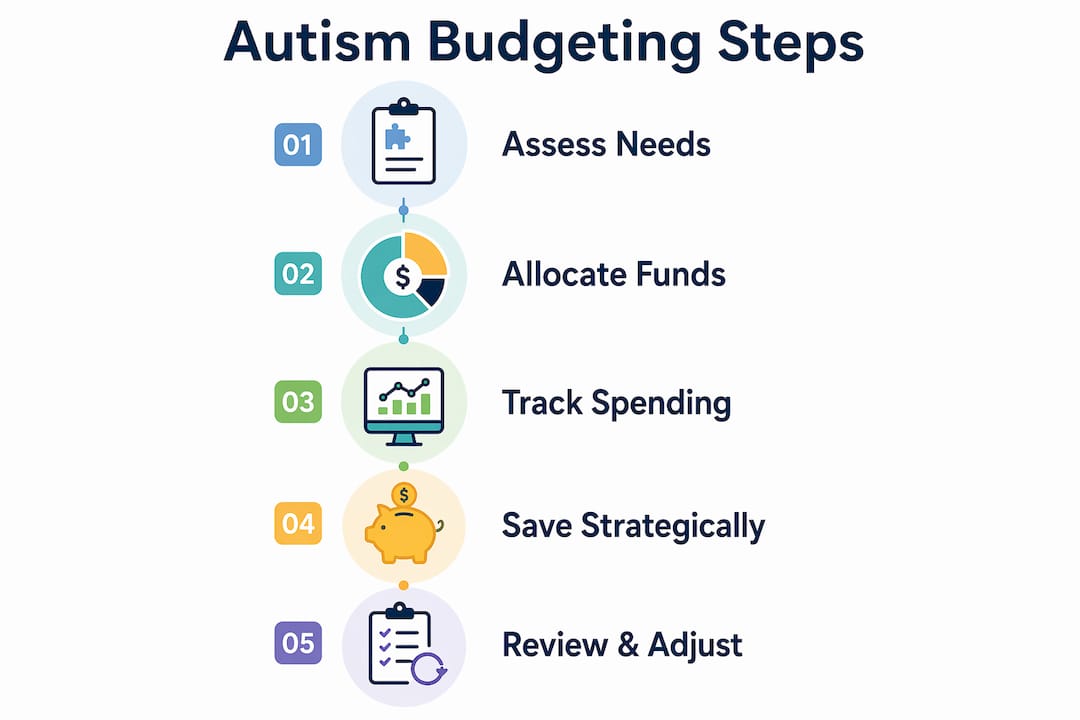
- Calculate your true monthly expenses, including all direct and indirect autism costs.
- Set a target of six months of expenses as your minimum fund balance.
- Open a dedicated high-yield savings account separate from your checking account.
- Automate a fixed monthly transfer, even if it starts small.
- Apply for SSI, Medicaid, and state waiver programs immediately and keep copies of all applications.
- Review the fund balance every six months and adjust contributions as costs change.
- Consult an estate planning attorney to align your emergency fund with your SNT and ABLE account strategy.
Combining funding sources like private insurance, SSI, Medicaid, and ABLE accounts is the most effective way to offset the full cost of autism care. No single source covers everything. The families who manage best treat funding as a portfolio, not a single line item.
Pro Tip: Keep a one-page financial summary that lists all active accounts, benefit programs, and legal documents. Update it annually and share it with a trusted family member. This document becomes critical if a primary caregiver becomes unable to manage finances.
Recognizing when your child is approaching a stress threshold also matters for planning. Families who understand early signs of overwhelm in neurodivergent children can anticipate care escalations before they become financial emergencies.
Key Takeaways
Effective autism financial planning requires combining the 50/30/20 budget framework with ABLE accounts, Special Needs Trusts, and a 6–12 month emergency fund to cover both daily and lifetime care costs.
| Point | Details |
|---|---|
| Use the 50/30/20 rule | Allocate 50% to therapy and medical needs, 30% to developmental wants, and 20% to savings tools. |
| Track hidden costs | Indirect expenses like lost wages and transportation can consume 20–30% of a household budget. |
| Open an ABLE account | Contribute up to $20,000 annually without risking SSI or Medicaid eligibility. |
| Set up a Special Needs Trust | Use an SNT to protect larger assets and inheritances from disqualifying your child from benefits. |
| Build a 6–12 month emergency fund | Caregiving disruptions are common; a dedicated fund prevents financial crisis during unexpected events. |
What I’ve learned from watching families plan for a lifetime of care
The families who handle autism finances best share one habit: they start before they feel ready. Keith Wargo, CEO of Autism Speaks, advises starting early as the single most impactful step a family can take. From what I’ve seen, that advice is correct, and the families who wait until a crisis hits pay a steep price.
The second thing I’ve noticed is that most families dramatically underestimate indirect costs. They budget for therapy and miss the income they lose from cutting work hours. They plan for today’s expenses and forget that transition to adulthood brings an entirely new set of costs: supported living, vocational programs, and adult day services. The $2.4 million lifetime figure is not a scare tactic. It is a planning target.
Legal tools matter more than most families realize until it is too late. I’ve seen well-meaning grandparents leave money directly to a grandchild with autism, not knowing it would disqualify them from Medicaid. A properly structured third-party Special Needs Trust prevents that outcome entirely. Getting an attorney involved early costs far less than fixing a benefits disqualification later.
The emotional weight of this planning is real. Budgeting for a lifetime of care while managing daily caregiving is genuinely hard. But the families who treat financial planning as an act of care, not a burden, tend to build more sustainable systems. Start with one tool, one account, one document. Then build from there.
— Keith
Autism Doctor Search: your next step in care planning
Autismdoctorsearch maintains one of the most complete directories of autism care providers and planning resources available to families. Whether you need ABA therapy, occupational therapy, speech services, or special needs financial planning support, the directory connects you with vetted providers in your area. Finding the right provider is the practical next step after building your budget. Browse autism therapy services to locate providers who match your child’s needs and your financial plan. For families working through trust and estate planning, the Special Needs Planning Institute listing offers direct access to specialized guidance.
FAQ
What is the average lifetime cost of autism care?
The lifetime cost of autism care averages $2.4 million. That figure covers therapies, medical care, education, housing, and support services across a person’s lifespan.
How much can I contribute to an ABLE account each year?
ABLE accounts allow up to $20,000 in annual contributions. The first $100,000 in the account does not count toward SSI asset limits.
What is the difference between an ABLE account and a Special Needs Trust?
An ABLE account covers flexible, everyday disability expenses with a contribution cap. A Special Needs Trust holds larger assets and inheritances without affecting Medicaid or SSI eligibility, and has no annual contribution limit.
How large should my emergency fund be for autism care?
Financial planners recommend an emergency fund covering 6–12 months of expenses for families managing autism care. Caregiving demands create income disruption risks that standard emergency fund advice does not account for.
Can autism therapy costs qualify as tax deductions?
Many autism-related therapy and medical expenses qualify as itemized medical deductions under IRS rules. A tax professional with special needs family experience can identify which costs qualify and how to document them correctly.